







Author Archive

Antioch councilwoman claims city attorney told all council members former police chief interfered with investigation of December incident with her sons

Friday, October 8th, 2021
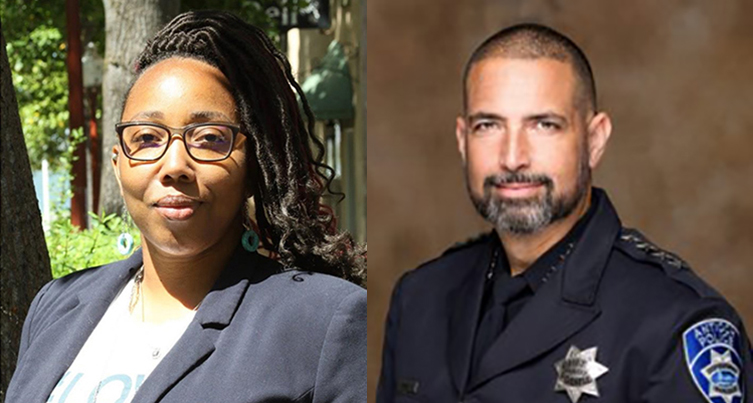
Antioch District 1 Councilwoman Tamisha Torres-Walker and Antioch Police Chief Tammany Brooks.

“…the first initial communication from the city attorney’s office to the full Council notifying us all that the chief had it [sic] in fact interfered in the outcome of at least one or two of the final findings.” – Councilwoman Torres-Walker

City staff has called for a new investigation due to a recently discovered impropriety and to avoid unfairness

Resident claims city attorney email to “city leaders” was “released” and she read it

Staff, other council members and Brooks can’t or won’t answer questions about allegations against him

By Allen Payton

In announcing her resignation as chair of the Antioch City Council’s Police Oversight Standing Committee on Tuesday, District 1 Councilwoman Tamisha Torres-Walker claimed that former Police Chief Tammany Brooks “took the liberty to modify the report” of the outside investigation of the incident involving police officers, her sons and her last December. They were riding an ATV and dirt bike illegally on city streets. Her younger son was stopped, but the older one drove off, went home and returned with the councilwoman. (See related articles here and here)

She demanded an independent investigation of the incident, making several accusations against the officers. The executive summary of the report from the investigator showed all Torres-Walker’s claims were either unfounded or not sustained. (See related article)

However, last Friday, Oct. 2nd, the City of Antioch announced that a second independent attorney will be hired to investigate her complaint due to “recent evidence” and to avoid “impropriety”. (See related article)

In a portion of the Tuesday announcement on her official Facebook page, Torres-Walker wrote: “Mr. Brooks received an impartial independent investigation report, and he took the liberty to modify that report. It’s this type of abuse of authority that must be called out which and [sic] fans the flames of tension in our community.”
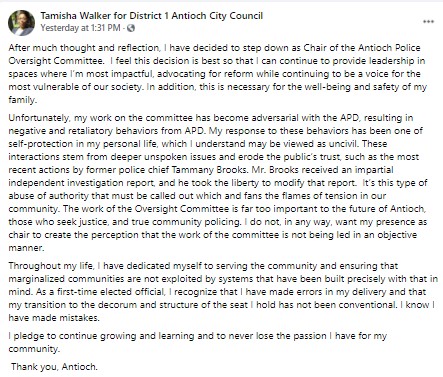
Torres-Walker’s post on her official Facebook page on Tuesday, Oct. 5, 2021.

Claims City Attorney Informed All Council Members of Brooks’ Interference in Investigation

In an email late Wednesday night, Councilwoman Torres-Walker was asked, how do you know the details of what happened with the first investigation and reasons for the need for a second? Was that information shared with you by city staff? Was it Ron Bernal, Thomas Lloyd Smith or someone in the Antioch Police Department? Was it shared in closed session with all council members since it’s a personnel matter? Also, were you given a copy of the complete report from the first investigation?

She responded Thursday morning, writing, “First, I had decided to step down as chair long before my colleagues made the request given what I know regarding Chief Brooks’ interference in the first investigation.

No, I was not allowed in closed session to be debriefed on all the details of how Chief Brooks interfered, but I was involved in the first initial communication from the city attorney’s office to the full Council notifying us all that the chief had it [sic] in fact interfered in the outcome of at least one or two of the final findings.

I never requested a second investigation I think it is a waste of city dollars. What I would like and what I wanted was the original report to be released so that we could move on.”

Questions for City Staff, Brooks

In an email sent late Wednesday night, City Manager Ron Bernal, City Attorney Thomas Lloyd Smith, Acting Police Chief Tony Morefield and Chief Tammany Brooks (who is still in his position through Saturday) were asked the following: Is what she wrote (in her resignation announcement) correct? Is that the impropriety that occurred that was recently discovered and the basis for the call for a second outside investigation?

If so, how does she know the details of what happened with the first investigation and reasons for the need for a second? Was that info only shared with her, or all council members?

Was it shared in closed session since it’s a personnel matter? If so, did the councilwoman violate closed session regulations by revealing it publicly?

Also, was she given a copy of the complete report from the first investigation? If what she wrote isn’t correct, can you please clarify for the public and respond to what the councilwoman wrote?

No Response from Staff, Questions Resent, Council Members CC’d

No response had been received as of 6:00 p.m. Thursday. The questions were then resent to the same individuals, as well as all five council members. The following additional questions were also asked: Did Chief Brooks modify the report from the investigation of her complaint, as she claimed? Is that what the impropriety was, and unfairness referred to in the press release about the need for a second investigation? If not, what was it?

Ogorchock responded Thursday night with, simply, “I’m not at liberty to say at this time.”

More Questions for Staff, Council

Torres-Walker’s response and the following, related questions were sent to the same staff members and all five council members Thursday night: Is that true that Attorney Smith said that to the council about Chief Brooks? If so, when was Chief Brooks informed of the allegations against him, and was he given an opportunity to respond and share his perspective with the council members?

Did Chief Brooks consult with Attorney Smith prior to responding to the draft or preliminary report of the investigation?

Two Council Members Respond But Can’t Comment

In response, District 3 Councilwoman Lori Ogorchock said, “It’s a personnel matter, so I can’t comment.”

“I can’t comment on any of that, as it’s a personnel issue and with confidentiality at stake, I can’t comment,” District 2 Councilman Barbanica also said in response.

Resident Claims She’s Read Email from City Attorney to Council Members
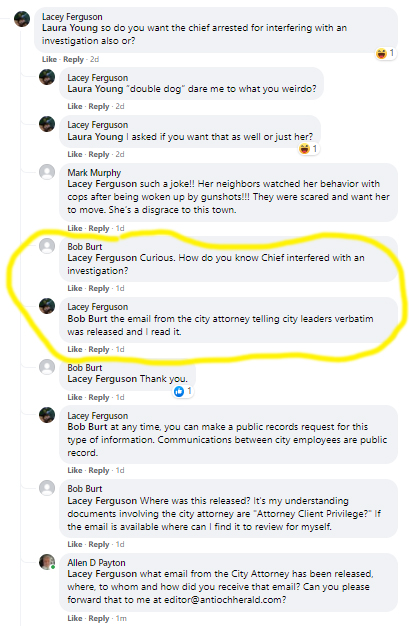
Antioch resident Lacey Brown’s comment on Torres-Walker’s official Facebook page below the post about her resignation as chair of Police Oversight Standing Committee on Tuesday, Oct. 5, 2021. (See highlighted section)

A comment was made by Antioch resident Lacey Brown (aka Ferguson on Facebook) on Torres-Walker’s official council page on Tuesday, below the post about the councilwoman’s resignation as chair of the Police Oversight Standing Committee. In response to the question in another comment, “How do you know Chief interfered with the investigation?” Brown/Ferguson claims “the email from the city attorney telling city leaders verbatim was released and I read it.”

That information, a screenshot of the conversation and additional questions were then emailed to city staff and council members, including: what email is she referring to, an email from Attorney Smith to the council members? To whom was it released? Who shared it with Ms. Brown/Ferguson for her to read?

Attempts to reach Brown asking her what email from the City Attorney has been released, where, to whom and how did she receive that email, were unsuccessful prior to publication.

As of Friday, Oct. 8 at 3:00 p.m. no one on city staff, Mayor Thorpe, Mayor Pro Tem Wilson nor Brooks had responded.

Please check back later for any updates to this report.

Governor signs Senator Glazer’s key local proposals

Friday, October 8th, 2021

Small wineries can open two off-site tasting rooms     

Local governments gain new tools for overseeing short-term rentals

Thousands of acres of East Bay wilderness to be preserved

By Steven Harmon, Policy Analyst/Communications, Office of Sen. Steve Glazer

State Senator Steve Glazer. (D-7-Orinda)

Governor Gavin Newsom has signed three long-standing proposals advanced by Senator Steve Glazer, (D-7-Orinda), that will have a direct impact on residents of Contra Costa and Alameda counties.

“It’s very gratifying to see important legislative priorities for my district signed into law,” Senator Glazer said. “These are bills and proposals that I’ve been working on with partners, in some cases, for years. I’m thankful to Governor Newsom for ushering them across the finish line with his signature, a nice reward for all the hard work put in by key allies and friends.”

The three proposals that Gov. Newsom signed were:

Winegrowers: Offsite Tasting Rooms (SB 19)

SB 19 will allow licensed winegrowers or brandy manufacturers to operate two off-site tasting rooms under their winegrower licenses. This bill will particularly help small and family-owned wineries to operate as California continues to recover from the Pandemic.

Approximately 55 wineries are located in Senator Glazer’s district, including in Livermore, Oakley, Brentwood, Byron and Moraga.

“Small and family-owned wineries have struggled the most among wineries, because they rely heavily on visitors and direct sales,” said Senator Glazer. “With tourism taking a terrible hit from the pandemic and consequences of the wildfires, I’m glad that Governor Newsom recognized that these wineries are in need of that additional outlet to provide tastings and sales to their customers.”

Prior to the current tasting room closures caused by the COVID-19 pandemic, many wineries viewed additional off-site tasting rooms as a significant benefit. This was even more pressing for many small wineries looking to expand business opportunities, especially those wineries that produce their wine in an agreement to use the facility and equipment of a second (usually larger) winery.

Steven Kent Mirassou, owner and winemaker of Steven Kent winery, part of the Livermore Valley Wine Country Association, said SB 19 will make a difference to the industry, but also to wine enthusiasts.

“The ability to take care of people – which is the true center of hospitality and wine – is important at all times,” Kent Mirassou said. “It is especially crucial during the pandemic when we are all striving to maintain connections with our larger circle of friends and patrons, that small wineries remain open and thriving. I am so appreciative of the hard work and perseverance that Senator Glazer and his staff have shown in helping us continue to add joy and richness to peoples’ lives.”

With the COVID-19 pandemic, tasting rooms have been required to either close or significantly alter their operations for tastings, but can continue to operate sales for curbside pickup or delivery. Tourism has become almost nonexistent and is not expected to recover for several years. As a result, the impact from COVID-19 to the wine industry is estimated to be $5.9 billon, with a $3 billion loss in tasting room sales.

In addition, the 2020 wildfires had a substantial impact on the wine industry. According to the Wine Institute, the estimate of damage from 2020 wildfires amounts to $3.7 billion, including a loss of $41 million in tasting room sales and $57.6 million in lost winery structures.

Allows Increased Fines on Short Term Rental Violations – to Rein in House Parties (SB 60)

Under SB 60, cities and counties can now impose increased penalties on short-term rental hosts who violate local property rental laws – an attempt to rein in house parties, sometimes violent, that have been occurring at short term rentals because of lax oversight of these properties. SB 60, which took effect immediately, authorizes localities to impose fines up to $5,000 for a violation of a short-term ordinance.

“These large gatherings have made some short-term rental properties the sites of underage drinking, brawls, noise complaints, and violence,” Senator Glazer said. “I’m grateful to Governor Newsom for signing this bill so that local governments have the tools to ensure the safety of those who want to continue to use short-term rentals, and of our residents who live nearby these properties.”

The legislation was sparked by a spate of violence at short-term rental properties, most notably a mass shooting in Orinda, where five people were killed. Other abuses at short-term rentals occurred in Los Angeles and other locales in Northern California, including a party at a Sunnyvale rental where a teenager was shot and killed in August after violence erupted at the gathering. (See related articles, here, here, here and here)

Smaller fines were proving to be ineffective in deterring violations. Hosts were able to charge so much rent for big houses that the fines, if they occurred, were just seen as a cost of doing business.

“Violence and destructive behavior at short term rentals has become a true public safety issue in cities throughout California, as residents of Orinda know all too well,” Orinda Mayor Amy Worth said. “I am thankful that mayors like me will now have the ability to impose fines at a level high enough to get the attention of property owners who operate short term rentals to ensure the safety of our residents. Senator Glazer has been a true champion of this issue, and we are thankful for his hard work on making this California law.”

The use of short-term rentals has skyrocketed by 105 percent over just the past three years, according to vacation rental data compiled by AirDNA. Though short-term rentals offer a way to improve tourism and earn owners some extra money, their recent proliferation has allowed bad actors to use the platform to advertise and secure homes for large parties, oftentimes in violation of local ordinances.

The Covid-19 pandemic led to an increase in people using short-term rentals to evade public health restrictions on large public gatherings. Noise complaints as a result of parties have tripled since the start of the pandemic, according to Host Compliance, which tracks legal compliance among short-term rentals for 350 cities and counties in the U.S.

In the last half of 2019, 42 people were shot inside or just outside a short-term rental property nationwide and 17 people died.

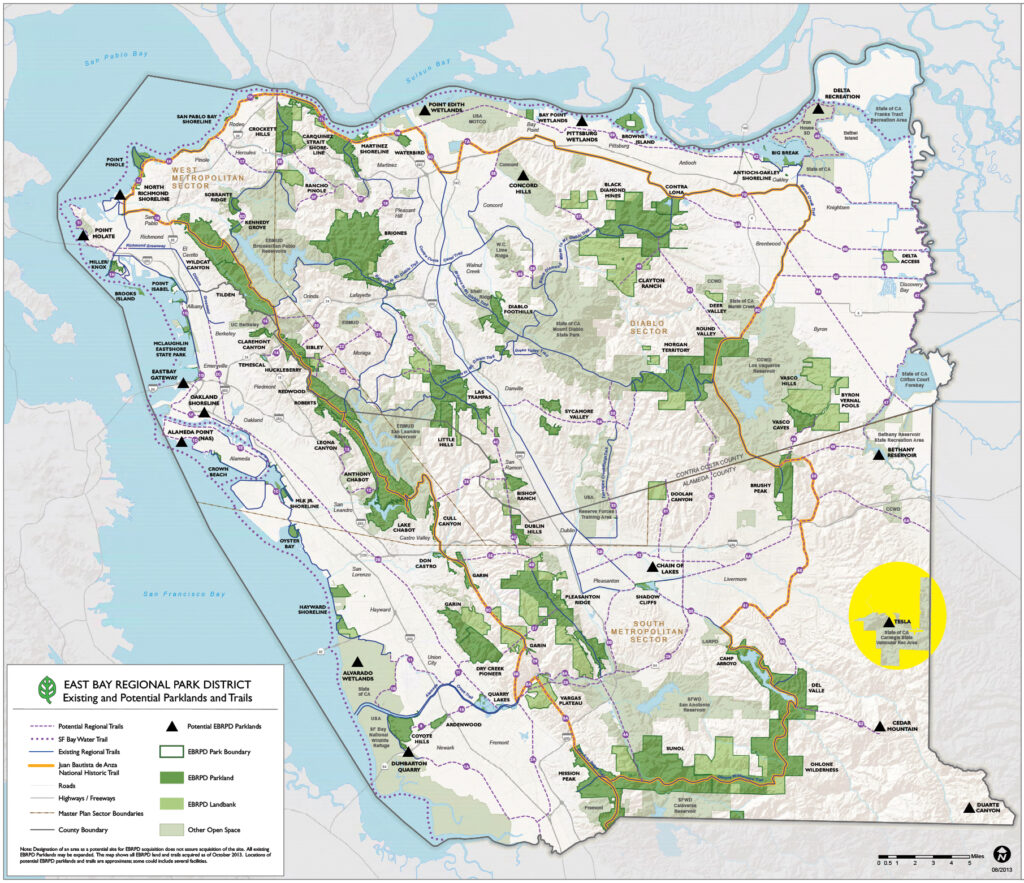
East Bay Regional Park District 2013 Master Plan Map designating Tesla site (yellow area) as a potential regional preserve. Source: EBRPD

Tesla Land Preservation (Budget)

Thousands of acres of East Bay wilderness threatened by the expansion of an off-highway vehicle park will instead be preserved. (See related article)

The legislation, approved in the Governor’s recent budget bills and took effect immediately, ends plans to expand the Carnegie State Vehicular Recreation Area into the 3,100-acre Tesla parcel in the southeast corner of Alameda County, which scientists have described as a biologically unique habitat and Native Americans have long considered to be a sensitive historical site.

That land will now become a new state park closed to motorized recreation. The state will reimburse the Off-Highway Vehicle fund for the purchase price of the land, its appreciation in value, and the money spent planning the expansion, which was opposed from the start 20 years ago by nearby residents and public agencies. That money will go toward the purchase and development of an off-road park at another location.

“Our community and region will preserve this natural and cultural treasure, leaving it pristine for future generations to enjoy,” Senator Glazer said. “Meanwhile, off-road enthusiasts will be able to keep their current park and receive funding to develop another park on land that’s more suitable to that kind of recreation. I appreciate the hard work that so many key individuals played in moving this critical environmental and cultural issue to the Governor’s desk, and, of course, for the Governor to work with all the players to sign this important agreement.”

Senator Glazer partnered with Assembly member Rebecca Bauer-Kahan, the Sierra Club, Friends of Tesla Park and other environmental organizations and individuals in getting the final approval from the governor’s office. Earlier, former Assembly member Catharine Baker worked with Senator Glazer on the same issue.

Nancy Rodrigue, a leading member of the Friends of Tesla Park steering committee and Livermore resident, said she was proud that years of hard work and persistence paid off.

“A very special thank you goes to Senator Glazer and Assembly member Rebecca Bauer-Kahan for the many years of work on this special project,” Rodrigue said. “Tesla Park will now be a reserve with no motorized recreation. Instead, the future holds Tesla as a protected native landscape for hikers, history buffs, nature lovers, researchers and educators.

“Saving Tesla Park has been a long, difficult, and now a rewarding journey, and we are grateful for the tremendous work of so many for saving Tesla as a legacy for future generations,” Rodrigue continued. “We are looking forward to planning the next phase of Tesla Park as a nature and cultural preserve, providing passive recreation and education to the community of the Bay area, the San Joaquin Valley, and Northern California.”


Bus driver helps Antioch police arrest man at BART station for earlier armed robbery

Friday, October 8th, 2021

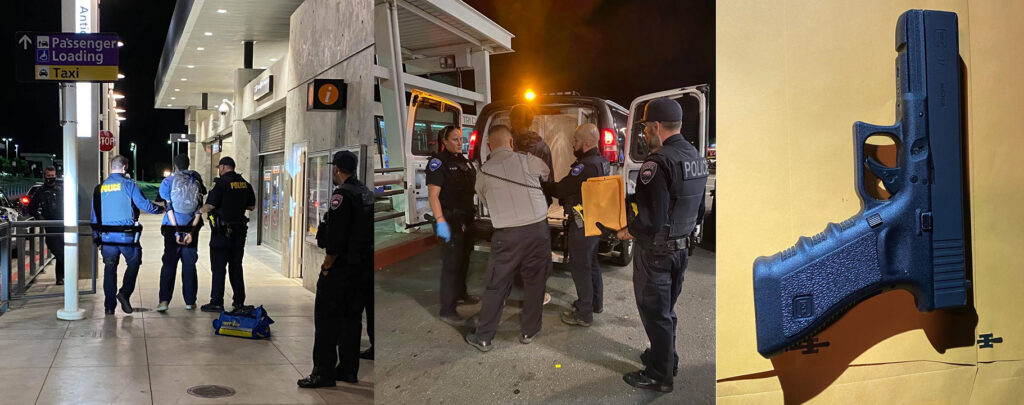
Suspect arrested at Antioch BART station and the gun found on him on Tuesday, Oct. 5, 2021. Photos: APD

Victim says driver helped him “get away safely”

By Antioch Police Department

Another great job by APD officers with help from BART PD and as always, great witnesses that help us in these cases that we are able to tell you about!
Tuesday night, Oct. 5, 2021, around 6:15 pm, our dispatch received a call from employees at Big Lots on Somersville Road after a man ran in asking them to call the police as he’d just been robbed at gun point on a bus. Our officers arrived and learned the man had been on the bus and a subject possibly armed with a handgun took his phone. He was able to flee from the bus and believed the bus driver helped him get away safely by closing the door keeping the armed suspect from following him. Initially, we weren’t able to confirm the story or that anyone on the bus witnessed this.

Just over an hour later, this same bus driver then called police to report that the subject from the earlier robbery was still on the bus and was possibly armed. She was now at the BART station, hiding, and unsure if he was on the bus or in the BART station. Several officers from APD and BART responded and located a subject matching the description both the bus driver and earlier robbery victim had given and were able to safely identify him.

As you can see from the pictures, this person was found in possession of a very real looking BB gun. Further investigation also located the victim’s stolen phone which was returned to him.

This was yet another example how great teamwork between both agencies involved, and our witnesses led to a peaceful and successful conclusion to this case. These two people kept calm under very scary and stressful circumstances and were able to help us make this arrest. While it is unfortunate the incident happened, we are grateful no one was injured and happier still to have a dangerous criminal off the street!

Antioch Police arrest teen Oakland carjacking suspect following Hwy 4 chase to Brentwood

Friday, October 8th, 2021

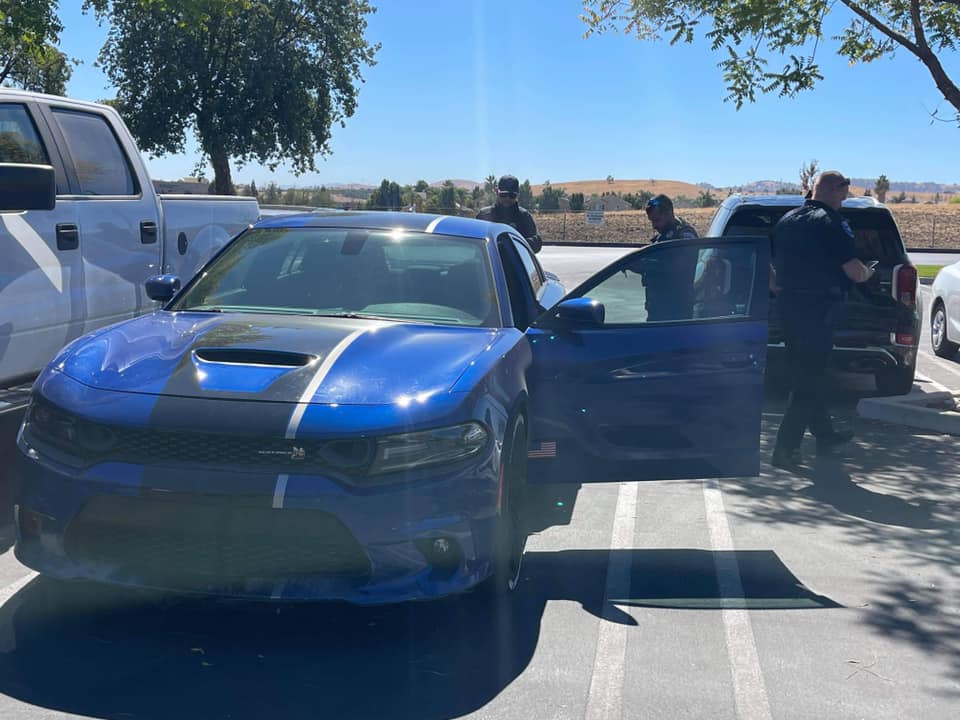
Stolen car from Oakland recovered following chase and arrest of suspect on Thursday, Sept. 30, 2021. Photos: APD

Causes John Muir Outpatient Center to be evacuated

By Lieutenant Joe Donleavy #6011 Field Services

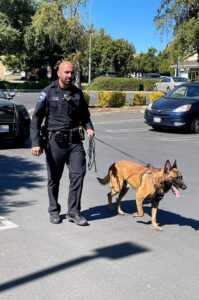
An Antioch Officer and K9 helped search for the suspect.

On Thursday, Sept. 30, 2021, at approximately 11:38 AM, Antioch Police Department Officers were advised that a vehicle taken during an armed carjacking in Oakland was traveling eastbound on Hwy 4 near Somersville Road in Antioch. Officers quickly located the vehicle and attempted to conduct an enforcement stop on it. The vehicle fled at a high rate of speed, leading officers on a pursuit eastbound on Hwy 4. During the pursuit, the stolen vehicle sideswiped an uninvolved vehicle near Laurel Road. The pursuit ultimately ended in Brentwood, when the suspect fled on foot into John Muir Outpatient Center at 2400 Balfour Road.

The center  was evacuated while officers from Antioch PD, Brentwood PD and the Contra Costa Sheriff’s Office conducted a search for the suspect. He was located hiding in a bathroom and was taken into custody without incident. The suspect was identified as a 17-year-old male. He was eventually turned over to the Oakland Police Department.

Anyone with information is asked to call the Antioch Police Department non-emergency line at (925) 778-2441. You may also text-a-tip to 274637 (CRIMES) using the key word ANTIOCH.

PUBLISHER’S NOTE: Apologies for the delay in publishing this. The Herald was traveling over the past week and somehow missed this press release from APD.


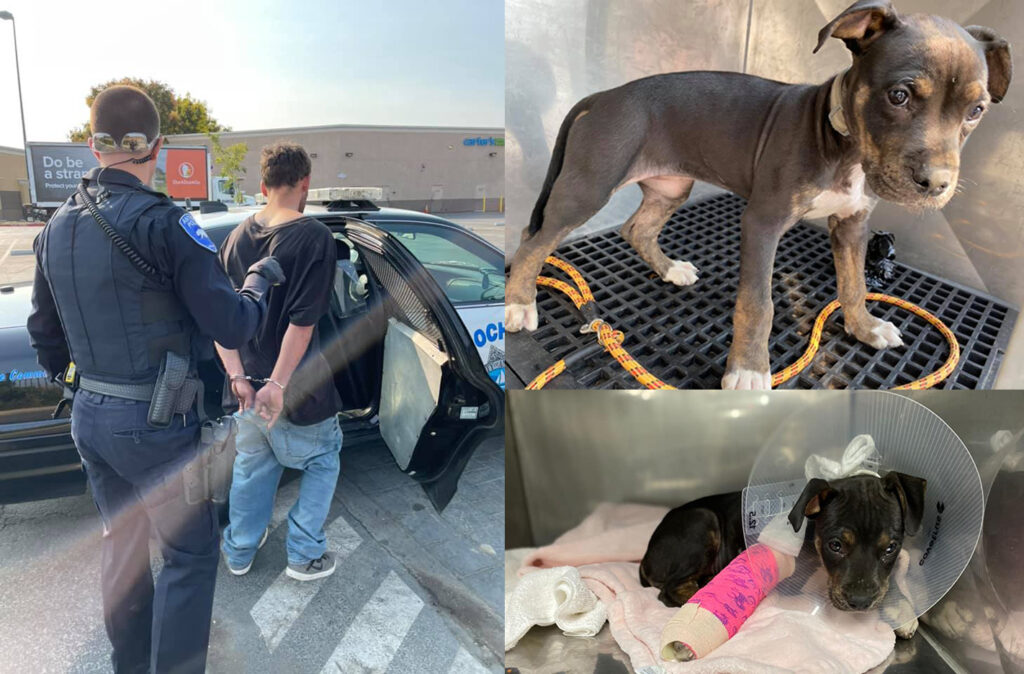
Man arrested in Antioch Monday for beating puppy

Friday, October 8th, 2021

Suspect arrested for animal abuse arrest and the puppy before and after receiving medical attention on Monday, Oct. 4, 2021. Photos: APD

By Antioch Police Department

Monday morning, we got a very disturbing call of a male beating a puppy behind Target on Lone Tree Way. Our concerned caller was not only witnessing the incident, but also filmed it while calling us.

When officers arrived, we were able to locate the person responsible and place him under arrest for animal abuse based on the information we were given by our witness. We are thankful to have citizens call us and work as part of our team to solve situations like this. The puppy was taken from this person and taken for medical treatment.

In a Monday afternoon update on the APD Facebook page, it included a photo of the puppy in recovery (see above), and a comment that reads, “She has a broken pinky and will be OK.”

Allen Payton contributed to this report.


Antioch Community Cleanup Saturday, Oct. 9

Thursday, October 7th, 2021

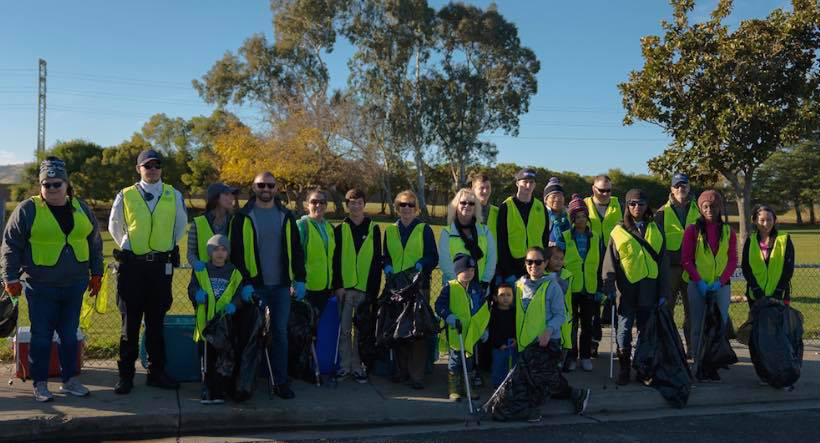
Photo: APD

By Antioch Police Department

After a 19-month hiatus due to Covid-19, the Antioch Police Department is excited to announce the resumption of monthly neighborhood cleanups! The first cleanup is scheduled for Saturday, October 9th from 9:00 AM – 11:00 AM. The meeting spot is Knoll Park, with the cleanup planned for the neighborhood immediately surrounding the park. The date was chosen to coincide with the National Faith & Blue Weekend. To that end, the cleanup is being coordinated with the congregation from The Fellowship Church. We are looking forward to resuming these important neighborhood events and ask anyone that is interested in donating a small amount of their time to come participate with us.

Los Vaqueros Reservoir Joint Powers Authority formed for capacity expansion of 275%

Thursday, October 7th, 2021

Los Vaqueros Reservoir JPA partners. Source: CCWD

It will be pretty dam big!

By Jennifer Allen, Director of Public Affairs, Contra Costa Water District

Los Vaqueros Reservoir. Photo by Aerial Photographer Dick Jones courtesy of CCWater.com

Brentwood – The Los Vaqueros Reservoir Expansion Project (Project) passed a significant milestone today, Thursday, Oct. 7, 2021, in officially filing agreements needed to form a Joint Powers Authority. This important milestone puts a group of Local Agency Partners one step closer to Project implementation.

Los Vaqueros Reservoir is an off-stream reservoir that was originally built by Contra Costa Water District (CCWD) in 1998. The original reservoir capacity was 100,000 acre-feet and in 2012, CCWD completed the first phase of expansion to hold 160,000 acre-feet.

Expanding Los Vaqueros to a new capacity of 275,000 acre-feet and adding new conveyance facilities will provide environmental, water supply reliability, operational flexibility, water quality and recreational benefits. Those benefits earned the expansion $470 million of the $2.7 billion in water storage investments approved by voters when Proposition 1 passed. The remainder of the project costs will be covered by federal and local partners.

Transforming a local reservoir into a regional facility requires partnerships. Agencies in the Bay Area and Central Valley, serving urban areas, agricultural land and wildlife refuges, have come together to move this expansion forward. A critical step in forming this partnership is the creation of the Los Vaqueros Reservoir Joint Powers Authority (JPA).

“Contra Costa Water District looks forward to working with all of the partners on the JPA in making financing, construction, and operations decisions for the expansion,” said Lisa Borba, CCWD Board President. “As the owner and operator of the system, we know the valuable benefits that Los Vaqueros continues to provide our customers and growing those benefits for a larger region is a smart investment for future generations.”

The JPA establishes the governance of the Project among the partnering agencies and provides the organizational framework for Project design, construction, operation, maintenance and funding. JPA members will bring perspectives from the agency or agencies they represent and work collaboratively to meet the needs of all agencies involved. The JPA will hold its first official public meeting in mid-November.

“The Los Vaqueros Reservoir Expansion is not only important for EBMUD, but for the Bay Area and the region as a whole,” said John Coleman, EBMUD Ward 2 Director and Los Vaqueros JPA Board Member. “Along with efforts such as water conservation, water recycling, and supplemental supplies, EBMUD will continue to support mutually-beneficial regional reliability efforts to prepare for an uncertain future.”

Looking forward, the Project team is continuing work to secure the necessary permits, approvals and agreements to begin construction. At this point, construction is scheduled to begin in the winter of 2023.

More information about the JPA is available at www.losvaquerosjpa.com.

OTHER JPA PARTNER STATEMENTS

Zone 7 – Tri-Valley

“For the Zone 7 Board, participation in this project represents a lesson learned from the last drought. Our constituents were clear that they wanted the Agency to pursue additional local storage and this is a key step towards fulfilling that request,” noted Angela Ramirez Holmes, Zone 7 Board President. “In addition to local storage, this regional partnership also has the benefit of emergency conveyance which is critical for when there are pumping restrictions in the Delta preventing Zone 7 from accessing State Water Project water. This alternative conveyance will increase the Tri-Valley water system’s reliability.”

Alameda County Water District

“The current drought is a stark reminder of the importance of reliable water storage, and Alameda County Water District is proud of our partnership with Contra Costa Water District and other Bay Area and regional stakeholders on this multi-benefit project,” said Aziz Akbari, ACWD Board President.  “ACWD’s participation in the JPA is another example of interagency coordination for the benefit of our customers and our region as we help guide improvements in long-term water supply reliability along with wildlife and environmental benefits as California works to combat climate change.”

Bay Area Water Supply and Conservation Agency 

“The Bay Area Water Supply and Conservation Agency (BAWSCA) is pleased to see continued progress in the Los Vaqueros Expansion Project, including this most recent milestone of the JPA formation,” said Nicole Sandkulla, BAWSCA CEO/General Manager. “The project, when in place, will serve to augment the water supply reliability of the San Francisco Regional Water System (System) during times of drought, helping to address the critical needs of the water users in the BAWSCA region that rely on the System to meet a majority of their water supply needs.”

Grassland Water District

“Grassland Water District is pleased to be involved with the formation of California’s newest water JPA,” said GWD General Manager Ricardo Ortega. “The Los Vaqueros Reservoir Expansion Project is a bright spot for California’s water future and will provide increasingly important ecosystem water supplies for wildlife refuges.”

San Francisco Public Utilities Commission

“Regional Cooperation is crucial for a resilient and reliable water future for our customers given the stresses that global climate change and shifting regulations put on our water supplies,” said Michael Carlin, Acting General Manager for the San Francisco Public Utilities Commission. “The SFPUC is committed to working with our partners on regional solutions, such as the Los Vaqueros Reservoir Expansion Project.”

San Luis & Delta-Mendota Water Authority

“California’s increasingly variable water cycle – including our current devastating drought conditions – continues to reinforce the need to pursue an all of the above approach to increasing water supply reliability for our communities and ecosystems,” said Federico Barajas, Executive Director of the San Luis & Delta-Mendota Water Authority. “We know the solutions – increased water storage, improved water conveyance, operations that are responsive to changing conditions – and are pleased to be a partner to advance the next step in making the Los Vaqueros Reservoir Expansion Project a reality.”

Santa Clara Valley Water District

“Our Board is proactively exploring ways to secure enough water to help all our communities in Santa Clara County weather droughts,” Valley Water Board Chair Tony Estremera said. “Valley Water looks forward to working with our JPA partners on this important project that could improve the reliability of our region’s water supply.”

Contra Costa, Bay Area health officers issue criteria for lifting indoor masking requirements

Thursday, October 7th, 2021

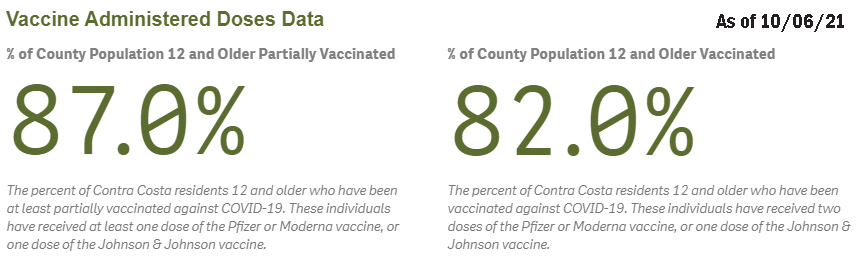
Source: CCC COVID Dashboard 10/07/21

“with regional data showing that the surge is now receding, and with the Bay Area one of the most vaccinated regions in the country, the health officers agree it is time to plan for a transition.”

Total population includes residents under age 12 who are not yet eligible for vaccinations.

As decisions to vaccinate and wear face coverings indoors drive down COVID-19 case rates and hospitalizations, health officers for the nine Bay Area jurisdictions that require face coverings in most indoor public spaces today reached consensus on criteria to lift those health orders.



These health officers continue to work together across the Bay Area to protect public health with a consistent regional approach, and to plan for the next phase of response to COVID-19 as this wave of the pandemic ebbs.

The counties of Contra Costa, Alameda, Marin, Napa, San Francisco, San Mateo, Santa Clara, Sonoma and the City of Berkeley will lift the indoor masking requirement in public spaces not subject to state and federal masking rules when all the following occur:

1) The jurisdiction reaches the moderate (yellow) COVID-19 transmission tier, as defined by the Centers for Disease Control & Prevention (CDC), and remains there for at least three weeks

AND

2) COVID-19 hospitalizations in the jurisdiction are low and stable, in the judgment of the health officer

AND

3) 80% of the jurisdiction’s total population is fully vaccinated with two doses of Pfizer or Moderna or one dose of Johnson & Johnson (booster doses not considered) NOTE – Total population includes residents under age 12 who are not yet eligible for vaccinations.

OR

Eight weeks have passed since a COVID-19 vaccine has been authorized for emergency use by federal and state authorities for 5- to 11-year-olds.

Curr

Most Bay Area health departments issued the masking requirements for their respective jurisdictions on August 3, following a summer surge in cases, hospitalizations and deaths.

But with regional data showing that the surge is now receding, and with the Bay Area one of the most vaccinated regions in the country, the health officers agree it is time to plan for a transition.

“It is no accident that transmission is slowing in Contra Costa County. Public health interventions, including the masking requirement, are working,” said Dr. Chris Farnitano, Contra Costa’s health officer. “We believe that health orders, along with vaccination, outreach and education are all adding layers of protection against COVID-19 in our community – and saving lives.”

Lifting a local indoor mask mandate would not prevent businesses, nonprofits, churches or others with public indoor spaces from imposing their own requirements. As COVID-19 easily spreads through airborne droplets, face coverings remain highly powerful in preventing its spread.

Each jurisdiction will rescind its order when criteria are met in that respective county or city. The criteria were developed to assist in determining the safest time to lift the indoor masking orders, based on regional scientific and medical consensus. The criteria also provide safety for school children, ages 5-11, who need the added protection of masks in the community to keep case rates low so they can remain in school until they can be vaccinated.

“Contra Costa is coming back strong, thanks to so many of our residents making healthy choices, such as getting vaccinated, or doing the courteous thing and wearing masks in places where the risk of transmission is a little higher,” said Diane Burgis, chair of the Contra Costa County Board of Supervisors. “I’m thankful for every resident who has done their part.”

California’s health guidance for the use of face coverings will remain in effect after local masking requirements are lifted, meaning that people who are not fully vaccinated for COVID-19 must continue to wear masks in businesses and indoor public spaces.

The state also requires face coverings for everyone, regardless of vaccination status, in healthcare facilities, public transit and adult and senior care facilities. California’s masking guidelines in K-12 schools would also not be affected by changes to local health orders.

An FDA advisory committee is scheduled to consider an application from Pfizer-BioNTech to grant emergency use of its COVID-19 vaccine for 5- to 11-year-olds on October 26.

Visit cchealth.org/coronavirus for local information about COVID-19 and Contra Costa County’s emergency response to the pandemic.