







Author Archive

Mandatory 10-digit dialing becomes effective in 925 area code Sunday

Friday, October 22nd, 2021

To accommodate new 988 three-digit number for National Suicide Prevention Hotline

By AT&T and Federal Communications Commission

The Federal Communications Commission (FCC) has adopted 988 as a new three-digit number to be used nationwide to reach the National Suicide Prevention and Mental Health Crisis Lifeline, starting July 16, 2022. Customers must continue to dial 1.800.273.TALK (8255) to reach the Lifeline until then.

For 988 to work in the 925 area code, mandatory 10-digit local dialing must first be implemented starting on October 24, 2021.

Get ready to change the way you dial your local calls!

What will be the new dialing procedure? To complete all local calls, you will now need to dial area code + telephone number. This applies to all calls within your area code that are currently dialed with seven digits. Some states or providers may use 1 + area code + telephone number, such as CA and parts of the Midwest.

Who will be affected? Anyone with a telephone number from your area code will need to make a change from 7-digit local dialing to 10-digit or 11-digit local dialing.

When will the change begin? Beginning October 24, 2021, you must dial 10 or 11 digits (area code + telephone number) for all local calls. On and after this date, local calls dialed with only 7 digits may not be completed, and a recording will inform you that your call cannot be completed as dialed. You must hang up and dial again using the area code and the 7-digit number or 1+ area code and the 7-digit number.

What will you need to do? In addition to changing your dialing patterns, all services, automatic dialing equipment, or other types of equipment that are programmed to complete calls to 7-digit local numbers will need to be reprogrammed to complete calls to 10-digit numbers or 1+10-digit numbers. Some examples are life safety systems or medical monitoring devices, PBXs, fax machines, Internet dial-up numbers, fire or burglar alarm and security systems or gates, speed dialers, mobile or other wireless phone contact lists, call forwarding settings, voicemail services, and other similar functions. Be sure to check your website, personal and business stationery, advertising materials, personal and business checks, contact information, your personal or pet ID tags, and other such items to ensure the area code is included.

Be sure to also add 1 (925) to all local phone numbers in your mobile phone contacts list.

What will remain the same?

  • Your telephone number, including current area code, will not change.
  • The price of a call, coverage area, or other rates and services will not change due to the dialing change.
  • A local call now will remain a local call regardless of the number of digits dialed.
  • You will continue to dial 1+ area code + telephone number for all long-distance calls.
  • You can still dial just three digits to reach 711 (relay services) and 911 (emergency services).
  • Any 211, 311, 411, 511, 611, or 811 services available in your community can still be reached by dialing their three-digit codes.

Why Is Ten-Digit Dialing Necessary?

There are more phones in America than there are people, and each phone needs its own phone number. Beginning in the early 1990s, to accommodate the growing need for more phone numbers, some areas began to add a second area code for local calls. Dialing both the area code and the seven-digit number was necessary to ensure the call reached the intended recipient. As more area codes begin to run out of new seven-digit numbers to assign, a second local area code may be added, requiring that area to transition to ten-digit dialing.

In 2020, the FCC established “988” as the new, nationwide three-digit phone number for the National Suicide Prevention Lifeline. The new three-digit dialing code will be available nationwide by July 16, 2022 and will provide an easy to remember and easy to dial three-digit number to reach suicide prevention and mental health counselors, similar to “911” for emergencies and “311” for local government services. To help facilitate the creation of “988”, area codes that use “988” as a local exchange, or the first three digits of a seven-digit phone number, will need to use 10-digit dialing.
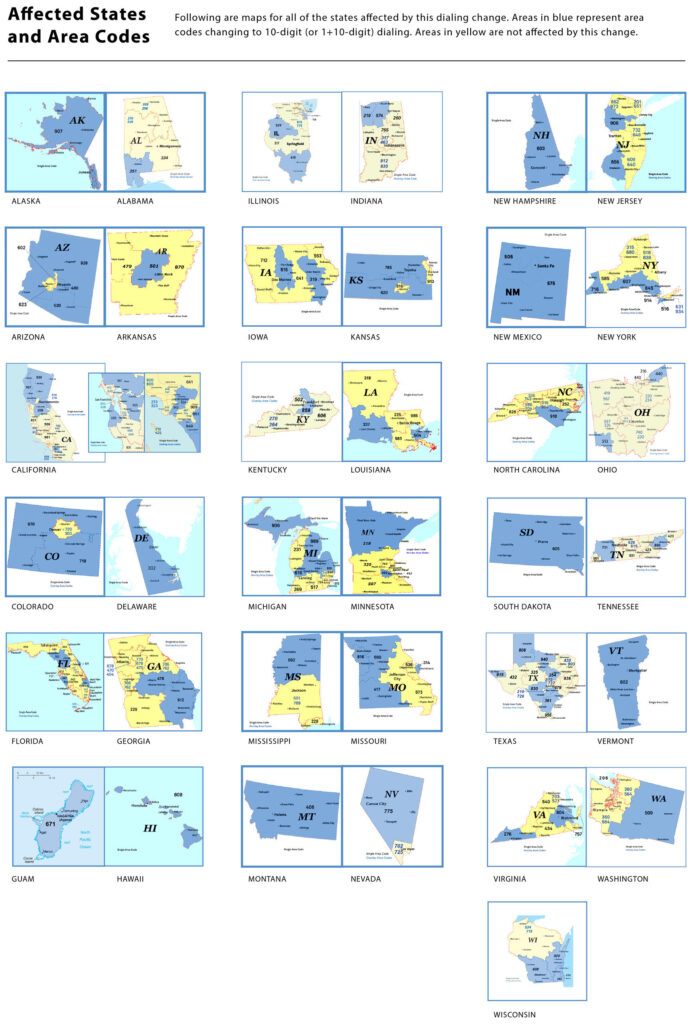
Affected Stated and Area CodesNEW DIALING PROCEDURE BECOMES MANDATORY ON OCTOBER 24, 2021 FOR ALL CUSTOMERS IN 82 AREA CODES

Other Area Codes Affected

The North American Numbering Plan Administrator has a complete listing of affected area codes and resource materials for local government and community organizations.  The other area codes in California affected by the change are 209, 530, 562, 626, 650, 707, 949, and 951. To see the list of all affected 82 area codes for customers in 35 states and one U.S. territory, click here.

10-Digit Dialing Fact Sheet: [ English | Spanish ]

Allen Payton contributed to this report.



Antioch Police Department selected for crime prevention initiative by U.S. Department of Justice 

Friday, October 22nd, 2021

One of only 10 new cities nationwide to participate in National Public Safety Partnership for coordinated, intensive training and technical assistance with focus on gun violence prevention

Councilman not happy mayor is attempting to takcredit for something “council had nothing to do with”

Announced by DOJ on Oct. 6, but press conference was held Thursday

By Allen Payton

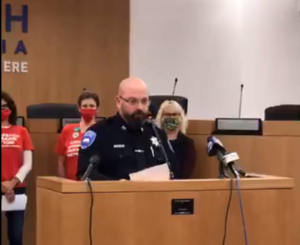
Interim Antioch Police Chief Tony Morefield speaks during the press conference as District 3 Councilwoman Lori Ogorchock and a member of Moms Demand Action listen on Thursday, Oct. 21, 2021. Video screenshot

The City of Antioch is one of 10 new cities selected nationwide to participate in the U.S. Department of Justice’s (DOJ) National Public Safety Partnership (NPSP).  NPSP resources aim to enhance the Antioch Police Department’s (APD’s) capacity to address gun violence, expand community engagement and, ultimately, prevent violent crime. To be considered for selection, a site must have sustained levels of violence that far exceed the national average and demonstrate a commitment to reducing crime and enhancing community engagement.

“Violence—gun violence in particular—has taken a heavy toll on communities across the country, and its impact has been felt most deeply in neighborhoods where resources have always been scarce and justice has historically been elusive,” said Amy L. Solomon, Acting Assistant Attorney General of the Justice Department’s Office of Justice Programs, whose Bureau of Justice Assistance (BJA) administers the PSP initiative.  “We are proud to join local leaders and our partners from across the Department of Justice as we work together to stem the tide of violent crime in these hard-hit communities.”

Officers will receive intensive training and technical assistance (TTA) from DOJ in the key areas of constitutional policing and community engagement to assess and implement collaborative strategies and a lasting coordination structure that prevent and combat violent crime, especially related to gun violence.

“The goal of this partnership is to gain better insight into the unique violent crime challenges in Antioch and inform future investments in what works,” Interim Police Chief Tony Morefield said. “The guidance will help determine system-wide approaches to crime reduction and enhanced public safety.”

First Announced on Oct. 6

According to the NPSP website, the 2021 PSP sites were introduced by U.S. Deputy Attorney General Lisa Monaco at the Major Cities Chiefs Association meeting on October 6, in New Orleans, Louisiana. It was also announced in a press release that same day on the DOJ’s BJA website.

Yet, Mayor Lamar Thorpe and Interim Chief of Police Tony Morefield held a press conference, Thursday to inform the Antioch community about the initiative. They were joined by Mayor Pro Tem Monica Wilson, District 3 Councilwoman Lori Ogorchock and four members of Moms Demand Justice. Also in attendance were the city manager, city attorney, assistant city manager and economic development director. (See press conference video)

During the press conference Thorpe tied the program participation to the council’s police reform efforts earlier this year. However, the police department applied for the program in 2020.

“The collaboration between the Antioch Police Department (APD) and the DOJ National Public Safety Partnership is important to lowering crime rates in Antioch,” said Thorpe. “APD will receive support that will improve crime prevention strategies and improve our service to all of Antioch, including historically neglected neighborhoods.”

The Antioch City Council recently passed a resolution mandating the integration and enhancement of specific topics into the training matrix of Antioch Police Department sworn personnel. These topics include de-escalation strategies, crisis intervention and conflict resolution, procedural justice, implicit bias, and meaningful engagement with members of the LGBTQ+ and youth communities.

“The integration of these topics, along with APD’s partnership with PSP, provide a mechanism for increasing our community’s access to justice and better supporting crime victims in this City,” says Interim Chief Morefield.

This is the seventh year for the DOJ program.

“From five to now 50 jurisdictions in seven years, PSP has taught the Department a new way to work with communities.  We have learned that it is only by leveraging the power of community and using all our collective resources and dedicating all our efforts that we will reduce crime,” said BJA Acting Director Kristen Mahoney.  “We look forward to partnering with the 10 new sites to achieve what we are all working toward—safe places to live and work.”

Torres-Walker Offers Comments on Program

While she was not in attendance at the press conference, District 1 Councilwoman Tamisha Torres-Walker posted a written and video message of congratulations on her official Facebook page in support of the program. “Congratulations Antioch for being selected as one of the 10 newest sites to be excepted [sic] into the Department of Justice’s Public Safety Partnership to advance racial equity reduce gun violence and promote Community engagement to build public trust and transparency,” she wrote. “We are ahead of the game in Antioch and for the first time in years, this city is ready to invest in violence intervention and prevention efforts that will get at the root cause of violence in our community.”

The focus has been on racial equity and community engagement to reduce violence, especially gun violence.

“This is an opportunity that comes with great resources, training and technical assistance towards violence prevention and intervention and creating public trust and transparency with our police department,” Torres-Walker said. She went on to speak about the council’s Community Violence Solution Ad Hoc Committee that was formed in June “with myself as the co-chair and the mayor as the chair” that has “met bi-weekly”. She also called for a review of “departmental policies where the police department can crack open the books and get someone to come in and do an honest look at violence but also look at our policies that aren’t racially equitable.”

Barbanica Wouldn’t Attend Press Conference

However, District 2 Councilman Mike Barbanica did not attend the press conference because he didn’t think the council should appear to take any credit for the program. “The city council had nothing to do with this and it wasn’t part of the police reform efforts, this year. APD applied for it in 2020.” But he does support the program.

About the National Public Safety Partnership

The PSP team supports local law enforcement and other key stakeholders in developing each site’s capacity to address its unique violent crime challenges to enhance public safety. Through a collaborative approach and data-driven decision making, the PSP approach ensures that local resources are maximized, and federal assets are leveraged where they are most needed. Implemented in 2014 as a pilot program, PSP has served more than 40 sites nationwide. The PSP team’s work is driven by local needs and priorities focused on increasing capacities to reduce violent crime and increase community engagement.

For more information, visit www.nationalpublicsafetypartnership.org.

The Office of Justice Programs (OJP) provides federal leadership, grants, training, technical assistance and other resources to improve the nation’s capacity to prevent and reduce crime, advance racial equity in the administration of justice, assist victims and enhance the rule of law.  More information about OJP and its components can be found at www.ojp.gov.

Rolando Bonilla, City of Antioch PIO, contributed to this report.

Pumpkin Carving Contest in Antioch’s Rivertown Saturday morning, Oct. 23

Thursday, October 21st, 2021

For more details visit Hot Rod 4 Paws annual car show fundraiser in Rivertown Saturday, Oct. 23 | Antioch Herald.

Supervisors aim for all electric, no natural gas for new houses by 2026

Thursday, October 21st, 2021

Could add more than $2,200 to cost of a home; revise nepotism policy

NOTE: This article was inadvertently overlooked due to the publisher being sick at the time it was submitted. However, the information is still timely. Apologies for the delay in publishing it.

————————

By Daniel Borsuk

Will all new houses built in Contra Costa County feature all solar powered electric appliances and lights with no natural gas by Jan. 1 2026?

That’s the game plan of the Contra Costa County Board of Supervisors who, on Tuesday, August 3, 2021, instructed the county’s Department of Conservation and Development (CCCDCD) to draft an ordinance that would require home builders to construct residential buildings with all electric powered appliances. (See Subcommittee Report and staff presentation)

Just when CCCDCD will have an ordinance ready for supervisors to consider is up in the air, but the supervisors’ action demonstrates their keen interest in environmental issues. Should the supervisors eventually pass an ordinance calling for all solar powered, electric new housing, natural gas-powered water heaters, heaters, stoves and clothes dryers will be taboo.  From then on, everything will be solar powered. (See Cost-effectiveness Study)

Supervisors expect the proposed ordinance will go into effect on Jan. 1, 2026. (See Ad Hoc Committee on Sustainability Committee’s recommended Building Electrification Ordinance for New Construction)

Just when planning officials will have an ordinance prepared for supervisors to review and act on is up in the air, but Area 2 Supervisor Candace Andersen of Danville raised questions about the cost effectiveness of such a proposed ordinance.

“I have serious reservations about the California Energy Commission’s recommendations to replace natural gas with all electric powered homes,” said Andersen. “We need better cost analysis.  There are some estimates going around that all-electric could add $2,000 to the cost of a house.”

Andersen cast the one dissenting vote in instructing CCCCDP officials to draft an all-electric new residential ordinance.

Lisa Vonderbrueggen of the Building Industry Association of the Bay Area also cautioned supervisors about the genuine costs associated with electric powered versus natural gas-powered houses. She said a California Building Industry Association study found that an all-electric home is $421 less expensive to build, including the cost of appliance, “but estimates from homebuilders show increased costs of more than $2,200 per home.”

Vorderbrueggen wrote: “Will California’s aging electric grid hold up under an all-electricity design.  The state is already anticipating major demand increases from electric vehicle charging needs.”

While a letter from PG&E supporting the county’s move to promote all solar-powered electric homes generated scant interest from the general public, District 1 Supervisor John Gioia of Richmond said,“I appreciate PG&E’s statement and it has provided in-depth analysis. But I am very hesitant to move forward on it.”

“Do everything you can do to eliminate gas,” pleaded Richmond City Councilmember Eduardo Martinez. “I liken natural gas to the Covid-19 pandemic.”

“We need to act quickly,” said Lisa Jackson, an environmentalist.  “We cannot wait for the state to act. PG&E even supports this.  Let’s move forward to eliminate this potential safety hazard.”

Before casting his vote, District 1 Supervisor Gioia, who drives an electric-powered car said: “It’s all about full electrification as our main source of power.”

Nepotism Policy Revised

After not updating its nepotism policy since 2011, supervisors took the plunge and loosened its the rules on appointments on boards, committees and commissions for which the board of supervisors is the appointing body.

Supervisors voted 4-1, with supervisor Gioia casting the dissenting vote, brother-in-law and sister-in-law from the prohibited relationship list.

The revised policy now states:

“A person will not be eligible for appointment if he/she is related to a Board of Supervisors’ Member in any of the following relationships:

  1. Mother, father, son, and daughter.
  2. Brother, sister, grandmother, grandfather, grandson, and granddaughter.
  3. Husband, wife, father-in-law, mother-in-law, son-in-law, daughter-in-law, stepson, and stepdaughter.
  4. Registered domestic partner, pursuant to California Family Code section 297.
  5. The relatives, as defined in 1 and 2 above, for a registered domestic partner.
  6. Any person with whom a Board Member shares a financial interest as defined in the Political Reform Act  (Gov’t Code 87103, Financial Interest), such as a business partner or business associate.”


Contra Costa to hold Community Redistricting Workshops for Supervisor districts October 23-28

Wednesday, October 20th, 2021

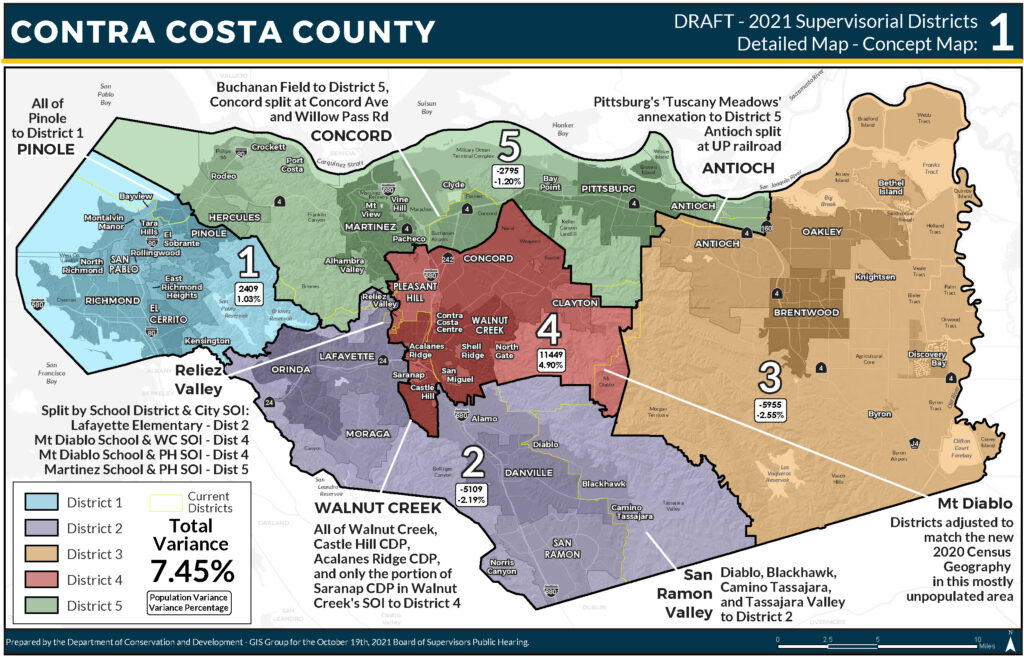
Contra Costa County Board of Supervisors 2021 Redistricting Draft Map 1. Source: CCC Department of Conservation and Development

East County workshops Oct. 24, 26 & 28

By Susan Shiu, PIO, Office of Communications & Media, Contra Costa County

Contra Costa County’s Redistricting effort is a once-a-decade process of redrawing the boundaries for Supervisorial districts after the U.S. Census. As part of that process,

a series of Community Redistricting Workshops to be held in each region of the County will take place October 20 – 29, 2021. To register for mapping workshops and to learn more, visit CoCoRedistricting.org.

The county is also offering easy-to-use mapping tools for public input. Five proposed maps have been created for review by the public and Supervisors. See Redistricting Concept Maps 1-5.

Redistricting is the regular process of adjusting the lines of voting districts in response to accordance with population shifts within the County. Every ten years, after the decennial census, supervisorial districts must be redrawn so that each district is substantially equal in population. This process is important in ensuring that each Supervisor represents about the same number of people.

Redistricting is based on the U.S. Census data, which was released in legacy format on August 12, 2021.  The actual drawing of Supervisorial District Maps requires the official California State Adjusted Redistricting data, which was released September 20, 2021 and includes updated data to ensure that individuals in the prison population are counted by each jurisdiction.

“The Contra Costa County Board of Supervisors welcomes your engagement and input in this important process,” said Board Chair, Supervisor Diane Burgis. “We are committed to a robust Redistricting and public outreach process with public hearings, a dedicated website at CoCoRedistricting.org, and public workshops.”

Workshop Schedule

Community Redistricting Workshop – District 2, San Ramon City Hall

October 23, 2021, 9:00 AM - 11:00 AM @ San Ramon City Hall, 7000 Bollinger Canyon Road. Hosted by Supervisor Candace Andersen

Community Redistricting Workshop – District 3 Zoom Workshop

October 24, 2021, 12:00 PM - 2:00 PM This workshop will be by zoom only. Hosted by Supervisor Diane Burgis

Community Redistricting Workshop – District 4, Pleasant Hill Community Center

October 25, 2021, 7:00 PM - 9:00 PM @ Pleasant Hill Community Center. Hosted by Supervisor Karen Mitchoff

Community Redistricting Workshop – East County Zoom Workshop

October 26, 2021, 7:00 PM - 9:00 PM This workshop will be by zoom only. Hosted by Supervisors Diane Burgis & Federal Glover

Community Redistricting Workshop – District 1, San Pablo City Hall

October 27, 2021, 6:30 PM - 8:30 PM @ San Pablo City Hall, 1000 Gateway Avenue, San Pablo 94806 Hosted by Supervisor John Gioia

Community Redistricting Workshop – District 5 Zoom Workshop

October 28, 2021, 7:00 PM - 9:00 PM This workshop will be by zoom only. Hosted by Supervisor Federal Glover

For more information about Redistricting and how to provide input, visit www.CoCoRedistricting.org or the County website’s homepage at www.contracosta.ca.gov.

Allen Payton contributed to this report.
Antioch school district shares what’s being done to help third graders reading below grade level

Wednesday, October 20th, 2021

Source: California Reading Coalition

PUBLISHER’S NOTE: The email received by the Herald from AUSD Associate Superintendent, Educational Services,  Christine Ibarra, on Thursday, Sept. 30 was missed until, yesterday. She responded to questions sent on Monday, Sept. 27 for the article entitled, “Statewide report shows 76% of Antioch third graders reading below grade level for 2017-18, 2018-19 school years.” While they’ve been added to the article, it’s best they be published separately. Apologies to Ms. Ibarra, district staff and our readers for the oversight. Allen Payton

9/30/21 UPDATE: AUSD Responds – Following are the Herald’s questions and the answers from Associate Superintendent Christine Ibarra:

Q – What is being done to rectify this situation? What ideas, programs, or suggestions have any of the trustees proposed during their terms on the board? Have any been approved and implemented? If so, what are the results? If so or if not, what do you propose be done?

A – AUSD is heavily invested in a computer adaptive instructional program known as iReady.  All students in grades K-8th participate in this research-based program.  This program provides three diagnostic assessments per year and produces individualized placement levels in reading.  The students then engage in a pathway of instruction that is both done within the computerized program itself and supported by intervention prep teachers on campuses with direct instruction that is tailored to the individual levels and needs of each student.  Since this is our third year utilizing this program, we have data that shows significant growth in students’ reading levels and abilities at all grade levels even during distance learning.

Furthermore, AUSD has provided every elementary school with a full-time intervention teacher who works with small groups providing intentional and targeted support in areas of need, specifically in fluency skills and reading comprehension. These intervention teachers utilize a wide array of differentiation strategies and support to ensure their time with student groups is maximized for the greatest impact on student growth and achievement.

In addition, AUSD has an MOU with UC Berkeley’s California Reading and Literacy Project for the 2021-2022 school year.  This partnership provides professional learning for all teachers TK-6th grade specifically focused on developing teachers’ content knowledge and expanding their teaching strategies guided by the state-adopted frameworks, content standards, and the science of reading.

Read 180 is a research-based program being reintroduced to AUSD intended for secondary students who are performing two or more years behind grade level in Reading.

AUSD is also heavily invested in the AVID programming and professional learning community which has provided hundreds of teachers across all grade levels with outstanding workshops focused on critical reading strategies across content areas so that all teachers have tools and supports to support reading levels at any grade level.  This summer alone, we had 50 teachers attend virtually.

The iReady program, Read 180, the AVID program, and the UC Berkeley partnership are Board approved contracts and the intervention teaching positions were board approved via the LCAP and Expanded Learning Opportunities grant.

Q – Since education begins at home, what is being done to work with the parents or guardians of the students reading below grade level to help them?

A – We provided ongoing trainings and support during school closures remotely in both English and Spanish. The parent trainings were not only for technology support efforts but were designed to also increase parents’ capacity to support their students at home and in their academics.  iReady specifically provided parent institutes that were widely attended virtually.  Since returning to in-person learning, we have worked closely with our District English Language Advisory Committees (DELAC) as well as our Parent Advisory Committees (PACs) and Site Councils from all schools across the district to assess what parents need and are interested in engaging in to support their students’ academic achievement.  Most, if not all of our elementary and middle schools, host parent training nights focused on both literacy and mathematics and are working to determine how to continue that effort with COVID-19 protocols in place this year.

Q – For the Hispanic/Latino students, is it a matter of Spanish being the primary language at home? How many ESL students are there in the district, please?

A – AUSD currently serves 2,687 English Learners (EL) and has over 450 students being tested to determine their English Learner status as of today.  Although Spanish is the largest group of English Learners’ population in AUSD, we have over 30 different languages spoken within our EL population.

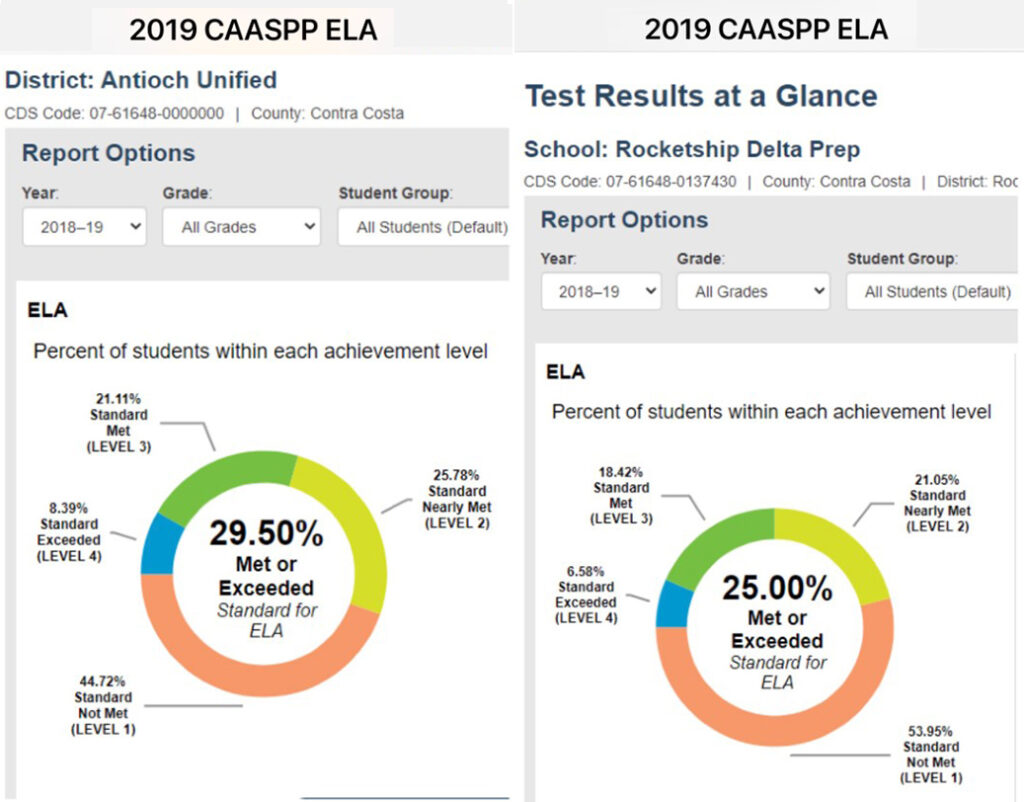
California Assessment of Student Performance and Progress (CAASPP) English Learning Arts AUSD vs Rocketship Delta Prep 2018-19. Source: CAASPP

Q – Have there been any efforts to work with Rocketship Delta Prep to learn what their best practices are which, according to their reports, show significant advancement among their students and in just one school year, and implement them in district schools?

A – The AUSD Educational Services department meets annually with Rocketship and reviews their programming efforts as required. Best practices are shared and exchanged during those meetings.  Since we have not had summative state data results in the last two years, the conversation has not been directly about the improvement of test scores.  In the 2019 CAASPP, AUSD students performed higher in English Language Arts.

Q – On whom does the responsibility lay for this, the board, superintendent, principals, teachers and/or parents?

Are there subject matters being taught in the classroom that aren’t required that take time away from focusing on reading skills?

A – Educating students and ensuring students have all the supports and opportunities they deserve and require is a collective responsibility.  When we can work together to that end, we will see students reach their full potential.

Daddy and Me Pinup Contest in Antioch’s Rivertown Saturday, Oct. 23

Wednesday, October 20th, 2021

For more details visit Hot Rod 4 Paws annual car show fundraiser in Rivertown Saturday, Oct. 23 | Antioch Herald.

Halloween Dogs Costume Contest in Antioch’s Rivertown Saturday, Oct. 23

Tuesday, October 19th, 2021

For more details visit Hot Rod 4 Paws annual car show fundraiser in Rivertown Saturday, Oct. 23 | Antioch Herald.