








October 15: BART to participate in Great ShakeOut 2026

You can too at 10:15am
By BART
BART will participate in the 2026 International ShakeOut Day earthquake drill on Thursday, October 15, to test our emergency response systems and to help raise public awareness of the importance of having a plan and being prepared.
At 10:15am, BART staff will trigger our ShakeAlert early warning earthquake system to ensure it is functioning and working correctly. Once triggered, trains will automatically slow down to 27mph. Then all trains will come to a very brief stop. BART will also make a systemwide public announcement encouraging riders to be prepared for earthquakes. BART will also test our internal communications systems to notify employees and the Operations Control Center will observe earthquake alarms and our train control systems to ensure they are working properly. BART has also added simulated damage inspections to its ShakeAlert drill, which you can read more about below.
ShakeAlert Early Warning Earthquake System
BART is an early adopter of the ShakeAlert system, which is connected to a network of USGS seismic sensors throughout California. When the BART seismic condition threshold is reached is reached, the system sends a speed restriction command to trains. This system removes human response time and can even slow trains down before the shaking occurs depending on how far away the quake is centered.

Emergency Response Plan
BART has an Earthquake Emergency Response Plan, and we hold several drills a year to ensure staff is trained and ready to respond. In the event of an earthquake, riders should listen for instructions from BART personnel. Employees are trained to evacuate the public from dangerous areas. Following an earthquake, BART trains are held in place (except for trains in the Transbay Tube and Berkeley Hills Tunnel) until it is determined it is safe to move the train to the nearest station where riders will be offboarded.
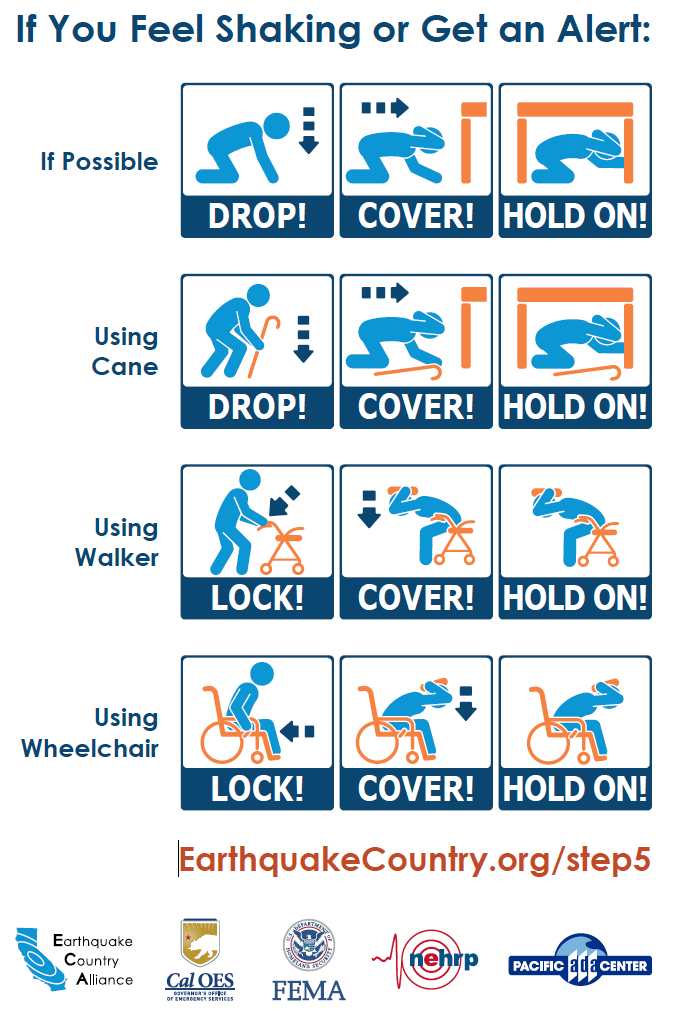
Earthquake Safety Tips
Where will you be and what will you do when the next big earthquake hits? Taking time to consider these questions now could help if you ever do find yourself in an earthquake.
LISTEN FOR INSTRUCTIONS
That’s one reason why the first guideline in a BART emergency is to follow instructions from BART personnel. The BART Operations Control Center is in constant communication with trains and Station Agents and is in the best position to manage emergencies and provide direction for the public.
ON A TRAIN
If you’re on a train during an earthquake, Train Operators will follow BART’s established emergency plan and provide you with important information. Sit down or grab a handhold to avoid injury. If an evacuation is necessary, emergency response personnel will coordinate.
IN A STATION
If you’re in a station during an earthquake, back away from the edge of the trackway. If you’re in the station concourse, don’t proceed to the platform. Instead, prepare to evacuate the station under the direction of BART personnel.
TRY TEXTING
No matter where you are, emergency experts recommend using text messaging instead of cell calls to communicate with family and loved ones in an emergency. Cell networks can be overwhelmed if everyone’s trying to call at the same time; text messages can be more efficient.
Earthquake Safety Program Completed in 2024
In September 2024, BART completed its Earthquake Safety Program, which retrofitted vulnerable high traffic portions of the original system to make it safer in a large quake. The Earthquake Safety Program was funded in part by Measure AA, a $980 million general obligation BART bond approved by voters in 2004. The program focused on upgrading portions of the original system not only for life safety but also to ensure that we can return to operation shortly after a major earthquake.
BART’s Earthquake Response Team
BART’s Earthquake Response Team (ERT) consists of around sixty engineers and thirty maintenance employees that fan out across the system in the advent of a major earthquake, defined as an earthquake with a magnitude of 6.0 or greater with an epicenter within 50 miles of the BART system. Since its inception, the ERT has never been activated for a real event, but they train throughout the year to prepare for the real possibility of a massive earthquake rattling the Bay Area.
The Great ShakeOut is the ERT’s big show. Once the international earthquake drill commences, BART staff hit the ground running. ERT members travel to all 50 stations to conduct structural assessments, simulating damage inspections that would occur during a real earthquake. They inspect walkways, support structures, elevators, escalators – anything that could sustain damage in a powerful earthquake.
The Great ShakeOut simulation is designed to exercise “muscle memory” for BART’s earthquake response as well as identifying areas for improvement.
Safety is BART’s mission above all, and the practiced ERT is crucial for getting service up and running quickly.
The team focuses their observations on stations and aerial structures. They’re looking for physical damage – cracks, leaning, displacement, unevenness, and foundation damage – as well as issues like station power outages, falling signage, and water intrusion.
Members of the ERT can be activated at any time, and staff volunteer to join the team. Every ERT member is issued two big backpacks full of supplies they might need, from batteries and measuring tools to safety vests and protein bars. One backpack stays at their house: the other in their office. See what’s inside in the video.

Visit Shakeout.org for simple safety steps during earthquakes.
the attachments to this post:

ShakeOut 2026 partners
Earthquake Protective Action Accessibility postcard
BART Shake Out 2026 video screenshot bartable BA logo wide

Great Shake Out 2026 BART