








Antioch schools superintendent sues District, Trustee Rocha, others claiming retaliation, discrimination, harassment, more
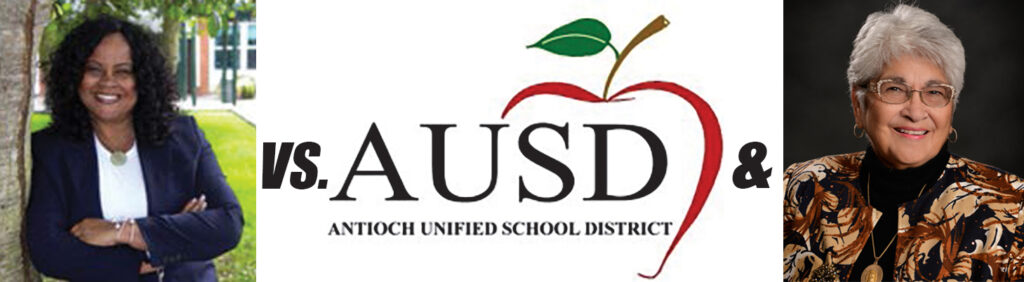
Dr. Darnise Williams, in her 4th job in the past 6 years, claims a “campaign to remove” her for refusing “to overlook questionable payments” and because she “disclosed fiscal and legal noncompliance to officials empowered to correct it,” plus, “she made an internal complaint concerning discriminatory, biased, harassing, and retaliatory treatment by Board leadership, including conduct directed at her as a Black woman” and makes multiple accusations against Rocha – the only Trustee to vote against hiring her
“I was the only one who didn’t vote to hire her. But on top of it, it takes three votes to get rid of her and she only targets me. Interesting, huh?” – Trustee Mary Rocha
By Allen D. Payton
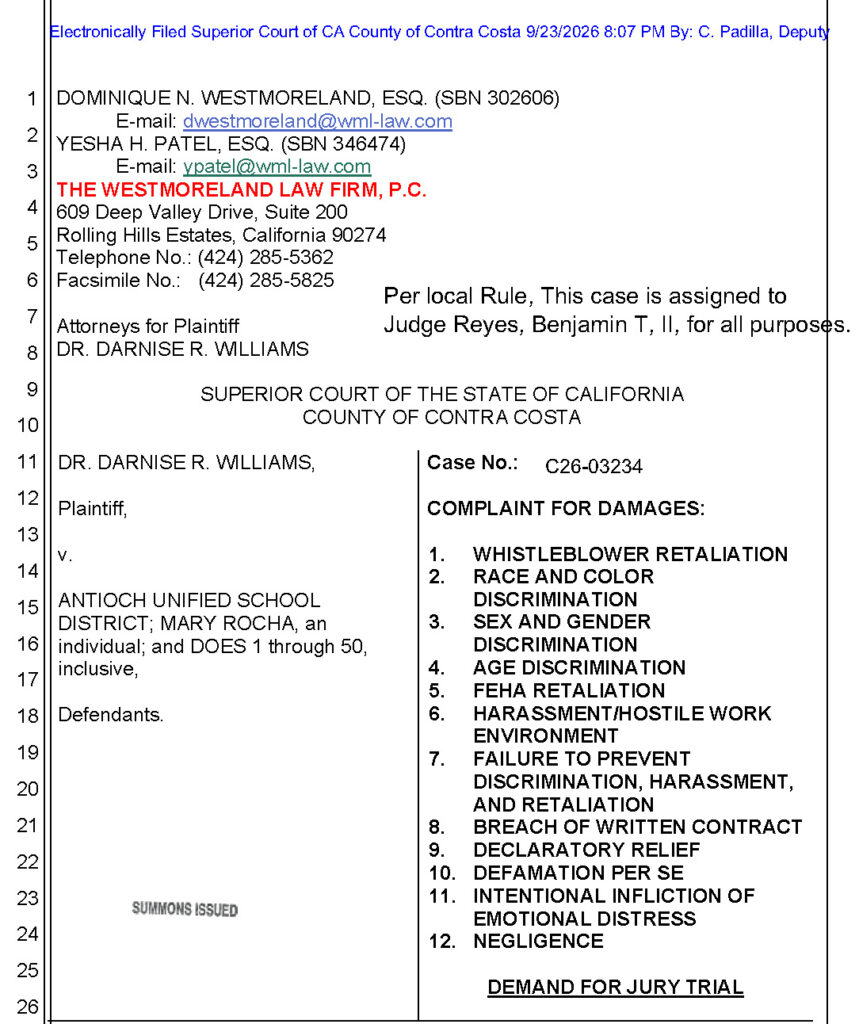
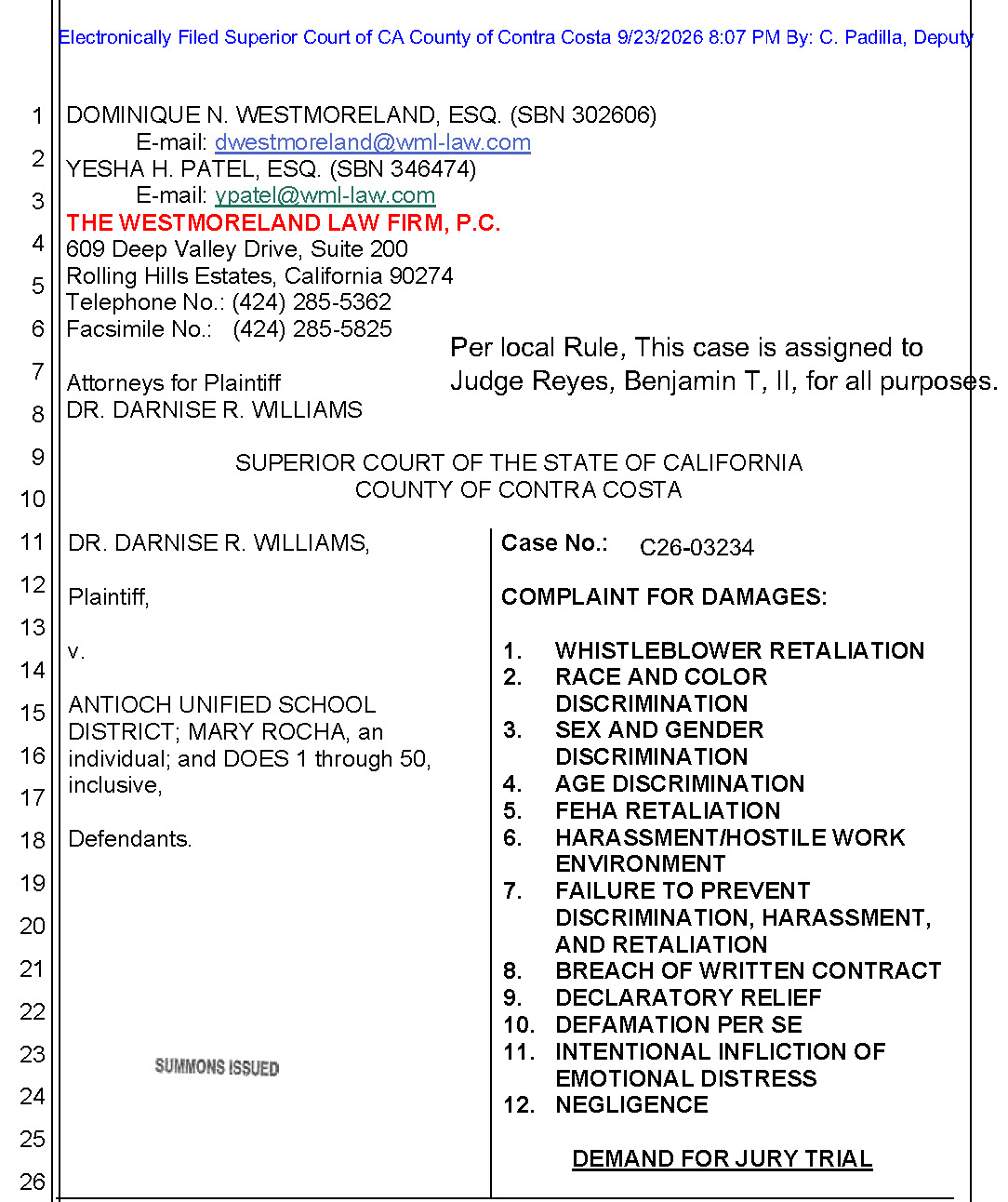
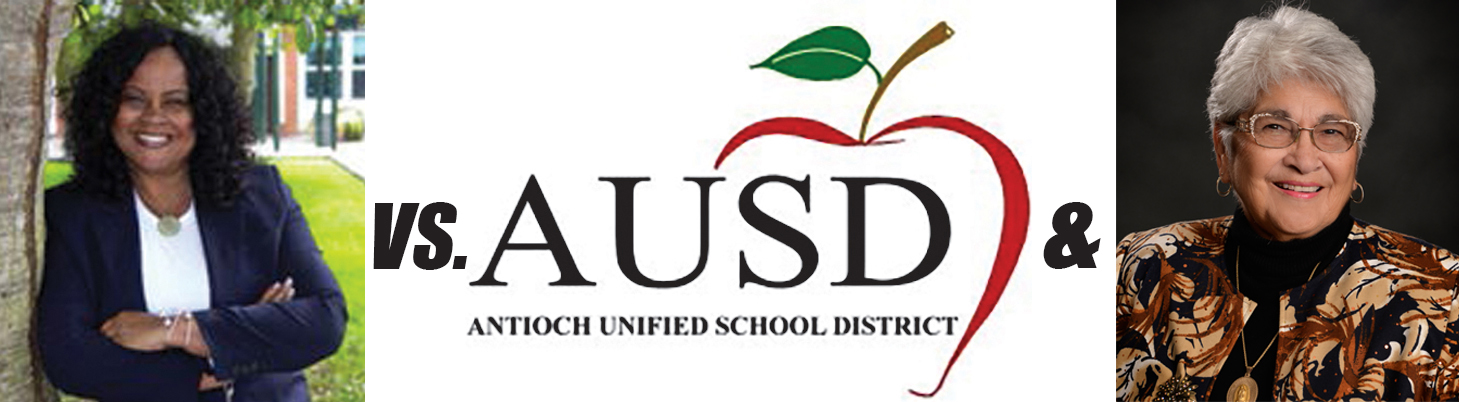
Embattled Antioch Unified School District Superintendent Dr. Darnise Williams has responded to being placed on paid leave by suing the District, Area 5 Trustee Mary Rocha and unnamed “DOES 1-50” claiming a list of 12 “Damages” including whistleblower retaliation, discrimination, harassment and more. She is seeking a jury trial.
Specifically, the lawsuit, filed in Contra Costa Superior Court on Sept. 23rd, claims race and color discrimination, sex and gender discrimination, age discrimination, plus, Fair Employment and Housing Act (FEHA) retaliation, harassment/hostile work environment, failure to prevent discrimination, harassment and retaliation, breach of written contract, declaratory relief, defamation per se, intentional infliction of emotional distress, and negligence. According to findlaw.com, “Defamation per se means that a false statement was so inherently harmful that further proof of harm isn’t necessary. The statement would have been likely to cause reputational damage regardless of the context.”
Williams doesn’t want punitive damages against the District, just against Rocha.
Background
On a 4-1 vote, with Board President and Area 2 Trustee Dr. Jag Lathan the only school board member to vote “no”, Williams was placed on paid administrative leave on Aug. 25, 2026, after less than 14 months in the job. Williams was hired during the June 11, 2025 School Board meeting on a 3-1 vote with Rocha the lone dissenter and Area 4 Trustee Olga Cobos-Smith absent. This is Williams’ fourth position in the past six years, her starting annual base salary was $353,045, plus contractual benefits, according to the lawsuit, and she was paid $357,234 last school year. (See related article)
The Board agendized the performance evaluation of Williams for that meeting and during three previous meetings, as well.
At their Special Meeting on May 27, which was not live-streamed, the report out reads, “There was no reportable action taken during closed session.”
Then during the August 5 Special Board Meeting, which was also not live-streamed, the report out of Closed Session reads, “The Board took action by unanimous vote of all trustees present to assign Trustee Cobos-Smith with the duty of compiling the Board’s evaluation of the superintendent consistent with Board Policy 2140.”
Finally, during their Regular Meeting on August 19th, the Board again agendized the performance evaluation of the superintendent. But Lathan did not report out from Closed Session any action on the matter.
Cobos Smith was asked ifthe performance evaluation was ever provided to Dr. Williams.
“The evaluation was complete and submitted to her,” she stated in response.
The school board held a special meeting on Oct. 7th during which they met in Closed Session to discuss the lawsuit. Under item A. described as, “CONFERENCE WITH LEGAL COUNSEL—Existing Litigation (Paragraph (1) of subdivision (d) of Section 54956.9) Name of Case: Dr. Darnise R. Williams v. Antioch Unified School District, et al., Contra Costa County Superior Court, Case No. C26-03234.”
Since there was no video of the meeting and the minutes are not yet available on the District’s website, asked about the results from that Closed Session, Cobos Smith stated, “There was no reportable action and Dr. Lathan did not attend. The attorney just shared the complaint with us so that we would know about it through official channels before it went public.”
Yet Williams claims in her lawsuit that the Board did not conduct the oral and written annual performance review required by her employment agreement. But later in her lawsuit she claims to have received an “unsatisfactory assessment,” but reiterated that the Board “did not provide the contractually required oral evaluation.”
Lawsuit Details
In the 30-page complaint, Williams shares the fact that she “is a Black and African-American woman over the age of forty…and therefore belongs to protected race and color classes.” The lawsuit also claims, “She was…qualified for and capable of performing the Superintendent position and performed that work successfully.”
The lawsuit explains Williams “timely presented a written claim to the District as required by the Government Claims Act. The District did not act within the statutory period, and the claim was deemed rejected.”
To support Williams’ claims of damages, the lawsuit provides general accusations and details against both the District, i.e. the Board of Trustees and staff, and specifically, against Rocha.
She claims, “Rocha…personally participated in the harassment alleged” and “Each DOE Defendant participated in, authorized, ratified, aided, or failed to prevent the unlawful conduct alleged here.”
The Introduction reads, “1. This action arises from a public school district’s campaign to remove its first-year Superintendent after she insisted that public funds, employee compensation, fiscal controls, and Board governance comply with law. Plaintiff was hired to lead and stabilize the District. She did that work. When she refused to overlook questionable payments and disclosed fiscal and legal noncompliance to officials empowered to correct it, influential trustees turned the scrutiny onto her.
“2. The retaliation followed a recognizable sequence: race- and gender-charged remarks; escalating personal hostility; dissemination of accusations that an outside investigation did not substantiate; manipulation of the contractual evaluation process; a manufactured unsatisfactory assessment untethered to the agreed performance goals; and, ultimately, removal from active duty on paid administrative leave while the District moved immediately toward interim leadership.
“3. The paid leave is nevertheless materially adverse: it stripped her of the duties and authority of Superintendent, impaired her reputation and future employability, denied contractual evaluation and compensation rights, and positioned the District to end her employment.
“4. The District did not conduct the oral and written annual performance review required by Plaintiff’s written employment agreement. After Plaintiff invoked the contract’s notice-and-cure procedure, the District still failed to complete the agreed review. Under the contract, her evaluation therefore became satisfactory and the applicable salary-step increase was due retroactively. The District instead issued a procedurally defective document built on generalized and stereotyped criticisms.
“5. Plaintiff seeks…no punitive damages against the District…only against Rocha based on malice, oppression, or fraud shown at trial.”
Specific Claims – Discovered Illegal Payments to Trustees,
Williams’ lawsuit offers details about multiple matters and claims the following:
First, regarding her claim of whistleblower status, under section B. Protected Disclosures and Opposition the superintendent alleges she “discovered cash-in-lieu health-benefit payments to trustees, including Rocha, that Plaintiff reasonably believed were unauthorized or otherwise inconsistent with governing law and lawful use of public funds…stopped or corrected the…payments…disclosed the issue to persons with authority to investigate, discover, or correct the noncompliance…sought legal guidance and refused to approve or perpetuate payments she reasonably believed unlawful.” Williams “also disclosed other fiscal and governance concerns, including unauthorized compensation or salary placements, failures of internal control, and conduct she reasonably believed implicated open-meeting, labor, or public-fund requirements…to District officials, Board members, counsel, auditors, fiscal professionals, and other persons or public bodies with authority over” her “or authority to investigate and correct the reported violations.”
Her complaint claims, “The District, Rocha, and other decisionmakers knew of Plaintiff’s disclosures and protected opposition before taking the adverse actions.”
Williams’ lawsuit also shares that, “She made an internal complaint concerning discriminatory, biased, harassing, and retaliatory treatment by Board leadership, including conduct directed at her as a Black woman.”
Claims Rocha Wanted a Latino Superintendent, Plus, Racial, Gender and Age Discrimination by District
Under section C. Defendants Violated Plaintiff’s Civil Rights, the lawsuit continues, “Rocha told Plaintiff (Williams) in substance that Plaintiff had not been Rocha’s preferred choice because Rocha wanted a Latino Superintendent. Rocha also invoked the prior Black Superintendent having been run out of the District. These remarks directly revealed race and ethnicity as considerations in Rocha’s view of District leadership.”
Williams also claims to have “challenged payments benefiting Rocha” and “Rocha and aligned decisionmakers repeatedly cast” the superintendent “through racialized stereotypes: angry, aggressive, threatening, bullying, incoherent, and unprofessional.” But Williams claims, “Those labels were not supported by specific contemporaneous facts and were inconsistent with witness accounts and investigative findings.”
She also claims that treatment was unfair and inconsistent as “the District treated white administrators and executives more favorably in evaluations, discipline, succession decisions, workplace complaints, and access to a fair process. White counterparts who exercised forceful leadership, enforced fiscal controls, rejected improper demands, or encountered complaints were not subjected to the same racialized labels, irregular procedures, removal of duties, or accelerated replacement activity. The comparative records are within Defendants’ possession and control.” However, only the superintendent is hired directly by the school board, while all other top district leaders are hired by the superintendent.
Williams’ complaint also claims, “race and color were substantial motivating reasons for those actions, as shown by direct race-based remarks, racialized stereotypes, materially less favorable treatment than similarly situated white counterparts, disparate handling of complaints, failure to follow objective procedures, and the participation of biased decisionmakers” and she was subjected as “a Black woman in the District’s highest executive position, to gendered and intersectional stereotypes” and that she was treated differently than “similarly situated male leaders” and that her “sex and gender were substantial motivating reasons for the altered evaluation, denial of compensation rights, removal of duties, paid leave, and succession activity, independently and in combination with race and color.”
Finally, Williams claims she “was over forty and qualified for the Superintendent position” and that “decisionmakers favored materially younger candidates for interim or permanent leadership, evaluated younger leaders more favorably, and considered Plaintiff’s age when accelerating succession planning” and claims further that her “age was a substantial motivating reason for the altered evaluation, denial of compensation rights, removal of duties, paid leave, and succession activity.”
Yet, after placing Williams on leave, the Board hired a retired superintendent, Jose Banda, who began his education career in 1984, as the District’s interim superintendent which would place his age to be in the mid-60’s.
Alleged Physical Incident with Rocha
Under section D. Manufactured Complaints and a Predetermined Evaluation, Williams claims an alleged physical incident with Rocha was “a brief interaction” in which she “did not yell at, threaten, touch, hit, block, or accost Rocha, and did not shake a phone in her face. Contemporaneous witnesses reported that Plaintiff was not angry and did nothing improper.” Further, the superintendent claims, “Rocha initially indicated that Plaintiff’s phone was not in her face and that she was fine. She later filed a formal complaint portraying the exchange as angry, aggressive, threatening, and physical.”
Williams’ lawsuit also claims that Rocha “later falsely stated as an asserted fact that Plaintiff hit or physically assaulted her” and “knew the accusation was false because no such contact occurred” with which Rocha disagrees (see below), and that, “Rocha advanced the accusation at a critical point in Plaintiff’s evaluation cycle, circulated it within the Board, and used it to advocate for Plaintiff’s removal.”
The superintendent’s complaint further explains, “An outside investigation did not sustain the principal accusation against Plaintiff,” with which Rocha agrees (see below). But Williams states, “The District nevertheless continued to rely on the accusation’s stigmatizing themes and allowed Rocha to participate in decisions affecting Plaintiff.”
Unfair, Incomplete Evaluation, Changed Process, Not Neutral or Done in Good-Faith
In that same section, Williams claims, “Before a fair evaluation was completed, Board members and agents changed the agreed process, marginalized the agreed goals, and relied on generalized complaints that staff felt bullied, that Plaintiff’s communications lacked clarity, that accountability was absent, and that social-media complaints had increased.” Further the superintendent claims the Board, “did not fairly apply the agreed instrument to the mutually established goals, and did not identify concrete facts sufficient to permit meaningful response,” and that “The assessment was signed or supported by persons who had participated in accusations against Plaintiff or had conflicts affecting their neutrality. Other trustees did not sign it. The process was irreconcilable with a neutral, good-faith evaluation.”
Finally in that section, Williams alleges, she “timely submitted a detailed written rebuttal. Defendants did not cure the process or apply the contract’s deemed-satisfactory provision and earned salary increase.”
Alleges Rocha Committed Unlawful Conduct, Made Defamatory Statements
Under section E. Rocha’s Unlawful Conduct and Defamatory Statements, Williams repeats her accusations against Rocha and further claims the Area 5 Trustee, “voluntarily republished the false accusation” that Williams “hit or physically assaulted” Rocha both “orally and in writing to District employees, community members, and other third persons who had no official role in, legitimate need for, or common interest in any such proceeding” and that “Those extrajudicial republications were not made in any official proceeding, were not made to initiate or achieve the objects of any official proceeding, and were not logically related to any such proceeding.”
Williams further claims that Rocha’s accusations, “directly injured Plaintiff in her profession as Superintendent by portraying her as violent, dangerous, and unfit to lead a public school district. It caused presumed and actual reputational, professional, economic, and emotional harm” and “District administrators and supervisory employees knew or reasonably should have known of Rocha’s hostility, bias, escalating retaliation, false accusation, and the foreseeable risk of reputational and emotional harm. They nevertheless failed to use reasonable care to separate conflicted actors, supervise the process, prevent unnecessary dissemination, correct known falsehoods, and conduct a neutral evaluation and investigation.”
Thus, Williams’ lawsuit asserts, “Those operational failures were negligent acts and omissions of District employees acting within the scope of their employment, not a claim that the District is directly liable at common law or liable
for Rocha’s misrepresentation” and their “conduct caused Plaintiff severe emotional distress and the other injuries alleged above.”
Alleges Being Placed on Leave by Board Was “Planned”
Finally, under section F. Paid Administrative Leave and Continuing Harm, Williams’ lawsuit claims that since, for the special Board meeting on Aug. 25th, “the agenda combined Plaintiff’s evaluation, dismissal or discipline, and appointment of interim leadership” the “sequence reflected that the result had been planned before any lawful and fair decision making process was completed.”
Actually, both terms “acting” and “interim” were included on the agenda for that meeting, and the items were options provided to the Board so, that if the second action was taken, they could take the third action and not have to wait to come back at a future meeting to appoint an acting superintendent. The three agenda items read: “A. Public Employee Evaluation – Superintendent; B. Public Employee Discipline/Dismissal/Release; and C. Public Employee Appointment – Acting and/or Interim Superintendent.”
However, it does appear that both individuals to fill the roles of acting and interim superintendent were already lined up. After announcing Williams had been placed on leave, Board President Dr. Jag Lathan reported out that the Board also, “took action in Closed Session by a unanimous vote…to appoint Ed Dacus as Acting Superintendent effective August 26th through August 30th, 20206 and Jose Banda as Interim Superintendent effective August 31st, 20206 through and until his services are no longer needed.”
Williams lawsuit claims, “When immediate termination could not lawfully proceed at that meeting, Defendants relied on a separate electronic-signature allegation as a basis to remove Plaintiff from active duty and open another investigation,” and that “interim or successor activity began before the formal leave decision, further showing pretext and predetermined removal.”
As a result, she alleges, “The leave nevertheless removed Plaintiff’s authority, duties, access, and professional platform as Superintendent; stigmatized her before staff and the community; interfered with contractual performance; impaired her reputation and future earning capacity; and denied the salary increase due under the agreement,” and she “has suffered and continues to suffer economic loss, lost contractual compensation and benefits, loss of professional opportunities, injury to reputation, humiliation, anxiety, panic symptoms, sleep disruption, headaches, emotional distress, and related harm.”
Finally, Williams complaint claims, “The temporal proximity, shifting explanations, deviation from established procedure, selective investigations, direct bias evidence, and use of unsupported stereotypes demonstrate that Plaintiff’s protected disclosures and protected characteristics were substantial or contributing reasons for the adverse actions,” and “If Defendants terminate her or otherwise reduce compensation, she will seek the resulting back pay, front pay, severance, benefits, retirement losses, and future earning losses.”
Causes of Action
The lawsuit then lists the 12 causes of action:
1. Whistleblower Retaliation — Labor Code §§ 1102.5 and 1102.6 Against District and DOES 1–25
2. Race and Color Discrimination — Government Code § 12940(a) Against District and DOES 1–25
3. Sex and Gender Discrimination — Government Code § 12940(a) Against District and DOES 1–25
4. Age Discrimination — Government Code § 12940(a) Against District and DOES 1–25
5. FEHA Retaliation — Government Code § 12940(h) Against District and DOES 1–25
6. Harassment and Hostile Work Environment — Government Code § 12940(j) Against All Defendants
7. Failure to Prevent Discrimination, Harassment, and Retaliation – Government Code § 12940(k) Against District and DOES 1–25
8. Breach of Written Contract Against District and DOES 1–25
9. Declaratory Relief Against District and DOES 1–25
10. Defamation Per Se Against Rocha and DOES 26–30
11. Intentional Infliction of Emotional Distress Against Rocha and DOES 26–30
12. Negligence — Government Code §§ 815, 815.2, and 820 Against District and DOES 31–50
Relief Sought
Williams seeks the following 11 items as relief:
From the District she wants, “general, special, compensatory, and consequential damages according to proof, including emotional-distress and reputational damages;
“economic damages…including unpaid contractual compensation and benefits, lost professional opportunities, and impaired earning capacity;
“back pay, front pay, severance, lost benefits, retirement losses, and future earnings to the extent such losses accrue and are recoverable; and
“the civil penalty authorized by Labor Code section 1102.5(f); That section is about retaliation and reads, “an employer is liable for a civil penalty not exceeding ten thousand dollars ($10,000) per employee for each violation of this section to be awarded to the employee who was retaliated against.”
Williams also seeks, “declaratory relief determining the parties’ rights and obligations under the employment agreement;
“the District to correct or remove the defective evaluation, honor the deemed-satisfactory and salary provisions, cease unlawful retaliation and discrimination, preserve relevant evidence, and provide other appropriate prospective relief;
“reasonable attorney’s fees; and costs of suit and prejudgment and postjudgment interest as permitted by law.”
From Rocha Williams wants, “presumed and actual damages for defamation per se against Rocha, including reputational, professional, and economic harm; punitive and exemplary damages against Rocha only on the harassment, defamation, and intentional-infliction-of-emotional-distress claims, in an amount sufficient to punish and deter.”
Finally, Williams wants, “other and further relief as the Court deems just and proper.”
Rocha Responds, Doesn’t Have Copy of Lawsuit
Rocha is the only incumbent running for re-election and the only one specifically named in the lawsuit.
When reached for comment Trustee Rocha said, “I was the only one who didn’t vote to hire her. But on top of it, it takes three votes to get rid of her and she only targets me. Interesting, huh?”
“She’s suing me for $5 million, is what I was told,” she added. But the lawsuit does not list any specific total dollar amount that Williams is seeking.
Asked if she attended the Oct. 7th Closed Session meeting Rocha said, “I was there.” Asked if she had to hire her own attorney she said, “No, not under these circumstances since I’m under the school board and the school district attorney represents me, is my understanding.”
Asked if she’s seen the lawsuit or has a copy of it, Rocha said, “I haven’t asked. I haven’t even been bothered with it, right now.” But it was reviewed with her and the other Board members during their Closed Session meeting on Oct. 7th.
Asked about the claim that she told Williams she wanted a Latino superintendent instead, Rocha said, “Yes, it’s true I didn’t vote for her. But that doesn’t mean I’m racist. I told her about the Hispanic candidate and that they were both equal in their background. But majority rules.”
“A majority of students in the District are Hispanic,” she pointed out.
According to the latest California Dashboard statistics about AUSD released Thursday morning, of the 15,159 students in the District, 7,756 or 51.2% are Hispanic.
Rocha also spoke about the incident with Williams when she claims things got physical saying, “It was during one of the meetings at the Deer Valley High theater between the restrooms and the state. “Dee saw it happen and stepped in between us.”
“I filed a letter to put in her file. I have never done that in my life. The attorney found it was no cause,” she added.
“They’re trying to find something to kick me out because they haven’t been able to,” Rocha stated. Then about why she’s running again said, “I want to get back there because I want to clean up things she’s made a mess of.”
“When people look at the disaster in the District, they’re going to think I’m part of it. But I didn’t vote for her. I didn’t vote for the wages. I didn’t vote for a lot of things,” Rocha stated. “I’ve been fighting this all the way, but I didn’t have the other two votes. Then two of them did join me,” referring to Brown and Cobos Smith. She said that occurred following the incident when things allegedly got physical.
Rocha faces one opponent in the November election, which will be held on Tuesday, Nov. 3rd. Lathan chose not to run for re-election for Area 2 Trustee and only Roxanne Reece filed to run.
Mail-in voting has already begun but the voter registration deadline is next Monday, Oct. 19th. For more information visit https://www.contracostavote.gov/election/november-3-2026-general-election/#Election
the attachments to this post:
Cover pg DR. DARNISE R. WILLIAMS vs M Rocha et al
Dr Darnise Williams vs AUSD & Mary Rocha