








Antioch City Council postpones decision on “Ethical Investing” policy with “Socially Responsible and Ethical Investment Exclusions”
Would exclude investments in aerospace, coal, oil and gas, specifically in Chevron and BP, as well as Caterpillar whose heavy equipment products have been used in Gaza demolition
“I’m not sure this is right for primetime.” – Mayor Pro Tem Don Freitas
“…we exist within a genocidal government that invests in the military industrial complex…that also sells weapons to other genocidal governments. It is a conundrum because we’re existing right now on stolen, colonized land.” – Councilwoman Tamisha Torres-Walker
“I’m not in support of changing our policy.” – Mayor Ron Bernal
By Allen D. Payton
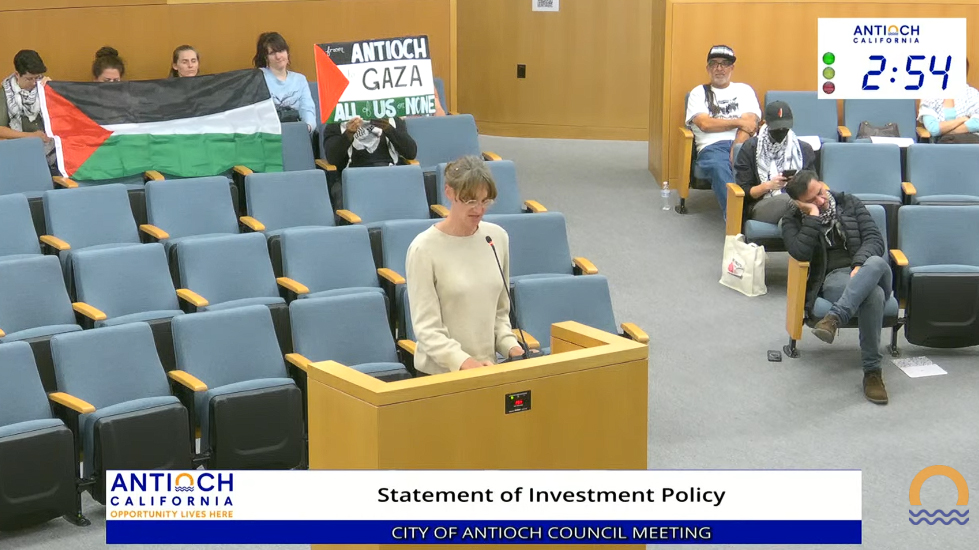
Just before midnight Tuesday, October 13, 2026, the Antioch City Council voted 4-0, with District 4 Councilwoman Monica Wilson absent, to extend the meeting that is usually to end by 11:00 p.m., until 1:00 a.m., to take up the matter of a proposed “Ethical Investing” policy that excludes certain industries and specific companies, because some of their products are used by Israel in Gaza. The proposals were developed by a work group that included City Treasurer Jorge Rojas, Jr., the City’s investment advisor, and three members of Contra Costa Divest, an activist group opposed to investing in oil, natural gas and coal, and more. But no decision was reached as council members said the proposed policy was too broad, they did not have enough information and shared concerns that it gave the City Treasurer too much power.
Proposed Policy Language
Under Section IV, entitled, “Ethical Investing”, the proposed policy includes the following language:
“It is the City’s objective to integrate socially responsible and ethical investing into investment decisions to the extent practicable and possible as a way to make a positive impact on human rights by minimizing potential investment exposure to abuses such as slavery, apartheid or genocide. The City will not invest in industries that are known to harm human health or the environment. Section VI outlines prohibited investments under this objective.
“Nothing in section VI shall restrict the City Treasurer from determining additional specific companies that do not comply with socially responsible and ethical investing. The City Treasurer will periodically review the City’s investment portfolio against current known facts and circumstances from trusted sources for any potential investments held that would not be considered socially responsible or ethical and notify the investment advisor to divest as soon as it is economically practical.
“Previously held investments that are not consistent with the criteria defined and prohibited in Section VI will be liquidated prior to maturity if and only if the sale would not result in a financial loss for the City. If the early sale would result in a financial loss to the City, the investment will be held until either (1) the time at which it can be sold without a loss or (2) until maturity.
Section VI, subsection 3. entitled “Socially Responsible and Ethical Investment Exclusions” includes the following proposed language:
“a. The City will not invest in any companies that produce alcohol for public consumption or tobacco products [defined by Bloomberg sectors: Beverages-Wine/Spirits, Brewery, Tobacco].
b. The City will not invest in any aerospace and defense companies, including those that produce or manufacture firearms, and ammunition, explosives, and military electronics [defined by Bloomberg sectors: Firearms & Ammunition, Explosives, Electronics-Military].
c. The City will not invest in any private prisons [defined by Bloomberg sector: Private Prisons].
d. The City will not invest in companies that produce or manufacture coal, oil and gas, oil and gas services and pipelines [defined by Bloomberg sector: Coal, Oil & Gas, Oil & Gas Services, Pipelines].
e. The City will not invest in these specific companies:
i. Chevron Corp
ii. Caterpillar Inc
iii. Lockheed Martin Corp
iv. BP PLC
f. Any companies the City Treasurer deems not socially responsible or ethical upon verification with trusted sources, and subsequently notified in writing to the investment advisor and approved by the City Council.”
The Council heard from the public and then discussed the matter.
Public Comments
All but one member of the public spoke in favor of the proposed City investment policy changes. Only this reporter, speaking as an Antioch resident, spoke against some aspects of the proposal.
I said, “First, this new, controversial investment policy should not be decided by the Council after midnight when most residents have already gone to bed and can’t participate. But if you’re going to make a decision tonight, I don’t think it’s unethical to invest in aerospace, such as SpaceX. What are they doing wrong? Nor is it unethical to invest in oil or gas which we all use every day, and specifically Chevron which directly employs 1,200 people at the refinery in Richmond and an additional estimated 1,800 contractors, some of which I’m sure live in Antioch. But guess what? They’re not here tonight to speak on this matter because they’re probably in bed already getting ready to go to work tomorrow.”
“As for Caterpillar…other than the fact their products are being used in Gaza, how can you blame a company for what others do with their products? Where does that start, where does that end?” I asked.
“Also, I would a add to the end of subsection ‘f.’ regarding giving the City Treasurer the power, to add the words, ‘and approved by the City Council.’ Because the current City Treasurer was not elected by the people with their knowledge that he would be given this much power or anybody. It should wait until after the next election if you’re going to apply that,” I concluded.
Council Discussion But No Decision
District 2 Councilman Louie Rocha was first on the dais to speak saying, “I’m impressed with where we are from our previous conversations. I’m happy to see there’s a working group come together. When I’m looking through the document the one question I have…it does seem somewhat of a subjective thought about the City Treasurer.”
“So, one individual is going to determine what we’re going to do as a City?” he asked.
Mayor Pro Tem and District 3 Councilman Don Freitas then said, “I have questions for Justin (Resuello from PFMAM the City’s investment advisor). Amended item number six. Defined by Bloomberg. We don’t have a copy.”
“As part of our…monitoring…we use Bloomberg terminals,” Resuello responded. “We want to make it very clear that Bloomberg…We’re trying to be very explicit and we’re using Bloomberg.”
“So, the United States of America is the largest manufacturer of weapons. So, with that, how can we invest in bonds?” Freitas asked.
“The United States is not a company,” Resuello responded.
“The government has contracts with all the companies that manufacture bombs and weapons,” the District 3 councilman pointed out.
“We could still invest in U.S. bonds because they’re not companies,” the investment advisor stated.
“Even though they invest, buy and distribute all war materials to Israel, in this case, it keeps coming up,” Freitas continued. “It’s peculiar to me that you can make a distinction between the two. That’s the problem I have with the policy. It’s so broad that if we’re going to be in compliance with it, it’s very clear the City won’t invest in any of these. I don’t know how you distinguish.”
City Finance Director Dawn Merchant said, “The government according to Bloomberg is not defined as an aerospace or defense company. It is a government agency.”
“I think you’re splitting hairs,” Freitas responded.
Regarding oil, coal and gas he said, “The United States leases our land.”
“To me, the policy is too broad,” he stated. “There’s nothing from Bloomberg attached here.”
“I’m absolutely opposed to the City Treasurer making decisions. He can make recommendations. It’s up to the City Council…to set policy,” Freitas continued. “That’s another very big issue I have.”
“I applaud the people who have gotten together. But it’s just too broad for me,” he said. “I like the language, ‘the City will not invest in industries that will harm health and the environment’.”
“You could change ‘F’ that whatever companies the Treasurer deems is unethical will bring back to the Council for discussion,” Merchant interjected but added, “It’s the elected City Treasurer’s role. It’s not the Council’s role.”
“I think that’s an improvement,” Freitas responded.
“That’s why I brought it up. That would have to be modified,” Rocha added.
“What kind of impact has such an investment policy had for other agencies?” Freitas asked Resuello.
“I couldn’t say these socially responsible investment policies…had a positive or negative result,” the investment advisor responded. “They are fee neutral.”
“Those portfolios have outperformed non-ESG portfolios over the last 10 years. But if you turn the clock back…non-ESG strategies outperformed ESG portfolios from say 2005 to 2020,” Resuello stated.
When pressed further on the difference by Freitas, he said, “Within one basis point.”
“So, one-one-hundredth. OK,” Freitas responded.
“There would be about an $11,000 loss if we sold one of the investments right now,” Merchant shared, speaking of the City’s investment in Lockheed Martin.
“It’s scheduled to mature in August 2028,” Resuello explained.
District 1 Councilwoman Tamisha Torres-Walker spoke next saying, “I guess what my brain is telling me at almost one in the morning. I guess what Mayor Pro Tem Freitas is saying is that we exist within a genocidal government that invests in the military industrial complex…that also sells weapons to other genocidal governments. It is a conundrum because we’re existing right now on stolen, colonized land. So, I can see how we can get to that conclusion. We are currently under a genocidal government. So, the argument would be what difference would this policy make if we are going to invest in America anyway when the American government consistently is investing in the military?”
“I support the policy as is, with the change, obviously around the Treasurer,” she stated then asked, “Things do have to come back to the Council as recommendations to make final, yes or no?”
“The City Treasurer has complete autonomy to make the decision with the investment advisor,” Merchant stated.
“The Treasurer is an elected official with these duties already. What we’re talking about is stripping the elected official of his duties. So, wouldn’t we need a completely different conversation about that?” Torres-Walker.
“Yes,” City Attorney Lori Asuncion responded.
“The Constitution of the State of California determines the duties of an elected City Treasurer,” Freitas said. “I don’t think we’re changing the Constitution of the State of California.”
Mayor Ron Bernal was the last council member to speak on the matter saying, “I’d like to thank everyone who was part of the discussion, city staff. I understand the importance of the genocide discussion and the claim. I guess the thing I’ve always had challenge with…if I look around the world…there are atrocities happening, now, not just in Gaza and by Israel.”
“The four…corporations that have been picked out, when there’s a list of many, many companies that provide weapons…all kinds of suppliers that supply Israel with…equipment, with all kinds of things,” he continued. “A U.N. report…2025…Human Rights Office database identified 158 companies involved in specified activities of Israel settlements. So, picking out four specific companies that are listed here, to me there are many companies that could have been listed, as well. I just believe that the list is too long and too broad to try to capture it for this purpose. I also agree…the City Treasurer should not have…to me, again, nothing towards Jorge. But anybody in that position it gives too much authority.”
“I’m not in support of changing our policy. I think we stay with what we currently have as a policy,” Bernal stated.
Merchant then proposed language for the City Treasurer clause.
“In section four it says, ‘nothing in section six restricts the City Treasurer.’ That would have to change because we’re doing exactly that,” Freitas stated.
Merchant responded with more defined language.
“It’s 12:51 so, it’s going to die without a second or die without a majority vote,” Torres-Walker said and made a motion to “approve the policy with the exceptions recommended by Finance Director Dawn Merchant.” But no one seconded the motion.
“Because I have hesitancy,” Freitas interjected. “It really is Lockheed. I’m willing to keep Lockheed there but delete the other three. I can live with that. I would like this to come back on a quarterly basis. I want to know if this will be the policy. My concern, it’s too broad…and there needs to be oversight. I’m willing to try for a year. But it needs to come back in a year.”
Bernal then mentioned the clause regarding, “not investing in industries that are known to harm human health or the environment.”
“I’m willing to support your recommended changes,” Torres-Walker said to Freitas.
Merchant said what Bernal quoted is a broad description.
But he reiterated, “In industries that are known to harm human health or the environment. That includes pretty much everything. I’d like to strike that statement. It’s too broad.”
“My concern is it’s too broad,” Freitas reiterated. “The committee has worked this far. I’d say, ‘go back’. This is the first time the council has heard it. I’m not sure this is right for primetime. I think, really, you need to go back, and various members of the council, I don’t think you’re going to get a second or three votes of council, right now.”
“I think it needs to come back with what the Bloomberg directions are,” he added.
“I’d like to see the specific statutory, what the City Treasurer can and can’t do under state law…what the responsibilities the Treasurer has” Bernal added.
With no other motion the council ended discussion of the matter.
See agenda item with proposed Statement of Investment Policy.
The meeting adjourned at 12:59 AM.
the attachments to this post:
Statement of Investment Policy ACC101326 screenshot