Hoops for Troops Antioch Family Night with Delta Veterans Group at the Warriors Nov. 12
Tuesday, October 26th, 2021










Source: BART
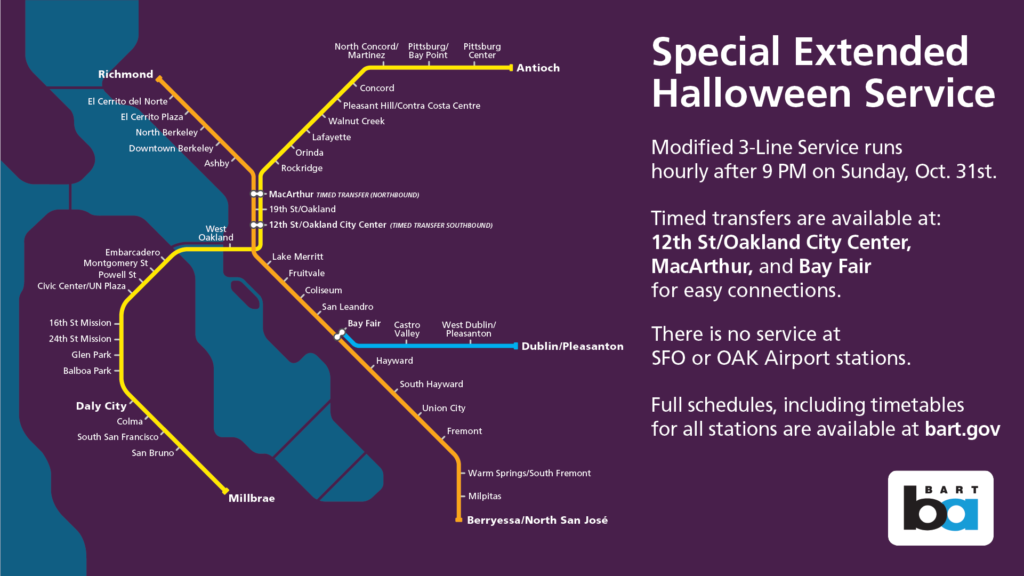
In anticipation of what is likely to be a high-ridership weekend BART will be offering special hourly late-night service on Sunday, October 31, 2021, beyond 9 pm.
Late night service will be a huge benefit for those who will be celebrating Halloween or attending the final day of the Outside Lands concert in San Francisco.
Details of special hourly service after 9pm on Sunday October 31
We will operate one transbay 10 car train an hour which will be timed to meet up with two other trains across the system to serve 48 out of our 50 stations. Trains will not serve the airport stations (OAK and SFO) but will stop at all other stations.
Extended service details:
Please note, this service will be operated using train operators taking voluntary overtime shifts and therefore it is subject to availability. BART will also ask for volunteer shifts to add event trains to the schedule to have even more service after 9pm. These trains could be brought in as large crowds for Outside Lands arrive at Civic Center Station after 9pm. But these extra trains will be subject to available train operators.
BART is in the process of adding these trips to the BART Trip Planner. We will make the special schedule available to third party apps, but we can’t guarantee third party apps will upload the special service schedule. All added trips will show up in Real Time Departures on bart.gov and the official BART app.
Background on midnight service and why we currently close at 9pm on Sundays
BART has been offering service until midnight Monday through Saturday since August 2, but those extended hours have not been in place on Sundays. BART has already committed to bringing midnight service back to Sundays permanently in February 2022.
BART service has been operating only until 9pm on Sundays throughout the pandemic. BART has used the earlier closing time on Sundays to advance critical rebuilding projects including the replacement of traction power cables in the heart of downtown San Francisco to ensure trains have a reliable source of electricity.
More Halloween Fun
Check out our BART themed pumpkin carving stencils.
On Thursday, October 28, 2021, the BART Police Department will be hosting its annual Trunk or Treat Halloween event at the North Berkeley BART Station parking lot between 4-7 p.m. Children can trick or treat in a safe environment.

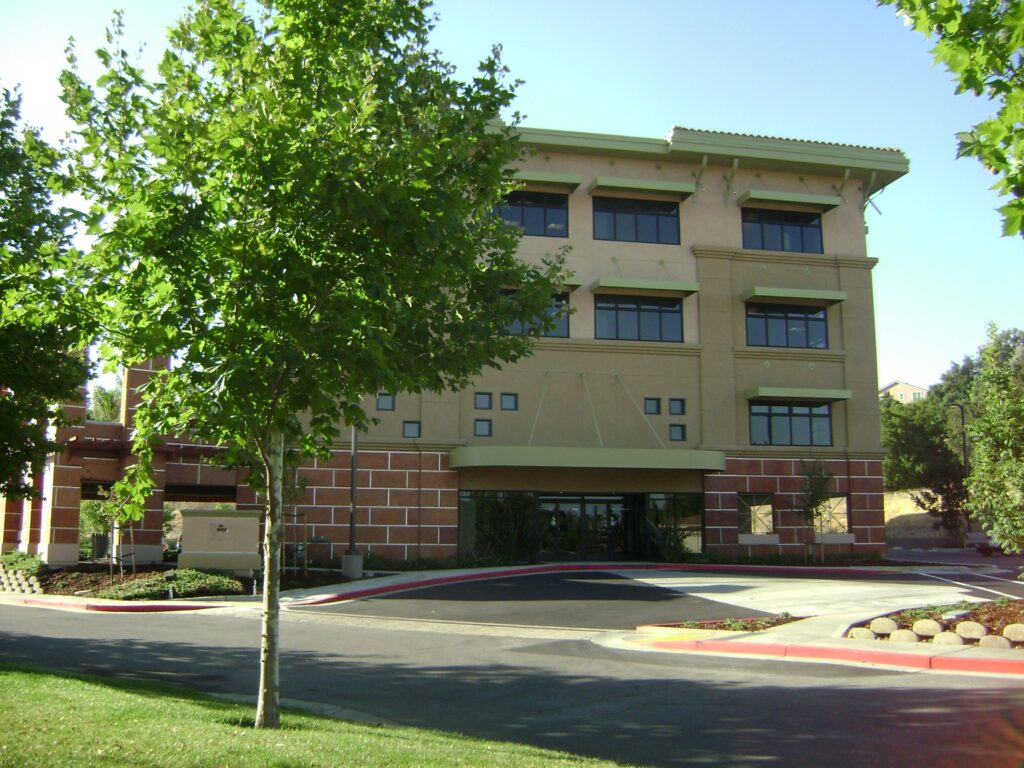
Th building at 3454 Hillcrest Avenue which houses the Antioch location for Kaiser Permanente’s Department of Mental Health and Addiction Medicine. Source: Kaiser
By Antonia Ehlers, PR and Media Relations, Kaiser Permanente Northern California
Kaiser Permanente’s Department of Mental Health and Addiction Medicine at their location on Hillcrest in Antioch is currently celebrating its 10th year of service. Mental health services are more important than ever, especially since the COVID-19 pandemic.
“We’ve definitely noticed an uptick in patients accessing our services,” said Director of Addiction Medicine Curtis Arthur, MFT. “Everybody is dealing with increased stress. People often turn to various substances to deal with that stress. It’s so important to engage in care during this very difficult time.”
It can be scary and intimidating to ask for help. However, Arthur and his team assure people of this: They meet people of all ages where they are, without judgment.
“Treatment for addiction can range from educational therapy to intensive therapy,” Arthur noted. “We know that the disease of addiction affects not only individuals, but also the family members who care about that person. We educate those family members and connect them to others who are affected in the same way.”
During the past year and a half, virtual appointments have significantly increased.
“Virtual care has made things so much more accessible,” Arthur said. “We are offering the latest technology and expertise, so patients can choose how and when they want to access their care.”
One of the key advances in recent years is the ability to diagnose various mental health conditions earlier and more accurately. According to the Director of Mental Health at Kaiser Permanente Antioch, Natasha Quackenbush, Psy.D , the demand for mental health services continues to grow, year after year.
“We’re encouraged that more and more people are reaching out for help, particularly because of the COVID-19 pandemic,” she said. “We’re also seeing more people from various community groups – particularly African American, Asian and Latino communities – reach out for help.”
Every person’s needs are unique and every Kaiser Permanente member who seeks support receives a care plan tailored to their mental and physical needs, drawing on a range of available services. A patient’s individual treatment could include outpatient psychiatric services, individual therapy, group programs, medication management, crisis intervention, intensive outpatient programs, and inpatient psychiatric care.
“It’s wonderful that as a society today, we are making progress to destigmatize mental health issues,” Quackenbush added. “They are, in fact, medical conditions. We don’t judge, because it would be the same as judging someone who has cancer or diabetes. There is hope. Mental health conditions can be treated, and our dedicated clinicians genuinely want to make a difference in our patients’ lives.”
For more information about Kaiser Permanente Mental Health Services, visit www.kp.org/mentalhealth

Source: PG&E
 SAN FRANCISCO, CA – Pacific Gas and Electric Company’s (PG&E) Emergency Operations Center and hundreds of crews continue assessing damage, making needed repairs and restoring power in the aftermath of a major atmospheric river storm that delivered damaging winds, record rain totals, flooding and debris flows over the course of the weekend and Monday. The storm was one of the most potent to hit Northern and Central California in over a decade.
Since the storm began early Sunday, approximately 630,000 customers lost power which is about 10% of the utility’s 5.5 million electric customers.
As of 5 p.m. Monday evening, power has been restored to approximately 92% or 580,000 of those customers. Approximately 50,000 customers remain impacted.
PG&E continues to respond with approximately 3,000 electric and tree personnel on the job, including distribution and transmission line crews and troublemen and women, who are the utility industry’s first responders to an outage. Hundreds more employees are staffing the storm centers, performing safety duties, delivering needed equipment to PG&E yards and more.
While crews were pre-positioned to be in key locations in advance of the storm, they are now being moved and redeployed to the hardest areas of damage such as Sonoma, San Mateo and Santa Clara counties which were ground zero for much of the damage.
Mutual Aid assistance crews from San Diego Gas & Electric are expected to arrive Tuesday.
Record Rain and Wind
The record-breaking rain combined with strong winds produced the most storm-related impact seen in the PG&E territory in the month of October dating back to 2009. Downtown Sacramento at 5.44 inches broke a rainfall record that dated back to 1880. Blue Canyon received 10.4 inches of rainfall surpassing a record that dated back to 1964. Mount Tamalpais received 17 inches of rain. The strongest wind gust recorded was 92 mph in Alameda County. There were a number of other gusts that exceeded 70 mph across Contra Costa, Santa Clara, Marin, Plumas, Placer, San Mateo, Butte, and Napa counties.
PG&E’s stand is simple, that everyone and everything is safe. With that in mind, crews will continue to work overnight Monday and into the week until all customers are restored.
Keeping Customers Informed
While the storm has moved out of many areas, it is still impacting areas like Fresno, Bakersfield and San Luis Obispo.
PG&E knows how important it is to keep its customers informed. Customers can view real-time outage information on its website outage center and search by a specific address, by city or by county. This site has been updated to include in-language support for 16 languages.
Additionally, customers can sign up for outage notifications by text, email or phone. PG&E will inform customers about the cause of an outage, when crews are on their way, the estimated restoration time, and when power is restored.
Storm Safety Tips
Other tips can be found at www.pge.com/beprepared.
About PG&E
PG&E, a subsidiary of PG&E Corporation (NYSE:PCG), is a combined natural gas and electric utility serving more than 16 million people across 70,000 square miles in Northern and Central California. For more information, visit pge.com and pge.com/news.

 The Association of Bay Area Governments (ABAG) and the Metropolitan Transportation Commission (MTC), during their joint meeting Thursday evening, Oct. 21, 2021, unanimously adopted Plan Bay Area 2050 and its associated Environmental Impact Report. The unanimous votes by both boards cap a nearly four-year process during which more than 20,000 Bay Area residents contributed to the development of the new plan.
All six representatives from Contra Costa County, including Supervisors Candace Andersen and Karen Mitchoff, Richmond Mayor Tom Butt and San Ramon Councilman Dave Hudson, who serve on ABAG, as well as Supervisor Federal Glover and Contra Costa City Representative Amy Worth, Mayor of Orinda, who serve on MTC, voted to adopt the plan.
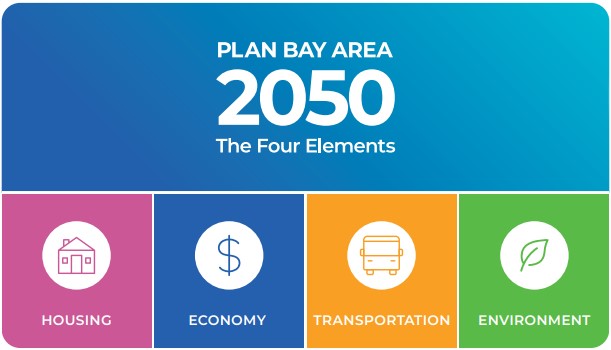
Defined by 35 strategies for housing, transportation, economic vitality and the environment, Plan Bay Area 2050 lays out a $1.4 trillion vision for policies and investments to make the nine-county region more affordable, connected, diverse, healthy and economically vibrant for all its residents through 2050 and beyond. From housing strategies that would produce more than 1 million new permanently affordable homes by 2050 to transit-fare reforms that would reduce cost burdens for riders with low incomes and paths to economic mobility through job training and a universal basic income, the goal of a more equitable Bay Area is interwoven throughout the plan. With a groundbreaking focus on climate change, strategies also are crafted for resilience against future uncertainties, including protection from hazards such sea-level rise and wildfires.
It is a long-range plan charting the course for the future of the nine-county San Francisco Bay Area. Plan Bay Area 2050 will focus on four key issues—the economy, the environment, housing and transportation—and will identify a path to make the Bay Area more equitable for all residents and more resilient in the face of unexpected challenges. Building on the work of the Horizon initiative, this new regional plan outlines strategies for growth and investment through the year 2050, while simultaneously striving to meet and exceed federal and state requirements. The Metropolitan Transportation Commission and the Association of Bay Area Governments are expected to adopt Plan Bay Area 2050 in fall 2021.
“Plan Bay Area 2050 reflects a shared vision that can’t be implemented by any single agency,” explained ABAG Executive Board President and Berkeley Mayor Jesse Arreguín. “To bring all these strategies to fruition will require ABAG and MTC to strengthen our existing partnerships and to form new ones — not just with our cities and counties and the state government, but also with the federal government, businesses and nonprofits.”

What will Plan Bay Area 2050 do? What won’t it do?
Plan Bay Area 2050 outlines a roadmap for the Bay Area’s future. While it pinpoints policies and investments necessary to advance the goal of a more affordable, connected, diverse, healthy and vibrant Bay Area, Plan Bay Area 2050 neither funds specific infrastructure projects nor changes local policies. Cities and counties retain all local land use authority. Plan Bay Area 2050 does identify a potential path forward for future investments – including infrastructure to improve our transportation system and to protect communities from rising sea levels – as well as the types of public policies necessary to realize a future growth pattern for housing and jobs.
Ultimately, Plan Bay Area 2050 reflects a shared vision – one that cannot be implemented by any single organization or government agency. Only through partnership with local, state and federal governments – as well as with businesses and non-profit organizations – will the Plan’s vision come to fruition. Before the Plan is adopted in 2021, MTC and ABAG, along with partner organizations, will create an implementation plan that will advance the strategies outlined in Plan Bay Area 2050.
MTC Chair and Napa County Supervisor Alfredo Pedroza acknowledged the work ahead. “Building and preserving affordable housing. Adapting to sea level rise. Getting more people closer to their jobs and more jobs closer to the people. Sharing prosperity equitably. All of these are big lifts. But the new plan can serve as a north star for the Bay Area’s journey to 2050.”
Among the features that distinguish Plan Bay Area 2050 from previous regional plans is an associated Implementation Plan that details the specific actions ABAG and MTC can take in the next five years to put the new plan into action.
“The Implementation Plan is a commitment to do hard things, not just think about them,” said ABAG-MTC Executive Director Therese W. McMillan. “Even if these steps have to be taken incrementally, they will lead us to a more equitable and resilient Bay Area.”
Housing Strategies
Costs for housing are estimated at $468 billion, with $237 billion budget to preserve existing affordable housing by acquiring “homes currently affordable to low- and middle-income residents for preservation as permanently deed-restricted affordable housing”. An additional $219 billion is budgeted for new, deed-restricted affordable housing and $2 billion to “further strengthen renter protections beyond state law” by limiting “annual rent increases to the rate of inflation, while exempting units less than 10 years old.”
Economic Strategies
The total cost for economic strategies in the plan is $234 billion. Of that amount $205 billion is budgted to “Implement a statewide universal basic income” and “provide an average $500 per month payment to all Bay Area households to improve family stability, promote economic mobility and increase consumer spending.”
Transportation Strategies
The plan projects to spend a total of $578 billion is projected to be spent on transportation over the next 20 years, with most of that, $389 billion, to “restore, operate and maintain the existing system”. An additional $81 billion will be spent to “expand and modernize the regional rail network” to “better connect communities while increasing frequencies by advancing the Link21 new transbay rail crossing, BART to Silicon Valley Phase 2, Valley Link, Caltrain Downtown Rail Extension and Caltrain/High-Speed Rail grade separations, among other projects.” The third largest budget item for transportation is $32 billion to “enhance local transit frequency, capacity and reliability. Improve the quality and availability of local bus and light rail service, with new bus rapid transit lines, South Bay light rail extensions, and frequency increases focused in lower-income communities.”
Environmental Strategies
A total of $108 billion is programmed for Environmental Strategies. The largest portion of that is $30 billion to “modernize and expand parks, trails and recreation facilities”. An additional $19 billion is budgeted to “adapt to sea level rise” by protecting affected “shoreline communities…prioritizing low-cost, high-benefit solutions and providing additional support to vulnerable populations.
In addition, the plan includes $18 billion to “fund energy upgrades to enable carbon neutrality in all existing commercial and public buildings” through “electrification and resilient power system upgrades”, and another $15 billion to “provide means-based financial support to retrofit existing residential buildings.” To “protect and manage high-value conservation lands”, an additional $15 billion is included in the plan.
The adopted final Plan Bay Area 2050, the EIR, and all the supplemental reports accompanying the new plan are available online at planbayarea.org/finalplan2050.
ABAG is the council of governments and the regional planning agency for the 101 cities and towns, and nine counties of the Bay Area. MTC is the transportation planning, financing and coordinating agency for the nine-county San Francisco Bay Area.

By Arts and Culture Commission of Contra Costa County
 Measure X is Contra Costa’s new countywide half-cent sales tax. The Measure X Community Advisory Board was formed to identify unmet community needs and recommend spending priorities to the Board of Supervisors. The Measure X Community Advisory Board recommended funding for the Arts and Culture Commission to the Board of Supervisors. At the Nov. 2nd meeting, Supervisors will be making final recommendations.
The current Contra Costa County $31,000 grant match budget is only a $.06 per person investment: Napa $3.55, Solano $2.19, Santa Clara $0.92, and Alameda County $0.54.
Please support signature programs that provide services to Contra Costa County: Arts and Culture Prospectus of Contra Costa County, ABOUTFACE, Poetry Out Loud, Youth Advisor, Jump StArts California Arts Council grant, Impact Projects California Arts Council grant, Art Passages, and more!
Transformational ideas include:
Ask: $625,000 at $.54 per resident!
District locator: https://www.contracosta.ca.gov/5715/Supervisor-Who-Represents-Me
Please send email by Nov. 2nd!
Sample email: The arts are important to me and to my community. Please increase funding for the arts in Contra Costa County from $31,000 to $625,000 annually. This will help the Arts and Culture Commission demonstrate support for the arts to be competitive for national and state grants. This will support signature programs that directly impact all communities including our youth to Veterans. It will help provide public art programs in each district, a Community Art Fund, a youth advisor in each district, an Artist-In-Residency in the School pilot program, the Arts Connection and Build Structures initiative and other great programs. It will help our County stabilize arts funding and be able to plan equitably for the future. Thank you.
Let’s build an arts foundation for Contra Costa County!
Source: CCC Public Works
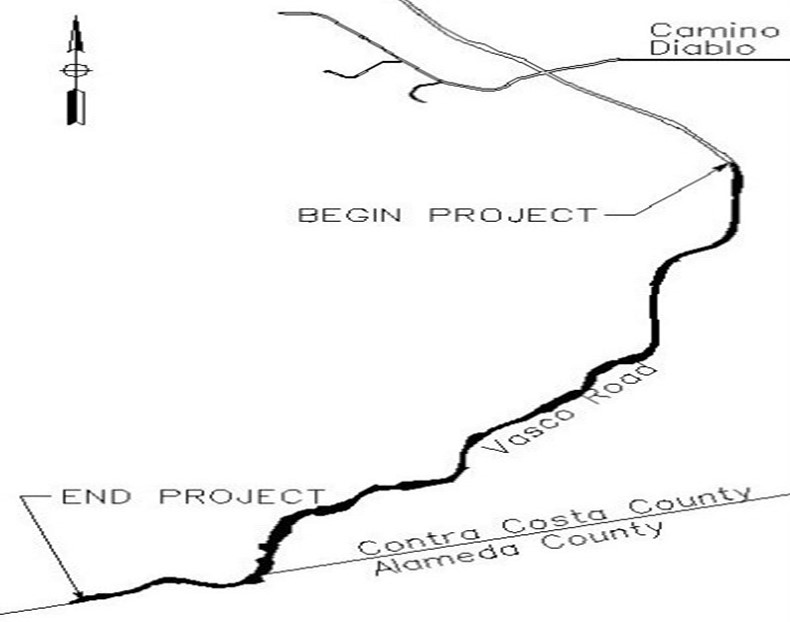
Contra Costa County Public Works Department will clean-up debris and replace delineators to enhance safety on Vasco Road. The work will occur approximately 1 mile south of the Camino Diablo/Vasco Road intersection to the Alameda County Line, a length of approximately 7.5 miles, and will include a rolling lane closure. The work is scheduled for Monday, November 1, 2021 through Thursday, November 4, 2021, barring unforeseen circumstances. Work will take place between 9:00 a.m. – 4:00 p.m., weather permitting. Drivers should expect delays. Message boards will be placed in advance to advise drivers of work and expected delays. This is essential work required for the public’s safety.
Hoops for Troops Antioch Family Night with Delta Veterans Group at the Warriors Nov. 12
Tuesday, October 26th, 2021Free Holy Eve Community Carnival at Grace Bible Fellowship in Antioch Sunday, Oct. 31
Tuesday, October 26th, 2021Kaiser Permanente’s Antioch Mental Health Services celebrates 10 years at Hillcrest location
Tuesday, October 26th, 2021PG&E crews respond to damage, power outages from atmospheric river storm
Monday, October 25th, 2021ABAG, MTC adopt final Plan Bay Area 2050 and Environmental Impact Report
Monday, October 25th, 2021










© 2026 Antioch Herald - Entries (RSS) - Comments (RSS) - Log in
Theme design by Christian Gnoth - 