Transportation authority to hold Telephone Tall Hall meeting for public input on tax measure Wed., Aug. 8
Monday, August 5th, 2019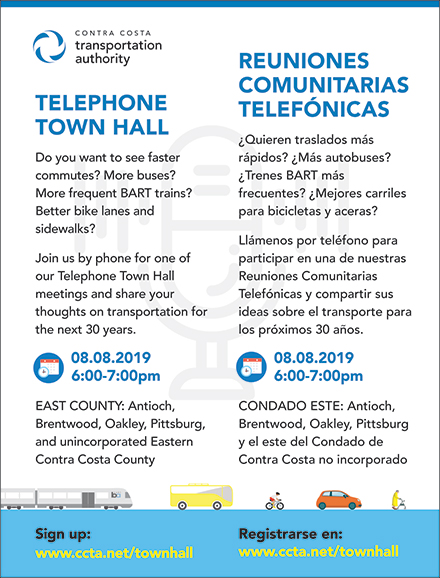








In 2018, voters passed Regional Measure 3 (RM3) which increased bridge tolls in the Bay Area and also established an Independent Oversight Committee. Each of 9 Bay Area counties appoint two members to the Committee. The Contra Costa County Board of Supervisors is seeking two members of the public to serve.
The RM3 Independent Oversight Committee (oversight committee) will be established by the Bay Area Toll Authority (BATA) pursuant to Senate Bill 595 (which placed RM 3 on the ballot). The purpose of the Oversight Committee is to ensure that any toll revenues generated pursuant to the RM3 toll increase are expended consistent with the applicable requirements of the RM3 expenditure plan set forth in Streets and Highways Code Section 30914.7. The Oversight Committee shall annually review the expenditure of funds by BATA for the projects and programs specified in Section 30914.7 and prepare and submit a report to the transportation committee of each house of the Legislature summarizing its findings.
An individual interested in serving on the Committee must be a resident of Contra Costa County and meet the Streets and Highways Code Section 30923 (h) (3) restrictions below:
The RM3 Oversight Committee is subject to open public meetings (The Brown Act). Meeting dates, frequency, and length of meetings will be established by the members of the committee. The location of meetings will be in San Francisco at the Bay Area Metro Center. BATA anticipates a stipend to members for meeting attendance. The term length for representatives is four years, and each representative is limited to two terms.
Applications are available online at https://www.contracosta.ca.gov/3418 or by contacting the Clerk of the Board’s Office at (925) 335-1900 or clerkoftheboard@cob.cccounty.us. Completed applications are due by 5 PM on August 9, 2019, and may be completed and submitted online, emailed to the Clerk of the Board of Supervisors, mailed or submitted to 651 Pine Street, Room 106, Martinez, CA 94553.
 CalTrans Sustainable Communities Planning Grant
The Contra Costa Transportation Authority (CCTA) won a Caltrans SB1 Sustainable Communities Planning Grant valued at $755,000 to support a study that will evaluate new transit options between the cities of Antioch and Brentwood in East Contra Costa County.
The East County Integrated Transit Study will guide the development of a plan for providing fast, frequent, high-capacity transit connections between Antioch and Brentwood that will directly integrate with existing local and regional services such as the Antioch BART station and Tri Delta Transit local bus service. The study will also look at improving connections to Capitol Corridor and ACE rail services, as well as proposed future ferry service between Antioch and Martinez. As part of its commitment to sustainable communities, CCTA will focus on new, zero-emission public transit options for potential outcomes of the study.
“Now that Highway 4 has been modernized to improve access to Eastern Contra Costa, I am pleased that we were successful in obtaining these funds to plan for a future that provides more transportation options to support economic growth and mobility for our residents,” says California Assemblymember Jim Frazier.
“We’re always looking for opportunities to harness new transit technology that can integrate with existing systems to create a smart, efficient network that easily connects people to their desired destinations,” explains CCTA Executive Director Randell Iwasaki. “This grant will enable us to expedite a much-needed study that will guide valuable transit improvements for Eastern Contra Costa County.”
“CCTA is a forward-looking organization,” states Bob Taylor, Mayor of Brentwood and Contra Costa Transportation Authority Board Chair. “I’ve always predicted a bright future for Eastern Contra Costa County and this grant win lays the foundation for the communities along Highway 4 to connect, grow, and prosper.”
 Will hire 19 more police officers, four fare inspectors
The BART Board of Directors has approved a $2.3 billion budget for Fiscal Year 2020 (FY20) which begins July 1, 2019. The budget focuses on expanding and investing in Quality of Life issues, including the addition of 19 police officers and four unarmed fare inspectors.
“This budget is designed to make BART safer,” said BART Board President Bevan Dufty. “Adding officers and establishing a community ambassador program shows our riders that we’ve heard their concerns and we’ve taken action.”
Quality of Life
Including funds added in FY20, since FY14 BART has spent $59 million on new budget initiatives addressing Quality of Life challenges in the areas of safety, fare evasion prevention, cleanliness and homelessness. The FY20 budget supplements and continues Quality of Life initiatives added in prior years. Among the highlights:
System reinvestment
The new budget dedicates $1.4 billion for capital programs, a 5% increase from FY19 with the largest portion (46%) coming from Measure RR funds. The use of Measure RR funding for FY20 is increasing as projects anticipate moving from design and pre-engineering to construction. Most of the capital budget (69%) is directed to reinvestment in the system. The use of previously awarded and current federal funds has increased as BART ramps up on train control modernization, state of good repair projects and continues the delivery of new rail cars. FY20 projects include:
Revenue and ridership challenges
The FY20 budget is balanced and includes $17 million in budget cuts made by all departments in the district.
Fare revenue is BART’s largest source of revenue, with $479 million of rail fare revenue forecast in FY20, a decrease of $5.6 million from FY19, reflecting a lower ridership forecast. Other operating revenue is forecast to be $10 million lower due to one-time revenues in FY19 not budgeted in FY20. These decreases are offset by increases in financial assistance, particularly sales taxes. Sales taxes are BART’s largest form of financial assistance budgeted at $277 million for FY20 a 3.2% growth over FY19
We take a conservative approach to projecting ridership for our FY20 budget. We are concerned about the length of this current economic expansion and the potential for a downturn in the future, which could impact ridership.
Service improvements
The budget includes funding for service enhancements that will ease crowding. Most notably, by February of 2020 we expect to have 160 Fleet of the Future train cars which will allow us to run all 10-car trains on the four Transbay routes. As we increase the number of Fleet of the Future cars, we will begin retiring legacy cars, which should increase reliability and reduce maintenance costs.
Silicon Valley Berryessa Extension fares
Along with approving the FY20 budget, the BART Board of Directors voted unanimously to establish a fare structure for the Silicon Valley Berryessa Extension. BART’s existing distance-based fare structure will be used to calculate trip fares on the 10-mile extension from the Warm Springs/South Fremont Station to Berryessa Road in San Jose. This is in accordance with the comprehensive agreement between BART and the Valley Transportation Authority. The extension includes stops in Milpitas and Berryessa/North San Jose.
Ambassador program
Though not part of the FY20 budget, $500,000 in additional anticipated revenue from the FY19 budget will be set aside to fund an ambassador pilot program. BART is in talks with the Metropolitan Transportation Commission to seek matching funds for the program.
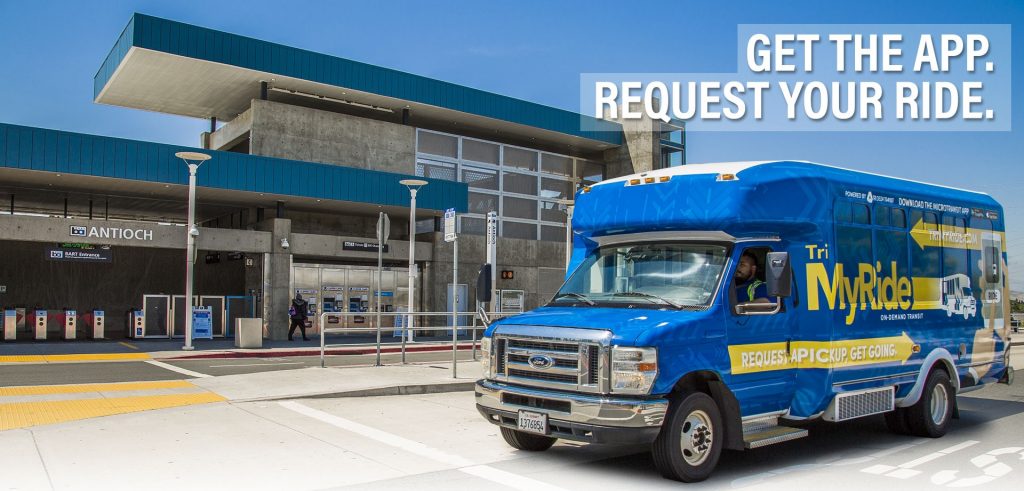
The new Tri MyRide will take riders to and from the Antioch and Pittsburg-Bay Point BART Stations or nearby destinations. Photo from TriMyRide.com
Eastern Contra Costa County Transit Authority (Tri Delta Transit) is excited to announce the launch of Tri MyRide, a flexible and dynamic on-demand shuttle service operating in neighborhoods near the Antioch BART Station and Pittsburg Bay Point BART Station. This six-month pilot program shuttle service begins operation today, Monday June 17. Tri MyRide operates Monday thru Friday from 5am to 8pm.
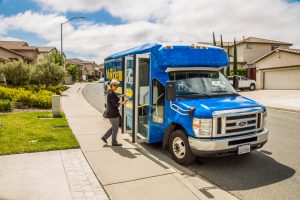
Photo by TriDeltaTransit.
Similar to ride-hailing services, Tri MyRide uses a smartphone app for riders to schedule customized curb-to-curb trips. Tri MyRide allows riders to plan their customized trips anywhere in the Hillcrest/Antioch BART service area or San Marco/Pittsburg Bay Point BART service area to BART or to a designated point of interest located in the service area. The app, known as Microtransit by TransLoc, is connected to proprietary software that allows bus operators to pick-up and drop-off passengers in an efficient manner.
The service uses small, neighborhood-friendly shuttle buses that easily maneuver on residential streets. Tri MyRide operators undergo the same background screening as other Tri Delta Transit operators, and all vehicles are equipped with surveillance cameras to ensure safe transport. The shuttle buses are wheelchair accessible and accommodate people with disabilities.
The cost to ride is only $2.00 per trip. Payment may be made through the Microtransit app or with cash. The low-cost makes Tri Delta Transit’s Tri MyRide more affordable than traditional ride-hailing services, which could cost riders at least more than three times the amount for a similar trip.
“By partnering with technology companies, Tri Delta Transit is meeting the evolving needs of passengers in our community. Tri MyRide allows our agency to provide on-demand service from the convenience of a smart phone app.” said Chief Executive Officer Jeanne Krieg.
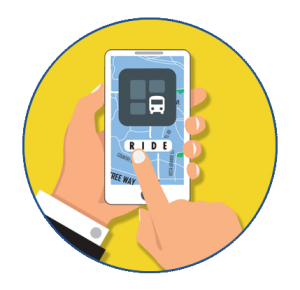
The service requires using the Microtransit app on your smartphone.
HOW IT WORKS
The six-month pilot program is being implemented in partnership with Tri Delta Transit and TransLoc, a Ford Smart Mobility Company. To use this new ride share program, passengers located within the service area first download the free Microtransit by TransLoc app to their smartphone and request a ride. Following a Tri MyRide request, the Microtransit app will provide passengers with an estimated pick-up time, track their bus in real-time, and alert them when the ride is about to arrive. Passengers are also notified when their ride is about to reach their destination.
Tri Delta Transit is one of the innovative transit agencies throughout the nation piloting microtransit technology. The new microtransit services are intended to complement existing public transportation services. By providing flexible, on-demand transportation services, transit agencies are bringing improved mobility and greater accessability to the communities they serve.
ABOUT TRI DELTA TRANSIT
Tri Delta Transit provides over 3,000,000 trips each year to a population of over 250,000 residents in the 225 square miles of Eastern Contra Costa County. They currently operate 15 local bus routes Monday – Friday, four local bus routes on weekends, door-to-door bus service for senior citizens and people with disabilities, on-demand rideshare services and shuttle services to community events. To learn more, visit TriDeltaTransit.com.
ABOUT TRANSLOC
TransLoc is the maker of mission-critical transit operations solutions for flexible on-demand and fixed route systems for both public and private transit agencies, and university and business campus transit systems. TransLoc is the largest provider of agency-owned microtransit systems for municipal transit agencies in the U.S., with the company’s products used at more than 400 agencies. To learn more, visit TransLoc.com.
For additional information about Tri MyRide, please visit TriMyRide.com.
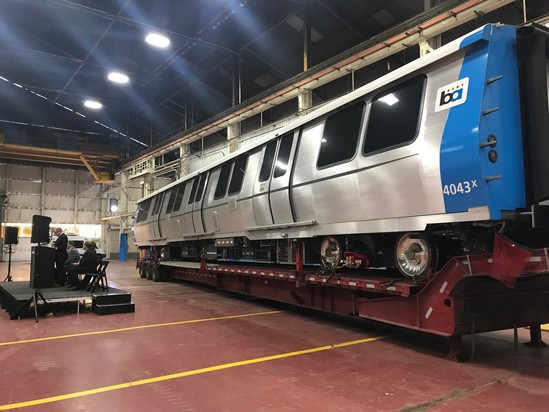
Fleet of the Future BART car at the Pittsburg assembly plant during the recent press conference. Photo by BART.
Bombardier Transportation announced it is opening a rail car assembly site in Pittsburg, California to assemble BART’s Fleet of the Future rail cars. This work, which is currently taking place in upstate New York, will be transferred to the Bay Area over the coming months.
The new facility will employ local workers, contribute tax dollars to the local economy and, thanks to its proximity to BART’s Hayward Test Track, greatly reduce the vehicle emissions needed to transport the cars to BART property.
What used to be a 3,600-mile journey home to the Bay Area, will now be a quick 50 miles.
It also means local jobs.
“It’s Bay Area workers building cars for Bay Area commuters,” said BART Director Mark Foley. “Bringing the work home.”
Riders are giving the new trains high marks for its new features and design. The customer survey results were unveiled at a recent Board meeting. The vast majority of features received at least 85 percent “Excellent” or “Good” grades.
Some of its most well-received features were the ease of on-board and off-boarding the train; lighting; audio announcements; floor-to-ceiling poles; comfortable air temperature; and digital displays.
BART’s website dedicated to the Fleet of the Future has lots of great information about the status of the roll out. They keep it updated with the number of new cars delivered to date and the number in service.
A Fleet of the Future tracker is in the works that will show you if one of the next approaching trains at your stations is a new train. That feature will roll out in phases, to eventually include digital platform signs, bart.gov, and the BART Official App, which you can download for free.
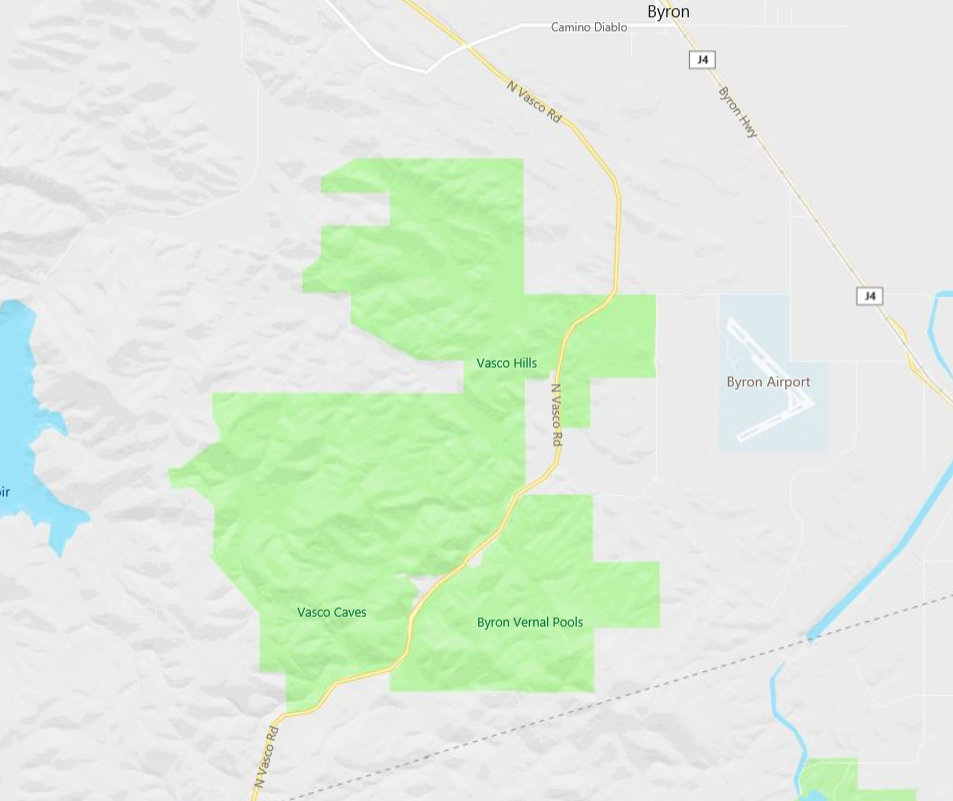
The Contra Costa County Public Works Department will repair guardrails on Vasco Road from Camino Diablo Road to the Alameda County line. The work will occur from June 3rd – June 6th between the hours of 9:00 a.m. and 4:00 p.m.
The work may be rescheduled based on weather conditions. Electronic message boards will alert drivers of the scheduled work. There will be traffic control through the work area and drivers can expect delays.
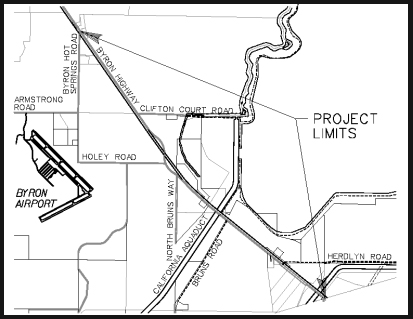
Contra Costa County Public Works will begin construction on the Byron Highway Traffic Safety Improvements Project. The project consists of an asphalt overlay on Byron Highway between Byron Hot Springs Road and the Alameda County line, restriping the centerline to feature double yellow no-passing lines and a centerline rumble strip, and replacing striping and pavement markings. Additionally, all signs along Byron Highway will be replaced to meet new reflectivity standards. The total project length is approximately 3.8 miles.
Construction will begin on Wednesday, June 5, 2019, with completion in late July 2019, barring unforeseen circumstances. Work hours will generally be in the evening from 7:00 pm to 6:00 am to minimize impacts to commute traffic. Drivers can expect delays of up to 15 minutes during construction.
Funding for this project is provided by the Highway Safety Improvement Program, and gas tax revenues provided by the SB1 Road Repair and Accountability Act. More information for this project can be found at http://www.cccounty.us/pwdmap.
Transportation authority awarded $755,000 to plan future transit between Antioch and Brentwood
Tuesday, July 16th, 2019BART Board approves $2.3 billion budget prioritizing safety and quality of life
Tuesday, June 18th, 2019Tri Delta Transit launches on-demand shuttle service to BART stations, nearby destinations
Monday, June 17th, 2019Byron Highway safety improvements construction to begin June 5
Sunday, June 2nd, 2019









© 2026 Antioch Herald - Entries (RSS) - Comments (RSS) - Log in
Theme design by Christian Gnoth - 