



Archive for the ‘Transportation’ Category

BART schedule change begins today Monday, February 10, 2020

Monday, February 10th, 2020
BART adjusted train schedules, today February 10, 2020 to improve service. The new schedule impacts all lines to some degree, especially first and last trips of the day. Some lines will see service start earlier and some will start a little later. Most changes are small tweaks and will adjust departures and arrivals by only a few minutes, but there are some more significant changes.

Major improvements include the return of two-line service into San Francisco on Sunday, the addition of Fleet of the Future trains on Saturday, earlier weekday train service for many riders, increased peak service for Concord riders in the morning and evening, and later evening direct service from San Francisco into Warm Springs.

Many of our riders plan their arrival times around the specific train they want to catch. We want to make sure all of our riders know about these adjustments in advance, so they are not caught by surprise. Train times have shifted by a few minutes throughout the day.

The new schedule is now available on our Trip Planner  and on the BART (Official) App when you plan a trip on or after 2/10. Also, PDF’s of the current and new schedule timetables can also be found here.

Highlights of service changes:

Weekdays

  • Morning peak-period trains that previously originated or turned back at Pleasant Hill will now originate/turn back at Concord, allowing BART to better serve more riders on this busy line by returning extra service to Concord. In September 2015, BART changed its schedule and these trains went from starting at Concord to starting at Pleasant Hill. Over the years, morning riders looking to target these short run trains because they were less crowded, shifted their origin station to Pleasant Hill. These riders may now opt to begin their trip at Concord once again. Pleasant Hill will still be served by the same number of trains in the morning, but many of them will no longer originate at the station. 3 trains will originate at Pleasant Hill in the 6 am hour. Some PM commute trains will also end at Concord instead of Pleasant Hill. Riders will no longer see “Pleasant Hill” trains on the platform signs, instead they will be “Concord” trains.
  • The first trip from Richmond to Warm Springs (Orange Line) will leave Richmond at 5:04 am—17 minutes earlier than before.
  • The 5:00 am northbound train from South Hayward is now a Warm Springs/Richmond (Orange Line) train to Richmond instead of a Warm Springs/Daly City (Green Line) train to Daly City.
    • Passengers heading to San Francisco will need to use Dublin/Pleasanton to Daly City (Blue Line) or Antioch/SFO (Yellow Line) trains for the first San Francisco arrivals, arriving in San Francisco 8 minutes later.
  • Service to San Francisco from Warm Springs will be earlier with the first Warm Springs/Daly City (Green Line) train departing at 5:01 am instead of 5:15 am.
  • We are extending evening direct service on the Warm Springs/Daly City (Green Line) from Daly City to Warm Springs with an added train departing at 7:12 pm.
  • We have eliminated the morning peak 9:12 am Antioch/SFO (Yellow Line) departure from MacArthur to Daly City to enable the Concord turnback trains to serve more riders.
  • The evening schedule has been adjusted to better accommodate Transbay Tube single-tracking
  • Saturday
  • We’ve added more Fleet of the Future (FOTF) trains—two each on Antioch/SFO (Yellow Line), Dublin/Pleasanton (Blue Line), and Richmond/Millbrae (Red Line). The Warm Springs/Daly City (Green Line) will run four FOTF trains, or 50% of our existing FOTF trains.
  • The first northbound Warm Springs/Richmond (Orange Line) train starts in service at Bay Fair at 5:52 am instead of Coliseum at 6:00 am
  • The first westbound Dublin/Pleasanton to Daly City (Blue Line) train starts in service at Bay Fair at 5:58 am instead of Coliseum at 6:06 am.
  • Sunday
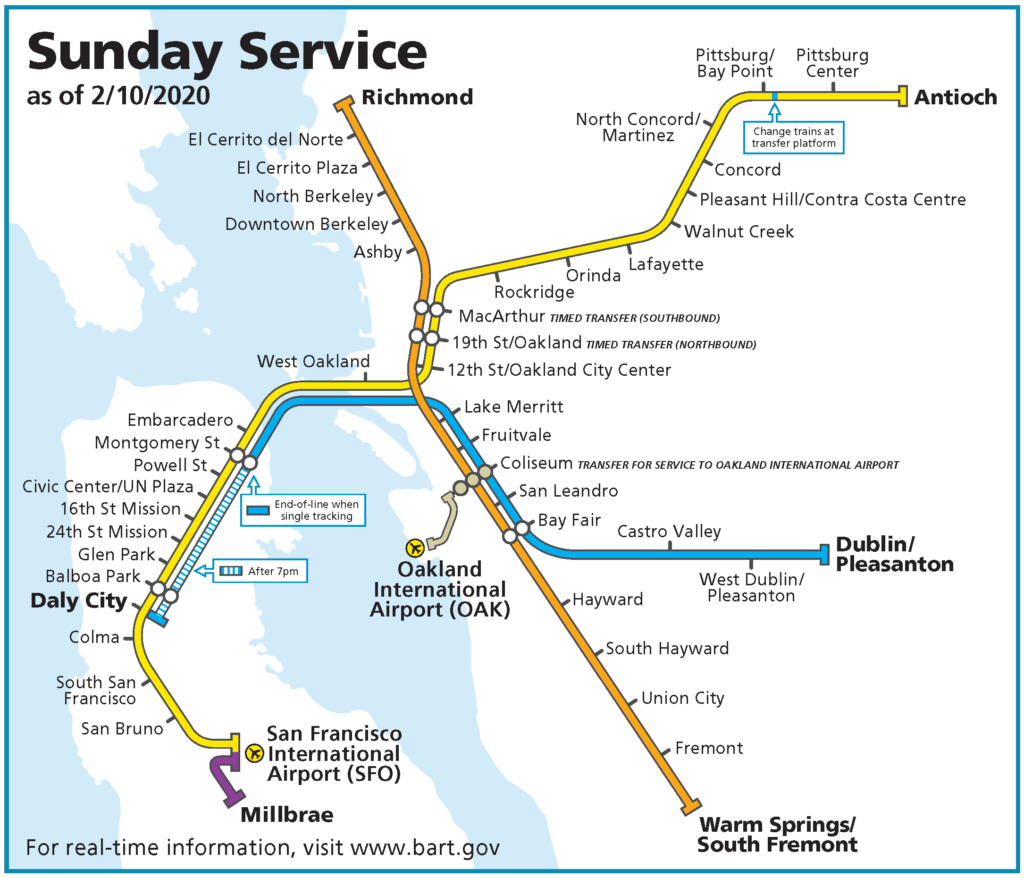
  • We will return to two-line service into San Francisco. The Dublin/Pleasanton (Blue Line) will serve San Francisco (see the map below). Blue line trains will terminate at Montgomery or Daly City depending on the time of day and if there is single tracking. Riders on the Blue Line who are travelling farther south will transfer to a Yellow Line train at Montgomery St.
    • Warm Springs/Daly City (Green Line) and Richmond/Millbrae (Red Line) trips were eliminated to make way for the return of Dublin/Pleasanton (Blue Line), service to San Francisco.
  • Headways on Sundays will be every 24 minutes on all lines, four minutes longer than the current Sunday service plan. BART staff believes this service plan will provide greater predictability and resilience in the event of a service delay.
  • Trips to Millbrae will no longer require a transfer at SFO on Sundays.  The Sunday map below still shows the “Purple line,” but with no transfer bubble. The Purple line was re-introduce as a unique line in Feb. 2019, and now all trips between SFO and Millbrae are considered the Purple line- regardless of what train is used to make the trip.  The Sunday trains will be labelled as “SFO/Millbrae” bound trains on platform signs and we will make on board announcements so Sunday riders know they don’t need to transfer at SFO to a Millbrae train.  The concept of showing two separate lines, but offering a one-seat trip with no transfer, is called “interlining.” The train switches from one route to another.  BART plans to use this concept moving forward for the Purple line to allow us to be flexible with how we operate this segment of service while keeping the map simple, without added annotations, and consistent.
  • The first northbound train is Dublin/Pleasanton (Blue Line), leaves 24th St/Mission at 7:50 am, and Civic Center at 7:54 am (instead of 8:04 am)
  • The first northbound train on Warm Springs/Richmond (Orange Line) will start at South Hayward at 7:54am and arrive at Coliseum at 8:10am. (Previously it started at Coliseum at 8:09 am)
 

Contra Costa Taxpayers Association: vote no on Measure J transportation sales tax increase

Saturday, February 8th, 2020

Dear Editor:

The chief selling point to Measure J on the March 3 ballot is to “reduce congestion”, a laughably empty promise. The 75 words on the ballot create a smokescreen for a 1/2% sales tax increase.

Measure J allots $148 million to BART, who has their own mega-budget and a long history of wastefulness. Only Contra Costa would shoulder the additional tax to be handed over to BART with no assurance that Contra Costa would benefit.

This measure contains hiring restrictions that will drive up costs of taxpayer-funded projects. It requires that all apprenticeship labor must come from certain politically favored sources, rather than the largest qualified pool of applicants. Construction labor short supply due to recent wildfire rebuilding efforts. As a result, projects everywhere are currently facing massive cost overruns. This is the wrong time to impose even further hiring restrictions.

Residents may see signs on the highway referencing Measure J for current projects. This refers to a Measure J generously passed by voters in 2004. The suspicious letter designation is confusing, but clearly this is not the same. This is an additional increase for 35 years.

We encourage a no vote on Measure J.

Susan L Pricco

President, Contra Costa Taxpayers Association

BART fares to increase January 1

Wednesday, December 18th, 2019

A 5.4% inflation-based fare increase will take effect on January 1, 2020 as part of a program first approved by the BART Board in 2003 and renewed for a second series in 2013.
For a short trip like Downtown Berkeley to 19th St./Oakland, the Clipper fare will increase by 10 cents, and a longer trip like Antioch to Montgomery will increase by 40 cents.

View the new fare chart. The Trip Planner and Fare Calculator will be updated with these new fares before December 13, 2019. The fare charts at stations will be swapped out just prior to January 1.

Paper ticket fares will continue to have a 50 cent per trip surcharge. Riders are encouraged to use Clipper and save.

All new revenue from this fare increase goes to BART’s highest priority capital needs including new rail cars, a new train control system to provide more frequent service and an expanded maintenance facility.

According to a KRON4 news report, “For example, if you go from Lafayette and get off at the Embarcadero station, a one-way ticket will cost you $5.30.

From Antioch to Embarcadero, that ticket will cost you $7.90.

Another example – south Fremont to Embarcadero is $7.10.

Dublin to the same station will be $6.60.”

Fare Increase is Based on Inflation

To help fund the BART system’s extensive capital needs, BART has an inflation-based fare increase program adopted by the Board of Directors that raises fares every other year at a rate .5% less than inflation for the previous 2-year period.

It is important fares keep up with inflation because BART is not heavily subsidized by the government and we rely on fares for two-thirds of our operating budget.   We are working very hard to improve the rider experience with stepped up cleaning efforts, additional police presence to keep you safe, and new solutions to address the Bay Area’s homeless crisis and the impact on our system.

This is the last of four biennial fare increases called for under the 2013 series. The BART Board has approved a third series of inflation-based fare increases that will go into effect in 2022, 2024 and 2026.  This latest series will follow the same inflation-based formula as the previous increases.

Means-Based Fare Discount Pilot

BART will participate in the Metropolitan Transportation Commission’s Regional Means-Based Fare Discount Pilot Program expected to begin in early 2020. The program will offer a 20% discount per trip to adult riders earning 200% or less of the federal poverty level.

Get Clipper

Clipper has many advantages over paper tickets:

BART is working to move toward a Clipper-only fare payment system because the region has prioritized the use of Clipper as the Bay Area’s all-in-one transit card administered by the Metropolitan Transportation Commission. Clipper has many advantages over paper tickets:

  • Clipper saves money. Adult paper tickets have a 50 cents surcharge on every trip, which equals $1.00 per round trip. With a one-time acquisition fee of $3.00 for a Clipper card, it pays for itself in just 3 roundtrips.
  • In addition to the 50-cent per trip savings on BART, customers who use Clipper also pay less on Muni, Golden Gate Transit buses and ferries, San Francisco Bay Ferry, AC Transit and Caltrain.
  • Clipper is tourist-friendly as it offers discounts on various transit agencies while eliminating the need to purchase and carry multiple fare products from different agencies.
  • Clipper is reusable and long-lasting, unlike paper tickets that get worn and tattered.
  • Clipper is accepted by nearly all transit agencies in the region. Many other agencies offer discounted fares when using Clipper.
  • Riders can set up their Clipper card account to reload automatically so they won’t have to wait in line.
  • The loaded value on the Clipper card is secure when it’s registered. If you lose the card, the balance can be replaced for a nominal fee.
  • Your Clipper card can be linked to your BART EZ Rider parking account for a fast and easy way to pay for BART parking. Once you have Clipper, go tohttps://ezrider.bart.gov/ezrider/ and follow the instructions to link the card to our parking program and then simply tap your Clipper at parking validation machines.
  • The tag in and out system allows Clipper card users to move through fare gates faster.
  • Clipper cards can be purchased at every BART station and at many retail outlets throughout the region.
  • Paper tickets can jam our fare gates, so Clipper usage means more open fare gates, shorter lines and less fare gate maintenance.
  • Clipper usage reduces the paper waste of the magstripe tickets in the BART system.


Antioch Council votes to support 2020 county transportation half-cent sales tax ballot measure, expenditure plan

Wednesday, October 23rd, 2019

$3.6 billion plan will provide $1 billion to East County, including an additional $1.6 million per year for local roads in Antioch

By Allen Payton

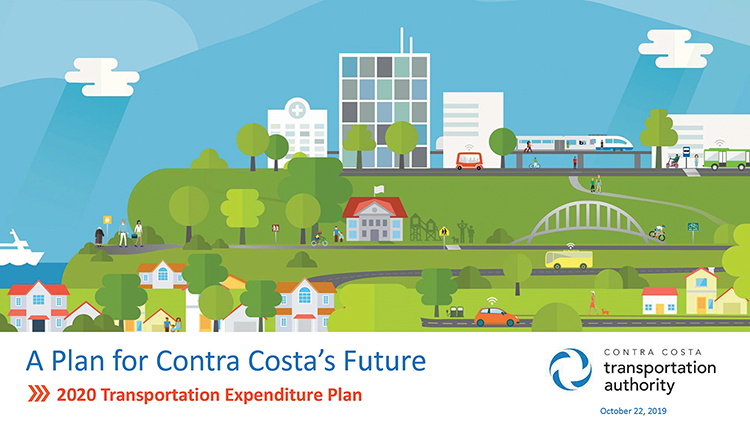
At their meeting on Tuesday night, Oct. 22, 2019, the Antioch City Council voted unanimously to support placing a second countywide, half-cent sales tax for transportation on the March 2020 ballot, as well as the associated expenditure plan. The measure is expected to generate $3.6 billion in revenue over the next 35 years. If passed, it will go into effect July 1, 2020 and will overlap the county’s current half-cent sales tax for transportation for 14 years. See plan, here: Draft 2020 Transportation Expenditure Plan

“We have support from all the cities in the county, except for Antioch and one other city. We still need two-thirds of the voters to approve the plan in order for it to take effect,” said Hisham Noeimi, Director of Programming for the Contra Costa Transportation Authority, who provided the presentation. “Despite our success our work is not done, yet. We still have four of the 10 most congested corridors in the Bay Area.” See presentation, here: 2020 Transportation Expenditure Plan Presentation

The other reason for the ballot measure is the housing jobs imbalance in the county, he explained.

“If we can bring jobs to housing rich areas, like Eastern Contra Costa County, that will help. We added 350,000 people over the last 20 years which has put strains on our transportation system. We expect to add another 350,000 people over the next 35 years.”

“The TEP (Transportation Expenditure Plan) attempts to provide the funding for all these needs…with a focus on green modes of transportation, like transit and bike, and growth management,” Noeimi continued.

The cost is estimated to be about $50 to $75 per household on average per year.

He said that $1.6 billion focused on major road improvements.

“The remaining $2 billion will be spent in your communities, coming back to the cities to improve your local streets, and improved transit services…to make it cleaner, more efficient,” Noeimi stated. “There is funding to attract jobs to East Contra Costa. There is also funding to improve air quality.”

“It was developed with sub-region equity in mind. So, for East County that’s about 28% of the $3.6 billion that will come back to East County.

“At the Authority we recognize we can’t widen our way out of the problem. That’s why funds will be spent on transit, what we call green transportation. Most of it will be spent along the major corridors in East County, Highway 4, 242, Vasco Road, the road to Byron Airport…” he said.

“Right now, Antioch receives $1.5 million per year for local roads and transportation. If it passes, the city will receive another $1.6 million per year,” Noeimi shared.

“With the TEP, over the next 35 years we will be able to reduce green house gas emissions by 7%. The TEP is more than funding. New policies include improving growth management, making transportation more efficient and our roads safer,” he concluded.

Councilman Lamar Thorpe asked about the Growth Management Plan asking, “Are you talking about the Urban Limit Line?”

“Yes,” Noeimi replied.

“I didn’t understand it this way, but would the county Urban Limit Line supersede our Urban Limit Line?” Thorpe asked.

No. Antioch has its own voter approved Urban Limit Line,’ Noeimi said, then referred to “hillside development. Ridgeline protection. If you have one of these conditions and have a policy to address them, then you mark the box.”

“We’re asking the cities to adopt a Vision Zero Policy, to make our streets safer for all users,” he added.

Thorpe responded, “So, again, getting people out of cars, getting them on bikes in a suburban community.”

TriDelta Transit will get $110 million out of the $392 million in the program, Noeimi shared

“You said something about the cities and a checklist. The return to source money…is conditioned upon the cities meeting their growth management plan. They have to submit a checklist to the CCTA every two years. That just carries that same procedure. If they don’t meet the checklist are the return to source funds withheld?” Councilwoman Lori Ogorchock asked.

“Yes,” Noeimi replied. “That hasn’t happened in the last 30 years.”

Mayor Pro Tem Joy Motts asked about the ferry service to Antioch included in the plan.

“The funding can be used for WETA (the Bay Area’s Water Emergency Transportation Authority) or privately-run service, the landing platform,” Noeimi explained. “The money in Antioch could be used for that.”

Mayor Sean Wright then said, “The three-to-one leverage ratio is huge. The way that works, we use the money to start the planning process. Then we go out looking for…the state and federal funds. That’s what CCTA has been able to do.”

“Some of this money is coming back to East Contra Costa for economic development, trying to create jobs, here. A study has shown that if we were able to take 10% of the traffic on our freeways and reverse it…the Bay Area would go green, meaning our highways would no longer be red,” he stated.

Following the presentation, the council then considered the matter for a vote on a separate item on the agenda.

During public comments, Adam Alexander spoke in favor of the adoption of the TEP, saying, “As a training coordinator, representing the Carpenters Training Fund. I’m here to support the TEP…with the inclusion of the joint labor management apprenticeship training program.”

Antioch Police Crime Prevention Commissioner and recently announced city council candidate, Dwayne Eubanks spoke next.

“I want to speak out in support of this amendment…with the inclusion of a BART extension stop at Somersville,” he said. “Contra Loma Somersville is our core corridor. You have all that businesses there. Why don’t we have a stop there? Hillcrest isn’t the center of town. It’s probably too late. But I had to put that out there.”

The council then voted unanimously to approve the resolution supporting the half-cent sales tax Transportation Expenditure Plan and to place it on the March 2020 ballot.


Supervisors prepare for PG&E power shutoff during Tuesday meeting

Wednesday, October 9th, 2019

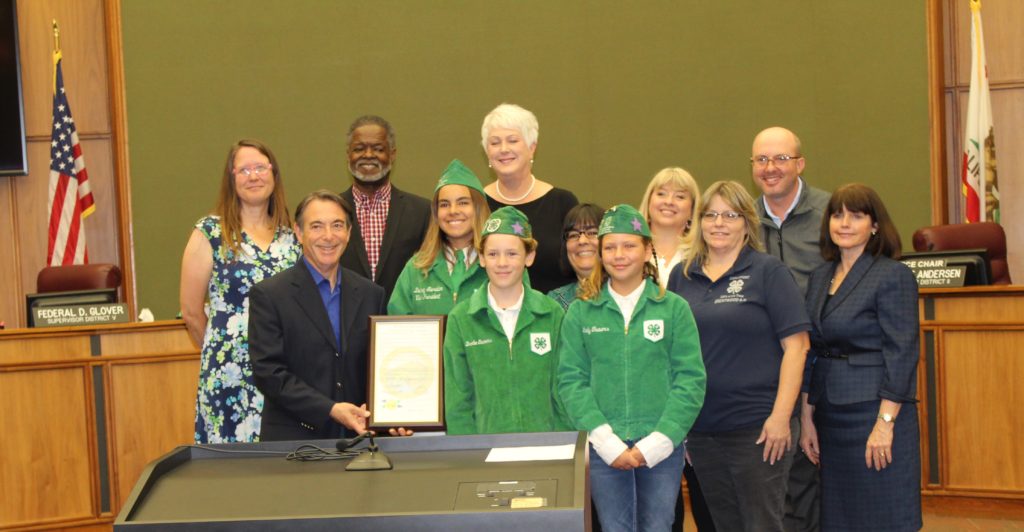
The Contra Costa County Board of Supervisors proclaimed October 6 through 12 as National 4-H Week throughout the county. Supervisors encouraged citizens to recognize 4-H for the “significant impact it has made and continues to make by empowering youth with the skills they need to lead for a lifetime.” 4-H has helped 3,159 youth in Contra Costa County to become leaders. The University of California Cooperative Extension delivers the program in California. National 4-H Week showcases the experiences that 4-H offers youth. Attending Tuesday’s resolution presentation were from left, West Contra Costa County 4H Director Jen Komaroni, Board Chair John Gioia of Richmond, District 5 Supervisor Federal Glover, eight year 4H member Delanie Sheridan, District 4 Supervisor Karen Mitchoff, seven year 4H member Brodie Emmons of Brentwood, fifth year 4H member Emily Tavers of Brentwood, Briones 4H Director Paula McCauley, District 3 Supervisor Diane Burgis, Brentwood 4H Director Julie Carter, University of California Cooperative Extension Director for Alameda and Contra Costa Bob Bennaton and Vice Chair Candace Andersen. Photo by Daniel Borsuk

Approve MOU for Route 239 in East County to connect Brentwood to Tracy; $2.1 Million for Low Income Home Energy Assistance Program

By Daniel Borsuk

Potentially facing the first-ever utility-induced electric power shutdown in parts of Contra Costa County, members of the Board of Supervisors discharged a barrage of questions on Tuesday about the preparedness of the Contra Costa County Fire Protection District in handling potential emergencies during what could be a power shutdown lasting several days.

At the end, Supervisors learned CCCFPD is ready to handle whatever might come down from a PG&E power shutdown.

Supervisors relayed their concerns about the CCCFPD’s fire emergency readiness at Tuesday’s fire district meeting where supervisors also serve as the fire district’s fiscal and policymaking entity.

PG&E revealed plans on Tuesday it would intentionally shut down power serving Rossmoor and parts of the Lafayette-Moraga-Orinda areas on Wednesday, due to high winds and concerns the winds could knock down power lines sparking a fire. The power shutoff could last through Friday or longer depending on weather conditions.

CCCFPD Chief Lewis Broschard III forecast one-third of Rossmoor or 4,000 to 5,000 residents could be potentially harmed by a power outage. Many elderly residents living in senior housing don’t have backup electric generators, he said.

“We’re looking at longer response times due to traffic tie ups,” the chief said. This will require having equipment and personnel strategically located ahead of potential emergencies.

Broschard acknowledged that the fire district has encountered a roadblock in obtaining state pre-position funding.

When Chief Broschard informed supervisors that the district’s newly built Fire Station 16 in Lafayette will be officially opened on Wednesday, Board Vice Chair Candace Andersen, whose District 2 covers most of the areas PG&E has identified will have power shut off observed “We might not have power tomorrow to dedicate the station.”

Chief Broschard said the district recently accepted delivery of its newest bulldozer, the district’s second bulldozer that will provide district extra firefighting power in what has been “a quiet fire season” up to this point in time.

In other business, supervisors unanimously approved their 2020 schedule consisting of 30 meetings. Vice Chair Candace Andersen of Danville has already been elected chair for next year and District 3 Supervisor Diane Burgis of Brentwood has been elected vice chair for 2020.

The Contra Costa County Board of Supervisors designated the second week of October as Code Enforcement Officer Appreciation Week in Contra Costa County on Tuesday. Supervisors recognized the work and dedication of code enforcement officers, of which there are five in the county. “You’re our unsung heroes<” said Supervisor Karen Mitchoff who acknowledged “We’ve recently have had some problems in the Pleasant Hill Barea area.” Supervisor Federal Glover of Pittsburg remarked “The work you do is unappreciated. That’s mostly because the cases are complaint driven.” The supervisors’ resolution states “Contra Costa County wants to recognize and honor our Code Enforcement Officers that serve our community and acknowledge their role in leading the way to improve quality of life within our communities.” Photo by Daniel Borsuk

Supervisors also approved as consent items:

MOU for Route 239 in East County

An amended and restated Memorandum of Understanding between the county and the Contra Costa Transportation Authority concerning the development and federal funding for State Route 239 Project in the Byron area. There were no public speakers concerning the $17.6 million project, $14 million in federal funding and $3.6 million in Local Road Fund.

$2.1 Million for Low Income Home Energy Assistance Program

Supervisors approved a $2,099,274 contract for the California Low Income Home Energy Assistance Program for the period of Oct. 1, 2019 through June 30, 2021. The grant is funded with federal money through the California Department of Community Services and Development.

Two streets in Antioch’s northeast industrial area to close to public beginning Thursday

Tuesday, September 17th, 2019

By Antioch Police Department

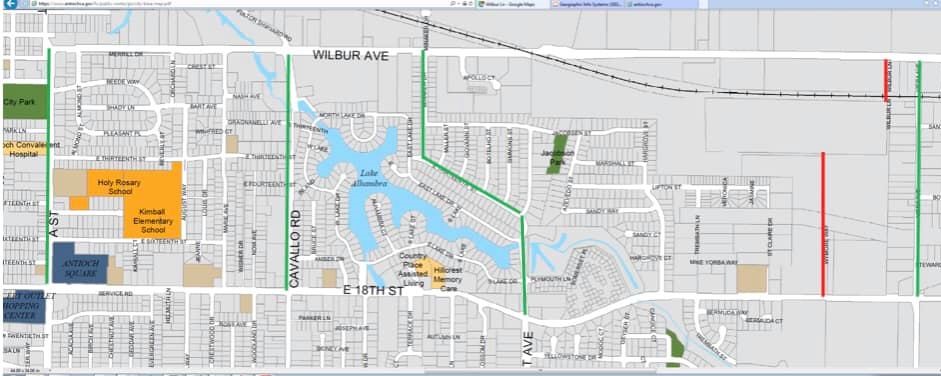
Effective Thursday, September 19, 2019 both Wilbur Lane and Wymore Way will be closed to through traffic. Wilbur Lane will only have gated access to the warehouse complex and businesses from the Wilbur Lane side, and Wymore Way is to be closed permanently.

“It’s being done by the property owners to help prevent crime from occurring in the complex,” said Antioch Police Chief Tammany Brooks.

“Wilbur Lane and Wymore are both private streets,” added City Manager Ron Bernal.

This has long been a popular thoroughfare for persons getting from East 18th Street to Wilbur Avenue. Due to this closure, everyone is cautioned and should now use alternate routes between these two roadways. Alternate routes include A Street, Cavallo Road, Hillcrest Avenue, and Viera Avenue. The highlighted areas in green show alternate routes and the red show the closed roadways. Please see the map above.

Allen Payton contributed to this report.

Weekend BART delays between Orinda and Walnut Creek 8/17-18, bus bridge, and Highway 24 lane closures

Friday, August 9th, 2019

There will be no single-tracking or track closures due to this project for the weekend of August 10-11.  However, there will be overnight lane closures on eastbound Highway 24 near the Lafayette Station.  You can get more details here. The first weekend track shutdown between Orinda and Walnut Creek stations is scheduled for the weekend of August 17-18.

We are making extensive repairs and upgrades to the track between Orinda and Walnut Creek stations on most weekends through October, including some upcoming full weekend closures with bus bridges.   Using Measure RR funds, we’ll be replacing track and electrical equipment, installing new switches, improving station platforms, and making other repairs and improvements to provide more reliable, safer, quieter, smoother and faster service.

Closure weekends: 8/17-18, 8/31-9/2 (Labor Day Weekend), 9/14-15, 9/28-29, 10/12-13, 10/26-27

Riders should expect delays of 40 minutes or more on closure weekends.

County Connection and AC Transit will provide free shuttle bus services:

  1.    Direct service between Orinda and Walnut Creek
  2.   Service between Orinda, Lafayette, and Walnut Creek stations.

Single-Tracking
Single-tracking on some Saturdays will mean delays of up to 30 minutes. Please plan your trip with that in mind. We will single-track on 7/27, 8/3, 8/24, 9/7, 9/21, and 10/19.  We may need to turn back some trains at Orinda to maintain our schedule. If so, you will be asked to leave the train you are on and board a different train to reach your destination.

Highway 24 Lane Closures

On select weekends including single-tracking Saturdays, we plan to close the two eastbound lanes on the far-left side of Highway 24 near the Lafayette Station and Oak Hill Road to allow equipment and material to be placed near and in our tracks. The next lane closure is scheduled for 11 pm Friday August 9 and will continue until 7 am Saturday August 10.  The two eastbound lanes of 24 will also be closed Saturday August 10 at 11pm until 9 am Sunday August 11.

Lane closures for single-tracking Saturdays will only happen during overnight hours from 11 pm Friday to 7 am Saturday and 11pm Saturday to 9 am Sunday.  All lane closures will happen near the Lafayette Station at Oak Hill Road.

Night Work

We will also do work at night after service closes on weeknights through at least the end of October.

Sunday single tracking in San Francisco

On select Sundays through the rest of this year, there will be single-track service between the Embarcadero and 24th Street Mission stations in downtown San Francisco due to electrical cabling replacement work.  This replacement project is critical to ensure our trains can count on a reliable power supply. The work can add 15-30 minutes to your trip. Get the latest on this project here.

Use the Trip Planner, call the BART Transit Information Center at (510) 465-BART (2278), or get the Official BART app to plan your trip.

Please tell CCTA: East County needs freeway from Brentwood to Tracy for long term economic growth

Monday, August 5th, 2019

The Contra Costa Transportation Authority is holding Telephone Town Hall Meetings to inform the public of the Initial Draft 2020 Transportation Expenditure Plan (TEP) and get their input before finalizing the plan and placing another tax measure on the March 2020 ballot to fund it. The meeting for East County will be held on Wednesday, Aug. 8 (see previous post on this website, below)


The plan (www.ccta.net/theplan) currently has a total price tag of $3.061 billion and the tax is in addition to the county’s current half-cent sales tax for transportation from Measure J, which voters approved in 2004 and expires in 2034. The new tax would last until 2050. The CCTA attempted to pass a similar additional half-cent sales tax in 2016, known as Measure X, but it failed. The only new section of roadway in the entire county in that plan was the $117 million “limited access” connector between Vasco Road and the Byron Highway, next to the Byron Airport. Voters overwhelmingly voted against the measure and it failed.

Fortunately, that project was included in the Regional Measure 3 expenditure plan which did pass. But, RM3 didn’t include the long-planned Route 239, the proposed four-lane freeway between Brentwood and Tracy, which will connect East County to Interstate 5, the economic lifeblood artery of the state.

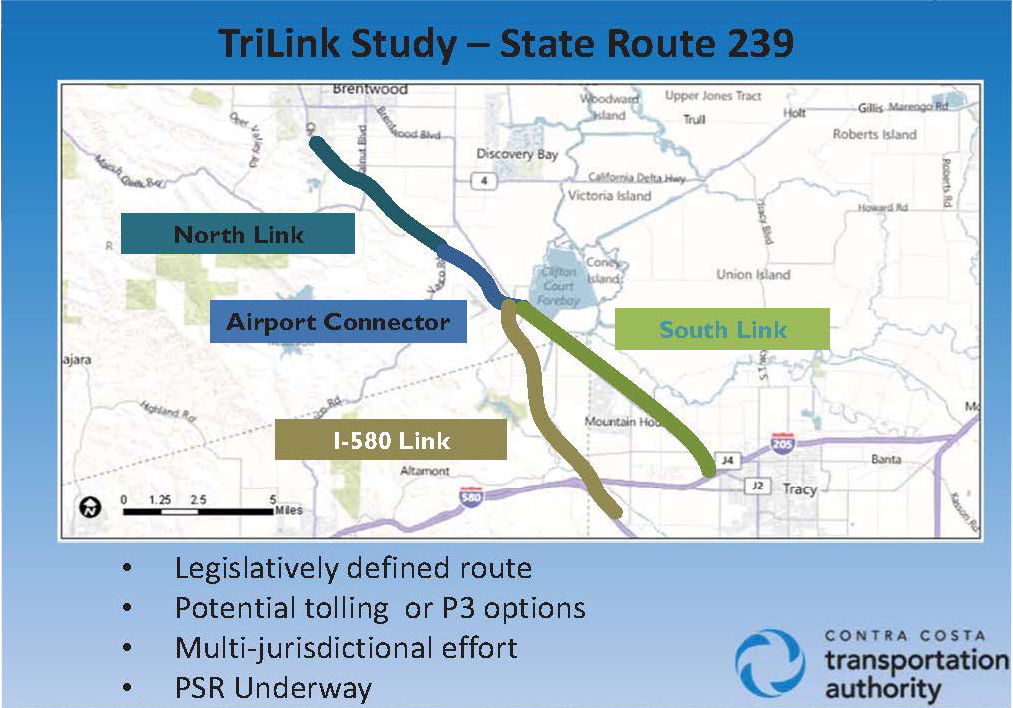
That road has been on the books for over 60 years. But, planning for it only began in 2013 as part of what was known as the TriLink Project, as it crossed the three counties of Contra Costa, San Joaquin and a sliver of Alameda, and was to also include two lines of transit down the middle, connecting the end of the BART line in East County to Tracy.

However, the TriLink Project website is no longer active and neither the four-lane freeway nor the transit lines are included in Contra Costa County’s plans for the next 30 years.

Yet, it’s Route 239 that will ensure East County’s long-term economic viability, allowing current businesses, including agriculture, to get their products to market quicker. Plus, it will open up our area for greater local job creation, and complete what I refer to as the beltway around Mt. Diablo, eliminating the cul-de-sac effect with the three two-lane roads connecting us to the east and south.

Antioch and East County have the freight rail connecting us to the east and west, plus the river connecting us to the world, to move goods. But we only have Highway 4 and BART connecting us to the west for moving people and goods.

Central County folks oppose Route 239 saying it will “induce growth in East County.” But they’ve been saying that for almost 50 years about every new road improvement, including the Hwy 4 Bypass/extension, which we had to fight for over four years from 1994-98 to just get approvals, not any money. In fact, it was that same mindset that prevented Hwy 24 from being extended to East County back in the 1970’s and the result is a surface road with the three names of Ygnacio Valley Road, Kirker Pass and Railroad Avenue, today.

I grew up in Walnut Creek and moved to Antioch because it was more affordable. In fact out of all us who attended the 35th reunion of the Northgate High School Class of ’81 in 2016, only four classmates still lived in Walnut Creek. Where did many move to? East County. So, as I said to my fellow elected officials when I was on a panel during a transportation conference back in the late 1990’s when I was serving on the Antioch City Council and Contra Costa Transportation Authority, don’t blame us for the growth. They had kids and we needed somewhere to live that we could afford. That was East County we were pushing for funding and approvals for Highway 4 widening and the Highway 4 bypass/extension. We received it and those projects are now completed.

It’s time we completed the transportation infrastructure in East County and Route 239 is a key part of it.

Besides, that road won’t induce residential growth. We have the Urban Limit Line to control that. But it will induce economic growth with more local jobs, which is what East County needs.

We need both Route 239 and the transit link between Antioch and Tracy. But, for now, let’s push for funds for the freeway to be included in the county’s new plan. Estimates are it will cost an additional $1 billion. I say add it to the total and let the voters decide.

We need bold leadership from our local elected officials and the voice of “we the people” to make it happen.