



Archive for the ‘Transportation’ Category

Tri Delta Transit: effective immediately a change in boarding procedures

Saturday, March 21st, 2020

By Maria Arce, Manager of Customer Service and Marketing, Tri Delta Transit 

ANTIOCH, CA, March 20, 2020 – In response to growing concerns surrounding COVID-19, effective immediately, Eastern Contra Costa County Transit Authority (Tri Delta Transit) customers will be boarding fixed route buses through the rear door unless they require the wheelchair ramp.  This will ensure social distancing.  Additionally, all fares on all Tri Delta Transit buses will be free.

Industry response to the COVID-19 crisis changes hour-to-hour. Tri Delta Transit staff is working hard to make sure those traveling to essential services and jobs get the transportation they require while keeping our employees safe and healthy.

“As a transit agency, it is important that we take precautions so we may continue to provide transportation services.  Protecting the health and safety of our passengers and staff is our top priority.” said Chief Executive Officer Jeanne Krieg.

For updates on Tri Delta Transit service changes and response to COVID-19 visit TriDeltaTransit.com and register for text and email alerts.

Cash toll collection suspended at Bay Area bridges but you still have to pay

Friday, March 20th, 2020

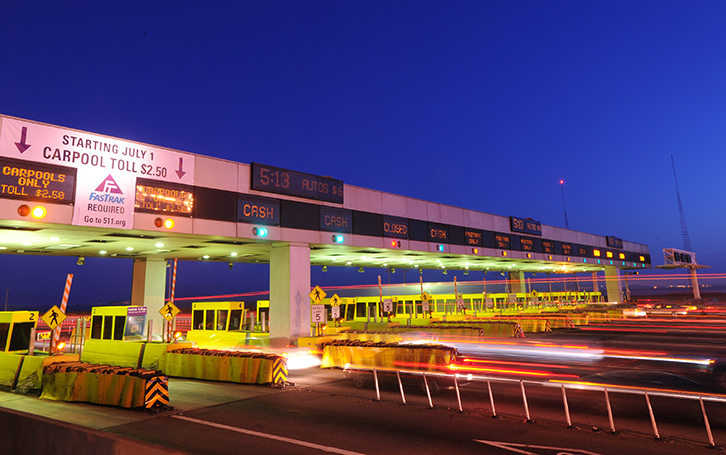
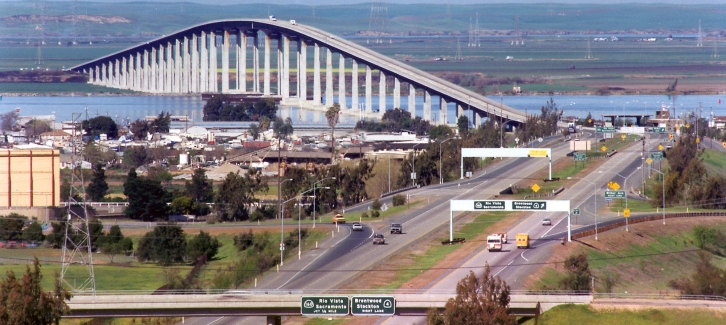
The John A. Nejedly Bridge in Antioch. Photo from BATA website.

Invoicing by mail to supplement FasTrak® during Covid-19 Emergency

March 20, 2019 . . . At the request of Gov. Newsom, Caltrans and the Bay Area Toll Authority (BATA) today announced the temporary suspension of cash toll collection at the region’s seven state-owned toll bridges in order to minimize toll collectors’ and toll-paying customers’ risk of exposure to Covid-19 during the current public health emergency.

The temporary suspension of cash toll collection will affect drivers who cross the Antioch, Benicia-Martinez, Carquinez, Dumbarton, Richmond-San Rafael, San Francisco-Oakland Bay or San Mateo-Hayward bridges. The Golden Gate Bridge adopted all-electronic tolling in 2013.

Beginning at midnight tonight, all toll booths at all Bay Area toll plazas will be unstaffed. Toll bridge patrons who normally stop at a toll booth to pay cash should continue through the toll plaza without stopping. Automated, high-speed cameras will capture images of customers’ license plates, and the FasTrak® customer service center will process the images and then mail a toll notice to the address at which the vehicle is registered with the DMV. While these notices will include a heading that reads “Toll Violation Notice,” these transactions will not be considered violations and the amount due on each notice will be for the toll amount only. The FasTrak customer service center will waive all toll violation penalties during the period in which cash toll collection is suspended, and also will suspend the escalation of penalties for previous unpaid toll crossings. This will include a temporary halt to referrals to the DMV for a hold on vehicle registration after a second toll violation notice has gone unpaid.

Patrons who normally use a FasTrak® toll tag or license plate account for toll collection will see no difference in their statements.

Caltrans and BATA encourage toll bridge customers who do not already have FasTrak accounts to open accounts online at www.bayareafastrak.org or by phone at 1-877-229-8655 (BAY-TOLL). Customers who may be leaving their homes to buy food or medicine at a Costco or Walgreens store may obtain a FasTrak toll tag at these stores and then activate their new accounts online. A map of retail locations at which FasTrak toll tags are available may be found at https://www.bayareafastrak.org/en/howitworks/retailmap.html.

Caltrans and BATA will monitor toll bridge operations and heed ongoing public health guidance before making any decisions about resuming cash toll collection at Bay Area toll bridges.

BATA administers all toll revenues from the region’s seven state-owned toll bridges. Caltrans owns and operates the state highway system, including the seven Bay Area toll bridges.

Bay Area Express Lanes “open to all” during public health emergency

Friday, March 20th, 2020

Photo: MTC.

No-toll policy takes effect Friday morning

By John Goodwin, Metropolitan Transportation Commission

In light of dramatically reduced traffic levels on Bay Area freeways following this week’s declarations of shelter-in-place orders around the region, and because the promotion of carpooling is inconsistent with the urgent need for social distancing, the Bay Area’s three Express Lane operators — the Alameda County Transportation Commission, the Santa Clara Valley Transportation Authority and the Metropolitan Transportation Commission — will jointly cease Express Lane tolling through at least April 7 unless congestion along the Express Lane corridors warrants a return to tolling.

Beginning, Friday, March 20, at 5 a.m., Express Lanes on Interstate 580 in Alameda County; Interstate 680 in Contra Costa County; State Route 237 in Santa Clara County; and southbound I-680 over the Sunol Grade in Alameda and Santa Clara counties will be open to all motorists. Changeable electronic signs over the Express Lanes will read “Open to All.”

The decision to temporarily suspend tolling on Bay Area Express Lanes will free California Highway Patrol officers from Express Lane enforcement duties to perform more urgently needed duties during the current public health emergency.

BART to temporarily reduce service hours based on ridership data, end daily service at 9 pm beginning March 23

Thursday, March 19th, 2020

Thursday, 03.19.20 Update

BART is taking swift action to reduce operating costs as ridership levels have declined by 90% as a result of the COVID-19 pandemic and shelter in place orders.  BART has done an exhaustive review of ridership and train car loads this week and will make the following changes to service until further notice:

Starting Monday, March 23, 2020, BART will provide service Monday-Friday from 5am-9pm (currently service is 5am-midnight). Current weekday train frequency will remain.

Starting Saturday March 28, 2020, Saturday and Sunday service will be from 8am-9pm (currently Saturday service is 6am-midnight and Sunday is 8am-midnight). Current weekend train frequency will remain.

All riders must be in the system by 8:45pm to have a guaranteed ride to their destination.

BART will monitor ridership data each day to determine how long these service hours will be in effect.

BART is currently compiling partner agency bus alternatives and will post that information here once confirmed.

Data based decision

Ridership after 9pm has dropped substantially and now represents only 3% of total daily ridership.  Closing early is a better option than running less frequently or running shorter trains after 9pm because BART will realize immediate costs savings to its operating budget by being able to reassign a significant number of operating staff to capital projects.  These are projects that will accelerate our system reinvestment work.

“This decision is being made now because all 9 counties in the Bay Area have shelter in place orders and our ridership has plummeted 90%,” said BART General Manager Bob Powers.  “We are taking a data-driven approach to these decisions to ensure as few people as possible are impacted.  These are extraordinary times and we did not take this decision lightly.  Our system operates using public dollars and we have an obligation to make financially sound decisions about service levels.”

Other steps taken to reduce operating costs

General Manager Bob Powers is closely monitoring revenues and expenses daily, adjusting while also balancing our obligation to provide public transit to essential workers in the region.  The immediate loss of fare revenue has a devastating impact on BART’s operating budget as 60% of our budget to provide service is from fare dollars.

BART’s General Manager has implemented the following cost reduction measures:

  • An immediate District-wide hiring freeze except for BART Police.  All other vacancies funded through the operating budget will remain vacant until further notice.
  • All overtime funded by the operating budget has been cancelled unless required for critical operating and maintenance functions, staffing requirements outlined in our Collective Bargaining Agreements, or legal requirements such as employee rest laws.  Overtime funded by the Capital budget is being approved on a case by case basis.
  • Some positions funded by the operating budget have been shifted to capital funded work. For example, as BART runs few trains on the yellow line in response to lower ridership, train mechanics have been shifted to Fleet of the Future related work.
  • All employee travel for conferences and other work-related travel has been suspended until further notice.

BART is seeking emergency funds from all levels of government during this crisis.  A sustained ridership loss of 90% and a 50% reduction of economic activity impacting other revenue sources could reduce BART’s monthly revenues by approximately $60M.

Shooting on Highway 4 in Antioch Wednesday afternoon, no injuries

Wednesday, March 18th, 2020

CHP had Highway 4 blocked in each direction backing up traffic on to Hillcrest Avenue in Antioch following a shooting in Antioch Wednesday afternoon. Photo by John Passur taken from the G Street overpass.

By CHP – Contra Costa

Today, Wednesday, March 18, 2020 at approximately 3:18pm, CHP was advised of a possible freeway shooting that occurred on HWY-4 westbound at L Street in Antioch. Upon CHP and emergency personnel arrival, the victim vehicle, a grey Volkswagen sedan, appeared to have bullet holes in it. The solo male victim from the Volkswagen was not injured and remained on scene. The suspect vehicle fled the area. Traffic backed up to Hillcrest Avenue as HWY-4 westbound was temporarily shut down and for the investigation and all traffic is being diverted off HWY-4 at L Street.

All lanes were reopened as of 5 pm.

This incident is still under investigation and we do not have any further details or information to release. If you have any information regarding this incident, please contact Contra Costa CHP in Martinez at 925-646-4980.

Assembly Transportation Chair Frazier commends Gov. Newsom for DMV relief related to COVID-19

Tuesday, March 17th, 2020

Sacramento- Governor Newsom Monday asked law enforcement across the state to exercise discretion for 60 days in the enforcement of driver license and vehicle registration expiration dates beginning March 16, 2020 in response to the extraordinary circumstances the state is facing as a result of the COVID-19 pandemic.

“In light of this pandemic, it is vitally important that our constituents practice social distancing. Our seniors and vulnerable populations should not risk their lives because their driver’s license or registration are expiring,” said Assemblymember Frazier. “I commend Governor Newsom on his actions to ensure people do not have to rush to a DMV office as they are asked to shelter in place in my district. I also want to thank DMV staff for continuing to provide vital services for the people of California.”

The DMV has taken several actions to encourage social distancing during the COVID-19 pandemic. DMV field offices are asking individuals for their phone numbers so they can wait in their cars and receive a text alert as to when DMV employees are ready to help them. The department is also encouraging people to use online services, DMV Now Kiosks, or a DMV business partner for transactions that do not have to occur in a DMV Field Office.

Assemblymembers Frazier (D-Fairfield) and Vince Fong (R-Bakersfield) Introduced AJR 28 in February, a resolution asking the Department of Homeland Security to delay REAL ID implementation for domestic air travel by at least three years.

“More and more Californians are being asked to shelter in place with fewer eligible to fly in October,” Frazier said. “I urge the federal government to make sure our travel industry does not take a double hit this year and extend the REAL ID deadline so people do not have to come into a DMV office during this crisis to get a new ID.”

The American Travel Association estimates that 57% of Americans are unaware they need a REAL ID to fly and that the U.S. economy will lose out on nearly $300 million of travel related economic spending in the first week of REAL ID implementation.


BART continues regular service during shelter in place

Monday, March 16th, 2020

Monday’s shelter in place emergency order from local counties considers BART an essential business. 

BART will continue to provide regular service for riders performing essential activities and for riders travelling to and from “essential business” work, with long enough trains to allow for social distancing. Based on ridership levels last week and over the weekend, social distancing is happening on BART.  Last week BART served 24%-61% fewer riders depending on the day of the week. There is enough space for riders to remain 6 feet from each other. Increased cleaning and disinfecting are continuing in stations and trains. (See related article).

The order provides the following guidelines specific to transit:

  • BART, along with other essential businesses, is “strongly encouraged to remain open.”
  • To the greatest extent feasible, BART should allow for Social Distancing of at least six feet from any other person including, but not limited to, when any customers are standing in line.
  • People must use public transit only for purposes of performing Essential Activities or to travel to and from work to operate Essential Businesses or maintain Essential Governmental Functions and Essential Infrastructure operations and maintenance. People riding on public transit must comply with Social Distancing Requirements, to the greatest extent feasible. The shelter in place order defines each of those categories.
  • Essential travel also includes travel:
  • to obtain necessary services or supplies for themselves and their family or household members.
  • to engage in activities or perform tasks essential to their health and safety, or to the health and safety of their family or household members.
  • to care for elderly, minors, dependents, persons with disabilities, or other vulnerable persons.
  • to or from educational institutions for purposes of receiving materials for distance learning, for receiving meals, and any other related services.
  • to return to a place of residence from outside the jurisdiction.
  • required by law enforcement or court order.
  • required for non-residents to return to their place of residence outside the County.

BART staff and frontline workers continue to deliver safe BART service.  BART staff is being provided the tools they need to perform their job safely including hand sanitizer, germicidal wipes, face masks for positions that require them, and other personal protective equipment.  We offer an Employee Assistance Program with resources that can assist with child/elder care referrals, financial consultation and counseling with a licensed mental health clinician.

Apply for free School Pool bus passes for youth in Antioch, East County in March

Friday, February 21st, 2020

Starting March 2nd through March 31, 2020, Tri Delta Transit will begin to accept applications for free bus passes for youth 19 years old and younger and attends a K-12 school in Antioch, Bay Point, Brentwood, Byron, Discovery Bay, Knightsen, Oakley, and Pittsburg. Eligible students will receive a bus pass good for 20 rides on Tri Delta Transit. You can request passes for up to three students.

  1. What is School Pool?

School Pool is a program that encourages students in grades 6-12 to use public transit instead of a car to get to and from school. The Spring 2020 East Contra Costa County School Pool program offers complimentary introductory Tri Delta Transit bus passes for up to three (3) students per household.

  1. Eligibility Requirements:

If your child is 19 years of age or younger and attends a K-12 school in the following communities, you are eligible to apply: Antioch, Bay Point, Brentwood, Byron, Discovery Bay, Knightsen, Oakley, and Pittsburg.

A parent or guardian must complete the application, pledge that their student will ride the bus to and from school instead of being driven by the parent/guardian, and agree to complete a follow-up survey to assess the effectiveness of the School Pool Program.

  1. Program Rules:

Complimentary bus passes are available for up to three (3) students per household, while supplies last. Each eligible student will receive a bus pass good for 20 rides on Tri Delta Transit. Bus passes will be mailed to the home address provided on the application within 1-2 weeks of approval. Lost, stolen or damaged bus passes will not be replaced. Falsifying information on the application will disqualify you from School Pool and all other 511Contra Costa programs. School Pool and 511 Contra Costa reserve the right to make changes to program eligibility requirements and program rules at any time without prior notification.

Application period: March 2-31, 2020

For questions about the Spring 2020 East County School Pool program, contact 925-969-0841 Ext. 1004 or info@schoolpool.org.

School Pool is brought to you by 511 Contra Costa and is funded by the Bay Area Air Quality Management District and the Contra Costa Transportation Authority.