Archive for the ‘News’ Category

New Highway 4 Off-Ramp at Somersville

Tuesday, February 21st, 2012

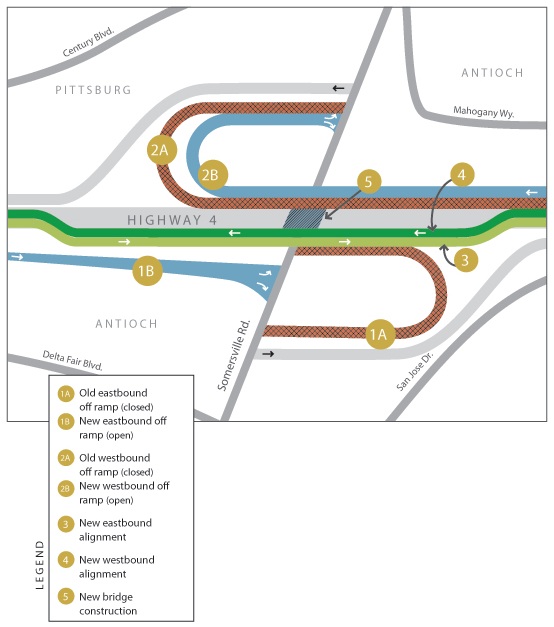
As part of the widening of Highway 4, traffic flow through Pittsburg and Antioch will undergo two significant modifications during the week of February 20.

The switch to the new eastbound off-ramp at Somersville Road, which was planned for Friday, February 24, 2012, has been cancelled. The planned closure of the eastbound highway and Somersville Road for Thursday night is also cancelled. This work will be rescheduled in the near future. Traffic will remain on the existing temporary off-ramp until that time.

The planned work on westbound SR-4 at Century Boulevard is still planned as follows: On Saturday, February 25, 2012, traffic flow on SR-4 at Century Boulevard will be modified. Westbound traffic will be shifted to the north over a portion of the newly constructed Century Boulevard Bridge.

In order to perform this lane shift, all westbound lanes of SR-4 will be closed from Somersville Road to Loveridge Road on Wednesday and Thursday nights between 10:00 pm and 3:30 am, and on Friday night between 11:00 pm and 5:00 am. The westbound on-ramp from Somersville Road will also be closed between 10:00 pm and 5:00 am on Wednesday and Thursday nights and between 11:00 pm and 6:00 am on Friday night.

Motorists are advised to expect delays and allow extra time for their commute. Signs will be in place at the closures to direct motorists to alternate routes. Please be alert and carefully follow all directional signs when encountering detours.

Caltrans and CCTA appreciate your patience as we work to improve the highways. For the most current information on all SR-4 corridor closures please visit our web site at: http://widensr4.org.

Chief: State Release of Criminals May Add to Thefts

Thursday, February 16th, 2012

By James Ott

While violent crime in Antioch declined 5.3 percent in 2011 compared with 2010 and its record breaking 13 murders, property crime has jumped over 25 percent, according to a presentation at Tuesday’s City Council meeting by Police Chief Allan Cantando.

Cantando said the cause of the sharp rise in property crimes, including increases of nearly 23 percent in burglary and 50 percent in theft, is hard to pinpoint because of a new online crime reporting system that simplifies the reporting of property crimes. “It’s difficult for me to say if it actually went up that much or if people are reporting more accurately,” said Cantando. “But those are the figures so those are what we have to live with.”

The increase in crimes like theft could also be related to the state’s release of some criminals from prison, he added. No direct explanation was provided for the more than 51 percent increase in arsons – 56 in 2011 versus 37 in 2010.

Despite the large uptick in non-violent crimes, total arrests last year were down an average of 8 percent. That is most likely a direct result of a reduced police force, said the chief. The department is currently looking to hire two new officers, although Cantando said that more are needed.

After the presentation, the council floated the idea of approving the hiring of more than two new officers – perhaps as many as five. Public Employees Union Local 1 and the Antioch Police Officer’s Association, however, are still in labor negotiations with the city. As many as 120 officer positions have been authorized, but due to budget constraints the city can only afford 92 sworn officers.

The council and police chief agreed that more funds are needed to hire more officers, lamenting the fact that the majority of voters seem reluctant to pay out of pocket to help the police force. Council Member Mary Rocha cited the rejection in November 2010 of the Measure P half-cent sales tax hike for public safety.

To view the complete police crime statistics presentation as part of the city council agenda or as part of the city council video, visit the city website at http://www.ci.antioch.ca.us/CityGov/CouncilMeetings/021412/

City Clerk and Treasurer on June ballot

Also at the meeting, the Council voted unanimously to place a measure on the June 2012 ballot to make the City Clerk and City Treasurer both appointed positions. Currently the two positions are elected. Salaries and benefits cost $12,000 to $20,000 per position, according to city staff. At a previous meeting the council decided that it would be more cost effective to have the positions be appointments by the city council rather than paid, elected positions.

The clerk and treasurer duties have been increasingly handled by professional staff and consultants. The cost of placing the measure on the June 2012 ballot is estimated at $105,000.

Former Antioch Council Member Martha Parsons suggested that Antioch adopt a rotating mayor’s position in which every elected council member would get a chance to serve as mayor of Antioch for one year, instead of electing a mayor for four years. Parsons said that the switch would provide Antioch with fresh views each time the mayoral seat was rotated to a new council member. She pointed out that only Brentwood, Martinez, San Ramon and Richmond have an elected mayor, while the other 14 cities in the county use the rotating system.

Mayor Davis added the item for council discussion and consideration at the next council meeting.

As part of the consent calendar, the council purchased a tractor through the National Joint Powers Alliance and Peterson CAT for $160,509 and entered into a 36-month lease with Xerox Corporation for $190,259 plus the unit cost per copy for copiers.

The council did not vote on entering into a contract with Raney Planning and Management for environmental document preparation for the WalMart expansion project. It also held off on filing a grant application with the state’s sustainable communities planning grant and incentive program to gain funding for a plan to upgrade the city’s downtown area.

Antioch resident Julie Young, who lives on and represents the residents of Mimona Court and Minona Drive, addressed the council about concerns with the new Neslon Ranch Park located behind her home. Young said that the park less than ten feet from her back fence is too close and poorly planned and that it threatens nearby residents’ privacy and safety. She claimed that she city staff were unresponsive to her attempts to resolve the issue.

The council will add the item to a future meeting agenda for discussion.

SUSTAINABILITY FORUM ON WATER AND THE DELTA

Monday, February 13th, 2012

For the first time, proponents and opponents of the State’s plans to transform the San Joaquin-Sacramento Delta will discuss the merits and drawbacks of the Delta Plan and the peripheral canal. The forum is scheduled Saturday, March 3, 2012 at the Civic Auditorium, in Stockton, and is open to the general public.

The purpose of this forum is to inform and explain to all residents in the Delta region the scope, and impact of changes that may forever alter the unique features of the Delta by redefining the character and future growth of communities that lie within the region, by eliminating family farms operating within the Delta, and by altering the fabric of life enjoyed by Delta residents.

“A Primer on Water and the Delta” is the first of three forums that are being hosted by the same coalition of environmental advocates, private business and local government that held community forums the past two years on how to employ sustainable practices in everyday life. Members of the coalition are the Sierra Club, Campaign for Common Ground, the A.G. Spanos Companies, the Stockton City Council and the San Joaquin Council of Governments.

“Water is vital to our local economy, our farms, and our cities. As residents of the region and stewards of this unique estuary and habitat to many species, it is important that we stay informed and alert to insure that we retain local control over our water and our future,” said Susan Eggman City Council Member.

Presentations at the forum will be made by Dr. Jerry Meral, Deputy Secretary for the California Natural Resources Agency; Jason Peltier, Chief Deputy General Manager, Westlands Water District; Jim Fiedler, Chief Operating Officer, Santa Clara Valley Water District; Ann Johnston, Mayor of Stockton and Chair for the Delta Coalition; John Herrick, an expert on local water issues; Jeff Michael, Director of the Business Forecasting Center, University of the Pacific; and Barbara Barrigan-Parilla, Executive Director of Restore the Delta.

The forum will begin at 8:30 a.m. and conclude at 12:00 noon. Each presentation will be followed by a question and answer period. Moderator for the entire series will be Susan Eggman, a City Council Member of the City of Stockton and Professor of Social Work at the California State University at Sacramento.

Members of the organizing committee are Dale Stocking, Sierra Club; Eric Parfrey, Campaign for Common Ground; Councilwoman Susan Eggman, Stockton City Council; Natalia Orfanos, A.G. Spanos Companies; and Andrew Chesley, Executive Director of the San Joaquin Council of Governments.

President’s Day Weekend Bay Bridge Closure

Monday, February 13th, 2012

Travelers Encouraged to Plan Ahead

The Bay Area’s award-winning 511 traveler information service is the one-stop source for transportation alternatives and detours during the Bay Bridge closure this Presidents Day Weekend, February 17 – 21.

Travelers can easily plan ahead by visiting 511.org or calling 511 from any phone in the Bay Area. Special Bay Bridge closure information is available at www.511.org/baybridge/PresDay2012.

Due to scheduled seismic retrofitting, the westbound deck of the Bay Bridge from Oakland to San Francisco will close Friday, February 17, at 8:00 p.m. and reopen Tuesday, February 21, at 5:00 a.m. The eastbound lower deck from San Francisco toward the East Bay will remain open.

Travelers are encouraged to plan ahead and take public transit, such as BART or ferries, to reach San Francisco. The 511 website features updates about bridge closure status and special information on transit options during the closure; a detailed map of detours using the Golden Gate, Richmond-San Rafael, San Mateo-Hayward and Dumbarton bridges; and information about current traffic conditions and areas to avoid due to anticipated traffic congestion.

“511 is the best local source for comprehensive transportation information, especially during incidents and closures, like the upcoming Bay Bridge closure,” said Adrienne Tissier, chair of the Metropolitan Transportation Commission (MTC). “511 offers information via the web, phone, mobile devices, text and social media, ensuring that people can obtain timely information whenever and wherever they need it.”

511.org features the popular 511 Transit Trip Planner, an online tool to help commuters plan transit trips anywhere in the nine-county region. On-the-go transit trip planning and current traffic conditions are available for people using smartphones at m.511.org. Motorists can also find current traffic conditions and driving times using 511’s interactive Traffic and Driving Times Map, the new 511 Traffic (Beta), or by calling 511 and saying either “traffic conditions” or “driving times” from the main menu.

As always, the 511 Traffic page provides the latest-breaking traffic news and emergency information affecting drivers. When urgent news breaks or emergencies occur, a ticker at the top of the page informs motorists about major traffic impacts and commuting alternatives. 511 Traffic updates are also available on twitter.com/511SFBay.

511 is a one-stop phone and web source for up-to-the-minute Bay Area traffic, transit, rideshare and bicycling information. It’s free of charge and available 24 hours a day, seven days a week from anywhere in the nine-county Bay Area. Call 511 or visit 511.org. 511 is managed by a partnership of public agencies led by the Metropolitan Transportation Commission, the California Highway Patrol, and the California Department of Transportation.

Nearly 300 Attend Foreclosure Prevention Seminar

Monday, February 6th, 2012

Senator Mark DeSaulnier (D-Concord) hosted a foreclosure prevention seminar at the Antioch Community Center to provide an opportunity for Contra Costa County homeowners to hear from professionals specializing in loan modifications, legal procedures, and tax liability.

Nearly 300 Contra Costa residents attended the event and received valuable information to avoid foreclosure.

“The number of people that came out on a Saturday afternoon demonstrates how widespread the problem is,” said DeSaulnier. “Too many Contra Costa homeowners are losing their homes through no fault of their own and are desperately fighting to keep them. They need as much help as they can get. I am hopeful that the information they received today will help them preserve the American dream of home ownership.”

Last year, about one for every 95 Contra Costa home owners received a notice of default on their home loan. Nearly 6,000 Contra Costa homes are in foreclosure. In Eastern Contra Costa County alone there are nearly 2,500 homes in foreclosure – one of the highest rates in the nation.

The following people participated in the seminar:
· Senator Mark DeSaulnier, Chair, Senate Transportation and Housing Committee
· Diane Richardson, Director, “Keep Your Home California”, a program of the California Housing Finance Agency
· Jan Lynne Owen, Commissioner, California Department of Corporations
· Maeve Elise Brown, Executive Director, Housing and Economic Rights Advocates
· U.S. Department of Housing and Urban Development approved counselors
· Staff from the Franchise Tax Board
· Representatives of Wells Fargo, Bank of America and Chase will also be available to provide additional information and resources.

Sen. Mark DeSaulnier (D-Concord) represents the Seventh Senate District, which includes most of Contra Costa County, including Antioch.

PG&E Backs SmartMeter Decision

Thursday, February 2nd, 2012

Residential electric and gas customers who have concerns about wireless technology can now choose either a new SmartMeter™ or a traditional analog meter, following the final decision today by the California Public Utilities Commission (CPUC). Pacific Gas and Electric Company (PG&E) supports the CPUC’s decision and will respond quickly to customers who opt-out of the utility’s SmartMeter™ program.

“We know personal choice is important to our customers when it comes to the meters on their homes,” said Helen Burt, PG&E’s Senior Vice President and Chief Customer Officer. “This final decision in support of analog meters is a positive step forward for those who have concerns over wireless technology. We understand some customers have been waiting for this decision, and we are actively reaching out to those who have expressed their desire for a SmartMeter™ alternative.”

PG&E is installing digital, wireless SmartMeters™ throughout its service area in Northern and Central California as part of a statewide effort to help customers save on their bills by offering them more control over their energy usage, improve reliability and customer service, and conserve natural resources to help the environment. As part of a global effort to modernize the energy grid and transform it into a digital network that will deliver more reliable power to homes and businesses, similar metering programs are now underway at utilities throughout the country and around the world. To date, PG&E has installed nearly nine million gas and electric SmartMeters™, on its way to about 10 million meters in 2012.

Independent studies repeatedly have affirmed the safety and accuracy of SmartMeters™. However, in response to comments from some customers, PG&E in March 2011 proposed offering them a choice to turn off the radios in their SmartMeters™, and then provided customers with the option to delay the installation of new SmartMeters™ pending the CPUC’s final decision. In December 2011, PG&E asked the CPUC to approve analog meters as another alternative to receiving a SmartMeter™, which was the central element of the CPUC’s decision today.

Burt added, “The vast majority of our customers are already seeing the many benefits of SmartMeters™. By choosing to stay with our program, our customers will continue having control by seeing where they can save energy throughout the course of the day and making simple but effective changes around the home to save money.”

PG&E customers who want to opt-out of the SmartMeter™ program can submit their request online at www.pge.com/smartmeteroptout or call 1-866-743-0263. PG&E plans to remove the gas and electric SmartMeters™ from the homes of those opt-out customers who already have SmartMeters™; those customers who still have analog meters will be able to keep them.

The CPUC’s final decision requires customers who opt-out of the program to pay a $75 initial setup charge and a $10 monthly charge. This will cover the costs of manual meter-reading and associated operational and billing issues. Income-qualified customers will pay a $10 initial setup charge and $5 a month.

Pacific Gas and Electric Company, a subsidiary of PG&E Corporation (NYSE:PCG), is one of the largest combined natural gas and electric utilities in the United States. Based in San Francisco, with 20,000 employees, the company delivers some of the nation’s cleanest energy to 15 million people in Northern and Central California. For more information, visit http://www.pge.com/about/newsroom/.

Delta Strategic Plan Meeting in Antioch

Thursday, February 2nd, 2012

Your input is needed as the Delta Conservancy completes its first Strategic Plan by summer 2012. The meeting will be Tuesday, February 7 from 3:30 pm to 5:30 pm at the Antioch Community Center 4703 Lone Tree Way.

“It is critically important to us that Delta residents let us know what they want and need as the Conservancy forms how it will pursue its mandates over the next five to ten years,” said Campbell Ingram, executive officer of the Conservancy.

People can provide their ideas and input over the next few months through strategic plan public meetings and strategic plan subcommittee meetings. For people unable to participate in meetings, a comment period on a public draft document is scheduled for spring 2012. The final strategic plan will be completed by June 30, 2012.

Virtual Workshop for Bay Area Development

Thursday, February 2nd, 2012

The Metropolitan Transportation Commission (MTC) and the Association of Bay Area Governments (ABAG) are asking members of the public for assistance in developing Plan Bay Area, a 25-year transportation investment and land-use strategy for the nine-county region from 2015 through 2040.

The agencies have created an online virtual workshop for anyone who wants to weigh in on options and trade-offs from the convenience of their computer. People can visit the online workshop at www.onebayarea.org/workshops/virtual.htm.

The virtual workshop closely mirrors the format of a series of nine public forums held in January in every Bay Area county, and includes numerous opportunities to comment. Web visitors can watch several informational videos and take a few short surveys on their priorities for the Bay Area’s future housing and land use development, transportation investments and policies and more. The virtual workshop will be up and running through February 15, 2012.

“We want to hear from you, so make your opinion count,” said MTC Chair and San Mateo County Supervisor Adrienne Tissier. “The goal of Plan Bay Area is to make our region more livable for current and future generations, and we need public input to ensure we’re hearing from as many residents as possible.”

By creating the virtual workshop, MTC has stepped up its outreach effort for the Plan Bay Area process, which is scheduled to conclude in the spring of 2013. Plan Bay Area will be the region’s first transportation and land-use plan to incorporate the Sustainable Communities Strategy mandated by state Senate Bill 375, which was signed into law in 2008.

More than 1,000 people attended Plan Bay Area workshops in all nine counties in January 2012. An additional 150 people attended 10 focus groups held with community-based organizations (CBOs) throughout the region.

Survey results and comments from the virtual workshop will be tabulated and considered by MTC and ABAG decision makers — along with feedback gathered from workshops, CBO meetings, focus groups and a statistically valid telephone survey — at a meeting slated for March 9.

MTC is the transportation planning and financing agency for the nine-county San Francisco Bay Area. ABAG is the official regional planning agency for the 101 cities and towns and nine counties of the Bay Area.