Archive for the ‘News’ Category

Century Blvd Undercrossing Closure in Pittsburg and Antioch May 30 – June 1

Monday, May 28th, 2012

The California Department of Transportation (Caltrans) and the Contra Costa Transportation Authority (CCTA) are widening State Route 4 (SR-4) through Pittsburg and Antioch. As part of this construction work, the contractor will be closing a portion of Century Boulevard in Pittsburg and Antioch where it crosses under SR-4 from 5:30 pm on May 30, 2012 through 5:30 pm on June 1, 2012.

This 48-hour closure will allow for demolition of the abandoned bridge. During this phase of construction, the Century Boulevard undercrossing will be closed to all vehicular, bike, and pedestrian traffic. Signs will be in place to direct traffic around the work site. Please see attached map for detours. Once demolition is completed, the contractor will begin construction of a new highway bridge and an eBART bridge over Century Boulevard.

For more information on the Highway 4 widening, visit http://widensr4.org.

Antioch Council Votes Unanimously Against Renaming L Street to Marina Parkway

Friday, May 25th, 2012

Holds Budget Study Session, Hears of $52.5 Million Five-Year Capital Improvement Plan

By James T. Ott

Potential new names proposed included “Marina Plaza Parkway” and “Marina Parkway” but in the end city council voted 4 to 0 – Mayor Pro-Tem Wade Harper was absent – in favor of keeping L Street’s current name, for now.

Members of the public spoke for and against the issue. Proponents said that renaming L Street something like “Marina Way” or “Marina Parkway” would help promote Antioch’s historic downtown and waterfront. Former Councilman Allen Payton (and publisher of the Herald) spoke in favor of the change and presented petitions signed by about 50 patrons of Humphrey’s, mostly from Antioch, supporting the renaming.

Opponents disliked the idea, saying that it flew in the face of downtown Antioch’s traditional alphabetical and numerical street names and that the estimated $40,000 needed to change freeway and road signs were sorely needed by the struggling city in other areas.

The idea of renaming L Street to Marina Way or Blvd., and A Street to Rivertown Drive, was first proposed in 1996 as part of the city’s adopted Economic Development Plan because it would help promote Antioch’s historic downtown and waterfront.

Harper requested the issue be brought before council after the Planning Commission reviewed it and unanimously recommended the renaming to Marina Parkway at their May 16 meeting.

Staff said that if the name-change was going to be made, that now might be the most opportune time due to the Highway 4 widening project under way because CalTrans will be replacing freeway signs anyway.

Staff also said that 107 properties and businesses, including the Antioch Police Department would be affected and that they had notified them all.

The police as well as the fire district must approve the name change. At the meeting staff said that the police department had approved the name change and that they expected a reply from the fire department “within another week or so.”

According to staff, the fire district has a policy against similar street names when they are nearby one-another as it could confuse police and fire crews and reduce response time in an emergency.

So because Pittsburg already has a Marina Boulevard and because businesses near the new Marina such as Humphrey’s use “Marina Plaza” in their addresses, staff suggested “Marina Plaza Parkway” as a good compromise.

The estimated $40,000 project cost – which staff admitted might be a little high – would go toward paying for one new freeway sign plus changing signs all along L Street as well as paying for the police department to change stationary to the new address.

City Manager Jim Jakel said that if they waited to make the change later that those costs could potentially go up to $100,000 or $150,000. In the past, the city spent $90,000 to change the freeway signs when it changed the name of the north side of Somersville Road to Auto Center Drive.

Council Member Brian Kalinowski was the first member of council to express his disapproval of changing the name of L Street. He scoffed at the idea and said he did not want to change the name when so much needed to be done along the street to clean it up first, especially along the notoriously crime riddled “Sycamore” section of the street near the freeway.

“I don’t want to just slap a new name on it,” said Kalinowski. “First we need to ask what conceptually we need to [change about L Street] to improve access to downtown and the riverfront.”

Kalinowski went on to call Sycamore a “shooting gallery” and joked that “we can change Sycamore to Elm Street.”

He also suggested renaming L Street instead of A Street to Rivertown Drive, as it will be more of a main entrance to downtown, but quickly dropped the idea.

The other present council members agreed with most of what Kalinowski said and voted down the name change.

Council Member Gary Agopian suggested the parkway concept be pursued as part of the city’s Capital Improvement Budget in 2017 or 2018 and that they city wait to change the street name as part of a future vision.

Mayor Jim Davis weighed in, after suggesting the council postpone the matter until they heard back from the fire department. But, then decided to vote against the idea.

“We can have the best businesses in town but what good is it if no-one is safe to use them,” said Mayor Jim Davis. “Besides, this money, although not much, could go a little way toward helping improve public safety.”

Also at the meeting:

During a study session on the budget prior to the meeting, the Council was presented with the Five-Year Capital Improvement budget and plan, with a total of $52.5 million for community facilities, road improvements, traffic signals, wastewater and storm drain systems and water systems.

The community facilities include the Marina Boat Launch Ramp restroom and third boarding float, as well as the turf fields at Antioch Community Park.

Keep Antioch Beautiful celebrated the success of their cleanup efforts at the city council meeting Tuesday. Antioch Unified School District Board Vice President Joy Motts said that more than 200 volunteers showed up on the April 21 cleanup day and together picked up 4.88 tons of trash.

She also announced the individual school winners based on which student body picked up the most trash:

High School Winners

First Place – $500 reward: Antioch High

Second Place – $300 prize: Deer Valley

Third Place – $200 prize: Dozier Libbey

Middle School Winners

First Place – $500 reward: Park Middle

Second Place – $300 prize: Dallas Ranch Middle

Third Place – $200 prize: Antioch Middle

Elementary School Winners

First Place – $500 reward: Antioch Charter Academy

Second Place – $300 prize: Holy Rosary

Third Place – $200 prize: Belshaw

The council received an update on what Code Enforcement is doing to prevent and remove squatters from occupying vacant homes.

:

 

Antioch Auto Center Owner, Tom Nokes, Donates $100,000 to City for Police

Friday, May 25th, 2012

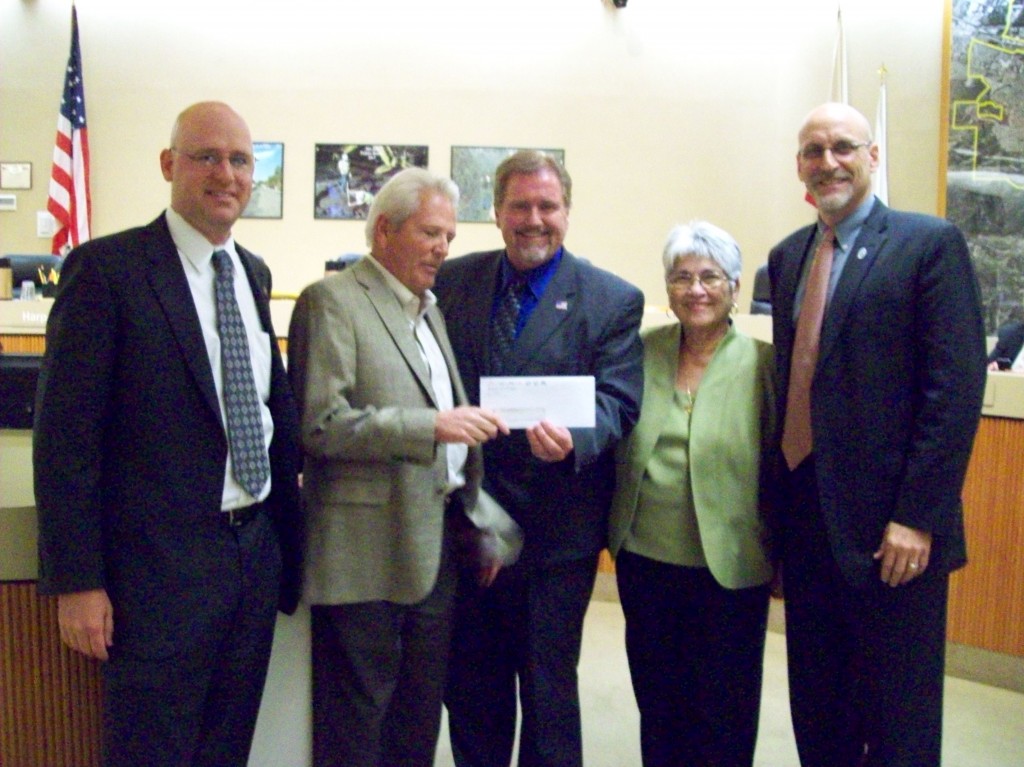
Antioch Auto Center Tom Nokes presents a check for $100,000 to Mayor Jim Davis and Councilmembers

By James T. Ott

Tom Nokes, owner of the Antioch Auto Center presented the City Council with a $100,000 check at the Tuesday, May 22, 2012 council meeting as part of a promise to match the city’s fundraising efforts.

Although the city did not raise quite the $100,000 that Nokes and his son Brian Nokes pledged to match – Tom said they would support the city any way they could and presented the full $100,000 anyway.

City Council Members were heavy in praise for all that Nokes and the Auto Center had done for the city.

Kalinowski said he thought the Auto Center single handedly kept Antioch out of bankruptcy during the last few troubled years and said that the best way for residences to support the city was to shop at the Auto Center.

Mayor Davis said “we appreciate everything you do,” and Council Member Mary Rocha said Nokes “represents the spirit of Antioch.”


Council Distributes Federal Funds to City Programs and Non-Profit Groups

Friday, May 25th, 2012

By James T. Ott

When it came time to approve the spending of Community Development Block Grants, (CDBG), at Tuesday’s City Council Meeting, council members found themselves having to do more with less.

Despite over $2 million in applications from non-profits and programs, in the end the council only had about $763,000 to work with and in the end approved $531,897 in block grants to go toward city code enforcement, housing rehabilitation, downtown curb cuts, job placement and training and small business training.

The council faced losses that could have been utilized for these programs, such as $143,000 in funding the city lost this year when the state eliminated redevelopment agencies. In fact, according to a staff report, the city lost 11 similar grants when the Antioch Development Agency was cut by the state.

CDBG consultant Teri House said that the loss of such redevelopment funds created a “huge impact on [city] programs.”

As a result of decreases in funding and increases in applications, the city said it had a, “very painful decision-making process,” and had to deny many programs this year that it has supported for years such as the Child Abuse Prevention Council, the Contra Costa Food Bank, and the Community Housing Development Corporation.

CDBG consultant Teri House said that the loss of such redevelopment funds created a “huge impact on [city] programs.”

The city allocated $131,897 toward code enforcement to hire its first code enforcement officer since 2009 when budget cuts eliminated the position. The main focus of the officer will be the abandoned/foreclosed homes in Antioch. The city has had an epidemic of squatters of late stemming from the housing crash. This Code Enforcement Officer will help Deputy Director of Community Development Ryan Graham who currently only has the ability to help with the very worst cases in Antioch.

$200,000 will go toward single and multi-family rehabilitation services such as loans to assist in fixing dilapidated buildings, tenant-landlord counseling and infrastructure improvements all in an effort to clean up lower-income areas of Antioch.

$135,000 was set aside for curb cuts to provide easier access for the handicapped.

$50,000 will go toward job training at and placement for struggling residents via Opportunity Junction who are having trouble finding work and $15,000 will be allocated to the Antioch Chamber to fund small business training for Antioch residents who own, or are looking to own a business.

Also at the meeting:

The city council decided Tuesday to table the decision on proposed changes to components of it’s Master Fee Schedule until next city council meeting due to council indecision as to whether or not the changes were currently necessary.

Most of the proposed changes in the schedule were to fees associated with the Police Department and Animal Services, Community Development and Public Works, and a majority of them were slight increases.

The changes are to go mainly toward capital improvement projects and also for a repair and replacement fund for the city’s water and sewer districts, said Antioch Finance Director Dawn Merchant.

The proposed adjustments were made according to a 2010 report by consultants Black and Veatch – a report that Merchant said city staff still felt was valid.

According to a city staff report, Police fees in general are set to go up about 5 percent and city water and sewer rates will increase 8 percent and 4 percent, respectively – changes that were already approved in resolutions back in 2010.

Merchant said that the proposed increases were in accordance with the standard increases according to the Consumer Price Index, which is where the main sticking point for the council seemed to come from.

Councilmember Agopian protested raising fees just because the Consumer Price Index said it could or should be done. Agopian said that it makes it more expensive to live and do business in Antioch and so he is apposed to raising such fees seemingly arbitrarily.

City Manager Jim Jakel said that most of the increases are negligible and most amount to $2 to $6 increases. Jakel and Merchant both said that the fees were made to recoup increased city costs due to things such as rate increases, and may indeed be necessary.

Council Member Brian Kalinowski pointed out that some fees in the proposal don’t increase at all, such as some animal fees that used to require a ten day minimum and now can be paid day by day, potentially saving Antioch residents hundreds.

In the end Kalinowski and the other council members agreed that they would postpone the decision until they could hear more from residents and get more details from staff on the changes.

If the changes are approved they are currently set to go into effect July 1, 2012.

Any changes to the master fee schedule are also set to be brought before city council for review in two years.

Planning Commission Unanimously Recommends Renaming L Street to Marina Parkway

Monday, May 21st, 2012

Cost will be closer to $25,000 and avoid $90,000 in future expenditures. Council to decide Tuesday.

By Allen Payton, Publisher

Following much discussion among commissioners, the Antioch Planning Commission unanimously voted to recommend to the City Council the renaming of L Street to Marina Parkway, at their May 16, 2012 meeting.

Commissioners stated that this will help promote the marina and downtown to anyone driving down the freeway. Commissioner Mark Langford pointed out that although it’s not a parkway, yet, that’s something the city should pursue in the future.

Only three members of the public gave input, including two residents of L Street who spoke against the change. I spoke, as well, providing additional historical background on the issue and in favor of the change.

The renaming idea originated with Antioch’s 1996 Economic Development Plan, that was developed with the help of 100 community leaders, and adopted by the City Council, later that year. It also included changing the name of A Street to Rivertown Drive.

The idea was brought up again, when Don Freitas was Mayor. He stated he liked the idea but thought it best to wait until the improvements to L Street between 4th and 10th Streets were complete, and Highway 4 was widened.

While driving down the freeway a few months ago, I realized the state was in the process of putting up the new off ramp signs. I then sent an email to the Mayor, Councilmembers and City Manager reminding them of the idea of changing the names of L and A Streets and suggested it be done, now before the new signs went up.

Mayor Pro Tem Wade Harper asked staff to pursue the change to just L Street, for now.

City staff explained to the commissioners that this will be the most cost-effective time to make the change and informed them that the cost to change Somersville Road to Auto Center Drive was $90,000 and only included the state’s portion. If the change was made later, the city would have to pay those extra costs, as well as the projected city costs. Director of Public Works Ron Bernal stated that the cost will be closer to $25,000 than the original $40,000 estimate.

While one proposed source of funds to pay for the change is the city’s gas tax funds, there are other potential sources, such as the remaining funds in the Residential Development Allocation program. The council in the past spent $200,000 of those funds to pay for the bluish-grey and silver “City of Antioch” signs seen throughout town.

One attempt by the Council to change the name of A Street to Rivertown Drive, failed on a 2-3 vote, in 1997, since there were three businesses on A Street with “A Street” in their name. Those businesses are now gone or have changed owners and names. Now that A Street is connected to 2nd Street, the suggestion is to rename both to Rivertown Drive. The City Council could decide that at a later meeting, since the freeway widening hasn’t yet reached A Street, giving businesses and residents more time to adapt to the renaming.

The City Council will make their decision on the name change of L Street at their meeting on Tuesday, May 22.

Full Highway Closure Eastbound Highway 4

Monday, May 21st, 2012

The California Department of Transportation (Caltrans) and the Contra Costa Transportation Authority (CCTA) are widening State Route 4 (SR-4) through Pittsburg and Antioch. As part of this construction work, the contractor will be closing all lanes in the eastbound direction of SR-4 from Loveridge Road to Somersville Road on the evenings of Tuesday, May 22 through Thursday, May 24 between 11:00 pm and 6:00 am.

Beginning Friday, May 25 at 6:00 am, eastbound traffic on SR-4 between Loveridge Road and Somersville Road will be shifted to the south over a portion of the Century Boulevard Bridge to allow the contractor to prepare for demolition of the old Century Boulevard Bridge.

Caltrans and CCTA appreciate your patience as we work to improve the highways. For the most current information on lane closures please visit our web site at: http://widensr4.org.

Motorcyclist Struck, Injured by SUV That Ran Red Light on Lone Tree Way

Monday, May 21st, 2012

By Sergeant Quintero, Antioch Police Traffic Bureau

On Sunday, May 20, 2012 at 12:45 p.m., a 29 year old male Oakley resident was traveling eastbound on a Honda motorcycle from Golf Course Road onto Bluerock Drive with a green signal light for his direction. At that same time, a 34 year old female Oakley resident driving a Toyota Highlander was traveling northbound on Lone Tree Way and failed to stop for a red signal light for her direction. The Toyota struck the Honda motorcycle broadside ejecting the motorcyclist into the street and sending the motorcycle to the curb.

The motorcyclist sustained severe lower leg injuries to both legs and was flown to John Muir Medical Center by helicopter for emergency treatment. Although severe, his injuries do not appear to be life threatening at this time. There were no injuries reported by the occupants of the Toyota.

There are no indications that alcohol or drugs were related to this collision.

Bay Area Agencies Approve Preferred Land Use Scenario and Transportation Investment Strategy

Saturday, May 19th, 2012

Plan Bay Area Links Local Aspirations With Goals for a Strong Economy, Healthy Environment and Social Equity

At a packed joint meeting of the Metropolitan Transportation Commission (MTC) and the Association of Bay Area Governments (ABAG), officials voted last night to approve a draft long-range guide to the Bay Area’s transportation, jobs and housing.

The “Preferred Land Use and Transportation Investment Strategy” is a key milestone in developing the final Plan Bay Area, which is due for adoption in April 2013. MTC also voted to approve the “One Bay Area Grants” (OBAG) program, and ABAG approved a draft housing allocation methodology for Bay Area cities.

“We’ve heard over and over that the public’s top priorities are preserving the Bay Area’s high quality of life and each community’s unique characteristics,” said Ken Kirkey, ABAG planning director. “Plan Bay Area will achieve these goals by strengthening the connection between housing, jobs and transportation, by growing jobs and the economy, and by ensuring stewardship of our region’s spectacular scenic and natural resources.”

ABAG President and Napa County Supervisor Mark Luce added that “these actions signify the strides we are making toward adopting a long range plan that links local aspirations with goals for a strong economy, healthy environment, and social equity.”

The Preferred Land Use and Transportation Investment Strategy approved last night by MTC and ABAG steers Plan Bay Area to promote compact, mixed-use development that combines both residential and commercial uses and is located close to public transit, jobs, schools, shopping, parks, recreation and other amenities.

The approved One Bay Area Grants initiative is an incentive-based program designed to stimulate the production of housing in areas well-served by transportation, particularly public transit. It uses federal transportation dollars to reward jurisdictions that accept housing allocations through the state’s Regional Housing Need Allocation (RHNA) process and that actually produce housing.

When completed, Plan Bay Area will be the region’s 25-year blueprint for transportation, housing and land use policies and investments. California’s Sustainable Communities and Climate Protection Act (SB 375, Steinberg) requires that each of the state’s 18 Metropolitan Planning Organizations – and in the Bay Area specifically MTC and ABAG – develop a long-range plan to reduce per-capita greenhouse gas emissions from cars and light trucks. The Bay Area is required to reduce emissions by 7 percent by 2020 and by 15 percent by 2035. SB 375 also requires Plan Bay Area to include a strategy to house by 2035 all of the Bay Area’s projected 25-year population growth, without displacing current low-income residents.

The Preferred Land Use and Transportation Investment Strategy will comprise the Plan Bay Area project alternative to be evaluated as part of the Environmental Impact Report (EIR) required by the California Environmental Quality Act (CEQA). In December 2012, the agencies expect to release the draft Plan Bay Area and EIR, which will be followed by public hearings throughout the region. MTC and ABAG are due to adopt the final Plan Bay Area and certify the final EIR in April 2013.

In a separate action, ABAG voted last night to approve a draft Regional Housing Need Allocation (RHNA) methodology. The methodology will be used to meet state requirements to include sufficient affordable housing for the Bay Area’s projected population growth, so that people won’t have to commute to their jobs from homes outside the Bay Area.

ABAG will take final action on the RHNA methodology at its July meeting.

MTC is the nine-county San Francisco Bay Area’s transportation planning, coordinating and financing agency. ABAG is the council of governments and regional planning agency for the nine counties and 101 cities and towns of the San Francisco Bay region.

For more information on the One Bay Area Plan, visit www.OneBayArea.org.