







Archive for the ‘News’ Category

Antioch City Manager writes first letter to the community

Tuesday, September 9th, 2014

September, 2014

Dear Antioch Resident,

I have been on board as Antioch’s City Manager since January 7th and this letter is to provide you with an update on the City’s recent activities and financial condition.

This effort is part of the City’s Strategic Plan, as follows: “Strategy L-1: Improve community communications and trust in City government and keep the community well informed as to the activities of the City departments.” Along the same lines, we have also implemented written Weekly Reports and Monthly Reports. All these documents are on the City website: www.ci.antioch.ca.us.

The City Council and staff have been very busy the last several months. In January we held four Community Cafés as part of the citywide Strategic Plan development. These were great opportunities for the Council and staff to meet residents who don’t usually have the time to come out to a Council meeting. We gathered a lot of good information from folks on the direction they’d like to see the City head over the next few years. The Council adopted the Strategic Plan on June 10th.

The Council also adopted the fiscal year 2014/15 budget in June. This is the first year that Measure C funding is included in the budget. The Council allocated 100% of the Measure C revenue, projected at $4,489,747 for this fiscal year, to the Police Department and Code Enforcement. This is the planned use of Measure C funds for the seven year life of the measure. The breakdown for 2014/15 is $4,300,847 to Police, and $188,900 to Code Enforcement. Code Enforcement is bringing on another Code Enforcement Officer with their allocation. The Police Department’s goal is to bring the number of sworn Officer staffing up to 97 this fiscal year and to 104 within two years. Unfortunately, retirements and other separations are keeping us from gaining ground quickly. Since January 2013 we’ve hired 26 Officers, but have only gained a net of 4 due to retirements and other separations. Public safety and Police Officer hiring remain our top priorities. The budget document is also available on the City’s website.

The City is actively looking for economic development opportunities. The Downtown/ Rivertown area has been primed for redevelopment for several years. With the downturn in the economy, capital investments dried up. But, now that the economy is improving, things are looking up. The City’s Strategic Plan calls for updating and implemenAntioch City Manager writes first letter to the communityting the 2006 Downtown Plan. The City has issued a Request for Qualifications/Proposals (RFQ/P) for City-owned sites on the east end of downtown. The vision for this location is market-rate, for-sale, transit-oriented residential development. The deadline for developer qualifications and proposals is November 3, 2014. In the meantime, the City will be conducting focus groups to get community input. Once we have a viable proposal, two community cafes are planned to get input on the specifics of the proposal.

The City, having recently obtained full ownership, is now marketing the former Humphrey’s restaurant, located at the beautiful downtown marina. We are seeking an experienced, well financed, restaurateur to renovate the building and bring a quality destination restaurant.

Also related to Downtown/Rivertown revitalization, the City was awarded a $429,000 grant from the California Strategic Growth Council for a Downtown/Rivertown Specific Plan. This plan will analyze the potential development opportunities, especially as they relate to transit-oriented development, creating jobs, and increasing economic vitality. This effort will complement the downtown east project.

Eight months into this job, the most repeated concern I have heard from people is “why can’t Antioch afford more staff, especially Police Officers?” The answer is easy; but solving the problem is hard. Antioch continues to face a severe fiscal crisis. We do not have a spending problem. We have a revenue problem.

Although the citizens passed Measure C in November, 2013, revenues are still inadequate to provide acceptable levels of service to the community and we continue to be among the poorest city governments in the County. With Measure C, our budgeted General Fund revenue for fiscal year 2014/15 is $43,046,381. With a population of 106,455, that puts our per capita revenue at only $404.36. Compare this to our neighboring cities of Brentwood at $817.35 and Pittsburg at $555.84. Comparable sized cities Concord and Richmond are at $681.68 and $1255.75 – a General Fund three times as large as Antioch’s. Since 2007, the City has cut staffing and expenses by over 30%, instituting furlough Fridays and cutting upper management salaries by 10%.

This revenue problem is why the City Council put Measure O on the November ballot. In 2013 a citizens group requested that the City Council add the rental or leasing of residential property to the business license ordinance at a rate of $240 per unit per year. At that time, the City Council decided to only bring one measure forward, and elected to move ahead with the sales tax ordinance (Measure C). This year, Measure O will ensure that residential landlords pay a Business License Tax based on the number of units rented. The rate structure is $250 per year for single family dwelling rentals, and $150 per year for multi-family rental units. In addition, the minimum Business License Tax is proposed to go from $25, where it was in the 1960’s, to $100 (except for non-professional home based businesses, which will remain at $25). Detailed information is on the City web site.

The City Council and City staff are dedicated to making Antioch the best community we can, and we want to hear from you, our residents. Of course, you can connect with the Council at any Council meeting or by e-mail. I also encourage you to contact me directly to share your thoughts or to ask any questions. I can be reached at sduran@ci.antioch.ca.us. I always look forward to your feedback.

Sincerely,

Steven Duran

City Manager
Chamber, Herald to co-host forums for local candidates, Measure O in September

Friday, September 5th, 2014

Tuesday & Thursday, September 16 & 18, Antioch Council Chambers

By Allen Payton

The Antioch Chamber of Commerce and the Antioch Herald will co-host two nights of forums for the eight candidates vying for two seats on the Antioch City Council, the four candidates seeking the two seats on the Antioch School Board, the four candidates, two each for the two districts that included Antioch on the County School Board, as well as Measure O, the Antioch business license tax on the November ballot.

“This will provide the voters in Antioch the opportunity to ask questions of and learn more about the candidates and Measure O, to make a more informed decision before they vote,” said Chamber CEO Dr. Sean Wright.

The first two forums will be held on Tuesday, September 16 from 6:00 p.m. to 9:00 p.m., with a debate on Measure O from 6:00 p.m. to 6:45 p.m., followed by the city council candidates’ forum from 7:00 p.m to 9:00 p.m.

The forums for the two school board races will be held from 7:00 p.m. to 9:00 p.m. on Thursday, September 18, starting with the County School Board candidates at 7:00 p.m, followed by the Antioch School Board candidates at 8:00 p.m.

Both nights will be held at the Antioch City Council Chambers, 3rd and H Streets in downtown Antioch. Be sure to bring your questions and submit them at the beginning of the meeting.

The format will include an opportunity for the candidates to ask each other questions and challenge each the responses from their opponents.

DeSaulnier Social Purpose Corporations bill headed to Governor

Wednesday, August 27th, 2014

A measure by Senator Mark DeSaulnier (D-Concord) to encourage the formation of Social Purpose Corporations is headed to Governor Brown. This bill strengthens previous efforts by Senator DeSaulnier to encourage companies to incorporate with a special purpose.

“It is important that California provide options to socially conscious entrepreneurs,” Senator DeSaulnier said. “This bill will help encourage the formation of businesses driven to do more than just maximize profits for their shareholders. SB 1301 ensures that California remains on the forefront of promoting socially conscious business practices.”

Senator DeSaulnier carried legislation (SB 201) in 2011 to establish a new corporate form—a Flexible Purpose Corporation. This new corporate form integrated the for-profit philosophy of the traditional corporation along with a “special purpose” mission to encourage and expressly permit companies to pursue one or more charitable or public purpose activities in addition to creating economic value for shareholders. Washington and Delaware followed California’s lead in creating similar corporate forms.

SB 1301 renames Flexible Purpose Corporations as Social Purpose Corporations, to more accurately reflect the spirit of the law. SB 1301 seeks to strengthen and clean up the corporate code created under SB 201, by clarifying that directors of Social Purpose Corporations are required—and not just encouraged—to consider a special purpose. This bill also cleans up California code to better conform to other states’ guidelines and new corporate laws that have proven successful in encouraging companies to incorporate with a special mission.

According to the Secretary of State, a total of 62 Flexible Purpose Corporations have been formed since January 1, 2012.

To learn more or contact Senator Mark DeSaulnier visit http://sd07.senate.ca.gov/.

DeSaulnier (D-Concord) represents the Seventh Senate District, which includes most of Contra Costa County and parts of Alameda County.

Give input on county transportation options at Thursday workshop or online

Tuesday, August 26th, 2014

What do you want in Contra Costa? BART? Buses? Bikes? Roads? Ferries?

In an effort to obtain greater input on the transportation needs and priorities of county residents the Contra Costa Transportation Authority will host a workshop this Thursday, August 28 at 7 p.m. at the Pittsburg City Council Chambers located in the Pittsburg Civic Center at 65 Civic Avenue.

The Countywide Comprehensive Transportation Plan, or CTP, is one of the key planning tools called for in the Measure J Growth Management Program (GMP). Specifically, Measure J requires the Contra Costa Transportation Authority to:

Support efforts to develop and maintain an ongoing planning process with the cities and the County through the funding and development of a Comprehensive Transportation Plan

The CTP provides the overall direction for achieving and maintaining a balanced and functional transportation system within Contra Costa – including a series of strategies and implementing actions – while strengthening links between land use decisions and transportation. It outlines the Authority’s vision for Contra Costa and it establishes goals, strategies, specific projects, and other actions for achieving that vision.

The Authority adopted its first Countywide Plan in 1995. The first major update to the Plan was adopted in July 2000. The second major update, which helped define the Measure J Expenditure Plan and GMP, was adopted in May 2004. The third update was adopted in 2009.

During 2014, the Authority will undertake a fourth update to the CTP. The 2014 Issues and Opportunities brochure, (available for download on the CCTA website, below) sets the stage for the 2014 Update.

If you can’t attend Thursday night’s meeting, you can participate online by sharing your ideas and seeing what other ideas have been submitted by visiting www.keepcontracostamoving.net, and calling (925) 256-4720 or emailing 2014CTP@ccta.net to get a copy of the survey mailed to you.

For more information on the CTP, visit http://ccta.net/_resources/detail/11/1.

Highway 4 closures in Antioch area Thursday through Saturday

Wednesday, August 13th, 2014

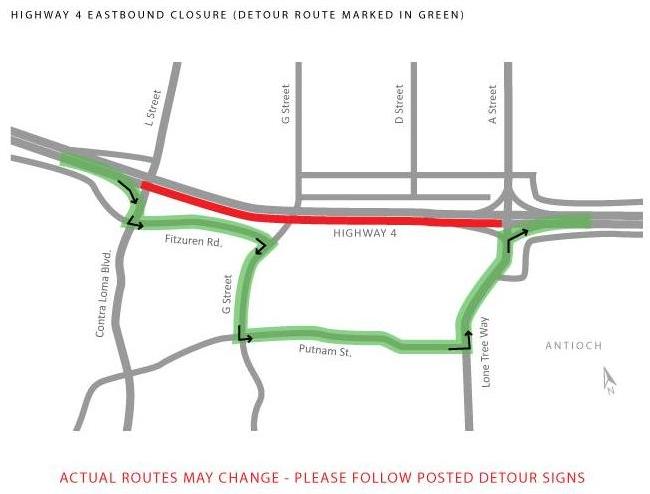
Hwy 4 detour mapThe California Department of Transportation (Caltrans) and the Contra Costa Transportation Authority (CCTA) are widening State Route 4 (SR-4) through Pittsburg and Antioch. As part of this construction work, the contractor will be installing drainage ditch alongside the highway at Contra Loma Boulevard.

In order to ensure crew and public safety during this work, the contractor will close all lanes of SR-4 in the eastbound direction from Contra Loma Boulevard to Lone Tree Way/A Street on the mornings of Thursday August 14 and Friday August 16 from 12:01 am to 4:00 am. And again on the morning of Saturday, August 16 from 2:00 am until 6:00 am.

The detour for this work will be as follows:

o Eastbound motorists will be directed off the highway at the Contra Loma Boulevard off-ramp and left onto Fitzuren Road, right onto G Street, left onto Putnam Street, and then left onto Lone Tree Way and then onto the EB on-ramp.

The Highway 4 projects include improvements to the entire project corridor that will help revitalize eastern Contra Costa County. The projects expand Highway 4 from four to eight lanes between Loveridge Road and SR-160, and add a BART extension from Pittsburg to Antioch (eBART). The projects will also expand the highway from two to four lanes from Lone Tree Way to Balfour Road. This will greatly improve transit accessibility for the region and help reduce traffic congestion and enhance the quality of life for the more than 250,000 residents of eastern Contra Costa County. The projects have been carefully staged to keep 130,000 vehicles per day moving as major construction and demolition work continue, and include over $1.3 billion in State, Federal, Regional Bridge Toll, and Contra Costa Measures C & J sales tax funds.

Caltrans and CCTA appreciate your patience as we work to improve the highways. For the most current information on all Highway 4 corridor closures please visit our website at: http://4eastcounty.org.

Delta tunnels opponents: Gov. Brown’s water bond will be referendum on tunnels

Wednesday, August 13th, 2014

Sacramento, CA – Restore the Delta (RTD), opponents of Gov. Brown’s rush to build water export Tunnels that would drain the Delta and doom sustainable farms, salmon and other Pacific fisheries, today called Governor Brown’s water bond proposal to have taxpayers buy water for future fish flows to satisfy exporter mitigation requirements “nuts.” RTD said the governor’s bond measure is not “tunnels neutral,” and contains $485 million to buy water to replace what will be pumped into the tunnels.

“Charging taxpayers $485 million to replace water sent through the tunnels to enrich mega-growers in Westlands and Kern Water Districts is nuts,” said RTD Executive Director Barbara Barrigan-Parrilla. “With that Ponzi scheme included, this bond will become a referendum on the tunnels.”

The governor’s flow language would allow public funds to be used to purchase water that could be diverted into the Delta tunnels. “The half-billion dollars in funding for purchase of water upstream of the Delta, and later diverted into the tunnels is a massive transfer of wealth from the rest of us to a few mega-growers who hog 70% of the water exported from the Delta,” said Barrigan-Parrilla. “Water transfers are needed by the BDCP for mitigation — essentially they can’t operate the new tunnels without putting more water in the River, which the BDCP will purchase – at taxpayer expense – from water districts and growers in the northern Sacramento Valley.” 

Here is simple language that could fix the bond measure’s shift of costs from water exporters to taxpayers: No water purchased under this division can be used directly or indirectly for exports from the San Francisco Bay Delta. That’s tunnels neutral.

Restore the Delta board member and water law expert John Herrick, said, “Legally it is the obligation of the projects to protect these fisheries and return their populations to pre-project or other levels. Until the projects have undertaken and accomplished this restoration of the fish populations, no public funds should, or can be legally used to recover the fish. Hence, any proposal for state or federal funding of new habitat for fish rearing or purchased water for fishery flows is a transfer of the projects’ contractors’ obligations onto the general public. Such a transfer is not just bad policy, it is illegal.”

The Department of Fish and Wildlife would use up to $485,000,000 from Sections 79733 and 79737 to buy water that would be dedicated under Water Code Section 1707 for in stream use in waterways upstream of the Delta.  However, once that water reached the tunnel intakes it could be diverted into the tunnels. The new wording does not prevent that. This water would be available for export from the Delta the same as any other water purchased by the exporters. The public would be paying for that benefit to the exporters.

Restore the Delta is a 15,000-member grassroots organization committed to making the Sacramento-San Joaquin Delta fishable, swimmable, drinkable, and farmable to benefit all of California. Restore the Delta works to improve water quality so that fisheries and farming can thrive together again in the Sacramento-San Joaquin Delta. www.restorethedelta.org.

Antioch Council won’t fill Agopian’s vacant seat, tables minimum wage discussion

Wednesday, August 13th, 2014

By John Crowder

At their Tuesday, August 12 meeting, the Antioch city council decided not to fill the vacancy created by the death of Councilman Gary Agopian and tabled the idea of setting a minimum wage in the city.

As reported earlier, under state law the council had the option of calling a special election or appointing someone to the vacant seat. However, as city attorney Lynn Nerland pointed out, a special election could not be held until November 19, and the seat is already set to be filled at the general election on November 4. This meant that the only option effectively under consideration was whether or not to appoint someone to the seat, and, if that decision was taken, what process to follow.

Willie Mims, of the East County NAACP, was the only member of the public to speak on the item. He wondered why the city did not yet have a policy in place to fill such vacancies, and told the council that it would be prudent to fill the position, suggesting they find someone with views that were similar to those held by Agopian.

With respect to the need for a policy, Mayor Wade Harper questioned Nerland who confirmed that many cities purposely do not set up a specific procedure to follow in order to allow for flexibility based on the circumstances. Harper also asked how long the process would take to conduct interviews and make an appointment, to which city manager Steve Duran responded that it would typically take 45 to 60 days, leaving only two council meetings before the general election.

Council Member Tony Tiscareno stated that, while he tended to agree with Mims that an application process is more fair than an out-and-out appointment, with ten candidates vying for the two open council seats, it would be better to wait for the election to fill the vacancy.

All members of the council concurred that it would be better to allow the November 4 election to fill the seat, and, on a motion to that effect put forward by Mayor Pro Tem Mary Rocha, they voted 4-0 in favor.

The idea to have a minimum wage law specific to Antioch was also on the agenda. Four members of the public spoke on the issue, two in favor, and two opposed.

In favor were realtor Mark Jordan and Mims, who is a Pittsburg resident. Jordan said that he had raised the issue at a council meeting late last year, and that a higher minimum wage was a “progressive issue,” and about fairness. Mims said that it was important to give folks a livable wage.

Opposed to the measure were Realtor Lori Ogorchock, a candidate for city council, and Dr. Sean Wright, CEO of the Antioch Chamber of Commerce. Both expressed concern that, with the crime rate in the city already negatively impacting businesses choosing to locate here, adding the higher costs of a separate minimum wage would only make the city even less competitive.

Duran echoed those sentiments, also pointing out that staff wages would rise if Antioch increased the minimum wage. “There’s not a lot of upside in that,” he said, referring to the proposed idea.

While council member Tiscareno seemed sympathetic to the idea, he wanted more information. Council Member Monica Wilson expressed concern that raising the minimum wage might negatively impact the ability of the city to bring an end to the Friday furloughs.

Mayor Harper summarized the sense of the council when he said that he would not advocate pursuing a minimum wage for Antioch at this time, and that the council should just move on.

In other news, members of the public were on hand to express their continued dismay over crime in the city, and a handful of people expressed concern that the Nick Rodriguez Community Center might be demolished. Notable among the speakers was Karen Rodriguez-King, daughter of Nick Rodriguez, who opposed the demolition of the center.

In discussing the process undertaken by the city on the Rivertown RFP, the council ultimately decided that, in order to receive more feedback from the public, the bidding process should be extended to October 31. The motion to extend the bidding passed on a 4-0 vote. An extra focus group was also added in order to ensure all interested parties have a chance for input into the plan.

The next regularly scheduled meeting of the city council is set for Tuesday, August 26.

Antioch Council to consider filling Agopian’s seat, minimum wage increase, Tuesday night

Tuesday, August 12th, 2014

By Allen Payton

At their regular council meeting, Tuesday night, August 12, 2014, the Antioch City Council will consider filling the vacant council seat held by the late Gary Agopian, who passed away after a 10-month battle with brain cancer.

According to the Council Agenda for the meeting, “with Council Member Gary Agopian’s death on July 28, 2014, state law provides the following options for addressing the vacancy on the City Council within 60 days of the vacancy:

1) Call a special election to fill the vacant seat, which would arguably not require the City Council to do anything further because the seat is already up for the regular election on November 4, 2014 and the City Council has already called for that regular election; or

2) Appoint a person to fill the City Council vacancy until the election results in November are certified and the elected Council Member seated.”

City staff has included two resolutions for the council to consider, one appointing someone at the meeting, and the other inviting applications for an appointment to the council at a later meeting.

However, an appointment is not necessary under state law and the council can leave the seat vacant, because the regular election will be held on November 4, which is within 114 days of the vacancy occuring. A special election could be called, but not held until November 19. According to staff, “a common sense reading strongly suggests that the regular election in November 2014 should fulfill the statutory option of having a special election.”

Leaving the seat vacant will save the city money, as it would incur no additional staff time, and no salary or benefits would be paid to the appointment Council Member.

If an appointment is made, that person would only serve until the new council members, elected in November, are seated some time in December.

Also on the council’s agenda is a discussion to consider a local minimum wage in Antioch higher than the state or federal minimum wage. Staff has brought the matter forward upon direction from the council, earlier this year, but is recommending against it.

The third major item on the agenda is the Community Outreach and Communications Plan for the proposed Antioch downtown east residential development project, which has become controversial due to the location of the project and the possible tearing down and replacement of the current Senior Center. The proposal is to have meetings with a two focus groups, one made up of seniors who use the center and another group that uses the Nick Rodriguez Center theater, as well as the Chamber of Commerce Economic Development/Government Affairs Committee and the city’s Economic Development Commission between now and October. Staff is proposing to have a council decision on which developer to choose for the project by sometime in October or November.

The Antioch City Council meetings begin at 7:00 p.m. on the second and fourth Tuesdays of the month and are held in the Council Chambers at City Hall, 3rd and H Streets in downtown Antioch or you can livestream them on the city’s website at www.ci.antioch.ca.us or watch them on Comcast Local Cable Access Programming Channel 24.