







Archive for the ‘News’ Category

Harper recall organizers ran ad in newspaper, website with fake committee name, paper takes responsibility

Friday, June 12th, 2015

Recall ad in East County Times.

Recall ad in East County Times with fake committee name.

Collected money without keeping proper records; never formed committee, opened bank account or filed state paperwork

By Allen Payton

In a recent Herald article about the failure of the second recall attempt against him, Harper stated “Now that the recall attempt has ended, I am asking Mr. Buongiorno to please cancel the ‘Committee to elect Wade Harper,’ it is misleading, dishonest and it is not a committee to elect me.” That has opened up other issues regarding how the recall was handled.

Harper was referring to what appeared in an ad the recall organizers ran in the East County Times print edition and online in April.

“The misleading committee was listed within an ad posted on Contra Costa Times,” Harper stated via email.

According to Buongiorno, he was told by one of the remaining recall organizers in April, the day the ad ran, that there was a type-o in the ad. He informed the organizers that it was a violation of state elections law to use a committee name that wasn’t theirs or hadn’t been filed.

By that time, Buongiorno had resigned from the effort, as he was undergoing a kidney transplant.
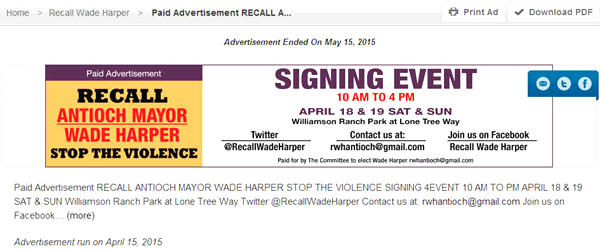
Recall ad that appeared on the Contra Costa Times website.

Recall ad that appeared on the Contra Costa Times website.

Closeup of recall ad that ran on the Contra Costa Times website showing the fake committee name.

Closeup of recall ad that ran on the Contra Costa Times website showing the fake committee name.

Times takes responsibility for “typo”

In an email to Harper, Times’ reporter Rowena Coatsee explained what happened:

“I had looked into the bizarre wording of the ad when it first appeared and at that point contacted the account manager. I’m forwarding you her response, although I’m not sure whether it was she or someone else who actually made the typo.

She explained to me that political ads are required to identify who paid for them and as such they usually contain the wording ‘Paid for by the committee to ELECT (fill in the blank).’ But in this case, unfortunately, whoever keyed in the information didn’t carefully read the heading of the ad ‘Recall Antioch Mayor Wade Harper’ and so he/she wrote the standard verbiage.

She went on to say that yes, we can run a corrected version of the ad, but also pointed out that it might create confusion now that the recall is over — i.e., people might think there’s going to be yet another attempt (there won’t), etc.

But it’s up to you — please let me know what you’d like to do ….”

Harper responded:

“You have stated that this was a “typo.” I reject the idea that this was a “typo” as my name is spelled correctly. In my opinion this was an error in judgment that does harm and discourages any fundraising by the subject of the recall (me). This is my request, 1) refund the cost of the ad to the customer(s), 2) print a retraction stating that this ad was not paid for by Committee To Elect Wade Harper and that this was printed in error. This was a BIG mistake by Bay Area News Group and should never have happened. Thanks.”

“It was someone’s poor judgment,” he added.

When asked who approved the ad, and if all ads require approval before the Times runs them, Coatsee responded:

“I’m afraid I have no idea…Rich indicated (and the updated story will reflect this) that a couple of members of a splinter group went ‘rogue’ and took it upon themselves to place the ad. He says he knew nothing about the wrong wording until someone alerted him — categorically denies authorizing it.

When he saw the wording at the bottom of the ad, he told me he thought it was a typo.

But yes, you’re right — any ad that we run is approved by the person/group that pays for it (obviously) and then goes through a vetting process on our end.

As for our internal processes, I have nothing to do with ads, as you know. Editorial and advertising here are two different departments that almost never intersect (for good reason). So who creates the ads we run, who signs off on them — I wouldn’t know.”

Multi Media Account Manager Karen Cortez, who handled the ad for the Times, was asked who approved it and she responded via email:

“The error in the ad was not the clients fault it was ours. I can simply give the name of the committee. There (sic) contact information was in the ad.”

The ad was run both in the print edition of the newspaper and on their website, she added. “We are publishing a correction statement in the East County Times on Sat. [June 13, 2015].”

Organizers never created formal committee

The Times may have used an incorrect committee name in the ad, the organizers never formed a committee, although they were required to do so, in their effort to recall Harper, according to the Secretary of State’s Political Reform Division, if they raised or spent at least $1,000.

When Buongiorno was asked when the recall committee formed, he responded, “It is required only if you have expenses that exceed $1,000.”

Buongiorno explained what happened after he resigned from the effort, in March, due to undergoing a kidney transplant. He said he passed on the responsibility to a committee of five people who were all agreed to keep the recall going, including Antioch residents Jani Fletcher, Lisa Lacy, Paula Knight, Anabelle Gudilano Donato and Laura Allen Stewart.

“They were given the information, they were given the forms and they were supposed to have done that, but they didn’t,” Buongiorno stated. “I told them I already had a name, of ‘Reclaiming Antioch’ that I was going to put on the form.”

When Paula Knight was asked about forming a committee, she responded, “No we were never informed of that by Rich. We were asked to form a committee, because he was going in for transplant surgery. But, we were never told it had to be done by law. Lie. Never happened.”

“I’ve talked to Jani and Lisa and they don’t know anything about that,” she shared. “All we were told on the recall Harper page. ‘I just got a call by UCSF and I gotta go. You guys have to form a committee.’”

“We only had about five or six people step up, out of 300, to lead the effort,” Knight continued. “We all donated the money for the ad to be placed in the Contra Costa Times. We were never informed we had to file any forms.”

Knight and Buongiorno were the original organizers of the recall.

“Rich handled the first one,” she stated. “We started the second one and Rich, again, got all the information he needed. Never was there a request that we file any forms. Because if he did tell us, it would have been done.”

They paid $500 for the ad in the Times.

When asked if a bank account had been opened, Knight responded, “I think there might have been an account. Anabelle, she set up the ad to go in. She or someone in her family did the graphics.”

“When we started the second recall, some of us donated money for the other expenses,” she explained. “I gave cash to Rich. I remember Rich saying form a committee and open up a bank account, but I don’t know if that was done.”

We put our heart and soul into this, the five or six people who stepped forward. We went door-to-door, set up tables at stores.”

She was sympathetic and understood that Buongiorno needed to back off because of his transplant.

“But, he was home within three days and he was in contact with us, constantly,” Knight added. “Now he’s throwing us under the bus.”

No one is sure if $1,000 threshold was reached, no bank account was opened

“We never had a bank account, because I was the only one spending money, me personally, on my credit card,” Buongiorno said. “That’s it.”

A total of $250 came in through a PayPal account in Buongiorno’s name. That is until the ad was paid for.

“I made sure I had receipts for everything,” he said. “I would say at the most people gave was an additional $50.”

Other than Buongiorno, no one else contributed more than $100, he said.

“Maybe Paula didn’t know,” he offered. “But, the other two did. Lisa and Jani were the ones heading things up. I told one or the other, I don’t remember, because they’re sisters and always together, that they had to form a committee once they reached $1,000.”

“I was told by Arne we had to use Form 460 to report the finances,” Buongiorno stated. “That asks who everyone is and it also says ‘once you reach $1,000.’ Then once you do you have to report it. You can do it earlier, but you have to do it once you’ve hit $1,000.”

Lisa Lacy, Annabelle Donato and Laura Stewart did not respond to multiple attempts to contact them for this report.

However, when a phone number for Lisa Lacy was called, a man who would only identify himself as “one of the proponents,” but later identified as Roger Hudson, answered questions.

“The stuff he [Buongiorno] got he didn’t write down and all we did was collect signatures and get money for the ad,” Hudson said. “We got the truth on our side.”

When asked how much money was raised, he responded, “We got $500. Half of that came from us” referring to the group of individuals helping to pay for the ad. “Nobody contributed $100 or more to us.”

When asked about what Buongiorno said that they had to form a committee and open a bank account, Hudson responded, “He’s lying…to you. He had the committee.”

When Jani Fletcher was reached for comment, she shared about her part in the recall effort.

“I took up the $500,” she stated. “It was all cash. People would give $5, $10. I don’t think a committee was ever formed.”

“It was Amy Landry, Susan Williams and Marie Crandell, that’s who we thought was the committee,” Fletcher stated. “But they dropped out of sight. I didn’t know about forming committees. I was just trying to get signatures. He [Buongiorno] never mentioned nothing about a committee.”

“Rich jumped all over me because I was taking down people’s names and amounts they gave, because I wanted to be honest about it,” she stated. “He said he had no idea how much people had given. I said, ‘Are you kidding? Because this is serious.’”

When told that Buongiorno said no one had contributed more than $100 Fletcher responded, “That’s crap, because I gave him money after money. He collected money at a bar, one time, and at a park.”

“I know some people with a fancy car contributed. That had to be more than $100,” she added.

In response to Fletcher’s accusation, Landry provided the following statement via email:

“Based on my experience during the first recall attempt, Rich was very detailed with information about how and why a committee needed to be formed. Rich provided the information time and time again regarding fundraising and the formation of a committee during both attempts to recall.

I was a tentative member of the committee during the first recall attempt. Before we could even raise any money and finalize the formation of the committee, the first recall attempt ended abruptly (“missed” deadline). It was at that point that personal matters pulled my attention away from the recall. When the second attempt began, I signed the Intent document with the other proponents and donated money (to someone other than Rich) through my PayPal account.

The reason why this matters to me is because the comments made about the original committee are inaccurate and imply that there was some type of dishonesty or wrong doing. I assure you that the lot of us (including Rich) wanted every little aspect to go perfectly because we all knew that one little error could mean the end of all our hard work.”

State requirements for political committees

By law any political effort becomes a committee and organizers must file the required reporting forms, once the $1,000 threshold is reached, according to California Fair Political Practices Commission (FPPC) spokesman Jay Weirenga, stated.

Candidates and other campaign committees are required to file papers with the California Secretary of State’s office and then obtain an FPPC identification number.

Regarding the committee name listed in the newspaper ad David Hoang, Program Technician II of the Secretary of State’s Political Reform Division said “We have no record of a committee with that name.”

“The ad should have also included the Fair Political Practices Commission number,” he added. “You can talk to them about what legal action they can take.”

He said the information on all political committees in California could be found on the Cal-Access website, which lists only two committees with the name Wade Harper included. Those are for both Harper’s 2012 and 2016 campaign committees for Mayor. That information can be viewed, here.

Organizers may face up to a $5,000 fine

“When we would receive a complaint or notice something in a media report, that would raise our attention, we would investigate,” the FPPC’s Weirenga stated. “We don’t do any criminal action, here,” If the DA wants to pursue this, they can use our law.”

“Violations of the political reform act can be fined up to $5,000, based on how complex the case is and how cooperative those involved are, and how egregious and how much harm it can cause the public,” he added. “Those are the kinds of things that are taken into consideration. There are penalties and there are rules to be followed in proper reporting of committee activities.”

UPDATE 6/13/15 9:45 PM: Harper considered filing complaint, but won’t

Harper had said he was considering filing a complaint against both the Times and the organizers of the recall for the misleading committee name.

“I will definitely be looking into possibly filing a complaint,” Harper stated, earlier this week.

However, in an email to the Herald on Saturday, June 13, 2015, Harper wrote “After prayerful consideration I have decided not to file a complaint against the recall proponents (specifically Mr. Buongiorno). I know he has had health challenges. I wish him good health as he recovers.”
Antioch Council denies request of speed bumps by grieving mother, hear about Kids Club

Friday, June 5th, 2015

By John Crowder

The mother of a man, killed in April by a hit-and-run driver, expressed her frustration with speeding and reckless drivers on the street where she lives, and made an emotional plea for the Antioch City Council to take action to prevent further deaths at their May 26, 2015 meeting.

Linda Hudson, the mother of Timothy Hudson, recently deceased, was visibly upset from the outset of her statement. She began by saying, “Two minutes isn’t enough time for me to tell you what I’ve experienced in the last two weeks.” (Due to the large volume of speaker cards submitted, Mayor Wade Harper had reduced the time available for public comments to two minutes per person from the three minutes typically allowed for members of the public to address the council on items not listed on the agenda.)

Hudson went on to relate that, on the 11th of April, a little after 5:00 p.m., and upon hearing a commotion, she went outside to find her son laying in the street.

“This is the second son I’ve buried, out of four children,” she said.

Hudson said, “We’ve called the City to have speed bumps put in,” but staff responded that they couldn’t afford it. She also said, “We’ve called the police department,” and asked them to send someone out to deal with commuter traffic “racing down 11th street [at] 60 to 65 miles an hour,” but was told they were short-handed and couldn’t deal with it.

As she continued to relate the events of that day, on which she said a nineteen year old driver, who was “making donuts in front of my house, a sideshow,” ran over and killed her son, her time to speak ran out. “May I have somebody’s two minutes, please?” she asked.

“No, you can’t do that,” Harper responded.

Hudson was not to be deterred, however, and continued to speak about the incident, while directly addressing council member Mary Rocha, telling her, “Think about it Mary, it could be your kids…” leading to an exchange between her and Harper in which the mayor continued to intervene by telling her, “thank you,” advising that her time was up, and banging his gavel.

Finally, after relating her son’s last words, she moved away from the microphone. At this point, with the audience erupting in loud applause in support of her statement, Harper said, “Thank you, thank you very much, it’s heartfelt, passionate.”

Harper then said, “The request is to take a look at speed bumps, and it’s going to be forwarded to the city manager.”

Relatives and neighbors of Hudson also addressed the council, all lamenting the speeding traffic on 11th street, and asking that speed bumps be installed.

Coincidentally, residents living in the vicinity of Bluerock Drive and Rockford Drive addressed the council with a similar request.

Patrick Shire, a resident of Rockford Drive, requested the City place an all-way stop at the intersection of Bluerock Drive and Rockford Drive because of the traffic that, “has greatly increased.” He said that, “numerous crashes have occurred.” Shire submitted a petition to the council requesting they take action to deal with the matter.

Other residents of the area concurred with Shire’s request, one saying, “The excessive speeds have gotten way out of hand.”

Kid’s Club

Several speakers also addressed the council members regarding the expiration of a lease for Kid’s Club Preschool. This time, the speakers were asking that the City provide them with vacant land on which they could establish a new facility.

Many talked about how much Kid’s Club had meant to them, some relating stories of being able to complete their education only because Kid’s Club was available, providing free child care, allowing them to continue to go to school.

In addition to speaking in support of the program, one speaker, Ariana Santos, submitted a stack of, “over 1000 letters” on behalf of Kid’s Club.

Mark Mokski, Executive Director of the program, began his remarks by saying, “I’m here once again because this community has a problem. We have 300 low-income families that are losing their preschool, their social services.”

After noting that the money to pay for the preschool came from the federal and state government, Mokski said, “We have requested land from the city. We have requested land from the [school] District.”

Mokski then said, “I should not be having conversations with other mayors and other school districts to relocate this program. I do not want to, this is an Antioch program, it needs to stay in Antioch. If it does have to move, these other communities will put a restriction on there that no people from this community can come in. And that’s wrong.”

Mokski concluded, “We can secure portable buildings, we can secure modular buildings, we need help with facility space. Empty land. The City has it. Several parcels. The District has it. Several parcels. Something needs to happen here, very quickly, otherwise the lives of 300 of your most vulnerable population is going to be disrupted.” His last statement was, “We ask for empty land.”

Master Fee Schedule

In regular City business, a public hearing was held on proposed updates to the Master Fee Schedule, with changes to take effect on July 1, 2015. According to the staff report, the strategic purpose falls under the Strategic Plan Long Term Goal of achieving and maintaining financial stability and transparency. “This is achieved through the specific short term objective of reviewing and increasing as many fees as possible annually to ensure maximum cost recovery is obtained,” according to the report.

No member of the public spoke during the hearing on the matter. However, Mayor Pro Tem Lori Ogorchock asked why no changes had taken place with respect to fees associated with animal services. In response, Antioch Chief of Police, Allan Cantando, explained that keeping fees flat would help with animal adoptions, as residents would be more likely to adopt animals out of the shelter, rather than see them euthanized.

Council Member Rocha asked about the bicycle registration fee. She asked for the justification for the fee, given that, “nobody registers bikes anymore.” City Finance Director Dawn Merchant replied that, “The police department isn’t currently collecting this fee.” Rocha then said she would like to see the fee removed from the schedule.

Council member Monica Wilson asked about park fees, prompting a discussion about people showing up early in the morning at parks, camping out to hold spots when nobody has reserved them.

Following the council discussion, the new fee schedule was adopted on a 5-0 vote.

Budget Actions

Another order of business involved action taken on budget items brought back by staff for direction.

The council voted 4-1, with Ogorchock opposing, to reinstate earthquake insurance for City Hall and the police Facility. City Manager Steve Duran explained that the cost for the insurance would be between $71,500 and $81,500 on facilities with a total value of over $38 million.

The council voted 5-0 not to fund additional library hours, but to have city staff continue to meet with Antioch’s County Board of Supervisors representatives in order to obtain County funding for increased hours of operation. Council member Monica Wilson expressed concern that if Antioch funded the library, it would lead to a “slippery slope” of the County pushing more expenses onto the City.

Finally, two Water and Sewer Fund positions were approved by the Council on a 3-2 vote, with Harper and Council member Tony Tiscareno voting against. Council members in favor expressed concern that not funding the positions might leave the City exposed to fines should an accident occur. City Engineer Ron Bernal emphasized this fear, saying that, “related to the water (and the drought)…the fines could be up to $10,000 per day if we’re found to be not in compliance with, best efforts to accomplish that program.” Bernal also stated, “Regarding the sewer side of the house, if we were to overflow into the river, the fines can be in the millions.” “Both programs are in need of the oversight,” he said.

Wilson wanted to know if one person would be sufficient to handle the recommended jobs, but Bernal assured her that there was enough work for two positions.

Still, both Harper and Tiscareno expressed concern with the timing of the matter. Tiscareno said, “We’re talking about a timing issue at this point. Regardless of where these particular funds are coming from, we want to make sure we’re doing what we’re supposed to be, as far as being financially responsible.” He said bringing it back in three or four months would be “a better time.” “I just want to make sure that everybody’s doing what they’re supposed to be doing before we start moving on to new positions.”

On close questioning by Tiscareno, Bernal affirmed that the City is currently in compliance.

Bernal also said it would take a year to hire the staff for the positions, “if approved today.”

Tiscareno asked if they would be able to stay in compliance during that time.

Bernal said he would be, “much more confident” with the positions now.

Harper said, “I don’t want to approve these two positions with contract negotiations still open. I think it sends a bad message. The groups are reviewing our finances…and we’re talking about the financial status of the city, and here we are, possibly approving two brand new positions. I think it sends a bad message.”

After a failed motion to table the matter until a later date, supported only by Harper and Tiscareno, Rocha put forward the motion, which ultimately passed, to hire the two positions. The total cost of the two positions, annually, will be approximately $262,000, according to the staff report.

The next city council meeting is scheduled for Tuesday, June 9, at 7:00 p.m. Meetings take place in the City Hall Council Chambers, located at 200 H Street.

Antioch leaders share good news at annual State of the City luncheon

Friday, June 5th, 2015
Antioch Mayor Wade Harper speaks at the annual State of the City lunch on Friday, May 29, 2015.

Antioch Mayor Wade Harper speaks at the annual State of the City lunch on Friday, May 29, 2015.

By Allen Payton

Antioch City Manager Steve Duran and Mayor Wade Harper shared some surprising news at the Antioch Chamber of Commerce’s annual State of the City luncheon, Friday, May 29, 2015.

The City has come into some unexpected money and will not be running a deficit, starting July 1st, this year, but a small surplus, instead. They also project a surplus for the 2016-17 fiscal year, as well.

That was just part of the positive message shared by them and Police Chief Allan Cantando, at the well-attended event, held at the Antioch Community Center at Prewett Park.

Duran was the first to address the audience.

“There are now, over 108,000 people in Antioch,” he stated. “We surpassed Richmond, last year, as the second largest city in the county.”

“We’re starting to get our sea legs, again. Things are getting better, but not great, yet,” Duran shared. “They [the city council] weathered the storm. We have a double-A rating by Standard & Poor’s.”

He then mentioned the budget surplus, then offered his vision for the city.

“We want to position Antioch as the family friendly, business friendly place,” he said. “Everything is coming our way. The business community needs to have their voice heard.”

He encouraged those in the audience to attend the Downtown Specific Plan Update meeting on June 2 and the General Plan Update meeting to be held on June 17.

Chamber CEO, Dr. Sean Wright, in introducing Cantando, shared a story of his daughter and he greeting some prospective home buyers, recently. He shared how that one type of action can make a difference in attracting people to Antioch and changing the perception people have about our city.

“It’s our job to not hide out in our homes and be scared,” he stated.

Cantando then took the podium and offered a slide show of crime statistics. He spoke of the hostage standoff with the carjacking suspect, just two days prior.

“The narrative should be the Antioch Police Department stepped up and took a scary situation and everyone came out safe,” he implored.

“This whole issue about perception of crime in Antioch, they’re not looking at the numbers,” Cantando stated. “People in this community are making a difference. That’s the perception I have.”

He then shared some of the statistics.

“In the first quarter of 2015, compared to 2014, there’s been over a 13% reduction in violent crime, a 6% reduction in property crimes and a 7.7% reduction in Part I crimes, overall,” he shared. “They call us Little Oakland, Little Richmond. The city to our west had nine homicided in one year. We’ve had one.”

“I didn’t create the stats,” Cantando said defending the numbers. “A crime analyst did.”

“Adult arrests are up 30%. How can that be if crime is down?” he asked. “We may arrest more than one person in a crime.”

He went to share about a “56.8% increase in officer-on-view…officers being pro-active” and “Priority 1 response time is dropping.”

Cantando then mentioned the EBRCS communication system the city recently purchased.

“We are the only city in the county who doesn’t have it,” he stated. “We’ll be online with that system by Thanksgiving.”
He then mentioned the addition of license plate readers in all police cars and body cameras.
“We’re going to be able to protect ourselves better in lawsuits,” said Cantando.

He mentioned all the things being done for youth through the Police Activities League, including “starting a Junior Giants program in partnership with Bank of America; free baseball for eight weeks for kids, in conjunction with the Leo Fontana Foundation; bowling, skating, an after school program, and etiquette classes.”

Cantando also spoke about the new Antioch Police Citizens Police Academy starting later this month.

“The reality is the staff cares,” he said. “We’re talking about how we can work smarter and get the job done. We have a wonderful community.”

“The city manager cares,” Cantando shared. “He understands economic development. Mr. Duran has us living within our budget, within our means.”

“The city council cares,” he stated. “They choose to let staff do their jobs. Each are involved in a different way,” which he delineated.

Then Harper spoke last, offering his words of what sounded like a reelection speech.

“I’m always excited aobut providing the State of the City address,” he said. “I always introduce Antioch as ‘the great city of Antioch.’”

He stated that he teaches two law enforcement classes in Antioch schools.

Harper then spoke about vision and quoted Habakuk 2:2. “Write the vision, and make it plain on tables, that he may run that reads it.”

“We have already developed a vision,” he stated.

He spoke of having good communication with the citizens and the police department.

“Officer complaints are down. We authorized the aggressive hiring of police officers to get to 102 and three more CSO’s [Community Service Officers], thanks to the citizens who approved two tax increases,” Harper added.

He then touched on a list of other things the city is doing, including obtaining a grant for more police officers, “dispatch has been handling calls for service for both Antioch and Brentwood,” he said. “Kudos to Public Works for 726 days without an accident.”

“We want to improve our downtown area,” said Harper. “It won’t happen over night.”

“We will be launching something like a Youth Commission,” he shared. “We want to hear from our youth.”

He mentioned the new Antioch Community Foundation, and being able to make “grants for local programs that benefit our youth” through a partnership with NRG, the power company with a plant on Wilbur Avenue on Antioch’s northeast water front.

Harper also mentioned the water park, and that the “improvements begin, this year, with an all-abilities play area.”

He then spoke about business and economic development.

“Antioch, we are a frienly and welcoming city to business and developers,” Harper said. “We will have to remove the red tape and roll out the red carpet. We have to remain a business friendly and welcoming community.”

“We have a new Smart & Final and Hobby Lobby,” he shared. “Let’s figure out how to kee our Uno’s and Schooner’s…retaining our Lowe’s and auto dealerships.”

“We celebrate being Antiochians with our parades, events, celebrations and ceremonies,” Harper said in conclusion. “Lets’ make it the greatest place to live, work, play and worship. God bless the great city of Antioch.”

Wright concluded the event with a comment of his own about job creation.

“We have a half job for every household,” he shared. “That needs to change. Antioch truly can be the best place to live.”

Sanitary District asks public to participate in East County Survey on unused medicine disposal

Friday, June 5th, 2015

CHILD IN MEDICINE CABINET June2015Poisoning, accidental death and impacts on water quality are some of the negative consequences facing local communities due to the improper storage and disposal of medicines. As the lead agency for the Delta Household Hazardous Waste Collection Facility, Delta Diablo Sanitation District has joined with other local environmental stewards, law enforcement agencies and public health advocates exploring opportunities to increase medicine disposal opportunities in East Contra Costa County.

Please help our efforts by completing a brief, five minute survey with questions about the guidance, if any, you have received from prescribers, current disposal practices, and what disposal locations would be most convenient for your family. Responses will be kept confidential and pooled with other East Contra Costa residents.

Click here for the survey. Thank you.

Antioch ARCO owner shares experience of being held hostage, offering to be human shield for carjacking suspect

Friday, June 5th, 2015
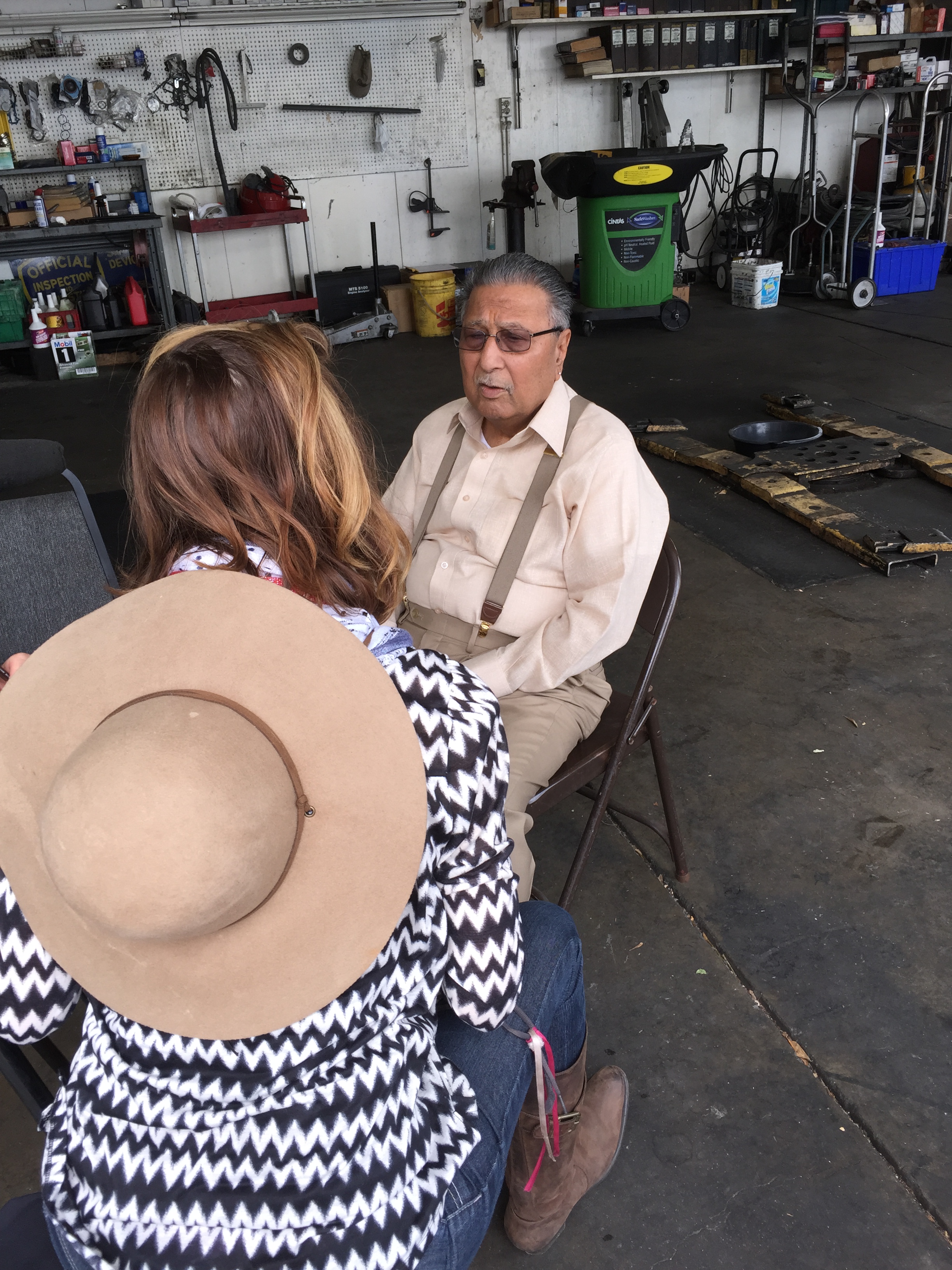
ARCO station owner, "Jack" Bhalla is interviewed the day after being held hostage for three hours, on Wednesday, May 27, 2015.

ARCO station owner, “Jack” Bhalla is interviewed by a TV news reporter, the day after being held hostage for three hours, on Wednesday, May 27, 2015.

By Allen Payton

The very brave owner of the ARCO gas station in Antioch, where the hostage standoff occurred, on Wednesday, May 27, 2015, Jagdish “Jack” Bhalla shared about his experience being held hostage with his employee, Tony, by a gunman and car jacking suspect.

I spoke with him, at his service station, the following day, after being interviewed by reporters from Channels 4 and 11.

Here is his story:

“I was standing here,” Bhalla said sitting inside the garage of his gas and service station. “Tony was standing there [pointing to the driveway near the gas pumps] and saw people running. By the time we figured things out, we heard a pop. I don’t know from where. I saw one person running this direction and a police officer following him with a gun in his hand.

He ran and hid behind dispenser [gas pump] three and the police officer was in the driveway.

Tony told me go to the office. The man ran into the mini mart and into the garage. We ran into the office and locked it from inside.

He tried to break one of the side windows to get out but it was welded.

He came to the office and told us to open the door. Then he broke open the door. He told us ‘I’m not going to harm you.’ Then he made a barricade against the door.”

They were in the office with him for about three hours.

“We had the air conditioning going in the office. We tried to break the silence. He was breathing really hard. So, I offered him something to drink. He drank a bottle of Brisk tea.”

In the meantime, the police were calling on the business phone.

He was instructing me to pick up the phone or not pick up the phone. He was the one taking directly to police. He would not allow us to talk. I offered him something to eat and he said ‘no thank you.’

He was very polite and gentle to us. He never used any hard language with us.

For some reason he was feeling dizzy and his revolver was slipping out of his hand, which he’d been holding the whole time.

We tried to run out because he was dozing. But the door [inside the mini mart] was stuck.

After that he took us back in the office. After about five minutes he told Tony ‘let him get out, open the door,’ [refering to Bhalla]. But the door could not be opened. So we went back to the office.

He didn’t hurt us. He never pointed the gun at us.

At one point I told the guy ‘your parents will see you dying if you go out. The police will shoot you. I can be a human shield so the police won’t shoot you. I will protect you and they will arrest you. If you go by yourself, they will shoot you.’

All the time he was very respectful of me and Tony. I befriended him.

After a few minutes he said to Tony ‘open the garage door and he let Bhalla out.’

About a half hour later, he let Tony out, as well, because Tony pursued him to surrendere. He emptied the revolver and gave it and the bullets to Tony, who dropped them in the safe. After that Tony was much more comfortable. He also had a stun gun which he also handed to Tony.

Then he let Tony out and then surrendered.”

Bhalla, who lives in Concord, and is in his 70’s, has owned the gas station since April, 1992. Tony lives in Pittsburg.

When asked about his and Tony’s health, following their ordeal, he responded. “Tony has worked here over two years. He’s about 40 [years old] and he’s OK.”

“They checked me out when I got to the police station,” Bhalla added. “When they put me in the armored car I hurt my knee.”

Bhalla wanted everyone to know that he plans to tear down his current building and replace it with a new, larger facility and has begun the approval process with the city to do so.

Federal funds on way to combat invasive weeds in the Delta

Thursday, June 4th, 2015

New Funding will Aid in Enhanced Coordination among State and Local Partners along with USDA to Eradicate the Menacing Plants with more Effective Methods of Control

(Stockton, CA) San Joaquin and Contra Costa County leaders today applauded $1 million in new funding from the U.S. Department of Agriculture‐Agricultural Research Service (USDA‐ARS), Area-wide Pest Management Program to help in the ongoing battle to control the invasion of aquatic plants in the Delta.

“We wish to thank the USDA, and also acknowledge the important role of our local legislators and congressional delegation, along with other State, federal, county and community partners to secure these much needed federal funds to control these aquatic weeds that have severely impacted our local economy and all those who do business in the Delta Region,” said Supervisor Kathy Miller. “These invasive plants have sucked the oxygen out of our Delta’s waterways, prevented ships from reaching the Port of Stockton and deterred visitors from reaching marina businesses due to clogged waterways.”

“The funding received could not have come at a better time due to the ongoing drought and unseasonably warm temperatures. The funds will be invested in improved coordination so these weeds and the mosquitos that nest and breed in them could be eradicated once and for all,” said Supervisor Mary Nejedly Piepho. “This is the result of parallel efforts by local, state and congressional leaders to fight the scourge of water hyacinth with tools that are equal to the scale of the infestation,”

Assemblymember Susan Talamantes Eggman said. “This infusion, and the operation it funds, in combination with the additional $4 million in ongoing state funds secured by Delta representatives in the State Legislature, is a significant augmentation of the arsenal we have to deploy against water hyacinth.”

“This federal funding represents a direct investment in the health of the Delta as an economic driver in the region, and our ability to eradicate dangerous and invasive plants from its ecosystem. It will provide critical new tools to better manage the growth of these aquatic weeds that can obstruct waterways and stifle the ability to provide water for urban and agricultural uses. I am thankful to the USDA and all of our partners who came together to address the threat that these invasive species can have on the Delta economy, environment, and agriculture,” said Congressman Jerry McNerney (CA‐9).

“Invasive species is a chronic problem in California which impacts hundreds of species. Eradicating water hyacinth is critical for healthier waterways, a better boating experience, expanding commerce at our ports and operating California’s water systems,” said Congressman Jeff Denham (CA‐10).

“These federal funds will enable communities in the Delta to make use of new techniques that have proven to be far more effective in controlling the weeds than prior eradication methods that were ineffective and expensive,” stated U.S. Rep. Mike Thompson, Co‐Chair of the Invasive Species Caucus. “We all know invasive species pose a costly challenge to infrastructure, agriculture and the environment. These are preventing ships from reaching port, discouraging visitors and hurting business. By making use of new and better eradication techniques, we can get our delta waterways back to the healthy state on which so many jobs and businesses depend.”

“This team effort jointly spearheaded by stakeholders in San Joaquin County, Contra Costa Counties, and the federal government will help address the invasive aquatic weeds that pose an environmental risk to our communities, which depend on the Delta to provide valuable water resources to the area,” said Congressman DeSaulnier (CA‐11).

“We’ve all seen how the drought has made the problem of invasive species worse in the Sacramento‐San Joaquin Delta. Water hyacinth, Brazilian waterweed and emergent giant reed present massive threats to agriculture, navigation and the environment. As a member of the House Invasive Species Caucus, I am proud that we have worked together at the local, state and federal level to prevent further harm to our health and to the local economy,” noted Congressman John Garamendi.

The inter‐agency partnership for improved control is targeting floating water hyacinth and submerged egeria or Brazilian waterweed, as well as the shoreline giant grass known as arundo. All three plants are non‐native and invasive and produce flowers, but typically spread via buds and fragments borne by Delta currents. They can grow throughout most of the year in the Delta. In the summer and fall of 2014, the Stockton Deepwater Ship Channel, Port of Stockton, private marinas and public boat ramps, and the state and federal water pumping stations around Tracy were plagued with dense mats of water hyacinth that made navigation dangerous or impossible, restricting commercial shipping and trapping recreational boats in their slips.

Water hyacinth and egeria also reduced water flow to the South Delta pumping facilities, requiring removal of tens of thousands of tons of plants over the fall and winter with conveyer belts, backhoes and huge dump trucks. Dense aquatic weeds caused similar problems in Discovery Bay and elsewhere in Contra Costa County. The mats of aquatic weeds made control of mosquitoes by the San Joaquin and Contra Costa County Mosquito Vector Control Districts more difficult. Mosquito outbreaks led to detections of West Nile virus in mosquitos and birds in both counties in 2014.

The USDA‐ARS Delta Areawide project, which first received funding in June 2014, is designed to develop and implement principles of IPM, to increase the efficiency and success of control of water hyacinth and other invasive aquatic plants, and to improve coordination among agencies responsible for their management in the Delta. Some of the funds will also be used to improve control in the western Delta in Contra Costa County. Key participants include the USDA Agricultural Research Service, Exotic and Invasive Weeds Research Unit in Albany and Davis, which is leading the project and conducting research to improve weed control efficiency.

The NASA‐Ames Research Center in Mountain View is using satellites, areal images and visual models based on water nutrients and flow to pinpoint and predict where water hyacinth and other aquatic plants are growing and moving. This critical information is being used by California State Parks, Division of Boating and Waterways to prioritize the worst invasive populations of water hyacinth for treatment with herbicides and mechanical removal under its state‐funded programs.

The San Joaquin and Contra Costa County Mosquito Vector Control Districts are receiving funding to augment their efforts to control mosquitos near aquatic plant‐invaded waterways. Several departments at UC‐Davis are also involved, providing new knowledge of weed and mosquito biology and an economic model to track project success. New partners this year include the California Department of Food and Agriculture‐Plant Health and Pest Prevention Services, and the Sacramento‐San Joaquin Delta Conservancy. The ultimate goal of the Delta area-wide project is to reduce or eliminate the economic and environmental damage caused by large populations of water hyacinth and other invasive aquatic plants, thereby improving protection of water resources and Delta habitats.

City removes unauthorized speed bumps placed on Antioch street for grieving mother, provides process for approval

Monday, June 1st, 2015

By Allen Payton

A pair of speed bumps placed on 11th Street in Antioch on Friday, without city authorization, were removed by city workers, Monday morning. They were placed in response to the desires of Linda Hudson, who lives on the street and is the mother of Tim Hudson who died as a result of being hit by a car, there, last month.

At the same time the speed bumps were being removed, Hudson and her husband Jerry, were attending the funeral for their son, according to other news reports.

Mrs. Hudson spoke at last Tuesday night’s council meeting, in an attempt to get the city to place the speed bumps on the street where she lives. But, the city has to follow state standards and city policy, according to City of Antioch Public Works Director Ron Bernal.

Had the speed bumps been allowed to stay and an accident occurred as a result, the city could have been held financially liable.

“We [city staff] got together this morning,” Bernal said. “We developed a plan to deal with the installation, that did not follow the policy in place, which was adopted in 1998.”

Regarding the removal occurring during Tim Hudson’s funeral, Bernal responded, “We did not know the family was at the funeral. It was not our intent to upset the family when they were grieving over their loss. We wanted to do it as soon as possible, because we feel it was a liability.”

The process for placing speed tables on a city street, as the city refers to them, has eight points that need to be satisfied.

First, 75% of the affected property owners have to approve of the placement of the speed tables;

Second, the speed tables, and related signing and striping must be placed at no cost to the city;

Third, the following agencies must sign off including Antioch Police Department, Contra Costa Fire Department, Tri Delta Transit and the Antioch Unified School District;

Fourth, a speed survey must be conducted;

Fifth, the speed tables can only be removed upon receipt of petition of 51% of affected property owners;

Sixth, the petition to gather the signatures of affected property owners must include a copy of this list of conditions;

Seventh, construction of the speed tables can be done using either city staff or by a private contractor; and

Eighth, items 1, 2, 3, 4 and 6 must be satisfactorily completed, before approval can be obtained.

Please click here to view the details: Speed Table Conditions.

“Could they possibly satisfy the conditions to install the speed tables? Yes. But, the city doesn’t currently budget for them,” Bernal added.

If the Hudsons or their neighbors want to pursue the issue, they will have to follow the process to get speed bumps placed on their street, again.

Antioch Council approves water and sewer rate increases, Ogorchock votes against tiered rates

Friday, May 22nd, 2015

By John Crowder

The Antioch City Council, on two votes, one split and one unanimous, voted to increase both sewer and water rates for Antioch residents, at the May 12 council meeting.

Following a public hearing at which Antioch residents spoke out against Water and Sewer Rate increases proposed by city staff, and Mayor Pro Tem Lori Ogorchock questioned the need for tiered water rates, the council approved both.

The first vote on the tiered rates was split, with Ogorchock casting the lone dissenting vote and the second vote, for capacity charges, passing unanimously.

According to a staff report by City Engineer and Director of Public Works Ron Bernal, “The proposed rate adjustments are necessary to maintain the financial stability and the structural integrity of the City’s Enterprise Programs.”

He also said, “If these enterprise funds run dry, the General Fund would be tapped to provide the funding necessary to operate the enterprises.”

According to Bernal, the rate adjustments were due to, “new regulatory mandates, as well as increased costs affecting both Water and Sewer operations.”

He listed operating and maintenance expenses including labor, utilities, supplies and materials, and capital expenditures for infrastructure. Bernal also referenced, “the rising costs of purchasing and treating water.”

This year, due to the high salinity levels in the river, from where Antioch usually pumps most of it’s water, the city is having to purchase 95% of its untreated water from the Contra Costa Water District.

Under California law, a city council is unable to increase water rates if half of those impacted by the new rates object in writing. In order to ensure compliance with the law, during a break in the proceedings, City staff publicly counted all written objections to the proposed rate increase that had been received, and at the conclusion of the process the council was informed that only 54 comments had come in. The threshold for preventing the increase, based on the 31,056 notices sent to the public, was over 15,000 comments required to be in opposition.

Tiered rates

In a lengthy discussion regarding the rate increases, council members, in particular Ogorchock and Rocha, questioned why a “tiered rate” was necessary, with Rocha pointing out that a larger family in a single household would be required to pay higher costs per person, even when they were using less water per capita.

At one point, Ogorchock put forward the idea of a motion that would allow for an overall increase, but with only one rate.

After comments by City Manager Steve Duran and City Attorney Lynn Nerland, however, with each pointing out that under her proposal the rate for the people who would have been under the lowest tier rate would be subject to a higher rate, it was determined that such a decision would require another notice be sent to the public notifying them of the new rate structure, and she determined not to pursue her idea.

Water and sewer funds used for police, other budget items

Another issue raised by Ogorchock dealt with money being transferred out of the water and sewer funds.

“When I’m looking at the study, the sewer fund, Fund 621, when I’m looking at transfers out, and it has with rate increase and with no rate increase, what are the transfer outs for ‘15-’16 for $602,375? Then in ‘16-’17 they’re going to go up to $678,592, do we know that?” she asked.

Merchant responded to Orgorchocks questions.

“So, there’s several transfers out that are part of there,” she said. “A few hundred thousand goes to pay for police services protecting the water and sewer enterprise. The sewer fund has the transfer out as well, There’s a hundred thousand dollars that goes toward capital project sidewalk improvements, which is paid for out of the capital improvement fund. Part of the transfers out go to pay for GIS services…mapping the water and sewer lines in the ground, so it’s broken up into several portions of that.”

In response to a further query by Ogorchock, Merchant said, “And in the water fund the transfers are of the same nature.”

Public Works staffing rejected

During an earlier special budget session, prior to the regular council meeting, Mayor Wade Harper was joined by Antioch City Council Members Tony Tiscareno and Monica Wilson in a 2-3 vote to reject a proposal by city staff to hire two new technicians requested by Antioch’s Public Works department. Council Member Mary Rocha and Ogorchock, who had made and seconded the motion to approve, voted for the positions.

Had the positions been approved, an additional expense of $131,000 per year would have been added to the City’s Water Fund and the same amount added to the City’s Sewer Fund, for a total of $262,000 in additional salary expense.

According to a staff report submitted to council members by Dawn Merchant, Antioch’s Finance Director, the positions were needed in order, “to make sure that data collected in the field is complete and accurately recorded to comply with State and Federal regulations as they apply to Water Distribution,” and so that reporting related to sewer management, “compliance is timely and accurate.” Other duties the positions would have assumed included coordination of training and providing education to the public.

During discussion regarding the positions, Harper, noting that only four months had elapsed since city worker furloughs were ended, asked why the duties to be performed under the new positions could not be done by current staff, perhaps through reclassification of certain jobs.

Mike Bechtholdt, Deputy Public Works Director for Antioch, responded to Harper.

“It’s strictly volume of work,” he stated. “Our Admin Staff, which is attempting to do some of this, they’re overwhelmed with calls and they’re starting to fall behind. And when you have water and sewer calls, you cannot fall behind. One fine, will more than pay for both of these technicians for years. So that’s why, one of my first statements was, we look at this as a defensive position.”

“We run the risk of liability and fines, and that’s the main reason for proposing this, basically trying to stay out of trouble and stay compliant,” he added.

Tiscareno expressed concern over the timing of the hiring proposal.

“I support the positions,” he said, “I don’t support at this particular time.”

After Tiscareno’s statement, Harper added, “My feelings are similar, I support it but not at this time.”

“We have to look at this in light of that entire department,” he added, and referenced the current salary negotiations being undertaken by the city and employees.

Wilson then stated she also felt the timing was wrong, and that, at this time, “we’re asking a lot of the citizens.”

The next city council meeting is scheduled for Tuesday, May 26, at 7:00 p.m. Meetings take place in the City Hall Council Chambers, located at 200 H Street. They can also be viewed on Comcast Channel 24 or via live stream on the city’s website at www.ci.antioch.ca.us.

Allen Payton contributed to this report.