







Archive for the ‘News’ Category

Antioch School District 2018-19 budget decreases again, this year by $4.2 million

Thursday, June 14th, 2018

Board discusses LCAP, LCFF; support staff contract approved

By Robert Pierce

At the June 13, 2018 Antioch School Board meeting all five trustees discussed the draft Local Control Accountability Plan (LCAP) and preliminary budget for the 2018-2019 school year. They also approved the tentative collective bargaining agreement between the district and California School Employees Association for non-teaching support staff, and several new district policy items that were voted on as a group. Summary of Tentative Agreement CSEA

The meeting began with official congratulations to the recent high school graduates, and a happy birthday message by the rest of the board to trustee Walter Ruehlig.

There was a single comment from the public by Mary Rocha, who is planning on running for the board in November’s election. She urged the board to reconsider their decision and “if nothing else, slow down” the development of two new charter schools, which the board authorized last month. Rocha cited concerns with budget and documentation as reasons to reconsider.

“I ask you to reconsider, because, in the end, we are going to be affecting our own school system and our own employees,” Rocha said.

Back on the main agenda, district reports were given on both the LCAP and the Local Control Funding Formula (LCFF) by Dr. Jason Murphy. 2018-2019 LCAP District Report

According to the official district website, “The Local Control Funding Formula (LCFF) is a California funding calculation that recognizes that students with additional academic needs – low-income, English language learner, and foster youth students – need additional financial resources to support their education.”

The district LCAP website

The LCFF provides a per-pupil “base grant”, a “supplemental grant” for every student in one of the target areas and a flat “concentration grant” for districts with more than 55% of their students in one of those three groups. The LCAP, in turn, is a “planning tool” in which the district uses to report how they are going to use that funding, as well as the effectiveness of the programs and services the funding was used on.

Specifically, the LCAP, which AUSD has received funding from since the 2013-2014 school year, has local districts tie their budgets to concrete improvement goals. AUSD’s LCAP for this year currently has six LCAP goals, which according to Murphy were designed to mirror both state priorities and Maslow’s hierarchy of needs and include goals such as “Provide effective and enriching learning environments,” “Build inclusive school communities” and “Reduce the achievement gap amongst student groups.”

Murphy brought with him several students and parents from district high schools to comment on their involvement with the process of developing an LCAP. All of them spoke highly of their experiences with the program and expressed a desire for greater student and community member involvement, even at the middle school level.

Trustee Debra Vinson asked how the efficacy of a program is tracked, specifically programs dealing with behavioral justice, and mentioned the district’s current struggles with high suspension, expulsion and absenteeism despite heavy investment in programs such as “Positive Behavioral Interventions & Supports”. Vinson also asked how it is determined when and if a program needs to be dropped entirely.

Murphy responded that there is an on-going process of in-depth analysis of each program and service associated with LCAP, a big part of which involves getting community feedback and perspectives from students and parents, and using this data to help shape LCAP goals, mentioning specifically that they are actively working on using grant money to bring in more mental health professionals.

Murphy also explained that they have a vetting process for any vendor they choose to do business with, but for vendors who already passed the vetting and have a contract but are underperforming, information and data on the programs and services that vendor provides are available on the district website so that any staff member or community member can see how well they are working and use the data to have “critical conversations.” For Murphy, getting the LCAP data online, publicly available, was a major goal.

“We thought our theory of action would necessitate that we develop a process that includes all stakeholders,” he stated. “Available on the district website… is the list of all of our stakeholder engagement opportunities.”

Murphy said he strove for more engagement with stakeholders “whether they are students, parents, staff members or even community members” so that they can collaborate directly with the district to improve LCAP goals and processes. Another stated reason for online engagement was so that community members could interact with LCAP even if they were unable to physically attend meetings on it.

Vinson also specifically asked about the potential creation of a Restorative Justice program and a school site Climate Team to tackle issues regarding bullying and student emotional trauma that affect student attendance and classroom behavior; Associate Superintendent Christine Ibarra responded that she currently has a team looking into that issue and considering multiple solutions to it including Restorative Justice.

Ultimately Ruehlig reflected that it was a lot of information to digest, and trustee Diane Gibson-Gray encouraged parents and students to reach out with their ideas.

District reports were also given on the 2018-2019 preliminary budget by several staff, chiefly Associate Superintendent Teresa Santamaria.

Santamaria highlighted that the full implementation of LCFF, the elimination of gap funding, rising expenditures and a potential recession are creating “a huge squeeze for local education authorities.” While revenue assumptions per grade level based off of ADA grants rose about $200, drastic shifts in both federal and local revenue sources as well as rising salary and benefit costs for many employees created said squeeze.

Despite all of that, however, the district only lost $4.2 million this school year compared to a loss of $9.9 million last year, and the district will remain in the black this year as well.

“Looking at this number, we can definitely say the budget year 18-19 will be positive,” Santamaria stated. However, she explained that in the long term, due to revenue losses and expenditure increases as well as the opening of new charter schools in the area, “there will be a huge impact on our fund balance.”

The full preliminary budget

Santamaria declared that the full budget will be presented at the June 27 meeting and will include more in-depth discussion of “the major components of the budget” as well as “multi-year budget projections” with true budget balance being a huge goal for the future.

In addition to district reports, there were public hearings for both the LCAP and the preliminary budget, despite the public having already had chance to comment; Board President Gary Hack observed that it was a “silly” situation but, required by law. Predictably, both public hearings ended without any comment.

No votes were taken for either item during the meeting. The final adoption is expected to occur at the board’s meeting on June 27.

Employees Association Contract Approved

“Disclosure and Ratification of the Tentative Agreement Between Antioch Unified School District and California School Employees Association for 2017-2018,” was passed 5-0 with little to no discussion by the board, merely accepting the result of a collective bargaining agreement already settled by the district required by law to be publicly disclosed before final confirmation. The settlement included extra pay and benefits and a definitive workweek of five consecutive days Monday through Friday for most employees. The district also commended both sides of the negotiation. The full settlement, ratified 5-0

To view the complete meeting, visit the District’s YouTube Channel.
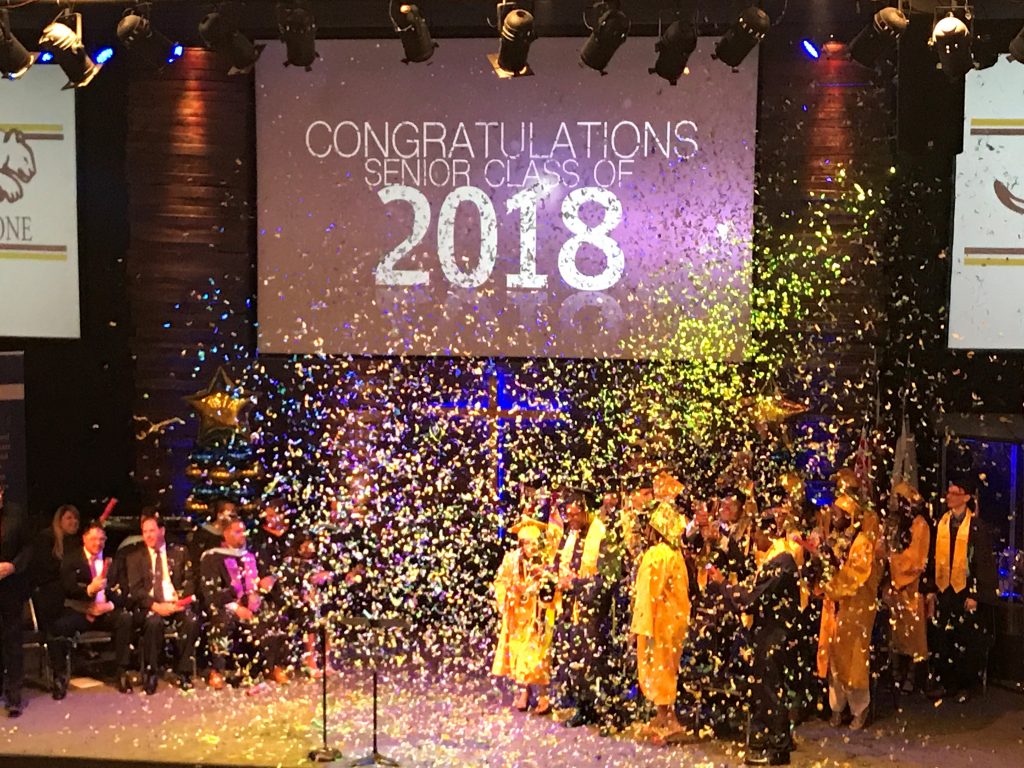
Antioch’s Cornerstone Christian School celebrates Class of 2018

Thursday, June 14th, 2018

Cornerstone Class of 2018 graduates, faculty and staff celebrate on Thursday, June 7, 2018.

Article & photo by Denise Baquing

Cornerstone Christian School’s graduating Class of 2018 included some top performing students.

Valedictorian Ryan Sierra earned a GPA of 4.14 and will be attending Grand Canyon University where he will major in mechanical engineering.

Salutatorian Michaela Felmann earned a GPA of 3.98 and will be attending Los Medanos College.

Cougar of the Year Jordan Edwards earned a GPA 3.9 and will majoring in computer engineering, also at Grand Canyon University.

Jordan has played three years of varsity basketball and received All League honors in both his junior and senior years. He’s maintained his high grade point average while serving the school in multiple ways, including being elected as President of the Student Government.

Jordan has volunteered at Royal Family Kids Camp where he’s been a counselor to foster kids, and he’s been a part of the youth leadership, at Cornerstone.

Cornerstone Christian School is located at 1745 E. 18th Street in Antioch and serves grades K-12. For more information about the school visit http://www.cornerstonechristianschool.net/.

Antioch High sends off 300 graduates into the world

Wednesday, June 13th, 2018

Salutatorian Diego Gonzalez Ventura and Valedictorian Diana Muñoz speak to their classmates on Friday night, June 8, 2018. Photos by Luke Johnson.

By Jesus Cano

Not even the strong winds infiltrating Antioch High School’s Class of 2018 graduation could have ruined the milestone celebration for its students.

But that is just one of the adversities the class had to face during their tenure as Panthers.

Something expressed deeply by many of the speakers was how discontent they were about not having a cafeteria throughout high school. In addition to that, during their sophomore year these scholars did not have their home, outdoor multi-purpose athletic facility (Eels Stadium), as it was under renovation.

That foreshadowed what these students were able to receive over time. Principal Louie Rocha pointed out that these students were able to witness the opening of the new library and media center.

But at the end of their high school careers, many of the students felt that walking across the stage was well worth the struggle.

Valedictorian Diana Muñoz and Salutatorian Diego Gonzalez Ventura both touched on the subjects about being children of immigrant parents in their speeches, but Gonzalez Ventura additionally spoke about his denial into both Dozier-Libbey and granted admission into one of Deer Valley’s academies.

“The best decision of my life was withdrawing my petition for appeal at Deer Valley,” Gonzalez Ventura said. “I got to create a whole new family here at Antioch.”

This was a smaller class for Antioch, with only 300 graduates, but Rocha saw unity. It was demonstrated by them organizing a rally on the National Walkout day to spread awareness about gun control following the tragic school shooting in Parkland, Florida.

“This class really highlights a strong sense of community,” Rocha said. “I think they’re going to make a difference in the years to come.”

See more photos on the Antioch Herald Facebook page.

Antioch High Class of 2018 graduates celebrate.

Nationwide Operation Broken Heart results in online child exploitation arrests in county

Wednesday, June 13th, 2018

Investigators with the Contra Costa County Internet Crimes Against Children Task Force recently participated in the nationwide Operation Broken Heart, a nationwide effort to investigate individuals exploiting children on the internet. Throughout March, April and May, the team conducted investigations of subjects who distributed child pornography over the internet and focused on individuals traveling to Contra Costa County to meet minors to engage in sexual activity.

In addition to the proactive investigations the ICAC team participated in, a significant school outreach program was also undertaken to teach parents and students about the risks associated with smartphones and social media. During the three-month period, investigators and prosecutors delivered presentations at six schools, reaching 140 parents and over 300 students. During the 2017/2018 school year, the ICAC task force has delivered presentations to over 300 parents and over 2,800 students in Contra Costa County.

The three-month nation-wide operation by the ICAC Task Force Program resulted in the arrests of 2,300 suspected online child sex offenders.

“No child should ever have to endure sexual abuse,” U.S. Attorney General Jeff Sessions said. “And yet, in recent years, certain forms of modern technology have facilitated the spread of child pornography and created greater incentives for its production. We at the Department of Justice are determined to strike back against these repugnant crimes. It is shocking and very sad that in this one operation, we have arrested more than 2,300 alleged child predators and investigated some 25,200 sexual abuse complaints. Any would-be criminal should be warned: this Department will remain relentless in hunting down those who victimize our children.”

Some notable arrests and investigations conducted during Operation Broken Heart include:

-On April 6, 2018, investigators arrested Russell Meirose of Milpitas, California. Meirose was arrested after chatting online with someone he believed to be a 13-year old girl and enticing her to meet for sex. Meirose was arrested at a hotel in Pleasanton after he rented a room for the girl and himself. The girl he was talking to was actually an undercover police officer. Meirose has been charged with multiple felonies including attempted lewd acts with a child and arranging to meet a minor for sex.

-On April 19, 2018, investigators arrested Andrew Lund, a fourth grade teacher and school supervisor at Glen Cove Elementary school in Vallejo. Lund was arrested after it was determined he was sending harmful material to a person he believed to be a minor and attempting to arrange a meeting with that 14-year-old girl for sex. In reality, Lund was chatting with an undercover police officer. When investigators searched his house in Vallejo, they located child pornography on Lund’s cell phone. Lund has been charged with possession of child pornography and sending harmful material to a minor, among other charges.

In conjunction with Operation Broken Heart, on May 25, 2018, which is nationally recognized as Missing Children’s Day, the ICAC task force executed three search warrants in Contra Costa County, targeting offenders distributing child pornography.

-Investigators with the Contra Costa County District Attorney’s Office, Contra Costa FBI Safe Streets Task Force, San Ramon Police Department, United States Secret Service, San Jose Police Department, Santa Clara County Sheriff’s Office and the Contra Costa County Probation Department served a search warrant in the 1200 block of Elmwood Drive in Walnut Creek. Investigators located a significant quantity of child pornography on computer devices inside of the home and the Contra Costa County District Attorney’s Office is currently reviewing the case for potential criminal charges.

-Investigators with the Contra Costa County Sheriff’s Office served a search warrant in the 200 block of Hillside Ave in Antioch. Investigators located a significant quantity of child pornography on computer devices inside of the home and arrested Raymond Myers for possession of child pornography. The Contra Costa County District Attorney’s Office is currently reviewing the case for potential criminal charges.

-Investigators with the Contra Costa County District Attorney’s Office and Homeland Security Investigations, Child Exploitation Unit, served a search warrant on Brush Creek Drive in Pittsburg. Investigators located a significant quantity of child pornography on computer devices inside of the home and the Contra Costa County District Attorney’s Office is currently reviewing the case for potential criminal charges.

The Silicon Valley Internet Crimes Against Children Task Force is managed by the San Jose Police Department. In Contra Costa County, detectives and investigators from the Walnut Creek, Martinez, San Ramon, Concord and Moraga Police Departments, the Sheriff’s Office, Contra Costa County Probation Department and Contra Costa County District Attorney’s Office participate in the task force along with Special Agents from the United States Department of Homeland Security and the United States Secret Service.

Parents are encouraged to discuss online safety with their children and can visit the website www.kidsmartz.org for further information. If you believe your school or community organization would benefit from a smartphone and social media awareness presentation, please contact Deputy District Attorney Lauren Whalen at lwhalen@contracostada.org or Senior Inspector Darryl Holcombe at dholcombe@contracostada.org.

Sheriff identifies inmate who committed suicide as Antioch suspect in eight-count child molestation case

Wednesday, June 13th, 2018

By Jimmy Lee, Director of Public Affairs, Contra Costa County Office of the Sheriff
The investigation into the in-custody death at the Martinez Detention Facility is continuing. The death is being investigated by the Contra Costa County Office of the Sheriff and the District Attorney’s Office per the in-custody death protocol.

At approximately 7:43 AM Tuesday, a Deputy Sheriff at the Martinez Detention Facility found an inmate who had hung himself in the shower.

The inmate was unresponsive. Deputies called for medical staff at the facility and began CPR. An ambulance and the fire department also responded to MDF. The inmate was later pronounced deceased at the scene.

The inmate has been identified as 52-year-old Phillip Andrew Jacobson of Antioch. He was arrested and booked into jail on July 11, 2017 by the Antioch Police Department. He was being held on eight felony counts of child molestation. His bail was set at $4,150,000.

Arrest photos of child molesters are not typically released by the Antioch Police Department out of respect for the victims.

Dozier Libbey Medical High graduates 127 in Class of 2018

Wednesday, June 13th, 2018

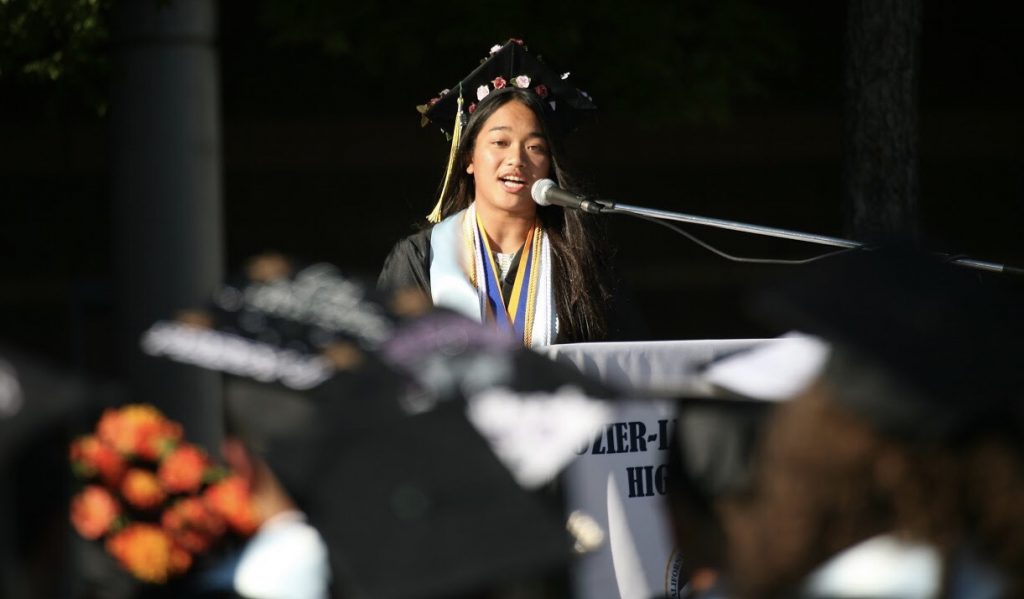
2018 Co-Valedictorian Natalie Tong speaks to her fellow graduates on Friday evening, June 8, 2018. Photos by Luke Johnson.

Co-Valedictorian Cinddy Wu Deng addresses her classmates.

By Jesus Cano

Dozier Libbey Medical High School’s graduation illustrated how much of a tight knit community the Antioch campus really is.

As principal Scott Bergerhouse addressed the 2018 Dozier-Libbey graduates, he not only did so as a class, but he mentioned 40 kids individually with the positive aspects they brought to him and the school. He described the smiles students offered him, anecdotes about the daily life of a student at Dozier Libbey, and recognized pitcher Ayanna Sanchez for tossing a perfect game.

“I wanted to recognize as many people as I can, because that’s how much they mean to me.” Bergerhouse said. “It all about the kids, it’s all about their accomplishments and what they do.”

He has been able to watch this class grow, since when he took over the helm as principal, they were just freshman.

This class of 2018 saw 127 seniors walks the stage. This was one of the smallest classes in recent memory according to the principal. Bergerhouse added that it isn’t necessarily a bad thing, but that it’s because many students ended up switching districts.

This year, Dozier Libbey had co-Valedictorians, in Natalie Tong and Cinddy Wu Deng. While they shared similarities in grade point average, they mentioned commonly how attending a close community like Dozier Libbey served as an advantage.

“Even if we don’t talk to everyone, we can always be there for each other.” Tong said.

See more photos on the Antioch Herald Facebook page.

Dozier-Libbey graduates cheer on their classmates.

Summer Reading and Lunch at the Library in Antioch through August 4, kick-off today

Monday, June 11th, 2018

Summer Reading is underway at the Antioch Library from June 4 to August 4. The program is the Contra Costa County Library’s yearly effort keep kids reading during the summer months. Readers of all ages can visit our Summer Reading page at ccclib.org/summer, for brain-training activities and challenges. All finishers will take home a free book and a raffle entry to win amazing prizes.

The Antioch Library Summer Reading kick-off event will be held on Monday, June 11 from 4 to 7 p.m. Meet our staff and volunteers, pick up your reading record and get a preview of the amazing prizes you can win just by participating.

Lunch at the Library in Antioch

June 11 – July 18

Mondays, Tuesdays, Wednesdays

12:30 to 1:30 p.m. Lunch at the Library is a program that provides free, healthy lunches to kids and teens 18 and under, in an effort to prevent a summer nutrition gap. Many low-income children face nutrient deficiencies when school closes for the summer break. Event Type(s): Library Program

Age Group(s): Young Children (0-5), Kids (5-11), High School (Grades 9-12)

Teresa Raines (925) 757-9224 or traines@ccclib.org

SUMMER READING PROGRAMS

Hour of Code

Wednesdays, beginning June 13, 1 p.m.

The ‘Hour of Code™’ is a nationwide initiative by Computer Science Education Week and Code.org to introduce millions of students to one hour of computer science and computer programming. All students K-12 are welcome.

Puppetry Workshop

Thursdays, beginning June 14, 1 p.m.

Over seven-weeks children will learn to create, and perform with puppets.

On Tuesday, June 19 at 2 p.m. we welcome a Jelly Jam Time Puppets Performance with Risa Lenore.
Teen Programming

Thursdays, 3 p.m.

June 14 – Board Games

June 21 – Video Games

June 28 – Arts in the Afternoon

Fairy Tale Engineering with the Bay Area Discovery Museum

Monday, June 18, 2 p.m.

Sharpen those STEM skills by solving problems for beloved fairy tale characters. Perfect for ages 4-9.
Bike tips for Commuters

Monday, June 25, 6 p.m.

Learn about the bike features at the new BART extension.

For more information, visit our website at ccclib.org or contact the Antioch Library, 501 West 18th St., (925) 757-9224.


Bill introduced to grant Contra Costa Water District ownership of canal system

Monday, June 11th, 2018

Contra Costa Water District canal. Photo from CCWatercom

Title transfer would advance modernization of the 81-year-old facility

This week, Senator Dianne Feinstein, Senator Kamala Harris and Congressman Mark DeSaulnier introduced legislation to transfer federal ownership of the Contra Costa Canal System to Contra Costa Water District (CCWD), taking an important step toward modernizing the aging water supply aqueduct.  CCWD is pleased to strongly support the introduction of this legislation.

The canal system serves as the primary water delivery system for 500,000 people in central and eastern Contra Costa County. It was first constructed in 1937 as part of the U.S. Bureau of Reclamation’s Central Valley Project.

The canal system includes the 48-mile Contra Costa Canal, the Shortcut Pipeline, two reservoirs, and other related facilities. Under the companion bills, CCWD receives ownership of assets it has operated since 1972 and has 100% paid off (principal plus interest) since 2010. Ownership of the canal system on the local level means CCWD can more efficiently operate and maintain the system and will reduce federal administrative burdens and associated costs.

In addition, CCWD would be more secure in investing millions of dollars to modernize the aging canal.  CCWD is studying options to modernize the main canal that stretches from Rock Slough Intake near Oakley to Concord. “For those investments to be made,” said CCWD Board President Lisa Borba, “CCWD is awaiting ownership of the canal system.”

Because the canal system is currently owned by the federal government, title transfer requires an act of Congress. This canal system is an ideal unit for title transfer because, its single beneficiary, CCWD, has paid for the facilities and will continue to operate for the benefit of customers currently served.

“The canal system has reliably served the people and businesses of our community for 80 years,” President Borba said. “We appreciate the leadership from Senator Feinstein, Senator Harris and Congressman DeSaulnier to help us gain ownership of a system we can modernize to serve our customers for the next century.”

The canal system also includes recreational trails, Contra Loma and other facilities that will be maintained for recreation with the transfer. This action has gained support from local recreation managers, including East Bay Regional Park District and the cities of Walnut Creek and Antioch.

To learn more about studies to modernize the Contra Costa Canal System, visit www.ccwater.com/688.