Archive for the ‘News’ Category

Man drunk driving 75 MPH on Antioch city streets crashes into parked cars, fights with police, arrested Tuesday morning

Thursday, June 27th, 2019

By Sgt. Rick Smith, Field Services – Patrol, Antioch Police

On Tuesday, June 25 at 10:11 AM, a uniformed Antioch Police Officer in a fully marked Antioch Patrol Unit driving north on Deer Valley Road observed a driver, travelling southbound on Deer Valley Road approaching Country Hills Road, commit various traffic violations, including striking the median. The Ofc made a U-turn at the next intersection to attempt to get behind Bickham and conduct a traffic enforcement stop.

As the Officer made the U-turn, for unknown reasons, Joshua Bickham, age 33, ran the light he was stopped at and turned down Country Hills Drive while speeding away at an estimated speed in excess of 75 MPH. The officer attempted to catch up to Bickham, but due to his speed, did not pursue. A short distance away, the officer found Bickham after he had lost control of his vehicle near Montara Drive. Bickham crossed over into oncoming lanes and collided with several parked cars in the driveways of two residences.

Bickham was the only occupant of the vehicle and was found unconscious in the vehicle when officers checked on him. He quickly regained consciousness and began to fight with officers as they were attempting to help him. He was found to be under the influence of alcohol and transported to John Muir Hospital as a precaution. He suffered no injuries as result of being arrested.

Luckily, no officers, pedestrians or other motorists were injured as result of this incident. The investigation is ongoing and will be forwarded to the District Attorney for review once completed.

Anyone with information is asked to call the Antioch Police Department non-emergency line at (925) 778-2441. You may also text-a-tip to 274637 (CRIMES) using the key word ANTIOCH.

Antioch Council approves marijuana store near mosque, in same building as Christian church on 5-0 vote

Wednesday, June 26th, 2019

Entrance to the Masjid AbuBakr AlSaddiq Muslim Community Center on West 10th Street with the view of the building where the cannabis dispensary will be located. Photo from www.masjidabubakralsaddiq.com.

But, only after getting property and business owner to agree to locate it on the other end of his building; will require 24-hour armed security.

By Allen Payton

NOTE: Apologies for any misspelling of some of the names of the speakers which may be incorrect. We will work to update this article with the correct spelling of their names.

On Tuesday night, the Antioch City Council approved a second marijuana retail store on W. 10th Street, this time near a mosque and Islamic community center, and in the same building as a Christian church, on a unanimous vote. But, that was only after hearing overwhelming opposition from the members of the mosque and getting the building and business owner to locate the store on the other end of his building, further away from the Masjid AbuBakr AlSaddiq Muslim Community Center.

The Delta Dispensary, cannabis retail store will open at “2101 W. 10th Street, in a shared tenant building, in the cannabis overlay business district, near Costco,” according to City of Antioch Associate Planner Zoe Meredith. The Victory Outreach church is one of the tenants located in the same building.

“The police department reviewed the security plan and met with the applicant on the plan. The application meets all of the city’s cannabiss ordinance and guidelines,” she stated.

The security plan includes a requirement for an armed guard 24 hours a day. (See City Staff Report here: Delta Dispensary Cannabis Dispensary 06-25-19)

PROPONENTS SPEAK

The project proponent was given 10 minutes to speak during the public hearing. The lead opponent was given 10 minutes to speak, as well.

Rick Hoke said, “I am the owner of a commercial construction business (The Richards Company) and the business park located at 2101 W. 10th Street. We have built our business, here and are already contributing to Antioch. We have worked with city staff…and are grateful for their guidance.”

_____________________________________________________

“a quality establishment…and a destination Antioch residents can be proud of.”

_____________________________________________________

He labeled it “a business that will be to the benefit of the city, directly and indirectly.”

Hoke projected “a return of investment of “$25,000 in quarter four, $100,000 in 2020 and double that in 2021,” and claimed it would be “a quality establishment…and a destination Antioch residents can be proud of.”

“They have two main concerns,” he continued. “That children attend their community center with their parents and that there will be cannabis use on the property. They don’t like that they can see the dispensary from their property. We have proposed a concrete wall to block the view. We’re willing to go above and beyond the rules for your approval.”

“I’m excited, encouraged and have a hope for the future of our business in Antioch,” Hoke added. 

Jason Teramoto, a consultant based in Sacramento who grew up in the East Bay, spoke next as part of the proponent’s presentation.

“You have an applicant that has gone above and beyond the local rules. The commitment to public safety is number one,” he stated. “It’s never been profit driven. The impact on traffic is going to be minimal, at best. We go above and beyond the Lifescan screenings you require. Any city officials will have 24-hour-a-day, 365 days a year access to the financial records. Given the date of acceptance, this application has been in compliance with the ordinances in place.”

LEAD OPPONENT SPEAKS

The lead opponent to speak was John Coker, an “attorney in the county for 52 years,” as he described himself.

“It may not be a violation of city ordinance, but the city council has discretion,” Coker stated. “Is this a good discretion? This is right next to a mosque and a community center. The ordinance requires a 600-foot setback of childcare centers. Well, this is a childcare center. It’s not 600 feet away.”

“This institution has 400 people a day who come to meetings, to pray, and play sports. In Antioch only, in the whole state of California, will there be a cannabis sales right next to a religious institution. There’s also even a church in the same building. There religion is important to them. Their children are important to them.”

“It isn’t always true marijuana doesn’t have crime problems. I have two murder cases, myself, where marijuana sales were involved. Drugs and alcohol for the Muslim religion…are forbidden.

The city council members have visited the mosque and have talked to them. They have described to me how they appreciated it. That’s so impressive. They’re hoping you will think about it and use your discretion,” he concluded.

_____________________________________________________

“There is not a single dispensary east of the Caldecott Tunnel.”

_________________________

PUBLIC COMMENTS

Only a few people spoke or wrote comments in favor of the dispensary. Most of the speakers, who were mainly from the mosque, opposed its location.

Greg Kremenliev, who said he was from “the Contra Costa Chapter of NORML (the National Organization for the Reform of Marijuana Laws),” spoke next.

“We believe access is the most important issue for the residents of Antioch,” he said. “There is not a single dispensary east of the Caldecott Tunnel. We’re hoping this will be the first. Areas around dispensaries have lower crime. Home values go up the closer you are to a dispensary. Keep in mind it’s 2019 not 1937.”

Mayor Sean Wright then read written comments by three supporters of the dispensary.

Cynthia Lopez, a resident of Antioch for 20 years said, “I am not for or against dispensaries when they’re placed in the proper perspective. When they’re placed next to a daycare, place of worship, park…How many of you would want to take your children to a daycare and leave them there, or to a church and leave them there next to a dispensary?”

Amir Josefia said, “You would never allow a liquor store next to a church or childcare center. You’re allowing a marijuana dispensary next to a mosque. You have the discretion. Antioch needs many other businesses besides a cannabis dispensary.”

Hadi Gaus said he has been “an Antioch resident for the past 20 years. I have four kids. I take my kids to this mosque and community center. Mosque is a place for prayer. We pray five times a day. It’s a place for the whole family. Kids play outside… We spend a lot of time in the mosque. It’s not a randomly used place. Our kids learn basic, family values.”

“The planning staff requires 24-hour security, with firearmed guard. That must mean it’s dangerous,” he continued. “To place this right next to a mosque, where our children will be, is dangerous. It will endanger the public coming to the mosque. Let’s do things that are going to be forward looking not backward looking.”

Abdul Maliq Ali said, “I am, to say the least, against seeing a dispensary within the vicinity of a mosque and a church, as well. There is already a dispensary, west of this location. As far as availability of cannabis…The dispensary is not a bad idea. But, the location is not where it should be.”

_________________________

“If this was being opened next to a Catholic church…there would be Hell to pay.”

_________________________

Armando Calderon then stated, “I was an active gang member in one of California’s most notorious street and prison gangs. It is 2019 not 1937, but the issues are very prevalent. Not all customers are bad people. But you can’t shy away from the fact that there are gang members that frequent these places at all times. Gang members are very predatorial. They prey on the weak…on the youth. We cannot shy away from that fact. There are armed guards there. We don’t have armed guards at the mosque to protect our children, should violence erupt.”

“Why are we going to welcome these types of people into our community? We put our youth at risk?” he asked the council members. “I can speak as an ex-gang leader. We preyed on kids and there are going to be kids right next door.”

Faldustein Shoman spoke next, saying “I’m here to contest the location, because at the mosque we have a Sunday school. The kids have activities and learn about religion. I’m not against CBD marijuana for medicinal purposes. But, I’m here to protest recreational marijuana. Some kids can get their hands on fake ID’s. When you’re high you don’t really know what you’re going to do. A kid coming out from Sunday school gets run over. There will be kids going there and affected by the people going to the dispensary.”

Mohammad Albu Fayad said, “They’re here, regardless of race, ethnicity, gender or belief. They’re here united for one reason. The safety of their kids and families.”

He spoke of a major accident on Interstate 880 last fall, caused by a person under the influence of marijuana

“We don’t allow these places…opening in a residential neighborhood,” Ablu Fayad continued. “We don’t allow them to open next to homes. How about the house of the Lord? We’re allowing it to happen next to the house of the Creator of those people?”

Rick Gorman said, “It’s kind of ironic I’m speaking on behalf of the Muslim community. I’m not particularly religious. I voted to legalize marijuana. My problem is the location. If this was being opened next to a Catholic church, I was raised Roman Catholic, there would be Hell to pay.” 

Mohammad Al Segir then said, “I used to smoke pretty heavy. I was a big pothead seven years ago, when I was 14 years old. I had a 0.0 GPA. When I was off it and in college, I had a 4.0 GPA. I haven’t witnessed many success stories of the people I used to smoke with. They said they have a history of supporting faith communities. Why aren’t they supporting our faith community?”

Mohammad Youseff said, “When I first came to this country, I worked at a 7-11 and I saw a lot of fake ID’s used to buy alcohol. They can have dispensaries far away from churches or mosques. If they can, please move the dispensary to somewhere else.”

Adinihab Hashib then said, “I’m an engineer and I love this city. That’s why I bought a house, here. A big house. But my kids live here and if they go to school next to this dispensary, that house is worth nothing. That’s where my kids go every day. I worked hard. Something may happen. So, please I hope everybody will vote against that.”

Wright then read two written comments supporting the dispensary.

Abda Hadwan was next to speak, saying, “I also am here to represent this community in Antioch. We bring our kids and leave them there sometime go to the store and come back and pick them up. This dispensary may attract bad people…and bring an influence on them.”

Mohammad Attia said, “I have three kids. I teach them we obey the law. But smoking is a bad habit. When I take them to the mosque to exercise, to play…for many activities, to learn, every single day, this is going to come into their mind. If something comes to destroy everything I’ve been teaching for a long time…we are not against the law, we are against it coming so close to our community center.”

Diane Tamiza then said, “I’ve lived in Antioch for the past one and a half years. For the sake of our youth…I have five grandchildren and I wouldn’t want them to be exposed to this, either. There hasn’t been a single day that I haven’t seen multiple children playing outside. As a community this is not something we should have placed near us.”

_____________________________________________________

“24-hour security, with firearmed guard. That must mean it’s dangerous.”

_____________________________________________________

Andrew Johnson speaking in favor of the dispensary, said, “I’m a third-generation Antioch resident. I’m a proud member of the Antioch community. I used to own a small business down the street. I am here speaking in support for the use permit for the dispensary. However, as the attorney pointed out, you have a discretionary duty to look at the facts. It is an approved legal business in California, in Contra Costa County, in Antioch.”

“What more is the applicant to do to get this business up and running?” he asked the council members. “Antioch needs additional tax revenue. There is an opportunity to improve the economic tax base. I think we are missing an opportunity if we fail to approve this project.”

Ralph Hernandez said, “The location is wrong. Antioch is the wrong location. That particular location on W. 10th Street is the wrong location. It’s great someone is trying to make money off of the Antioch community. They will make millions. We don’t need to make money for them. We don’t need their dispensary, which is a magnet for crime, criminals and other activities. They can take their proposal, their company and go somewhere else in Contra Costa County. Why Antioch? We should not be an easy city for them to make money off of. You will spend more than you will get, on police…I have seen a lot of the negativity that comes with drug sales, that includes murder. Next to the mosque and the children there, it’s absolutely the wrong location. I say deny it.”

PROPONENT’S REBUTTAL

The proponent then had three minutes to offer a rebuttal.

Teramoto, the dispensary’s consultant, spoke again, saying, “Make no mistake, this is an issue that creates certainly passionate opinions on both sides. We suggested to increase the height of the wall to 12 feet and make it a living wall…for a beautification issue for both parties on each side of the wall. Yes, this is a business. We’re talking about a multi-million dollar investment back into the city of Antioch.

There won’t be a square foot that a person won’t be on a surveillance. So, the assertion we will be a magnet for gang activity, that may be true. But, the Antioch Police would want to invite these people” to the dispensary.

COUNCIL DISCUSSION & DECISION

The council members then asked questions of the proponent.

Mayor Pro Tem Joy Motts was first, saying “You said you paid a living wage. Do you also pay benefits?”

“Yes,” replied Teramoto.

“How many people are allowed in the waiting lounge?” Motts asked.

“About six people will be in the waiting lounge,” he answered. “This location will not see more than 100 people a day. That’s less than 10 per hour. The seating area we’ve accommodated up to five or six. The retail area is about 1,500 square feet. So, you could have up to 10 people in there at one time.”

“Every parking spot…is under surveillance. So, I can’t imagine people waiting in their cars,” Teramoto stated in response to Motts additional concern. “The license plates and faces of the customers will be scanned, as well as their driver’s licenses. So, the argument that anyone can come in with a fake ID is false,” the consultant stated. “Any customer who comes into the sales force can physically touch the product. That’s against state law. There are two RFID scanners.”

“Did you sit down and meet with the mosque?” Motts asked.

“We tried,” the consultant said. “I walked over there. It’s a 616-foot walk, door-to-door. There is no direct access from the community center to our facility. The same goes with the baseball field. That’s actually a 1,600-foot walk.”

Councilmember Monica Wilson spoke next, saying, “Thank you for clarifying the scanner, that no one can come in there with a fake ID. Will the police have access to the surveillance cameras?”

“24-7, 365-days” responded Teramoto. “This is the most scrutinized business. In any event, however unlikely that is, they (police) will have their own key to have access to the video cameras.”

“I like the fact that you said you’re a second-chance employer, and that Mr. Hoke said he will hire local contractors,” Wilson stated.

“Local vendors and local merchants will benefit from this dispensary,” Teramoto shared. “This is really going to be a landmark.”

“That there is no other dispensary next to a house of worship is not entirely true,” he added.

Councilmember Lamar Thorpe then asked, “The only other item I would bring up is equity. What the company’s equity program would look like.”

“The Hokes have had a long history of people who have gone through early parole,” Teramoto said. “First and foremost, you look for opportunity for dignified work.”

“I want to understand the company’s commitment to equity, more importantly your definition of equity,” Thorpe pressed him.

“It is integrating individuals in the community who have been disproportionately affected pre-Proposition 64…giving everyone the opportunity to benefit by this industry,” Teramoto responded. “We want to partner with them.”

“I have one other question for our friends over here,” Thorpe said. “I visited the mosque. He gave me a tour of the mosque and we talked about the wall. Is this acceptable to you?”

“This is not acceptable to me,” said one of the members of the mosque. “It has to be acceptable to the entire community.”

“If this is the last chance, I want it 16 feet tall,” he said.

_____________________________________________________

“this mosque has been there prior to our cannabis zone and frankly, it’s too close to a dispensary.” Mayor Wright, before voting for it.

_____________________________________________________

Councilmember Lori Ogorchock asked “how far away is this from the Babe Ruth baseball fields?”

“There is not a statutory requirement for a 600-foot separation,” Community Development Director Forrest Ebbs stated.

“I understand that. That’s not my question,” Ogorchock said.

“The project would be located 280 feet from the property line by the Babe Ruth organization. But 900 feet from the operating ballfields,” City Planner Meredith said.

“It’s owned by Dow,” Ogorchock said of the land where the Babe Ruth baseball fields are located along W. 10th Street. “I have concerns with the 600 feet. I’ve also looked at the smoke shops and the ordinances are tighter than cannabis shops. I appreciate the Hoke family is willing to put up the wall and make it aesthetically pleasing.”

“How many will this employ?” she then asked.

“Four full time staff, plus three full-time security staff. So, seven altogether,” Termoto replied.

Mayor Wright spoke last, saying, “It’s a tough decision. I did have the opportunity to tour the mosque. This is a zoning issue. Cities usually plan zones. We do that so we don’t have this issue. The issue comes in that we don’t have zones for churches. Cities don’t get to choose where churches can go. The city has fought churches before and lost. I’m just saying. So, I don’t know that we should choose. If churches wanted to destroy our cannabis zone…this mosque has been there prior to our cannabis zone and frankly, it’s too close to a dispensary. We’ll probably end up with four or five dispensaries in the Verne Roberts Circle area.”

“I don’t have a problem with what the Hokes are trying to bring. But I think it’s too close,” he added.

Wright then called for a motion.

Thorpe then said, “this entire area is zoned business.”

“Yes, it’s zoned business and industrial,” Ebbs stated. “To clarify, the church did receive a conditional use permit they are operating under, as a community center, there.”

“Not as a mosque,” Thorpe stated.

“As a mosque or a community center, we don’t slice those up,” Ebbs explained.

“I was under the impression our cannabis ordinance is more restrictive than for smoke shops,” Motts said.

“I’d say they are different,” Ebbs responded. “Actually, our most restrictive is for tobacco.”

“So, how many feet does a liquor store have to be away from a school or church?” Motts asked.

“No on-sale or off-sale liquor establishment shall be located within 500 feet of…a day care center or school,” Ebbs read from the city ordinance.

“What is the smoking one?” Ogorchock asked.

“We don’t allow any smoke shops,” Ebbs said.

“We don’t allow new smoke shops,” City Planner Meredith clarified.

“The card rooms are 1,000 feet,” said City Attorney Thomas Smith.

“A liquor store is not a business park zoning,” Ebbs stated.

Ogorchock then called Hoke back up to the podium

“Do you own the whole length of that building?” she asked.

“Yes,” Hokes said.

“Is it vacant?” Thorpe asked.

“I have an office there and there’s another small tenant there,” Hoke stated. “But it could be made vacant. Are you suggesting we move to the other end of the building?”

“I’m not suggesting anything,” Thorpe replied.

“I have a tenant that is month-to-month,” Hoke said.

“That would create some more distance,” said Thorpe.

“It would add another 280 feet,” Hoke stated.

“It’s the same parcel,” Ebbs said. “If that is the condition of the council, we could continue this. You could add that as a condition of approval and we could work it out.”

“Would you still be amenable..open to building the wall?” Motts asked.

“Yes,” Hoke replied.

“How far away would that be from the Babe Ruth fields?” Ogorchock asked.

“It would be another 280 feet away,” Ebbs stated.

Thorpe then made a motion to approve the dispensary, with the condition that it be located at the other end of the building owned by Hoke and have city staff work out the details with Hoke.

Wilson seconded the motion.

“The City’s maximum height is eight feet. Any wall has to stop twenty feet from the street, so a car pulling up can see on-coming traffic. We’ll get it as close as we can at that height,” Ebbs said.

“I would ask that you work with Babe Ruth. They’re not currently using that field. But, if they get to capacity, I want to make sure you work with Babe Ruth,” Ogorchock said.

Motts thanked the members of the mosque for speaking up and encouraged them to meet and speak with Hoke.

The motion then passed on a 5-0 vote approving the use permit for the Delta Dispensary cannabis dispensary.




Operation Broken Heart results in child exploitation arrests in county, two in Antioch

Monday, June 24th, 2019

By Scott Alonso, Public Information Officer, Contra Costa County District Attorney


Investigators with the Contra Costa County Internet Crimes Against Children Task Force recently participated in Operation Broken Heart, a nationwide effort to investigate technology facilitated crimes against children, including those who receive and distribute child pornography. Throughout April and May, the team conducted investigations of subjects who distributed child pornography over the internet and focused on individuals traveling to Contra Costa County to meet minors to engage in sexual activity.

In addition to the proactive investigations the ICAC team participated in, a significant school outreach program was also undertaken to teach parents and student about the risks associated with smartphones and social media. During the last year, investigators and prosecutors delivered presentations at multiple schools and community organizations, reaching thousands of parents, students and educators.

Some notable arrests and investigations conducted during Operation Broken Heart include:

-On April 11, 2019, Investigators arrested Gerald Jue of Danville, California. During the investigation, investigators learned Jue was accessing the internet and searching for child pornography. Jue is a third and fourth grade teacher in the Fremont School District. When a search warrant was served at Jue’s residence, a computer was seized that contained evidence of Jue’s internet searches as well as web pages containing child pornography. Jue was indicted by a federal Grand Jury in Oakland, Ca on June 6, 2019 and arrested on June 7, 2019. He was subsequently released on bond and is awaiting trial. This case was investigated by the ICAC Task Force and the United States Secret Service.

-On May 2, 2019, investigators arrested Sonny Mitchell, a registered sex offender from Antioch, California. During the course of the two-month investigation, it was discovered that Mitchell was distributing child pornography via the Facebook Messenger platform. When a search warrant was executed at Mitchell’s residence, investigators seized a device that contained additional images of child pornography. Mitchell was indicted by a federal Grand Jury in Oakland, California on May 9, 2019 and remains in custody. This case was investigated by the ICAC Task Force and the United States Secret Service.

-On May 3, 2019, investigators arrested William Cashell of Walnut Creek, California. In April 2019, Yahoo sent tips to the National Center for Missing and Exploited Children when child pornography was found in Cashell’s e-mail account. During a warrant at Cashell’s apartment, investigators located an iPhone which was later determined to contain images of child pornography. Cashell’s is charged with one count of possession of child pornography by the Contra Costa County District Attorney’s Office and a warrant has been issued for his arrest. This case was investigated by the Contra Costa County Sheriff’s Office and the ICAC Task Force.

-On May 16, 2019, investigators executed a search warrant in the 2400 block of L Street in Antioch related to a child pornography possession investigation. ICAC Investigators found evidence the suspect, Henry Cordon, a 34-year-old resident of Antioch, California and formally of Orange Park, Florida, kept images of child pornography stored in his various e-mail accounts. Additionally, during the search warrant Cordon confessed to sexually assaulting a child under the age of ten in 2009 while living in Orange Park, Florida. Cordon produced at least one image of the sexual assault of that child. Cordon was indicted by a federal Grand Jury in Oakland, California on May 30, 2019 for Receipt and Possession of Child Pornography. Cordon remains in custody and is currently under investigation in both California and Florida for other offenses related to crimes against children. This case was investigated by the Contra Costa County Sheriff’s Office, the ICAC Task Force and Homeland Security Investigations.

The Silicon Valley Internet Crimes Against Children Task Force is managed by the San Jose Police Department. In Contra Costa County, detectives and investigators from the Walnut Creek, Concord and Moraga Police Departments, the Contra Costa County Sheriff’s Office, Contra Costa County Probation Department and Contra Costa County District Attorney’s Office participate in the task force along with Special Agents from the United States Department of Homeland Security and the United States Secret Service.

Parents are encouraged to discuss online safety with their children and can visit the website www.kidsmartz.org for further information. If you believe your school or community organization would benefit from a smartphone and social media awareness presentation, please contact Senior Inspector Darryl Holcombe at dholcombe@contracostada.org.


County’s Northern Waterfront Economic plan draws Supervisors MOU nod as study’s budget dwindles

Friday, June 21st, 2019

The Contra Costa County Northern Waterfront Initiative area and participating agencies.

Antioch expected to soon adopt a similar MOU

By Daniel Borsuk

The $500,000 planning study to ignite an economic renaissance designed to create 18,000 low-tech manufacturing jobs by 2035 along the county’s northern waterfront gained momentum Tuesday when the Board of Supervisors joined the city councils of Hercules and Pittsburg in approving a memorandum of understanding (MOU) on the major waterfront planning project. (See Northern Waterfront Report)

Officials expect the city councils of Antioch, Brentwood, Martinez, and Oakley to soon adopt similar MOUs that have been prepared to permit jurisdictions to participate or not participate in joint projects that will generate jobs in the industries of food processing, clean tech, bio-tech/bio-medical, and advanced transportation fuels.

The county’s MOU also authorizes Department of Conservation and Development Director John Kopchik to file and obtain trademarks for “Northern Waterfront Economic Development Initiative” and “Capital of the Northern California Mega-Region” or similar phrases on behalf of the county.

District 4 Supervisor Karen Mitchoff cautioned colleagues over the planning project’s rising costs. The county awarded a $500,000 grant a year ago, but that amount has now dwindled to $94,500.

“I’d like to know how those funds are to be spent in the future,” she said.

Mitchoff forecast there will be competition from the Association of Bay Area Governments to pay for future regional planning studies that could potentially jeopardize funding for the waterfront project. “ABAG will give some push back,” warned Mitchoff, who represents the county on the ABAG board.

“There is going to be shared funding,” District 5 Supervisor Federal Glover of Pittsburg forecast about any potential planning funding tug-of-war with ABAG. Glover, who has been instrumental in launching the NWEP continued “I’m excited about what is happening.”

Glover mentioned Bombardier Transportation’s announcement last week to use an empty Pittsburg manufacturing site on Loveridge Road to assemble 775 new BART cars that will initially create 50 jobs.

“Right now, the economy is good so we need to invest in the Northern Waterfront Economic Development Initiative and create jobs,” said District 3 Supervisor Diane Burgis.

“This is something so critical to prepare a workforce that is ready to go,” said Vice Chair Candace Andersen of Danville.

Antioch man identified as apparent shooter of girlfriend from Santa Rosa in murder suicide case

Wednesday, June 19th, 2019

By Jimmy Lee, Director of Public Affairs, Contra Costa County Office of the Sheriff

Detectives from the Contra Costa County Office of the Sheriff Investigation Division continue to investigate a murder-suicide that occurred on June 13, 2019. (See related article)

At about 9:33 AM, Deputy Sheriffs were dispatched to the area of Nortonville Road and Kirker Pass Road in unincorporated Pittsburg for a citizen reporting having seen two people who appeared to have been shot in a parked vehicle.

It was later confirmed that both of the occupants of the vehicle, a man and woman, suffered from apparent gunshot wounds. They were pronounced deceased at the scene.

The two are identified as 58-year-old Dong Liu of Antioch and 56-year-old Meizhen Zhu of Santa Rosa. Detectives say the two had a boyfriend-girlfriend relationship. Liu apparently shot Zhu before taking his own life. The cause of death for each was gunshot wound. The exact motive is unclear at this time.

Anyone with any information on this case is asked to contact the Office of the Sheriff at (925) 646-2441 or Investigation Division at (925) 313-2600. For any tips, email: tips@so.cccounty.us or call (866) 846-3592 to leave an anonymous voice message.

BART Board approves $2.3 billion budget prioritizing safety and quality of life

Tuesday, June 18th, 2019

Will hire 19 more police officers, four fare inspectors
The BART Board of Directors has approved a $2.3 billion budget for Fiscal Year 2020 (FY20) which begins July 1, 2019. The budget focuses on expanding and investing in Quality of Life issues, including the addition of 19 police officers and four unarmed fare inspectors.

“This budget is designed to make BART safer,” said BART Board President Bevan Dufty. “Adding officers and establishing a community ambassador program shows our riders that we’ve heard their concerns and we’ve taken action.”

Quality of Life

Including funds added in FY20, since FY14 BART has spent $59 million on new budget initiatives addressing Quality of Life challenges in the areas of safety, fare evasion prevention, cleanliness and homelessness. The FY20 budget supplements and continues Quality of Life initiatives added in prior years. Among the highlights:

  • $2.1 million towards 19 additional police officers.
  • $500,000 to fund four additional fare inspectors.
  • $2 million to continue funding efforts to address the impacts of regional homelessness in the BART system, including outreach programs, elevator attendants and Pit Stop restrooms.
  • BART station hardening efforts are incorporated into many projects and programs throughout the District, using operating and capital funds. In FY20, $2.4 million of new and ongoing funds ($400,000 of new FY20 operating funds augments $600,000 of prior year parking revenue held in reserves and $1.3 million of capital staffing) will support station hardening projects, including raising railings and securing swing gates. Additionally, BART directs grant funds to station hardening, including federal formula funds for the fare gate modification program and often redirects existing engineering and maintenance staff to projects such as the fare gate cinch modification program as well as the camera upgrade program. BART’s Station Modernization Program also incorporates elements of station hardening in design, guided by the BART Facilities Standards. Six stations in the Station Modernization Program are spending or will spend a combined $16 million on station hardening elements. In addition, the $61 million Market Street Escalator Canopies project includes installing roll-up grilles at the street level, security cameras and handrail lighting. In summary, station hardening is a substantial, multi-year systemwide effort, leveraging new and existing operating and capital funds from a variety of sources into a wide range of projects.

System reinvestment

The new budget dedicates $1.4 billion for capital programs, a 5% increase from FY19 with the largest portion (46%) coming from Measure RR funds. The use of Measure RR funding for FY20 is increasing as projects anticipate moving from design and pre-engineering to construction. Most of the capital budget (69%) is directed to reinvestment in the system. The use of previously awarded and current federal funds has increased as BART ramps up on train control modernization, state of good repair projects and continues the delivery of new rail cars. FY20 projects include:

  • $101 million for station modernization and elevator/escalator improvements across the system, including replacement of escalators at downtown San Francisco stations, and station modernization efforts at El Cerrito Del Norte, 19th Street, Downtown Berkeley, Concord, Powell, and Pittsburg/Bay Point stations. The station modernization program also includes many elements of station hardening.
  • $303 million is budgeted for expenses related to the procurement of 775 new rail cars
  • $151 million towards the continuation of a multi-year program of traction power infrastructure replacement, including replacement of traction power cables in San Francisco and in Alameda County.
  • $71 million towards the Hayward Maintenance Complex, a modern facility to maintain the new rail cars.
  • $86 million for planning and engineering for the Train Control Modernization Program and for renewing components of the existing train control system, including transformers, switch machines and speed encoding equipment at stations.
  • Fare changes
  • A 5.4% inflation-based fare increase will take effect on January 1, 2020 as part of a program first approved by the BART Board in 2003 and renewed for a second series in 2013. This is the last of four biennial fare increases called for under the 2013 series. The BART Board also approved a third series of inflation-based fare increases that will go into effect in 2022, 2024 and 2026.  This latest series will follow the same inflation-based formula as the previous increases.
  • BART will participate in the Metropolitan Transportation Commission’s Regional Means-Based Fare Discount Pilot Program. The program will offer a 20% discount per trip to adult riders earning 200% or less of the federal poverty level. The FY20 budget assumes one-half year of the pilot with an estimated revenue loss of $2 million after the MTC’s estimated offsetting annual contribution to BART of approximately $2 million.

Revenue and ridership challenges

The FY20 budget is balanced and includes $17 million in budget cuts made by all departments in the district.

Fare revenue is BART’s largest source of revenue, with $479 million of rail fare revenue forecast in FY20, a decrease of $5.6 million from FY19, reflecting a lower ridership forecast. Other operating revenue is forecast to be $10 million lower due to one-time revenues in FY19 not budgeted in FY20. These decreases are offset by increases in financial assistance, particularly sales taxes. Sales taxes are BART’s largest form of financial assistance budgeted at $277 million for FY20 a 3.2% growth over FY19

We take a conservative approach to projecting ridership for our FY20 budget. We are concerned about the length of this current economic expansion and the potential for a downturn in the future, which could impact ridership.

Service improvements

The budget includes funding for service enhancements that will ease crowding. Most notably, by February of 2020 we expect to have 160 Fleet of the Future train cars which will allow us to run all 10-car trains on the four Transbay routes. As we increase the number of Fleet of the Future cars, we will begin retiring legacy cars, which should increase reliability and reduce maintenance costs.

Silicon Valley Berryessa Extension fares

Along with approving the FY20 budget, the BART Board of Directors voted unanimously to establish a fare structure for the Silicon Valley Berryessa Extension.  BART’s existing distance-based fare structure will be used to calculate trip fares on the 10-mile extension from the Warm Springs/South Fremont Station to Berryessa Road in San Jose.  This is in accordance with the comprehensive agreement between BART and the Valley Transportation Authority.  The extension includes stops in Milpitas and Berryessa/North San Jose.

Ambassador program

Though not part of the FY20 budget, $500,000 in additional anticipated revenue from the FY19 budget will be set aside to fund an ambassador pilot program.  BART is in talks with the Metropolitan Transportation Commission to seek matching funds for the program.

Tri Delta Transit launches on-demand shuttle service to BART stations, nearby destinations

Monday, June 17th, 2019

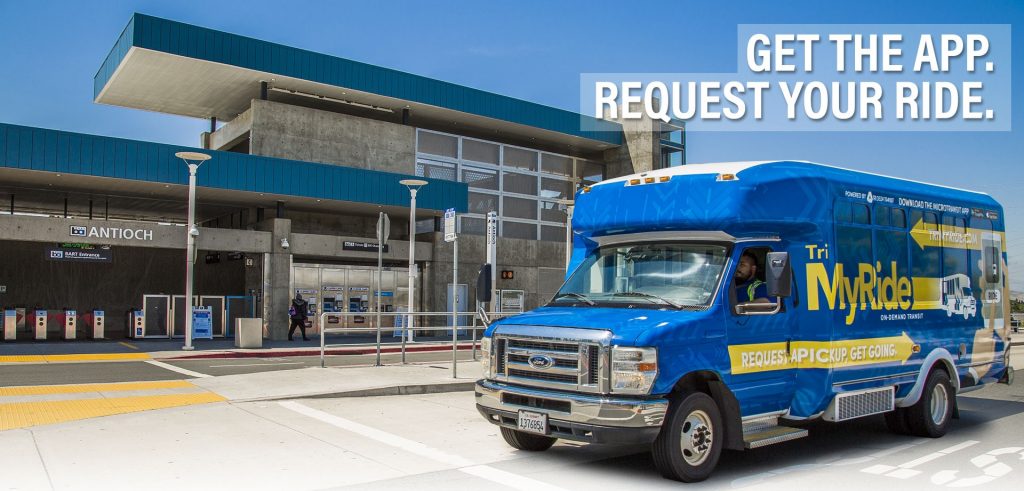
The new Tri MyRide will take riders to and from the Antioch and Pittsburg-Bay Point BART Stations or nearby destinations. Photo from TriMyRide.com

Only $2.00 per trip, much less than Uber or Lyft

Eastern Contra Costa County Transit Authority (Tri Delta Transit) is excited to announce the launch of Tri MyRide, a flexible and dynamic on-demand shuttle service operating in neighborhoods near the Antioch BART Station and Pittsburg Bay Point BART Station. This six-month pilot program shuttle service begins operation today, Monday June 17. Tri MyRide operates Monday thru Friday from 5am to 8pm.

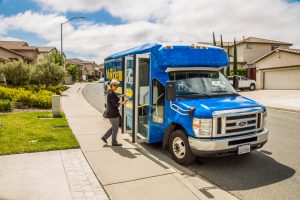
Photo by TriDeltaTransit.

Similar to ride-hailing services, Tri MyRide uses a smartphone app for riders to schedule customized curb-to-curb trips. Tri MyRide allows riders to plan their customized trips anywhere in the Hillcrest/Antioch BART service area or San Marco/Pittsburg Bay Point BART service area to BART or to a designated point of interest located in the service area. The app, known as Microtransit by TransLoc, is connected to proprietary software that allows bus operators to pick-up and drop-off passengers in an efficient manner.

The service uses small, neighborhood-friendly shuttle buses that easily maneuver on residential streets. Tri MyRide operators undergo the same background screening as other Tri Delta Transit operators, and all vehicles are equipped with surveillance cameras to ensure safe transport. The shuttle buses are wheelchair accessible and accommodate people with disabilities.

The cost to ride is only $2.00 per trip. Payment may be made through the Microtransit app or with cash. The low-cost makes Tri Delta Transit’s Tri MyRide more affordable than traditional ride-hailing services, which could cost riders at least more than three times the amount for a similar trip.

“By partnering with technology companies, Tri Delta Transit is meeting the evolving needs of passengers in our community. Tri MyRide allows our agency to provide on-demand service from the convenience of a smart phone app.” said Chief Executive Officer Jeanne Krieg.

The service requires using the Microtransit app on your smartphone.

HOW IT WORKS

The six-month pilot program is being implemented in partnership with Tri Delta Transit and TransLoc, a Ford Smart Mobility Company. To use this new ride share program, passengers located within the service area first download the free Microtransit by TransLoc app to their smartphone and request a ride. Following a Tri MyRide request, the Microtransit app will provide passengers with an estimated pick-up time, track their bus in real-time, and alert them when the ride is about to arrive. Passengers are also notified when their ride is about to reach their destination.

Tri Delta Transit is one of the innovative transit agencies throughout the nation piloting microtransit technology. The new microtransit services are intended to complement existing public transportation services. By providing flexible, on-demand transportation services, transit agencies are bringing improved mobility and greater accessability to the communities they serve.

ABOUT TRI DELTA TRANSIT

Tri Delta Transit provides over 3,000,000 trips each year to a population of over 250,000 residents in the 225 square miles of Eastern Contra Costa County. They currently operate 15 local bus routes Monday – Friday, four local bus routes on weekends, door-to-door bus service for senior citizens and people with disabilities, on-demand rideshare services and shuttle services to community events. To learn more, visit TriDeltaTransit.com.

ABOUT TRANSLOC

TransLoc is the maker of mission-critical transit operations solutions for flexible on-demand and fixed route systems for both public and private transit agencies, and university and business campus transit systems. TransLoc is the largest provider of agency-owned microtransit systems for municipal transit agencies in the U.S., with the company’s products used at more than 400 agencies. To learn more, visit TransLoc.com.

For additional information about Tri MyRide, please visit TriMyRide.com.

Antioch Police announce new hires, promotions

Sunday, June 16th, 2019

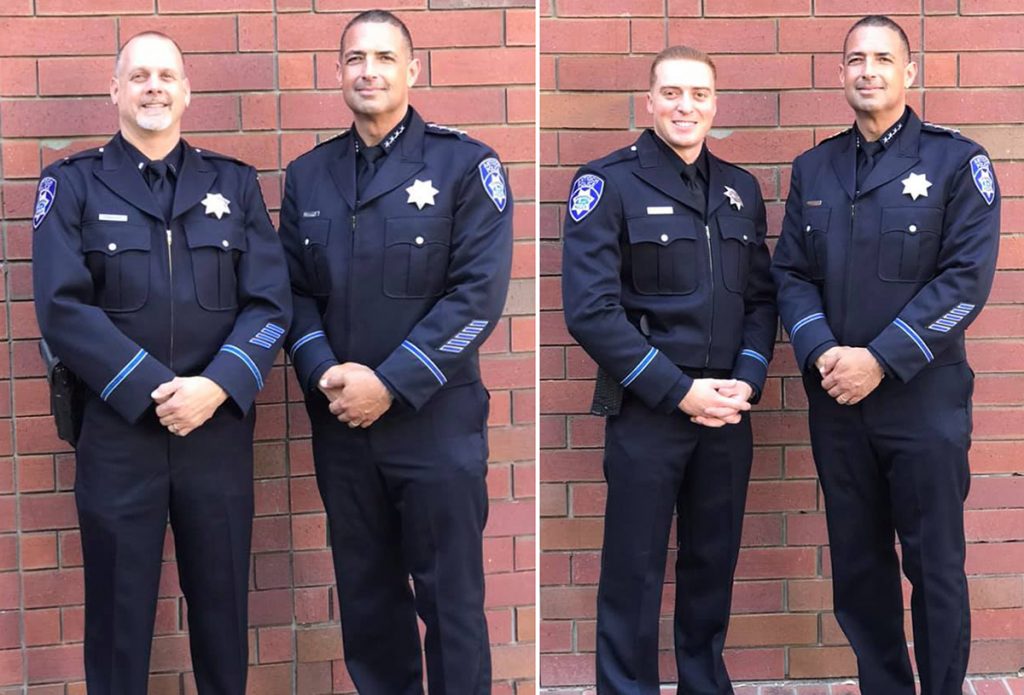
New Antioch Police Lieutenant Joe Dunleavey, left and Officer Matthew Nutt with Chief Tammany Brooks. Photos by APD

By Antioch Police Department

Earlier this month, the Antioch Police Department welcomed Lieutenant John Donleavy and Officer Matthew Nutt, and celebrated the promotions of Corporals Vanderpool and Rose, Sergeant Hoffman, and Captain Schnitzius.

Lieutenant Joe Donleavy

Joe grew up in Richmond and graduated from El Cerrito High School in 1989. After graduation, he became an EMT and worked for four years for Acme Western Ambulance in Oakland. Joe eventually attended San Francisco State University and graduated with a Bachelor’s Degree in Art in 1998.

In 2000, Joe put himself through the Napa Valley College extended night Police Academy while working a full-time job in the Athletic Business Office at Cal. He was picked up by the Walnut Creek Police Department while in the academy and started with them upon graduation in December of 2000. During his time with the Walnut Creek Police Department Joe served in Patrol, Motors and as a K9 handler. Additionally, he was on the SWAT entry team and was a firearm and chemical agent instructor. In 2012, Joe was promoted to Sergeant and eventually helped create a four-person Special Enforcement Team as well as supervising the Motor team and K9 unit. In 2017, Joe was promoted to Lieutenant and worked the remainder of his time there as a Patrol Watch Commander.

Joe is married to a Walnut Creek Police Officer and enjoys traveling with his family and is a die-hard Giants, Niners and Sharks fan!

Fun Fact: Joe’s son has the exact same birthday as him.

Officer Matthew Nutt

Matthew grew up in Claremont, CA, and graduated from Claremont High School in 2012. Before graduating, Matthew enlisted in the Marine Corps and he left for boot camp shortly after graduating. Matthew eventually became an Infantry Machine Gunner and served 4 years with the Second Battalion, Fifth Marine Regiment. Matthew was honorably discharged at the rank of Corporal in 2016.

Soon after being discharged, Matthew was hired by the Los Angeles Police Department and graduated from the Police Academy in October 2016. He was later assigned to patrol for 1.5 years in East Los Angeles, and spent the remainder of his time patrolling South Central Los Angeles. Matthew then accepted a job with the Antioch Police Department.

In his free time Matthew enjoys going to church, spending time with family and friends, rock climbing, and working out.

Fun Fact: Matthew is terrified of spiders and needs his wife to kill them for him.

Corporal Jason Vanderpool with Chief Brooks.

Corporal Jason Vanderpool

Jason grew up in Fairfield and graduated from Fairfield High School. Jason is happily married to his wife Danielle and is the proud father of three girls. Prior to working for the City of Antioch, Jason worked in the construction trades for several years and had his contractor’s license. He also had a flooring business for several years.

Jason started his Police career in December 2002, and was assigned to the patrol division from 2002 to 2013. In April of 2013, he transferred from Patrol into the Investigations Bureau where he worked as the Domestic Violence Investigator. In 2015, he was assigned to the Robbery/ Homicide unit and worked as a violent crimes investigator. In July 2018, he transferred back to the Patrol Division.

During his career, Jason has had numerous assignments which have included Field training officer (FTO), recruiting team member, MAMFF team member, and Explorer advisor. In his spare time, Jason enjoys wakeboarding, playing basketball, camping, golfing and spending time with his family.

Fun Fact: He’s proud to be a mama’s boy.

Corporal Brian Rose and Chief Brooks.

Corporal Brian Rose

Brian is a 12-year veteran of the Antioch Police Department. Brian’s assignments have been Field Training Officer and SWAT team member. In 2012, Brian was a recipient of the Antioch Police Department’s Meritorious Service Award which is presented to officers who display professionalism and excellence in performing his/her duties.

Brian has spent the last 5 plus years as a detective in the sexual assault/child abuse unit and has distinguished himself as a tremendous investigator. He is a POST certified sexual assault/child abuse instructor and travels throughout the state to train other detectives in this important discipline.

In 2016, Brian was honored as a 2016 Community Champion by Community Violence Solutions for those who go above and beyond the call of duty to end sexual violence in our community.

Brian holds a Bachelor’s degree in criminal justice management and in his free time, he enjoys spending time with his family, playing basketball, working out, and is an avid reader.

Fun fact: Brian has been nominated for Officer of Year a whopping 10 times but has failed to ever win the award.

Sergeant Rick Hoffman and Chief Brooks.

Sergeant Rick Hoffman

Rick was born in Berkeley and moved to Antioch when he was in the fifth grade. Rick spent the rest of his childhood in the city of Antioch. He met his future wife, in a church youth group when he was 15 years old, and eventually married her years later.

Rick began his law enforcement career with the Contra Costa County Office of the Sheriff in March 2006, and worked as a Custody Deputy at the Martinez Detention Facility from March of 2006 to September of 2007. Having grown up in Antioch, he knew that he wanted to be a police officer for APD. Rick lateraled to APD in September of 2007 and began his career with APD as a patrol officer.

Since joining APD, Rick has held a variety of assignments. In 2009, Rick was assigned as a SWAT team member. In 2010, he was assigned to be a gang investigator. In 2013, Rick was assigned to be a Field Training Officer (FTO) and in 2015 he was assigned to be a Defensive Tactics Instructor.

Rick was assigned to the Investigations Bureau in August of 2015 where he initially worked as a Missing Persons Detective, a Post Release Community Supervision (PRCS) detective and eventually was assigned to the Special Operations Unit. Rick was also awarded the APD’s 2017 Officer of the Year award.

Rick was promoted to the rank of Corporal in January of 2019. During his time as a Corporal, he has been assigned as a patrol Corporal, Gang Unit supervisor, and a SWAT Assistant Team Leader.

Rick is excited to begin this new step in his career and is eager to serve his department and the citizens of Antioch in a new capacity.

Fun Fact: Rick would like to share that he is much better at fantasy football than both of the newly promoted Corporals Vanderpool and Rose

Captain Trevor Schnitzius and Chief Brooks.

Captain Trevor Schnitzius

Trevor graduated from California State University, Sacramento in 1997 with a Bachelor’s of Science in Law Enforcement Management and Investigation. He was hired as a police trainee by the Antioch Police Department in January 1998 and attended the Los Medanos 135th Police Academy. Upon his graduation, he was sworn in as a Police Officer on May 26, 1998 assigned to the Community Policing Division.

Trevor transferred to in the Investigations Bureau in 2002 as the auto theft investigator. In 2003, he transferred to the person crime unit where he was the Sexual Assault/Missing Persons/Sex Offender Compliance Investigator. Trevor transferred back to the patrol division in 2007 and became a (FTO) Field Training Officer.

Trevor was promoted to Corporal in January of 2008 and was assigned to the Patrol Division. He was then promoted to the rank of Sergeant in 2013 and remained in the Patrol Division. In February 2016, Trevor promoted to the rank of Lieutenant.

Additionally, Trevor served as a Weaponless Defense Instructor, Impact Weapons Instructor, Field Training Officer (FTO), Honor Guard Team Member, Recruiting Team Member, Explorer Program Coordinator, Department Armor, Peer Support Coordinator, Volunteer Coordinator, K9 Unit Coordinator, and FTO Program Coordinator.

As fate would have it, the effective date of his promotion to Captain is exactly 21 years to the day from his original appointment as an Antioch Police Officer.

Fun Fact: Trevor’s nickname amongst his peers is Mr. Incredible due to his resemblance to the animated film character. Through the generosity of our officers, he has accumulated a decent collection of Mr. Incredible memorabilia over the years.