Archive for the ‘News’ Category

Parking changes at Antioch BART Station for new lot opening next year

Monday, July 6th, 2020

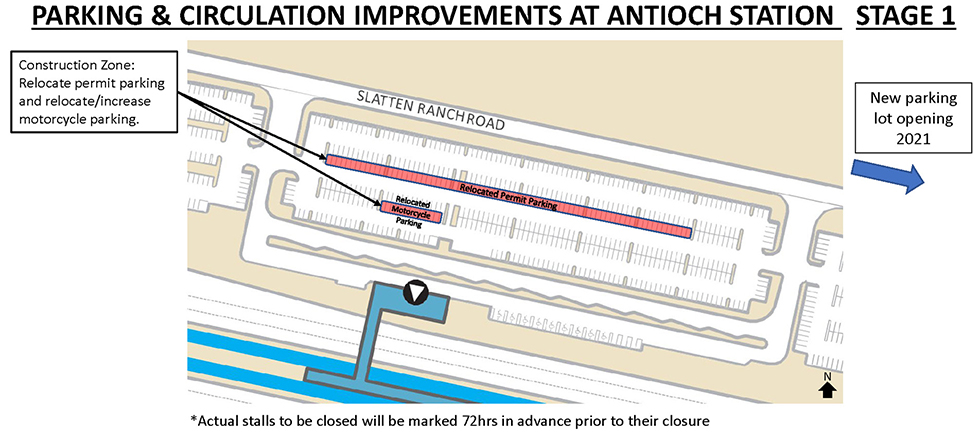
Graphics by BART.

850 more stalls; construction to be completed in multiple stages

As we expand parking at Antioch Station, we will also be making some modifications to the existing parking lot and access roads to comply with codes and improve traffic circulation and curbside operations. These modifications include: relocating permit parking, bike lockers, and the passenger loading zone; relocating and increasing ADA and motorcycle parking, designating spaces for future electric vehicle (EV) charging stations, providing a dedicated bus lane, and other access improvements.

Construction of the Antioch Station Parking Expansion Lot Project began on May 21. The project, located just east of and adjacent to the existing lot, includes:

  • Construction of approximately 850 fee parking stalls
  • Dedicated ADA accessible sidewalk to the Antioch Station
  • Lighting
  • Landscaping surrounding the new parking lot

We anticipate the opening of the new parking lot in early 2021.

All parking stalls that are to be removed or closed temporarily for construction will be signed at least 72 hours in advance. Please look out for barricades and signage to guide you around the work areas during this time.

Construction will occur in multiple stages to ensure that ADA parking, permit, and motorcycle stalls remain available at all times. At this time, Stages 1 and 2 are shown below. An update will be provided for Stages 3 and 4 which are anticipated to occur during September.
– Stage 1: Relocate permit parking; relocate and increase motorcycle parking.
– Stage 2: Construct dedicated bus lane (traffic flow during construction will not be significantly impacted); establish new ADA parking and future EV charging stations; motorcycle parking will be temporarily relocated as shown; install new railing to enhance station access.

Please see the maps of work areas for each stage of construction.

We apologize for this inconvenience and appreciate your patience during this construction.

During the current COVID-19 pandemic, some BART projects, including the Antioch Station Parking Expansion Project, have been designated as essential. For this reason, construction activities on the Antioch Station Parking Expansion Project will continue for the time being. BART and Contractors will ensure that workers comply with all CDC guidelines including the social distancing requirement. BART and Contractors will make adjustments as updates to the current situation are provided.

Secretary of State Padilla assigns numbers to November ballot measures, invites ballot arguments

Monday, July 6th, 2020

Two tax increases included in Props 15 and 19; Prop 18 lowers voting age to 17

SACRAMENTO, CA – Secretary of State Alex Padilla on Wednesday, July 1, assigned proposition numbers to the legislative, initiative, and referendum measures set to appear on the November 3, 2020 General Election ballot. Secretary Padilla also invited interested Californians to submit arguments to be considered for inclusion in the Official Voter Information Guide. The guide is mailed to every voting household in California and posted on the Secretary of State’s website.

The propositions are listed below, along with the Legislative Counsel’s digest or the Attorney General’s official circulating title and summary.

Proposition 14

AUTHORIZES BONDS TO CONTINUE FUNDING STEM CELL AND OTHER MEDICAL RESEARCH. INITIATIVE STATUTE. Authorizes $5.5 billion in state general obligation bonds to fund grants from the California Institute of Regenerative Medicine to educational, non-profit, and private entities for: (1) stem cell and other medical research, therapy development, and therapy delivery; (2) medical training; and (3) construction of research facilities. Dedicates $1.5 billion to fund research and therapy for Alzheimer’s, Parkinson’s, stroke, epilepsy, and other brain and central nervous system diseases and conditions. Limits bond issuance to $540 million annually. Appropriates money from General Fund to repay bond debt, but postpones repayment for first five years. Summary of estimate by Legislative Analyst and Director of Finance of fiscal impact on state and local governments: State costs of $7.8 billion to pay off principal ($5.5 billion) and interest ($2.3 billion) on the bonds. Associated average annual debt payments of about $310 million for 25 years. The costs could be higher or lower than these estimates depending on factors such as the interest rate and the period of time over which the bonds are repaid. The state General Fund would pay most of the costs, with a relatively small amount of interest repaid by bond proceeds. (19-0022A1.)

Proposition 15

INCREASES FUNDING FOR PUBLIC SCHOOLS, COMMUNITY COLLEGES, AND LOCAL GOVERNMENT SERVICES BY CHANGING TAX ASSESSMENT OF COMMERCIAL AND INDUSTRIAL PROPERTY. INITIATIVE CONSTITUTIONAL AMENDMENT. Increases funding for K-12 public schools, community colleges, and local governments by requiring that commercial and industrial real property be taxed based on current market value. Exempts from this change: residential properties; agricultural properties; and owners of commercial and industrial properties with combined value of $3 million or less. Increased education funding will supplement existing school funding guarantees. Exempts small businesses from personal property tax; for other businesses, exempts $500,000 worth of personal property. Summary of estimate by Legislative Analyst and Director of Finance of fiscal impact on state and local governments: Net increase in annual property tax revenues of $7.5 billion to $12 billion in most years, depending on the strength of real estate markets. After backfilling state income tax losses related to the measure and paying for county administrative costs, the remaining $6.5 billion to $11.5 billion would be allocated to schools (40 percent) and other local governments (60 percent). (19-0008.)

Proposition 16

ACA 5 (Resolution Chapter 23), Weber. Government preferences.

The California Constitution, pursuant to provisions enacted by the initiative Proposition 209 in 1996, prohibits the state from discriminating against, or granting preferential treatment to, any individual or group on the basis of race, sex, color, ethnicity, or national origin in the operation of public employment, public education, or public contracting. The California Constitution defines the state for these purposes to include the state, any city, county, public university system, community college district, school district, special district, or any other political subdivision or governmental instrumentality of, or within, the state.

This measure would repeal these provisions. The measure would also make a statement of legislative findings in this regard.

WHEREAS, Equal opportunity is deeply rooted in the American ideals of fairness, justice, and equality. Programs to meet the goals of equal opportunity seek to realize these basic values. Equal opportunity not only helps individuals, but also helps communities in need and benefits our larger society. California’s equal opportunity program was upended by the passage of Proposition 209 in 1996; and

WHEREAS, Proposition 209, entitled the California Civil Rights Initiative, amended Article I of the California Constitution to prohibit race- and gender-conscious remedies to rectify the underutilization of women and people of color in public employment, as well as public contracting and education; and

WHEREAS, Proposition 209 invalidated a series of laws that had been enacted by the California Legislature over the 20 years prior to it that required state agencies to eliminate traditional patterns of segregation and exclusion in the workforce, to increase the representation of women and minorities in the state service by identifying jobs for which their employment was underrepresented due to discrimination, and to develop action plans to remedy such underrepresentation without effectuating quota systems; and

WHEREAS, Proposition 209 also overshadowed other landmark civil rights and antidiscrimination laws. In 1959, after a 37-year campaign by labor and civil rights groups, the Unruh Civil Rights Act was passed, which was the forerunner of the Civil Rights Act of 1964; and

WHEREAS, As a result of the passage of Proposition 209, women and people of color continue to face discrimination and disparity in opportunities to participate in numerous forms of association and work that are crucial to the development of talents and capabilities that enable people to contribute meaningfully to, and benefit from, the collective possibilities of national life; and

WHEREAS, The State of California has provided employment opportunities for people of color and women of all races. However, lingering, and even increasing, disparity still exists, particularly for Asian Americans, Pacific Islanders, Black Americans, Latino Americans, Native Americans, and women, and should be rectified; and

WHEREAS, Proposition 209 has impeded California’s continuing interest in supporting the equal participation of women in the workforce and in public works projects, in addressing the historical and present manifestations of gender bias, and in promulgating policies to enforce antidiscrimination in the workplace and on public projects; and

WHEREAS, In the wake of Proposition 209, California saw stark workforce diversity reductions for people of color and women in public contracting and in public education. Studies show that more diverse workforces perform better financially and are significantly more productive and focused; and

WHEREAS, Since the passage of Proposition 209, the state’s minority-owned and women-owned business enterprise programs have been decimated. A 2016 study conservatively estimates that the implementation of Proposition 209 cost women and people of color over $1,000,000,000 annually in lost contract awards. Most procurement and subcontracting processes remain effectively closed to these groups due to the changes brought on by Proposition 209; and

WHEREAS, Women are vastly underrepresented among firms receiving public contracts and the dollars awarded to certified women-owned business enterprises fell by roughly 40 percent, compared to levels before Proposition 209. In addition, only one-third of certified minority business enterprises in California’s transportation construction industry are still in operation today, compared to 20 years ago; and

WHEREAS, Women, particularly women of color, continue to face unequal pay for equal work. White women are paid 80 cents to every dollar paid to white men doing the same work. Black women are paid 60 cents for every dollar paid to white men doing the same work and would theoretically have to work an extra seven months every year to overcome that differential. This persistent gender wage gap continues to harm women, their families, and communities; and

WHEREAS, Despite a booming economy with almost full employment, a persistent racial wealth gap remains rooted in income inequality. Improving minority access to educational and labor market opportunity reduces the wealth gap and strengthens the economy; and

WHEREAS, Proposition 209 has had a devastating impact on minority equal opportunity and access to California’s publicly funded institutions of higher education. This violates the spirit of the California Master Plan for Higher Education by making it more difficult for many students to obtain an affordable and accessible high quality public education. While federal law allows schools to use race as a factor when making admissions decisions, California universities are prohibited by Proposition 209 from engaging in targeted outreach and extra efforts to matriculate high-performing minority students. This reduces .the graduation rates of students of color and, in turn, contributes to the diminution of the “pipeline” of candidates of color for faculty positions; and

WHEREAS, Since the passage of Proposition 209, diversity within public educational institutions has been stymied. Proposition 209 instigated a dramatic change in admissions policy at the University of California, with underrepresented group enrollment at the Berkeley and Los Angeles campuses of the University of California immediately falling by more than 60 percent and systemwide underrepresented group enrollment falling by at least 12 percent. Underrepresented group high school graduates faced substantial long-term declines in educational and employment outcomes as a result of these changes; and

WHEREAS, Among California high school graduates who apply to the University of California, passage of Proposition 209 has led to a decreased likelihood of earning a college degree within six years, a decreased likelihood of ever earning a graduate degree, and long-run declines in average wages and the likelihood of earning high wages measured by California standards. The University of California has never recovered the same level of diversity that it had before the loss of affirmative action nearly 20 years ago, a level that, at the time, was widely considered to be inadequate to meet the needs of the state and its young people because it did not achieve parity with the state’s ethnic demographics; and

WHEREAS, The importance of diversity in educational settings cannot be overstated. The Supreme Court of the United States outlined the benefits that arise from diversity, as follows, “the destruction of stereotypes, the promotion of cross-racial understanding, the preparation of a student body for an increasingly diverse workforce and society, and the cultivation of a set of leaders with legitimacy in the eyes of the citizenry”; and

WHEREAS, Federal courts continue to reaffirm the value of diversity in favor of race conscious admissions, as exemplified by United States District Judge Allison D. Burroughs who stated, “race conscious admissions programs that survive strict scrutiny have an important place in society and help ensure that colleges and universities can offer a diverse atmosphere that fosters learning, improves scholarship, and encourages mutual respect and understanding. Further, Judge Burroughs recognized that there are no race-neutral alternatives that would allow a university to achieve an adequately diverse student body while still perpetuating its standards for academic and other forms of excellence; and

WHEREAS, It is the intent of the Legislature that California remedy discrimination against, and underrepresentation of, certain disadvantaged groups in a manner consistent with the United States Constitution and allow gender, racial, and ethnic diversity to be considered among the factors used to decide college admissions and hiring and contracting by government institutions; and

WHEREAS, It is further the intent of the Legislature that California transcend a legacy of unequal treatment of marginalized groups and promote fairness and equal citizenship by affording the members of marginalized groups a fair and full opportunity to be integrated into state public institutions that advance upward mobility, pay equity, and racial wealth gap reduction; now, therefore, be it Resolved by the Assembly, the Senate concurring, That the Legislature of the State of California at its 2019-20 Regular Session commencing on the third day of December 2018, two-thirds of the membership of each house concurring, hereby proposes to the people of the State of California, that the Constitution of the State be amended as follows:

That Section 31 of Article I thereof is repealed.

Proposition 17

ACA 6 (Resolution Chapter 24), McCarty. Elections: disqualification of electors.

The California Constitution requires the Legislature to provide for the disqualification of electors while mentally incompetent or imprisoned or on parole for the conviction of a felony. Existing statutory law, for purposes of determining who is entitled to register to vote, defines imprisoned as currently serving a state or federal prison sentence.

This measure would instead direct the Legislature to provide for the disqualification of electors who are serving a state or federal prison sentence for the conviction of a felony. This measure would also delete the requirement that the Legislature provide for the disqualification of electors while on parole for the conviction of a felony. The measure would provide for the restoration of voting rights upon completion of the prison term.

Resolved by the Assembly, the Senate concurring, That the Legislature of the State of California at its 2019-20 Regular Session commencing on the third day of December 2018, two-thirds of the membership of each house concurring, hereby proposes to the people of the State of California, that the Constitution of the State be amended as follows:

First-That Section 2 of Article II thereof is amended to read:

SEC. 2. (a) A United States citizen 18 years of age and resident in this State may vote.

(b) An elector disqualified from voting while serving a state or federal prison term, as described in Section 4, shall have their right to vote restored upon the completion of their prison term.

Second-That Section 4 of Article II thereof is amended to read:

SEC. 4. The Legislature shall prohibit improper practices that affect elections and shall provide for the disqualification of electors while mentally incompetent or serving a state or federal prison term for the conviction of a felony.

Proposition 18

ACA 4 (Resolution Chapter 30), Mullin. Elections: voting age.

The California Constitution authorizes any person who is a United States citizen, at least 18 years of age, and a resident of the state to vote.

This measure, in addition, would authorize a United States citizen who is 17 years of age, is a resident of the state, and will be at least 18 years of age at the time of the next general election to vote in any primary or special election that occurs before the next general election in which the citizen would be eligible to vote if at least 18 years of age.

Proposition 19

ACA 11 (Resolution Chapter 31), Mullin. The Home Protection for Seniors, Severely Disabled, Families, and Victims of Wildfire or Natural Disasters Act.

The California Constitution limits the amount of ad valorem taxes on real property to 1% of the full cash value of that property, defined as the county assessor’s valuation of real property as shown on the 1975–76 tax bill and, thereafter, the appraised value of the property when purchased, newly constructed, or a change in ownership occurs after the 1975 assessment, subject to an annual inflation adjustment not to exceed 2%. The California Constitution authorizes the Legislature to authorize a person over 55 years of age or any severely and permanently disabled person residing in property eligible for the homeowner’s exemption to transfer the base year value of that property to a replacement dwelling of equal or lesser value located in the same county, or another county that has adopted an ordinance allowing base years value transfers from other counties, as provided. The California Constitution also provides that the purchase or transfer of the principal residence, and the first $1,000,000 of other real property, of a transferor in the case of a transfer between parents and their children, or between grandparents and their grandchildren if all the parents of those grandchildren are deceased, is not a “purchase” or “change in ownership” for purposes of determining the “full cash value” of property for taxation.

This measure, beginning on and after April 1, 2021, would authorize an owner of a primary residence who is over 55 years of age, severely disabled, or a victim of a wildfire or natural disaster, as defined, to transfer the taxable value, defined as the base year value plus inflation adjustments, of their primary residence to a replacement primary residence located anywhere in the state, regardless of the location or value of the replacement primary residence, that is purchased or newly constructed as that person’s principal residence within 2 years of the sale of the original primary residence. The measure would limit a person who is over 55 years of age or severely disabled to 3 transfers under these provisions.

The measure, beginning on and after February 16, 2021, would exclude from the terms “purchase” and “change in ownership” for purposes of determining the “full cash value” of property the purchase or transfer of a family home or family farm, as those terms are defined, of the transferor in the case of a transfer between parents and their children, or between grandparents and their grandchildren if all the parents of those grandchildren are deceased. In the case of a transfer of a family home, the measure would require that the property continue as the family home of the transferee. The measure would require that the taxable value of the property be determined as provided. In the case of property tax benefits provided to a family home under these provisions, the bill would require the transferee to claim the homeowner’s or disabled veteran’s exemption within one year of the transfer. The measure would specify that the above-described provisions relating to transfers between parents or grandparents and children or grandchildren would apply to transfers occurring on or before February 15, 2021.

The measure would establish the California Fire Response Fund in the State Treasury. The measure would require the Controller to annually transfer a specified amount, based on calculations by the Director of Finance, of the additional revenues and savings that accrued to the state from the implementation of this measure’s provisions from the General Fund to that fund. However, the measure would provide that, if the amount required to be transferred to the California Fire Response Fund exceeds the amount transferred for the previous fiscal year by more than 10%, that excess amount would not be transferred to the California Fire Response Fund. The measure would require the Legislature to appropriate moneys in the fund solely for the purpose of funding fire suppression staffing by the Department of Forestry and Fire Protection and underfunded special districts that provide fire protection services, as provided.

The measure would also establish the County Revenue Protection Fund and continuously appropriate moneys in that fund for the purpose of reimbursing eligible local agencies, as provided. The measure would require the Controller to annually transfer a specified amount, based on the above-described calculations by the Director of Finance, from the General Fund to that fund. The measure would require each county to annually determine the gain of the county and any local agency within the county resulting from the implementation of this measure and, if that amount of gain is negative, provide that specified eligible local agencies may receive a reimbursement from the County Revenue Protection Fund. The measure would require the California Department of Tax and Fee Administration to provide a reimbursement to each eligible local agency that has a negative gain, determined every 3 years based on the aggregate gain of the eligible local agency, as provided, and require the Controller to transfer any remaining balance in the County Revenue Protection Fund to the General Fund at the end of each 3-year period, to be available for appropriation for any purpose.

Proposition 20

RESTRICTS PAROLE FOR NON-VIOLENT OFFENDERS. AUTHORIZES FELONY SENTENCES FOR CERTAIN OFFENSES CURRENTLY TREATED ONLY AS MISDEMEANORS. INITIATIVE STATUTE. Imposes restrictions on parole program for non-violent offenders who have completed the full term for their primary offense. Expands list of offenses that disqualify an inmate from this parole program. Changes standards and requirements governing parole decisions under this program. Authorizes felony charges for specified theft crimes currently chargeable only as misdemeanors, including some theft crimes where the value is between $250 and $950. Requires persons convicted of specified misdemeanors to submit to collection of DNA samples for state database. Summary of estimate by Legislative Analyst and Director of Finance of fiscal impact on state and local government: Increased state and local correctional costs likely in the tens of millions of dollars annually, primarily related to increases in penalties for certain theft-related crimes and the changes to the nonviolent offender release consideration process. Increased state and local court-related costs of around a few million dollars annually related to processing probation revocations and additional felony theft filings. Increased state and local law enforcement costs not likely to exceed a couple million dollars annually related to collecting and processing DNA samples from additional offenders. (17-0044.)

Proposition 21

EXPANDS LOCAL GOVERNMENTS’ AUTHORITY TO ENACT RENT CONTROL ON RESIDENTIAL PROPERTY. INITIATIVE STATUTE. Amends state law to allow local governments to establish rent control on residential properties over 15 years old. Allows rent increases on rent-controlled properties of up to 15 percent over three years from previous tenant’s rent above any increase allowed by local ordinance. Exempts individuals who own no more than two homes from new rent-control policies. In accordance with California law, provides that rent-control policies may not violate landlords’ right to a fair financial return on their property. Summary of estimate by Legislative Analyst and Director of Finance of fiscal impact on state and local governments: Potential reduction in state and local revenues of tens of millions of dollars per year in the long term. Depending on actions by local communities, revenue losses could be less or more. (19-0001.)

Proposition 22

CHANGES EMPLOYMENT CLASSIFICATION RULES FOR APP-BASED TRANSPORTATION AND DELIVERY DRIVERS. INITIATIVE STATUTE. Establishes different criteria for determining whether app-based transportation (rideshare) and delivery drivers are “employees” or “independent contractors.” Independent contractors are not entitled to certain state-law protections afforded employees—including minimum wage, overtime, unemployment insurance, and workers’ compensation. Instead, companies with independent contractor drivers will be required to provide specified alternative benefits, including: minimum compensation and healthcare subsidies based on engaged driving time, vehicle insurance, safety training, and sexual harassment policies. Restricts local regulation of app-based drivers; criminalizes impersonation of such drivers; requires background checks. Summary of estimate by Legislative Analyst and Director of Finance of fiscal impact on state and local governments: Increase in state personal income tax revenue of an unknown amount. (19-0026A1)

Proposition 23

AUTHORIZES STATE REGULATION OF KIDNEY DIALYSIS CLINICS. ESTABLISHES MINIMUM STAFFING AND OTHER REQUIREMENTS. INITIATIVE STATUTE. Requires at least one licensed physician on site during treatment at outpatientkidney dialysis clinics; authorizes Department of Public Health to exempt clinics from thisrequirement due to shortages of qualified licensed physicians if at least one nurse practitioner orphysician assistant is on site. Requires clinics to report dialysis-related infection data to state andfederal governments. Requires state approval for clinics to close or reduce services. Prohibitsclinics from discriminating against patients based on the source of payment for care. Summaryof estimate by Legislative Analyst and Director of Finance of fiscal impact on state and local governments: Increased state and local health care costs, likely in the low tens of millions of dollars annually, resulting from increased dialysis treatment costs. (19-0025A1.)

Proposition 24

AMENDS CONSUMER PRIVACY LAWS. INITIATIVE STATUTE. Permits consumers to: (1) prevent businesses from sharing personal information; (2) correct inaccurate personal information; and (3) limit businesses’ use of “sensitive personal information”—such as precise geolocation; race; ethnicity; religion; genetic data; union membership; private communications; and certain sexual orientation, health, and biometric information. Changes criteria for which businesses must comply with these laws. Prohibits businesses’ retention of personal information for longer than reasonably necessary. Triples maximum penalties for violations concerning consumers under age 16. Establishes California Privacy Protection Agency to enforce and implement consumer privacy laws, and impose administrative fines. Requires adoption of substantive regulations. Summary of estimate by Legislative Analyst and Director of Finance of fiscal impact on state and local governments: Increased annual state costs of roughly $10 million for a new state agency to monitor compliance and enforcement of consumer privacy laws. Increased state costs, potentially reaching the low millions of dollars annually, from increased workload to DOJ and the state courts, some or all of which would be offset by penalty revenues. Unknown impact on state and local tax revenues due to economic effects resulting from new requirements on businesses to protect consumer information. (19-0021A1.)

Proposition 25

REFERENDUM TO OVERTURN A 2018 LAW THAT REPLACED MONEY BAIL SYSTEM WITH A SYSTEM BASED ON PUBLIC SAFETY RISK. If this petition is signed by the required number of registered voters and timely filed, a referendum will be placed on the next statewide ballot requiring a majority of voters to approve a 2018 state law before it can take effect. The 2018 law replaces the money bail system with a system for pretrial release from jail based on a determination of public safety or flight risk, and limits pretrial detention for most misdemeanors. (18-0009.)

Ballot Arguments

Arguments may be submitted for or against the measures. Arguments selected for the Official Voter Information Guide will be on public display between July 21 and August 10. If multiple arguments are submitted for a proposition, state law gives first priority to arguments written by legislators in the case of legislative measures and to proponents of an initiative or referendum; subsequent priority goes to bona fide citizen associations and then to individuals. No more than three signers are allowed to appear on an argument or rebuttal to an argument.

Ballot arguments cannot exceed 500 words and rebuttals to ballot arguments cannot exceed 250 words. All submissions should be typed and double-spaced.  Arguments may be hand-delivered to the Secretary of State’s Elections Division at 1500 11th Street, 5th Floor, Sacramento, California 95814; faxed to (916) 653-3214; or emailed to VIGarguments@sos.ca.gov. If faxed or emailed, the original documents must be received within 72 hours.  The deadline to submit ballot arguments is July 7 by 5:00 p.m. The deadline to submit rebuttals to the ballot arguments is July 16 by 5:00 p.m.

Candidate Statements in the County Voter Information Guide

Candidates for the United States House of Representatives, California State Senate, and California State Assembly have until August 7 to submit candidate statements to their county elections official for the local sample ballot in the county or counties in which the district lies.

For more information on ballot measures, candidate filing requirements, and election deadlines, please visit: https://www.sos.ca.gov/elections/upcoming-elections/general-election-november-3-2020/


Antioch police respond to 88 calls, confiscate illegal fireworks in six hours Saturday night

Monday, July 6th, 2020

Photos by APD.

By Antioch Police Department

Last night, the proactive teams in our community were BUSY!! The teams issued citations and confiscated several dozen fireworks. They were on hand to put out several fires caused by fireworks and even made an arrest for a side show on the way to a fireworks call. This team alone responded to 88 calls for service in 6 hours. Thanks for all the patience and tips when you called in.

In spite of Gov. Newsom’s order, churchgoers will be singing while wearing masks

Saturday, July 4th, 2020

“Make a joyful noise unto the LORD, all the earth: make a loud noise, and rejoice, and sing praise.” Psalm 94:8

“Peter and the other apostles answered and said: ‘We ought to obey God rather than men.’” Acts 5:29

By Allen Payton

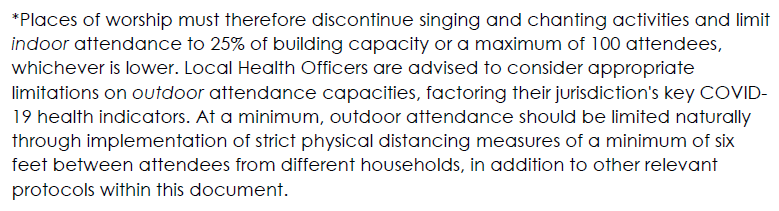
As part of his new statewide health orders issued on Wednesday, July 1, California Governor Gavin Newsom included a new requirement that “*Places of worship must therefore discontinue singing and chanting activities” during worship services. (Note: The asterisk does not refer to anything else in the document) See https://files.covid19.ca.gov/pdf/guidance-places-of-worship.pdf

Under the section entitled Considerations for Places of Worship it reads, “Discontinue singing (in rehearsals, services, etc.), chanting, and other practices and performances where there is increased likelihood for transmission from contaminated exhaled droplets.

The state’s document, entitled COVID-19 INDUSTRY GUIDANCE: Places of Worship and Providers of Religious Services and Cultural Ceremonies refers to the practice of one’s faith as “personal” as if it’s not supposed to be done in public, like other activities such as protesting.

“Even with adherence to physical distancing, convening in a congregational setting of multiple different households to practice a personal faith carries a relatively higher risk for widespread transmission of the COVID-19 virus, and may result in increased rates of infection, hospitalization, and death, especially among more vulnerable populations. In particular, activities such as singing and chanting negate the risk reduction achieved through six feet of physical distancing,” the document reads.

However, in response after contacting county officials, leaders of Golden Hills Community Church, one of the larger churches in Eastern Contra Costa County with campuses in Brentwood and Antioch which will hold their first in-person service in 17 weeks on Sunday, July 5, shared with their members that singing while wearing masks will be allowed.

In an email on Friday, June 3 Senior Pastor Phil Ward wrote, “This week both the state and the county announced a ban on ‘singing and chanting’ in houses of worship. Since we now have the ability to gather for in-person worship, and since singing is an essential aspect of Christian worship (Eph. 5:19; Col. 3:16), we found this prohibition unreasonable because it dictates what is permissible in worship. As a result, we reached out to the governing authorities to express our concern. In response, we were told that singing is permitted so long as masks are being worn—something we already planned to do.”

Although the sanctuary at their Brentwood campus has a capacity of 1,700 people and could easily accommodate 350 people while social distancing, the church will be following the limits of only 100 people per service. They will also utilize their former sanctuary, now used as a multipurpose room, which can also meet the state and county’s limitations of 100 people maximum or 25% of room capacity whichever is less. Finally, the church will be offering four services this Sunday and adding a fifth service, beginning next Saturday night, July 11.

Debate Over Following All Government Laws & Orders

International evangelist and San Francisco native Mario Murillo wrote this week in response to the governor’s order that Christians should not follow such laws or orders because they are evil and go against what God teaches His followers.

I can’t think of a worse idea than to stop praise and worship because Gavin Newsom told you to,” he wrote. “It’s time to wake up to the sad truth that California has declared war on the church. Doesn’t the Bible tell us to obey them no matter what? Absolutely not. And it is shocking how many believers do not know their Bible or have been given false teaching. There is no verse in the Bible that tells you to obey evil government or laws.”

Many believers often quote a section in the book of Romans, chapter 13, verses 1-7 to support following the government’s orders: “Let every soul be subject to the governing authorities. For there is no authority except from God, and the authorities that exist are appointed by God. Therefore, whoever resists the authority resists the ordinance of God, and those who resist will bring judgment on themselves. For rulers are not a terror to good works, but to evil. Do you want to be unafraid of the authority? Do what is good, and you will have praise from the same. For he is God’s minister to you for good. But if you do evil, be afraid; for he does not bear the sword in vain; for he is God’s minister, an avenger to execute wrath on him who practices evil. Therefore, you must be subject, not only because of wrath but also for the sake of conscience. For because of this you also pay taxes, for they are God’s ministers attending continually to this very thing. Render therefore to all their due: taxes to whom taxes are due, customs to whom customs, fear to whom fear, honor to whom honor.”

However, Murillo quotes other Bible verses that offer the opposite perspective, that believers are only to follow rulers who aren’t evil and laws that aren’t evil.

“It seems to say that we are to honor government in every form, right? Wrong,” he wrote. “Lost in all the quoting of this verse on submission to government is the most important part: The description of the ruling authority.”

Murillo shares that description writing, “they are not a terror to good works” and “they praise good works.”

He also shared what Jesus said of the Pharisees in Matthew 23:3, “Therefore whatever they tell you to observe, that observe and do, but do not do according to their works; for they say, but do not do.”

“Do what they say, but don’t partake of their hypocrisy,” Murillo explains. “Watch them for that moment when they cross the line and come between you and your God.  Just as our conscience should drive us to obey the law, we should also know when our conscience tells us not to obey an evil law.”

“Here’s when Peter reached that tipping point, speaking to those very same Pharisees,” he continues, quoting Acts 4:18-20, “So they called them and commanded them not to speak at all nor teach in the name of Jesus. But Peter and John answered and said to them, ‘Whether it is right in the sight of God to listen to you more than to God, you judge. For we cannot but speak the things which we have seen and heard.’”

Murillo then quoted Acts 5:29 writing, “Peter and the other apostles answered and said: ‘We ought to obey God rather than men.’”

Newsom’s Order is an Evil Law That Must Not Be Followed

“God not only does not endorse evil government: He will have no part in it,” Murillo continues. He then quotes Psalm 94:20 writing, “Can a corrupt throne be allied with you—a throne that brings on misery by its decrees? The wicked band together against the righteous and condemn the innocent to death.”

“There is your answer. A corrupt throne (government) cannot be allied with God,” he wrote. “In fact, evil laws are the worst form of sin. They provide legitimacy to evil.”

Murillo concludes by quoting German pastor, theologian, anti-Nazi dissident and Christian martyr, Dietrich Bonhoeffer, who said, “Silence in the face of evil is itself evil: God will not hold us guiltless. Not to speak is to speak. Not to act is to act.”

Wearing a Mask While Singing or Chanting Works

So, ordering followers, of at least Christianity and Judaism, to discontinue singing violates what God wants practiced during worship. As it is written in Psalms 98:4, “Make a joyful noise unto the LORD, all the earth: make a loud noise, and rejoice, and sing praise.” Therefore Governor Newsom’s order is an evil law that must not be followed. But, for safety’s sake the spirit of the order can be met by wearing masks while singing or chanting in church.

California Connections Academy virtually celebrates ten graduating seniors from Antioch

Friday, July 3rd, 2020

Network of six online public schools joined together for a virtual commencement ceremony on June 17 of over 800 students in the Class of 2020 

San Juan Capistrano, CA – California Connections Academy, a tuition-free network of online public schools serving students in grades TK-12 across 32 counties in California since 2004, celebrated more than 800 graduating seniors on June 17. While graduates were unable to walk across the stage to receive their diploma as tradition holds, school administrators and teachers honored the graduates with proper pomp and circumstance during the virtual graduation ceremony.

Students gathered with family members, friends, teachers and administrators in an online setting to commemorate this milestone and celebrate the many accomplishments of the Class of 2020. Fortunately, due to the school’s full-time virtual curriculum, seniors at California Connections Academy were able to finish their semester and complete all courses despite the public health crisis.

The following students are California Connections Academy graduates from East County:

  • Isabella Macayan, Antioch
  • Olivia Gregory, Antioch
  • Alden-Christopher Quintanilla-Sanchez, Bay Point
  • Rowyn De Witt, Oakley

Unfortunately, the list is incomplete as the school can only share the names of students who have consented to the Family Educational Rights and Privacy Act (FERPA).

“California Connections Academy prepared me well for graduation,” said Isabella Macayan of Antioch. “The teachers are always ready to help if you call and they make time to connect with students. My family feels like we made the right choice when deciding which school to attend.”

Another graduate who lives in East County shared his thoughts.

“California Connections Academy provided me with a flexible schedule and the classes I needed to graduate high school ahead of schedule. Moving from a private school to an online school was a big change but it gave m insight into time-management and self-motivation,” said Alden Christopher Quintanilla-Sanchez of Bay Point. “The school gave me the resources I needed and all I had to do was make good use of them.”

The Class of 2020 is comprised of graduates from six California schools – California Connections Academy Central, California Connections Academy Central Coast, California Connections Academy Monterey Bay, California Connections Academy North Bay, California Connections Academy Ripon and California Connections Academy Southern California – residing in 32 counties throughout the state. Among the graduating class, 65% plan to attend two- or four-year colleges or universities, 11% plan to enter the work force and 8% plan to attend vocational or technical school or join the military. Collectively, the graduating class earned more than $856,000 in scholarship funds and students have been accepted to notable in-state and out-of-state universities including UCLA, UC Berkeley, UC Irvine, UC Santa Barbara, UC Davis, Boston University, Columbia University, Carnegie Mellon, and NYU, among many others.

Among the graduates is California Connections Academy Ripon valedictorian Nthenya Maithya, who came to California Connections Academy in 2018 seeking a flexible schedule that would allow her to excel academically at her own pace. Maithya will attend Villanova University in the fall to study mechanical engineering.

“While attending California Connections Academy, I felt that I had the power to take my education into my own hands and learn about myself along the way,” shared Maithya. She added that she never thought she would be valedictorian. “I always push myself to be the best I can and set high standards for myself. At Connections Academy, I could see that paying off.”

“I am continually inspired by our 2020 graduating class,” said Dr. Richard Savage, California Connections Academy Executive Director. “These students have worked incredibly hard to finish the school year strong and I am so proud of all of their achievements. I have no doubt these students will be the next generation of successful and thoughtful leaders.”

California Connections Academy accommodates the needs of a variety of learners through unique curriculum opportunities, close-knit collaboration with fellow students and staff, supportive teachers and the flexibility to learn from anywhere with an internet connection.

Currently providing more than 7,600 students across six schools with a high-quality, personalized online education, the schools combine California-credentialed teachers with structured LiveLesson(R) online classroom sessions, and a curriculum that meets rigorous state education standards. Through advanced technology tools, teachers work closely with students to nurture their strengths and provide additional support for areas of difficulty, while parents can consistently monitor how their child is performing and progressing. The safe learning environment enables a dynamic student schedule and offers a solution to families with a variety of needs.

For additional information about online education and enrollment, the school is hosting free events for families to learn more. To learn more about California Connections Academy and begin the enrollment process, visit the school’s website.

About California Connections Academy

California Connections Academy is a network of tuition-free, high-quality, highly accountable online public school serving students in grades TK-12 throughout 32 counties via six school sites in California. All six schools are fully accredited by the Accrediting Commission for Schools of the Western Association of Schools and Colleges (WASC). California Connections Academy provides students a safe, supportive learning environment with the flexibility to learn from anywhere with an internet connection with an innovative curriculum that meets rigorous state education standards. The combination of state-credentialed teachers, an award-winning curriculum, personalized teacher support, unique electives and community experiences creates a supportive and successful online learning opportunity for families who want an individualized approach to education. For more information, call 1-800-221-2720 or visit the school’s website.

Contra Costa County off state’s Watch List as of Friday evening

Friday, July 3rd, 2020

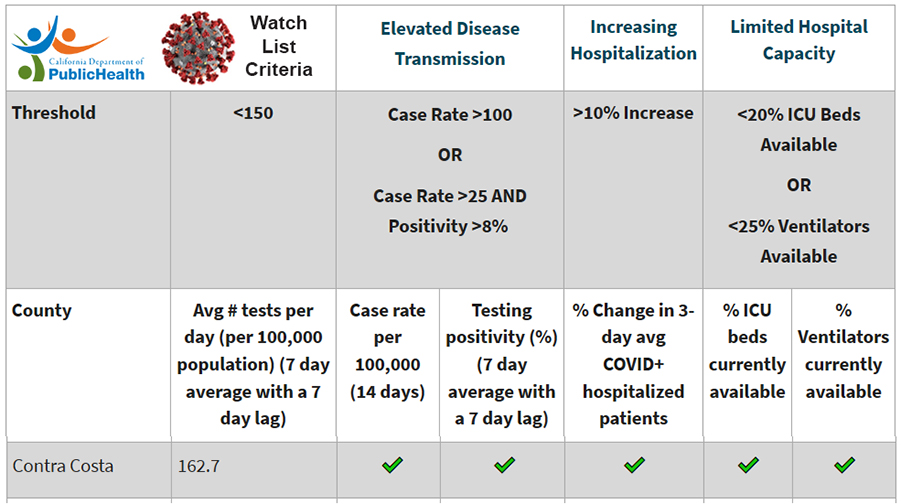
Check marks indicate a county has fallen below the monitoring level for that criteria.

County health officials evaluating local data to determine any further business reopening

By Allen Payton

As of Friday night, according to the California Department of Public Health (CDPH) COVID-19 website, Contra Costa County is no longer on the state’s Watch List for monitoring cases.

The state monitors three criteria, which includes elevated disease transmission with a case rate of more than 100 or a case rate of greater than 25 and positivity of more than 8%; increasing hospitalization of more than 10%, and limited hospital capacity with less than 20% of ICU beds available or less than 25% of ventilators available.

Contra Costa has fallen below the criteria which flags counties for inclusion on the watch list.

Asked if there had been an announcement about this new information since our county was included in the list as of Governor Newsom’s announcement on Wednesday, July 1, Contra Costa Health Services spokesman Karl Fischer responded, “No. Counties go on and off the watch list with some regularity, including ours.”

Asked if those businesses that were supposed to reopen on Wednesday would now be allowed to reopen on Monday, Fischer responded, “No determination has been made about changing the reopening timeline. We are evaluating the local data.”

A description of the data being monitored can be found in the Understanding the Data Being Monitored section. The data chart is updated and posted daily.

You can fight city hall: Antioch real estate broker sues city over rent and eviction moratorium, challenges city and county over curfews

Friday, July 3rd, 2020

City hires outside attorneys, sends case to federal court; 90-day repayment period per month of late rent still in place

“Freedom isn’t free. Sometimes you have to stand up,” – Mark Jordan

By Allen Payton

In efforts to fight for his rights, and those of other Antioch and Contra Costa County residents and property owners, local real estate broker, Mark Jordan has been suing the City of Antioch over its rent and eviction moratorium. Specifically, Jordan is fighting the “City Urgency Ordinance and the rental repayment infringement,” and challenging both the city and county over the curfews, in June.

Temporary Evictions, Rent Moratorium Lawsuit Served

In April, Jordan sent a “Cease and Desist Demand” to the members of the Antioch City Council on Friday, April 3 in response to their vote on March 31 to place a moratorium on evictions for both residential and commercial properties. The council’s actions give renters up to 90 days to repay for each month of rent they are unable to pay during the coronavirus pandemic. (See related article) ACC2020.03.31 – URGENCY ORDINANCE – Moratorium on Evictions       Temp Evictions Complaint.Jordan.v.COA

No action was taken by the city council in response to Jordan’s demand, so on June 2, he served the City of Antioch with a lawsuit challenging the council’s decision.

“I gave the City every opportunity to back up on this issue,” Jordan wrote. “They did not.”

On June 18 Jordan wrote the Herald regarding an agenda item on the June 23 City Council meeting agenda, that the “City is looking to walk back the Ordinance, but is not addressing the core issue of the suit which is the illegal 90-day per month grace period for missed rent.”

Semi-Victory as Council Expires Moratorium

For the Antioch Council meeting on Tuesday, June 23, 2020 Jordan submitted the following comments for the agenda item dealing with the expiration of the city’s moratorium on rent increases and evictions. However, they were not read into the record.

City Clerk Arne Simonsen said Jordan’s comments were sent to his personal email account. But Jordan said he emailed his comments to Simonsen and all five city council members.

“Mayor and Council,

For the citizens of the City of Antioch, let me bring you up to speed.

I am a Plaintiff in a lawsuit against the City of Antioch concerning the Urgency Ordinance passed on March 31, 2020 No: 2182-C-S. The case number of my suit at the Superior Court of California, County of Contra Costa is MSC20-00976.

Why am I suing the City of Antioch? Because when they passed the Ordinance they violated the

Constitution of the United States and also the Constitution of the State of California. They violated your rights.

I noticed them that in passing the Ordinance they were making a mistake but they pressed forward. I demanded they rescind the Ordinance. They did nothing. The Courts opened and I filed.

Just so you know when an elected official violates the Constitution they are violating their oath of office and are therefore in a position where they may be held criminally liable and where qualified immunity may not protect them. Not a good place to be Mr. Mayor, Council Members.

It is not that tenants did not need protection initially because of the pandemic. They did, but when the City created a 90 day repayment period for each month a tenant was not paying rent, that was too far.

Miss a year’s rent, get 1080 days to catch up. That is almost three years. Nonsense.

This is governmental interference in private contracts and there is case law all the way back to the beginning of the Republic. You do not pass the general legal three point test to validate your action.

So, why did the City Council do this? Because; the City Attorney, Mr. Smith is providing very poor council (sic). And, although Mr. Smith has an excellent legal education he has little time in the practice of law.

Advice to Counsel Smith, wisdom comes with age. You are over your head.

The City now is attempting to sunset the Ordinance stating tenants have other protectors. True, but the real reason is that the City Attorney is trying to create a situation in which he can file a response and claim the matter is moot (over). It is not. Constitutional violations remain past a sunset. And, I will press the matter.

Antioch, also know this. I called the City Attorney last Friday after reviewing Agenda item 9. There has been NO return call. I talked with Mayor Wright yesterday stating I had reviewed the information and was prepared to sit and work out a settlement and informed him that there has been no response from Mr. Smith.

Since that discussion there has been NO response to my offer from the City of Antioch, Mayor, Manager or Counsel Smith. When any citizen cannot get a return phone call, government is failing. You are failing City Council.

Therefore; Antioch be informed that your City government, our City government, my City government is prepared to spend our money on a matter they will not win and should be anxious to conclude.

Did Mr. Smith miss the class at Harvard on settlement? What exactly are you trying to achieve City Council?

This is not my first run in with the City of Antioch. The first was about Religious Freedom and I had to bring in legal counsel to explain the U.S. Constitution. I prevailed. A church was able to obtain their sanctuary.

The second was a suit in which the City violated the California Constitution, Prop 218 over a number of years and agreed to return nearly a million dollars to Antioch Enterprise Funds. Police don’t patrol or protect sewer lines.

City Council, you really want to go to court? Really?

If you do, know I’m all in. I will press my rights and the rights of every other property owner in Antioch.

Not to the detriment of tenants but to the equality of the law, due process and our, everyone’s Constitutional rights.

My phone works just fine. You have to dial the seven digits. It’s a local call.”

During their meeting, the Antioch City Council approved an urgency ordinance expiring the city’s rent increase and eviction moratorium, giving Jordan a partial victory. However, that action was only taken because the county’s moratorium, approved by the Board of Supervisors and runs through July 15, applies to cities as well as unincorporated areas of the county. According to the ordinance the City Council finds that “residences and businesses… will continue to have protections from eviction and adequate ‘grace periods’ to repay unpaid rent…from the Governor’s Executive Orders, Judicial Council Emergency Rule, and the County’s Urgency Ordinance.” Urgency Ordinance expiring Eviction & Rent Increase Moratorium ACC062320

Another Lawsuit by Others Against State

In addition to Jordan’s lawsuit, another lawsuit was filed against the state on June 15 by the Pacific Legal Foundation (PLF) on behalf of two rental property owners challenging California courts’ refusal to hear eviction proceedings. (Christiansen & Martin vs. California Judicial Council).

In that case, PLF argues “the California Judicial Council decided to take matters into its own hands and effectively banned all evictions by forbidding courts from issuing summons or entering default judgments.

Their measure, Emergency Rule 1, means that landlords like Peggy Christensen, a retiree who depends on her rental income, cannot take legal action against tenants who damage the property, harass other tenants, or refuse to pay rent. It also means that landlords like Peggy are forced to turn away considerate renters in need of housing. In making this rule, the Judicial Council has seized policymaking power from the legislature and governor to block landlords’ access to the courts. Peggy and Peter Martin, another landlord, are fighting back with a state lawsuit to rein in the Judicial Council’s illegal overreach, restore the rule of law, and protect the entire state’s critical rental housing industry.”

According to PLF the “government cannot deprive landlords of their right to evict tenants who are able to pay rent yet refuse to do so, crippling their businesses and handicapping their ability to help tenants who face financial hardship.” Furthermore, the PLF claims “the California Constitution’s separation of powers prevents government agencies like the California Judicial Council from overriding the legislature and governor to take the law into its own hands and make social policy.”

Jordan’s Not Backing Down on 90-Day Repayment Period

In spite of the Antioch Council’s action on Tuesday night, June 23, Jordan refuses to back down.

“The fact that they’ve sunseted the ordinance doesn’t mean their violation of constitutional rights goes away,” Jordan said. “There are still remedies. So, this is not over.”

“Smith just wants to file a motion to dismiss because the whole matter is moot, since they sunseted the original ordinance,” Jordan stated. “I told the mayor I was more than willing to sit down and have a conversation with the city attorney. But there have been no phone calls.”

City Settles Previous Lawsuit by Jordan Over Misuse of Tax Dollars

“When I sued the city over their misuse of enterprise funds for police, theirs and my attorneys sat down and met with me, and we worked out a settlement agreement,” he explained. “Then it was taken to the council for approval. Since I have no attorney representing me, it’s incumbent upon Smith to meet with me and to try and settle the matter and take that to the council.”

“I’m actually saving the city money. The last time I sued them they had to pay my attorney $75,000,” Jordan added. (See related article)

City Settles Previous Lawsuit by Jordan Over Misuse of Tax Dollars

The legal counsel for the California Association of Realtors has been given a copy of Jordan’s lawsuit.

“They are actively watching all of these suits,” he said.

“We have a court date for a temporary injunction. That would enjoin the city from implementing the entire ordinance. If in fact they have sunseted the ordinance, that hearing would probably be unnecessary and all that remains are the constitutional violations. I’m not looking for any money, personally, Jordan shared. When you settle a lawsuit, people don’t normally admit any culpability. What they’re prepared to offer to settle the suit I don’t know because I can’t get a returned phone call.”

“I told the mayor if you think you’re going to just file an order to dismiss when you’ve violated my and others’ constitutional rights, that won’t settle the matter.

The court date was set for the August 24th.

He pointed out that the urgency ordinance adopted by the city council on June 23 had the incorrect number for the original urgency ordinance on the rent and evictions moratorium. The number used nine times in the document was 2181 instead of the correct Urgency Ordinance 2182-C-S.

“It is the wrong ordinance that they sunseted, as it has the wrong number on it. I know I’m being picky and technical about it, but that’s the law,” Jordan stated. “So, if they didn’t change the number, they didn’t sunset it.”

City’s Contract Attorney Responds

As of Friday, June 26 City Attorney Smith had yet to respond to Jordan’s lawsuit. Instead, that night at about 6:00 p.m., according to Jordan, attorney David Mehretu of Meyers Nave in Oakland, who was hired by the City to represent them, contacted Jordan about his case.

City’s 90-Day Per Month Repayment Period Still In Place

In addition, the City asked Mehretu to answer the questions the Herald sent to City Attorney Smith about the incorrect ordinance number in the new urgency ordinance and the impacts of the council’s sunsetting of the urgency ordinance.

Mehretu explained that the incorrect number in the new urgency ordinance which sunseted the original urgency ordinance was merely a clerical error and could be corrected by city staff. The intent of the city council is clear and the language in the new ordinance clearly refers to the original urgency ordinance. So, no additional vote of the council is necessary.

Regarding the 90-day repayment period for each month a renter is unable to pay, Mehretu said, “the sunset or termination of the urgency ordinance did not eliminate the 90-day per month in arrears protection for renters in Antioch.”

The months covered are “from the date of the original ordinance” which was adopted by the city council during a special meeting held on March 31, 2020. So, the city’s ordinance covers rent for the months of April, May and June and gives renters in Antioch nine months from the end of the shelter-in-place, which is currently scheduled to expire on July 15, to repay their back rent.

Rent for July is covered under the county’s ordinance which gives renters 120 days to repay all back rent. Assuming the current shelter-in-place order is lifted on July 15, renters anywhere in the county who have been unable to pay their rent would have until November 15 to repay rent for July.

That’s what Jordan is fighting, claims is unfair and violates his constitutional rights.

Settlement Effort Breaks Down, New Meeting Set

Jordan attempted unsuccessfully to settle the case with the city out of court.

“We were close, but settlement failed,” he shared on Tuesday, June 30. “The City will respond to the lawsuit and we will move on.”

However, Jordan added, “We have a tentative agreement to have a discussion on settlement, next week.”

City’s Contract Attorneys Submit “Answer to Complaint”

The contract attorneys for the City, which now includes Deborah Fox, also of Meyers Nave, sent Jordan a response to his lawsuit, yesterday, Thursday, July 2nd. Jordan-Antioch-Answer

In their “Answer to Complaint” they offer eight Affirmative Defenses claiming Jordan’s lawsuit “fails to state facts sufficient to constitute a cause of action,” that he “lacks standing because Plaintiff (Jordan) has not suffered an injury in fact,” and “as a private party, Plaintiff lacks standing to enforce criminal laws.”

In addition, the City’s attorneys argue Jordan should have first filed a claim against the City, “pursuant to Government Code section 911.2 et seq.” The attorney’s Fifth Affirmative Defense is that the City “is not liable to Plaintiff because the acts complained of in the Complaint constituted one or more discretionary acts.”

The city’s attorneys are, of course, asking that the court dismiss the case and for Jordan to pay the City for costs and attorneys’ fees.

Case Moved to Federal Court – No Date Set, Yet

On Friday, July 3, Jordan shared, “City moves case from California Court to Federal court because there are US Constitutional claims of violation by the City.” Jordan-Antioch-STATE   ECF 1 Jordan-Antioch

In the filing, the first attorney listed for the city is Thomas Smith. So, both he and the attorney they hired are representing the city.

The case will no longer be heard on August 24th and there is no hearing date for a temporary injunction.

“I would have to write a new motion for federal court requesting a temporary injunction,” Jordan said. “The entire jurisdiction moves to federal court and whether they will set a new date we don’t know, yet.”

He reached out to the Pacific Legal Foundation, following advice of the California Association of Realtors, for possible pro bono representation.

Antioch Curfew Challenge

On Monday, June 1, 2020, the City of Antioch ordered a curfew for that night and later extended it through the following night. The Antioch Police Department stated in a Facebook post, that day that the “decision was made after we were made aware of credible threats of subjects coming into our community for the purpose of causing damage and committing criminal acts.” (See related article)

On June 2, Jordan wrote Mayor Sean Wright and councilmembers challenging both the curfew and the way it was announced: “I have read…that the City Manager has enacted a curfew. Is this correct? 1.  No posting exists on the City web site and therefore Notice does not exist for the public.  Or, where did you post such a notice and when for the public? 2.  By what right does the Manager have the right to enact a curfew?  Did you relegate your responsibility?  Why did the council not act? 3.  What emergency was declared?  Please see Emergency Services Act for approved list of emergencies. 4.  Where did you post the notice of emergency? 5.  What section of the Penal Code of the State of California are you using? Please answer the above questions or have the City Attorney respond to the questions.  Please provide a copy of the Notice if it exists.”

Jordan later wrote the Herald, “News is not a posting by the City. And, you must have an emergency declared.  Based on my reading. New report states Manager declared. Government does not have the right to take away civil rights based on a whim.”

Jordan received a copy of the Curfew Order from the city on the afternoon of June 2.

In response, Jordan emailed City Manager Ron Bernal writing, “Mr. Bernal, Please define exactly what events occurred in Antioch that you reference and which would constitute an emergency under the Emergency Services Act.  See Curfew Order, City of Antioch, 4th bullet point, dated June 1, 2020. You cannot act upon a belief or thought that an emergency may require this action.  There MUST be an actual emergency. This order without reference may constitute an attempt to silence free speech, the right of assembly and the right to present grievance against the government.  Please refer to the US Constitution and the State of California Constitution. Please define what, when and where caused this order within and for the City of Antioch.”

Having received no response, Jordan sent another email message to Bernal the next day, June 3: “Mr. Bernal, This is my 2nd request for exactly what events occurred within the City of Antioch that require this City curfew.  I will deal with the County separately. As with other matters I wish to give you and the City of Antioch every opportunity to comply with the requirements of the Emergency Services Act and to properly Notice the community as to what events occurred. A belief that an event might occur is insufficient to meet the requirements of the Act.  It is clear to the public now you know how to amend your Orders.

If you fail to respond, and fail to state to the public of Antioch exactly what events you reference and publish that clarification, well, then it is likely I will move to reverse you attempt to create a police state within the City.  Fair warning, don’t press me.  I take my civil rights, the United States Constitution and the Bill of Rights seriously.  And, I’m willing to fight to guard them.
I suggest you obtain legal advice outside of the City Attorney; perhaps someone well versed in the Constitution of the United States and the Bill of Rights.  I would direct your attention to Article 1. Your response and information is anticipated by the entire public of the City.”

Having still received no response from the City, Jordan wrote the Herald, “These documents and the Order of Curfew do not meet the requirement of the Act.  There is NO response from the City.”

Then on June 4, Jordan wrote the Herald, “no one from the City ever responded to my request for information. I posted the emails for the Mayor’s community forum 6/3/2020 but have no response from the Mayor. There was never a statement of what event(s) occurred which would justify such an order.  And, to be clear, ‘credible evidence’ that something might happen, is not sufficient to implement a curfew based on the Act. I’m not sure anyone at the City understands Constitutional Rights.”

County Curfew Challenge

That same day, June 4, Jordan emailed members of the County Board of Supervisors about his concern over the county’s curfew.

“Board of Supervisors, It is my belief that you do not have the right or authority based on the Emergency Services Act to issue an unlimited curfew. Your order appears in violation of both the United States Constitution, Article 1 and the State of California Constitution.

Understood that there exists activity that most likely violates the California Penal Code. And, that any alleged criminal behavior should be addressed and directed to the District of Attorney. That said this order is a massive overreach bordering on the creation of a police state affecting all of the citizens of the County who have nothing to do with or who are effected by any of the minor civil unrest.

Therefore, I demand that you amend the order immediately to include a date certain termination or rescind the order in total. Should you do either by June 9, 2020 I will consider this matter closed. Your correction and attention to this matter is appreciated. If your counsel wishes to speak to me have him call.”

Supervisor Karen Mitchoff’s Chief of Staff, Anne O. responded to Jordan via email later that day writing, “The County Administrator has rescinded the curfew, effective 1pm today.”

He also received a copy of the county’s curfew termination order, which ended that issue.

“Freedom isn’t free. Sometimes you have to stand up,” Jordan added.

 

Contra Costa fire, law enforcement officials warn of dangers of illegal fireworks during Independence Day holiday weekend

Friday, July 3rd, 2020

“all fireworks are illegal in Antioch as well as all of Contra Costa County. In addition to the possible $1,000 criminal fine, fireworks pose an extreme fire danger and can cause traumatic injuries.” – Antioch Police Chief T Brooks

Illegal Fireworks Use Poses Extreme Risk of Grievous Bodily Harm and Catastrophic Wildfires During; Current Period of Critically High Fire Danger

Contra Costa County Fire Protection District (Con Fire) and local law enforcement agencies across the county, this week warned citizens about the extreme dangers of illegal fireworks during the days leading up to the Independence Day holiday.

Fire and law enforcement leaders reminded residents and visitors that all fireworks, regardless of type or labeling, are illegal everywhere in the county. There are no “Safe & Sane” fireworks, regardless of labeling. Additionally, the potential for grievous bodily harm posed by these illegal devices and the risk of causing catastrophic wildfires during this time of extremely high fire danger is great.

With prolonged warm, dry and windy weather leading up to the Independence Day holiday, fire danger is unusually high making fireworks an even greater threat to our communities than in recent wetter and cooler years. Because of these conditions, in the month of June alone, communities across the District have experienced a nearly fourfold increase in grass and vegetation fires. More than a dozen of these were started by illegal fireworks; many have threatened homes and businesses.

“The only safe and sane approach to fireworks in Contra Costa County is to simply not use them,” said Fire Chief Lewis T. Broschard III, Contra Costa County Fire Protection District. “They are uncontrollable and dangerous, illegal, and their use poses the very real possibility of causing wildland fires that could easily destroy homes and threaten lives in this time of critically high fire risk.”

“This year, we have seen a tremendous increase in fireworks-related complaints and calls for service compared to previous years,” said Chief Tammany Brooks, Antioch Police Department. “I want to remind everyone that all fireworks are illegal in Antioch as well as all of Contra Costa County. In addition to the possible $1,000 criminal fine, fireworks pose an extreme fire danger and can cause traumatic injuries.”

“Fireworks aren’t just illegal, they’re dangerous. We want you to keep that and your community in mind as we approach the holiday weekend,” said Concord Police Chief Mark Bustillos. “We wish everyone a happy and safe 4th of July!”

“Already several weeks into what promises to be a high-risk fire season, we want to remind residents of the very real dangers involved with illegal fireworks,” said Lafayette Police Chief Ben Alldritt. “We owe it to our friends, families, and neighbors to be safe and avoid fireworks risks this Fourth of July holiday — the City of Lafayette wants everyone to be safe and avoid fireworks-related accidents and fires.”

“While Independence Day is a time for celebrating, and we wish you all the best on this holiday, the Martinez Police Department remains steadfast in our commitment to public safety,” said Chief Manjit Sappal. “As such, we wish to make it clear that fireworks are illegal and unsafe; they can cause injury and devastating fire-related damage. Please commit to the safety of your family, friends, and neighbors by not using any fireworks.”

“The Fourth of July is a great time to spend with family and friends, but illegal fireworks continue to be a problem in our community,” said Chief Brian Addington, Pittsburg Police Department. “We have already had more than 350 calls reporting illegal fireworks. We have a zero-tolerance policy; if you are caught with illegal fireworks, expect a $1000 fine, or a trip to jail.”

“We know how disappointed people are by the cancellation of the traditional fireworks shows due to COVID-19, but using illegal fireworks instead is not a safe solution. They pose serious danger to those using them, and to the surrounding community, as well,” said Pleasant Hill Police Chief Bryan Hill. “This year, we are encouraging everyone to celebrate at their place of residence, and to celebrate safely.”

“The pyrotechnic powder in most fireworks is extremely sensitive to heat, shock and friction, and in certain circumstances can explode even when you don’t want or expect them to,” said acting Lt. Anthony Mangini, Walnut Creek Police Bomb Squad. “The fire and injury danger from illegal fireworks poses extreme risks for civilians, and also for first responders and our hazardous devices technicians who must dispose of them.”

While public fireworks events around the county have been cancelled this year due to the COVID-19 pandemic, officials strongly discourage residents from attempting to replace these events with illegal consumer fireworks use. Instead, residents are encouraged to watch a fireworks display on television or online video, use safe and readily available glow-stick products, or many other ways of celebrating.

Fire and law officials urge residents to protect their homes, families and neighborhoods by reporting all use of illegal fireworks immediately to their local law enforcement agency’s non-emergency phone line. In cases where immediate risk to life or property exists, 911 should be called.

In addition to fire danger, there are significant risks of serious injury or death. On July 5th, 2018, an Antioch resident was severely injured handling a supposedly “Safe & Sane” firework discarded at his place of business. Nationwide, thousands are injured annually, more than half are under 15.

Last year, illegal fireworks use in the County sparked preventable vegetation fires threatening lives and structures and straining emergency resources needed for higher priority fire and medical emergencies.

For more on protecting homes and businesses from wildfires, visit www.cccfpd.org/wildfireprep.

About Contra Costa County Fire Protection District (Con Fire) — A recognized fire service leader — Con Fire provides fire and emergency medical services to more than a million people across its 304 square-mile District area, and through mutual aid, in and around the 20 cities and unincorporated communities of Contra Costa County, California. With few exceptions, county emergency ambulance transport services are provided by Con Fire through its unique sub-contractor Alliance model. In 2019, the District responded to nearly 78,000 fire and EMS emergencies and dispatched some 95,000 ambulances, providing exert medical care on more than 74,000 ambulance transports. The District, with 26 fire stations and more than 400 employees, is dedicated to preserving life, property and the environment.