Join us for the General Plan Update Kickoff Meeting on Tuesday, October 21st at 6:00 PM at the Antioch Community Center in Prewett Family Park at 4703 Lone Tree Way.
This special joint session with the City Council and Planning Commission will serve as a “General Plan 101” and is a great opportunity to learn how Antioch plans for the future and how YOU can get involved!
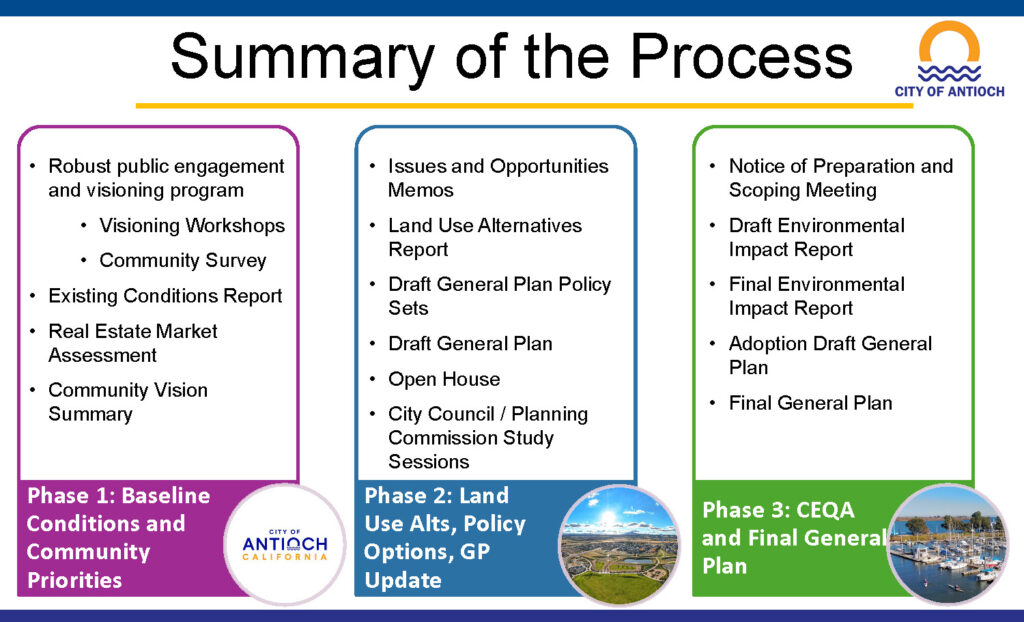
Every city and county in California is required by state law to prepare and maintain a planning document called a General Plan. A General Plan is designed to serve as the jurisdiction’s “constitution” or “blueprint” for future decisions concerning land use, social issues, circulation, recreation, infrastructure, public services, environment, and resource conservation. This General Plan Update will ensure Antioch addresses recent changes in state law, proactively plans for future challenges and opportunities, prioritizes economic growth and vitality, and builds upon the City’s unique heritage and community-focused atmosphere. The update, through each element, will provide a basis for local decision making and involves the community in the process of identifying goals and policies to define how the City should respond to needs for physical development over time.
On August 26, 2025, the City Council selected the De Novo Planning Group team to prepare its General Plan Update. The team’s subconsultants will provide technical expertise: W-trans (traffic and circulation), EPS (economic development and fiscal sustainability), Kearns & West (community outreach), and Cogstone Resource Management (cultural and historical resources).
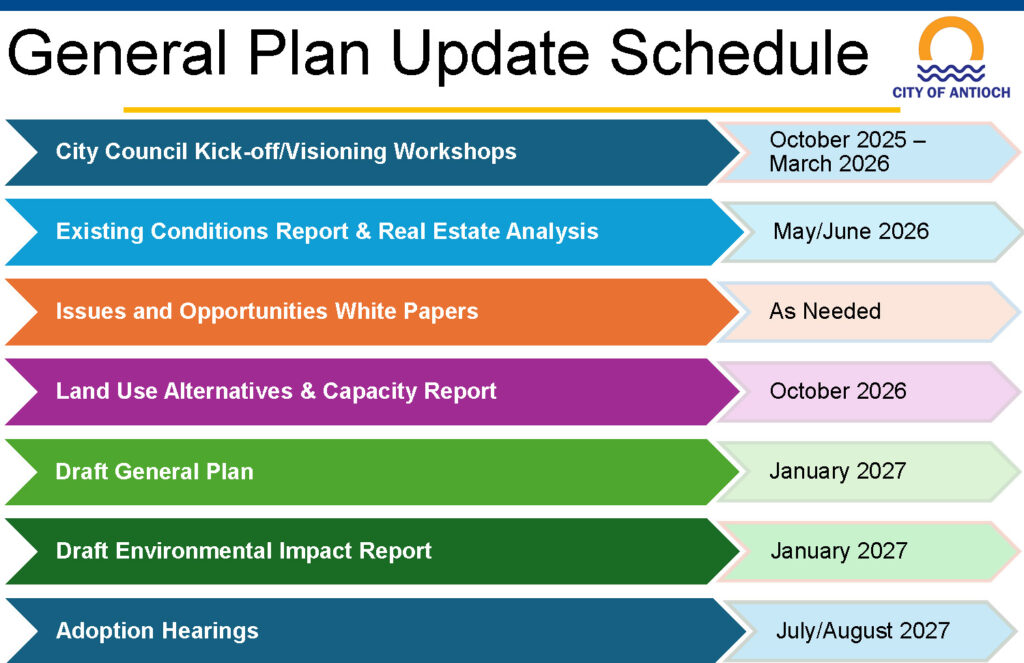
The process will occur over the next two years with the Draft General Plan to be issued in January 2027 and final adoption by the Council in July or August 2027.
Source: City of Antioch
The Council and Commission will hear and see the presentation from De Novo Planning Group regarding the General Plan Update process and provide staff and the consultant with input regarding the following:
Opportunities, Issues, and Priorities
1. What are the top three most critical issues or opportunities you believe this General Plan Update must address to best serve Antioch’s future?
2. Are there any specific geographic areas or corridors within Antioch (e.g., the waterfront, specific commercial districts, a neighborhood) that you feel require special attention or a focused vision during this process?
3. Beyond fulfilling state requirements, what key achievement or outcome will define this General Plan Update as a success for the City of Antioch?
Source: City of Antioch
General Plan Advisory Committee
The Council and Commission will also discuss forming an advisory committee.
To ensure the General Plan Update receives consistent and focused feedback, an advisory committee is often established. The structure of this committee is a key decision that shapes how community and technical input is integrated into the process. We seek direction on whether one should be established, and, if so, the preferred model for Antioch. Common options include:
• Option A: Community-Based Advisory: This is a committee appointed by the City Council, typically composed of 9 to 15 residents, business owners, and community stakeholders who represent a diversity of geographic areas, interests, and demographic backgrounds. With this approach, the GPAC would hold a series of public meetings to discuss General Plan topics and provide an opportunity for public comment. Locally, the City of Brentwood and Contra Costa County have used this approach for their General Plan Updates.
• Option B: Technical Advisory Committee: This approach relies on a committee of technical experts from City departments (e.g., Planning, Public Works, Economic Development) and key partner agencies (e.g., school districts, regional transit, utility providers). The TAC ensures the plan is technically feasible and coordinated. In this model, broader public input is gathered primarily through the visioning workshops, open houses, and focused community meetings rather than a standing citizen committee. The City of Pittsburg employed this approach for its recent General Plan Update.
• Option C: Hybrid Model with the Planning Commission: In this streamlined model, the Planning Commission serves as the primary advisory body, holding dedicated study sessions throughout the process to provide policy guidance. This approach prioritizes efficiency, leveraging the Commission’s existing knowledge of land use issues and is often supplemented by a staff-level TAC for technical review.
Let’s talk about the big picture: growth, housing, transportation, parks and more. Your voice matters in shaping the future of Antioch.
AB 692 will prohibit ‘stay-or-pay’ contracts that trap nurses and other workers in exploitative debt arrangements with employers
By California Nurses Association
California Nurses Association (CNA), the largest union of registered nurses in the state of California, applauds Governor Gavin Newsom for taking action to protect workers from employers’ use of predatory debt contracts and signing Assembly Bill 692 (A.B. 692) into law on Monday, Oct. 13. A.B. 692 prohibits employers from requiring workers to pay a debt, fee, or penalty if the workers wants to leave their job, expressly making these kinds of exploitative workplace debt arrangements unlawful.
“California is taking a proactive step forward to support the thousands of nurses and nearly one in 12 workers who are in exploitative stay-or-pay contracts,” said Sandy Reding, RNand CNA president. “We are grateful for Assemblymember Kalra championing this bill and to Governor Newsom for stepping up with the labor movement to stand up to Trump’s assaults on worker protections. California leads the rest of the country by signing this bill into law.”
A.B. 692 was authored by Assemblymember Ash Kalra (D-San Jose) and sponsored by CNA, as well as a broad coalition of co-sponsoring organizations, including the California Federation of Labor Unions, California Employment Lawyers Association, Protect Borrowers, and the American Economic Liberties Project.
“It has been an honor to work with CNA in abolishing exploitative stay-or-pay contracts and stopping employers from creating debt to trap and intimidate workers,” said Assemblymember Kalra. “I am grateful Governor Newsom signed A.B. 692, ensuring workers are not coerced into employment debt agreements and can be empowered to leave bad jobs.”
“Today, Governor Newsom signed an important bill to ban employer debt traps and protect nurses, actors, athletes and so many other workers. Employers use training repayment schemes to trap workers in jobs with low wages, unsafe conditions, and abusive managers,” said California Labor Federation President Lorena Gonzalez. “It doesn’t matter if you work in a hospital or play professional sports, no worker should have to pay an employer back if they leave a job. We are proud of California’s progress that will help workers level the playing field.”
A.B. 692 addresses the growing number of employers that are using debt as an exploitative tool to trap workers in jobs, often with low wages and substandard working conditions, and to bust unions. Sometimes called “stay-or-pay” contracts, employers coerce workers into predatory arrangements that require the worker to pay an alleged debt or other financial penalty to their employer if the worker leaves their job before a prescribed period of time–whether the worker is fired, laid off, or quits. With the threat of having to pay back a debt or fee to their employer, “stay-or-pay” contracts indenture workers to remain at a job and chills workers from seeking better wages or working conditions.
California Nurses Association/National Nurses United is the largest and fastest-growing union and professional association of registered nurses in the nation with more than 100,000 members in more than 200 facilities throughout California and more than 225,000 RNs nationwide.
Missing 17-year-old girl from Antioch, Morgan Crenshaw. Photo; Antioch PD
By Antioch Police Department
On October 5, 2025, Antioch Police Department took a report from a resident regarding a missing person. The missing person, Morgan Crenshaw (17), was reported by a family member who had not seen her since September 29th. This is not a normal pattern of life for Crenshaw.
On Oct. 6, CHP issued an Ebony Alert for Crenshaw on their CHP Alerts account on X (formerly Twitter).
Antioch Police Department detectives immediately began investigating the case and believe it is suspicious. After interviewing several acquaintances Crenshaw was possibly seen on October 3rd at about 5 AM in the area of International Boulevard and 12th Street in Oakland.
If you have any information regarding Crenshaw’s whereabouts, please contact Detective Allen at aallen@antiochca.gov.
By Greg Burt, Vice President, California Family Council
SACRAMENTO, CA — Governor Gavin Newsom has once again proven his contempt for California parents. Yesterday afternoon, he signed AB 495, a bill that fundamentally undermines parental rights and opens the door for abuse, kidnapping, and government interference in family life, all while claiming it “protects parents and children.”
After months of warnings from parental rights advocates, faith communities, and constitutional attorneys, Newsom ignored every concern. In a calculated act of deception, his office released a statement claiming AB 495 safeguards parental authority. In reality, this law allows any adult, without verification, without parental consent, and without even notifying parents, to make medical and educational decisions for a child.
CFC President: Newsom’s Assault on Parental Rights Endangers Children
“Governor Newsom is deliberately trying to deceive parents by claiming this bill protects them, when in fact it does the opposite,” said Jonathan Keller, President of California Family Council. “AB 495 strips parents of their constitutional rights and hands them over to unverified strangers. It is unconstitutional, it is illegal, and no school or medical facility should recognize or accept the authority of a Caregiver’s Authorization Affidavit without a verified signature from a parent or legal guardian. Newsom knows exactly what this bill does, but he’s hoping the press and the public won’t read it for themselves.”
“AB495 allows…any adult claiming to be a relative within five degrees of kinshipcan sign a Caregiver Authorization Affidavit giving them the ability to ‘authorize any other medical care.’ And all this can be done with no parent signature, no notary, no verification and no parent notification required.”
Despite claims to the contrary, AB 495 allows ANY adult to use the new Caregiver Authorization Affidavit as “sufficient to authorize enrollment of a minor in school and authorize school-related medical care.” Then any adult claiming to be a relative within five degrees of kinshipcan sign a Caregiver Authorization Affidavit giving them the ability to “authorize any other medical care.” And all this can be done with no parent signature, no notary, no verification and no parent notification required. This law will allow unvetted adults to make medical decisions, enroll children in school, and act as de facto guardians, even though parents would remain legal guardians.
“Governor Newsom deceptively describes AB 495 as a caregiver planning tool for undocumented immigrant parents. It’s more accurately described as a child trafficker’s and child predator’s dream bill,” said Dean Broyles, Esq., President and Chief Counsel of the National Center for Law & Policy. “Its sweeping application is not limited to immigrant families, does not require any parental notice or consent, and lacks even the most basic safeguards to protect children. Anyone falsely claiming kinship can easily sign the affidavit, access a child, obtain medical care, and enroll them in another school. Even the most basic safeguard of a notary is not required to confirm the true identity of the person accessing your child. AB 495 violates fundamentally constitutionally protected parental rights, endangers California’s children, and will be appropriately legally challenged and struck down.”
“With AB 495, state-sanctioned kidnapping is now legal,” warned Julianne Fleischer, Senior Legal Counsel at Advocates for Faith & Freedom. “This is more than overreach — it is a betrayal of families and a blatant disregard for parental rights. This unprecedented intrusion into parental rights marks a deeply concerning moment for our state — one for which Gavin Newsom must answer.”
“Governor Newsom’s actions define him, not his smooth talk and 100-watt smile,” added Erin Friday, Esq., President of Our Duty – USA. “Behind that veneer, is a man who consistently signs bills that eviscerate parental rights. Handing a child over to an adult five degrees separated by marriage, divorce, or blood based upon an unverified one-page document with any pre-authorization of the parents, is beyond the pale.”
CFC Calls for Defiance and Parental Vigilance
California Family Council is calling on schools, hospitals, and clinics to refuse to accept any Caregiver Authorization Affidavit that is not verified or notarized by the child’s legal parent or guardian.
“Governor Newsom may have signed this bill into law,” Keller said, “but parents are under no moral or legal obligation to accept its legitimacy. This bill violates both the Constitution and common sense. No one, not a school administrator, not a doctor, not a government bureaucrat, has the right to override a mother or father’s authority.”
CFC urges parents to take immediate action to protect their families:
* Update emergency contact lists at schools and medical offices to include ONLY those adults you trust to make educational and medical decisions for your child.
* Submit written directives stating that NO ONE outside your listed contacts is authorized to pick up or make decisions for your child.
* Support efforts to legally challenge AB 495 and restore parental rights in California law.
“This coalition will not rest,” Keller concluded. “We will work with our partners, our attorneys, and thousands of California parents to overturn this unconstitutional law. Parents, not politicians, are the rightful guardians of their children.”
About California Family Council
California Family Council works to advance God’s design for life, family, and liberty through California’s Church, Capitol, and Culture. By advocating for policies that reinforce the sanctity of life, the strength of traditional marriages, and the essential freedoms of religion, CFC is dedicated to preserving California’s moral and social foundation.
Five-county half-centsales tax would include Contra Costa County, last 14 years; in addition to existing half-cent BART operations sales tax
By John Goodwin, Assistant Director of Communications & Rebecca Long, Director, Legislation & Public Affairs, Metropolitan Transportation Commission
Gov. Gavin Newsom on Monday, October 13, 2025, signed into law state Senate Bill 63, authorizing a November 2026 ballot measure to prevent major service cuts at BART and other Bay Area transit systems and to make improvements to transit affordability, accessibility and reliability in the region. The new law allows the measure to be placed on the ballot either through action by a newly formed Public Transit Revenue Measure District governed by the same board as the Metropolitan Transportation Commission (MTC) or via a citizen’s initiative.
The half-cent sales tax would be in addition to the half-cent sales tax for BART operations in Contra Costa, Alameda and San Francisco counties in place since the 1960’s.
Enactment of the bill — authored by state senators Scott Wiener (D-11) of San Francisco and Jesse Arreguín (D-7) of Berkeley, and co-authored by Sen. Laura Richardson of Los Angeles County and Assemblymembers Mia Bonta (D-18) of Alameda County and Matt Haney (D-17) and Catherine Stefani (D-19) of San Francisco — clears the way for voters in Alameda, Contra Costa, San Francisco, San Mateo and Santa Clara counties to consider a 14-year regional transportation sales tax that would generate approximately $980 million annually across the five counties. The bill authorizes voter consideration of a half-cent sales tax in Alameda, Contra Costa, San Mateo and Santa Clara counties and a one-cent sales tax in San Francisco.
Approximately 60 percent of the revenue that would be raised if voters approve the measure will be dedicated to preserving service on BART, Muni, Caltrain, AC Transit — which an independent analysis confirmed face annual deficits of more than $800 million annually starting in fiscal year 2027-28 — as well as San Francisco Bay Ferry and smaller transit agencies providing service in the five counties to keep buses, trains and ferries moving. About one-third of the revenue would go to Contra Costa Transportation Authority, Santa Clara VTA, SamTrans and the Alameda County Transportation Commission, with flexibility to use funds for transit capital, operations, or road paving projects on roads with regular bus service.
If a regional tax measure wins voters’ approval next fall, about 4.5 percent, equivalent to $43 million in fiscal year 2027-28, will go toward improving the rider experience, funding priorities identified in the 2021 Bay Area Transit Transformation Action Plan.
“In addition to averting major service cuts for regional operators, MTC advocated for the measure to include dedicated funding to make Bay Area transit more affordable, reliable, and easy to use so that it becomes a system that will attract more riders,” noted Commission Chair and Pleasant Hill Mayor Sue Noack.
The suite of rider-focused improvements includes:
Free and reduced-fare transfers that could save multi-agency riders up to $1,500 per year and are estimated to increase transit ridership by some 30,000 trips per day.
Expansion of the Clipper START® program, which provides a 50% fare discount, to reach 100,000 additional low-income adults.
Improvements to accessibility for seniors and people with disabilities.
Transit-priority projects to make bus trips faster, and mapping and wayfinding improvements to make transit easier to use.
Bay Area transit riders take more than 1 million trips each day, with over 80 percent of these trips on Muni, BART, Caltrain or AC Transit. Riders include tens of thousands of students, seniors, people with disabilities, and low-income residents who can’t afford to own a car. Clipper START customers accounted for nearly 400,000 transit trips across the region in August 2025 and the fare-discount program is growing at a rate of more than 20,000 customers each year.
SB 63 includes several oversight and accountability provisions to reassure voters their tax dollars will be used responsibly. These include establishing an independent oversight committee to ensure expenditures are consistent with the law. Membership will include at least one representative from each county in the Public Transit Revenue Measure District, appointed by each county’s board of supervisors.
The new law also requires BART, Muni, Caltrain and AC Transit to undergo a two-phase independent third-party financial efficiency review overseen by its own oversight committee composed of four independent experts, four transit agency representatives, and an MTC Commissioner. MTC is responsible for procuring the third-party consultant to conduct the review and for staffing the Oversight Committee.
A maintenance-of-effort clause in SB 63 requires BART, Muni, Caltrain, AC Transit, Golden Gate Transit, SF Bay Ferry and the bus operators in Alameda and Contra Costa counties to maintain existing levels of funding for operating purposes if a 2026 tax measure is passed by voters. The legislature established this requirement to ensure the measure supplements, rather than replaces, current operations support, with provisions for exceptions that are subject to MTC approval.
To provide additional oversight regarding the quality of the transit service provided in each county participating in the measure, the legislation allows a county transportation agency or board of supervisors within the District’s geography to require review by an ad-hoc adjudication committee if they believe a transit agency funded by that county’s portion of the measure’s revenue is not applying standards (such as service levels, fare policy, cleanliness, maintenance, access and safety) consistently across counties or if those standards disproportionately disadvantage service or transit equipment/station quality in that county. The committee is composed solely of representatives from counties contributing revenue measure funds to the transit agency under review. Its determinations are binding and may result in withholding up to 7 percent of the transit agency’s funds, a strong incentive for agencies to deliver high quality service that follows consistent standards across all five counties.
What Local Transportation Officials are Saying:
“The BART Board of Directors supported SB 63 because it will cover a significant portion of BART’s operating deficit caused by remote work and will allow us to maintain current service levels and improve the rider experience,” said BART General Manager Bob Powers.
“SB 63 is a step towards protecting essential Muni service and will equip us with resources to continue meeting the needs of San Francisco and the growing region,” said Julie Kirschbaum, San Francisco Municipal Transportation Agency Director of Transportation.
“Through Governor Newsom’s leadership and the support of voters, SB 63 will help protect transit for our more than three million monthly riders. In fact, this summer, we took proactive steps to preserve service by redesigning 103 bus lines through our new Realign network. Designed over two years, this all-new network maintains service at 85 percent of pre-pandemic levels. SB 63 gives voters a chance to ensure that these vital bus lines – and our riders’ lifelines – are protected for the future,” said AC Transit Board President Diane Shaw.
“Caltrain has been reinvented as a state-of-the-art rail system, delivering the best service this corridor has seen in its 161-year history. We are seeing the benefits every day with growing ridership, cleaner air, quieter trains, and less-congested roads. To sustain these benefits, it is essential that Caltrain be funded. We are deeply grateful to Governor Newsom and the California Legislature for their leadership in crafting and supporting this legislation, which gives voters the opportunity to consider the vital Connect Bay Area measure in November 2026,” said Caltrain Executive Director Michelle Bouchard.
“SB 63 represents a transformative opportunity to invest in the future of public transit,” she said. With this measure, we can deliver faster, more frequent service and ensure better connections for all riders across Santa Clara County,” said Carolyn Gonot, Santa Clara Valley Transportation Authority General Manager and CEO.
“We’re excited the Connect Bay Area Act is moving forward and voters will soon have the opportunity to shape the future of public transit along the Peninsula and surrounding Bay Area communities. Next November’s vote will be a pivotal moment to secure reliable, connected and sustainable transportation. With this measure, we can ensure SamTrans, Caltrain and our regional transit partners have the stable funding needed to serve riders for years to come,” said SamTrans Board of Directors Chair Jeff Gee.
MTC is the transportation planning, financing and coordinating agency for the nine-county San Francisco Bay Area.
BART Issues Statement of Support
BART issued the following statement on Governor’s signing transit funding measure SB 63:
“BART is grateful to Governor Newsom for signing Senate Bill (SB) 63 into law. The Governor has been a steadfast advocate of transit and BART specifically, recognizing our role in moving the region and strengthening the economy. SB 63 is a historic opportunity to allow voters in five counties of the Bay Area to consider a sales tax measure in November 2026 aimed at preserving and improving transit.
A regional transportation funding measure would provide a reliable funding source for BART and other agencies to address deficits caused by remote work. The BART Board of Directors supported SB 63 because it will cover a significant portion of BART’s operating deficit and allow us to maintain current service levels and improve the rider experience.
Before measure funds become available, BART will rely on internal cuts, efficiency measures, and a series of one-time solutions to pay for operations. BART will continue to identify additional cost savings and efficiencies to address our deficit, and we welcome the enhanced accountability measures and financial efficiency review included in SB 63.
BART is also grateful to Senators Scott Wiener and Jesse Arreguín for championing this legislation and their fierce advocacy for transit funding.”
For more than 4,700 frontline healthcare workers across Northern California, securing progress on staffing, pay, working conditions
By Jennifer Kelly, Media Relations, SEIU-United Healthcare Workers West (SEIU-UHW)
OAKLAND, CA – As of Saturday, Oct. 11, 2025, frontline healthcare workers at eight Sutter Health facilities across Northern California have reached a tentative contract agreement with Sutter executives, averting the strike workers had overwhelmingly authorized. The new agreement addresses critical issues around staffing and working conditions by ensuring fair pay and benefits for frontline healthcare workers, allowing them to continue serving patients without disruption. (See related article)
“This tentative agreement shows that when we stand united, we can win improvements that protect both healthcare workers and our patients,” said Dinora Garcia, a dietary clerk from Sutter Lakeside. “Reaching this agreement wasn’t easy but we stood together to advocate for worker and patient safety, improved staffing levels, and fair wages and benefits that reflect the vital work we do every day.”
The tentative contract agreement needs to be voted on and approved by the members before it is final. If approved, the agreement will provide 14 percent across-the-board raises for workers. The agreement also protects healthcare and retirement benefits for these frontline healthcare workers.
The tentative agreement averts a strike at eight Sutter Health facilities in Oakland, Santa Rosa, Roseville, Berkeley, Lakeport, Vallejo, Antioch, Castro Valley and San Francisco, where thousands of workers had been preparing to strike.
SEIU-UHW represents a variety of workers across Sutter Health, including nursing assistants, respiratory therapists, licensed vocational nurses, environmental services, food services, x-ray technicians, respiratory therapists and others. The ratification vote will be scheduled for later this month.
Sutter Health Issues Statement
According to a Sutter Health spokesperson, “Sutter Health and SEIU-UHW reached tentative agreements for new contracts on Saturday covering more than 4,400 employees at eight hospitals.
The parties have negotiated in good faith since July for an agreement that recognizes and rewards employees while supporting our ability to deliver safe, high-quality care. We believe the tentative agreements meet those goals.
SEIU-UHW will soon hold a ratification vote for its membership. We encourage all eligible employees to participate in the vote and support this fair contract offer.”
About SEIU-UHW
SEIU-United Healthcare Workers West (SEIU-UHW) is a healthcare justice union of more than 120,000 healthcare workers, patients, and healthcare activists united to ensure affordable, accessible, high-quality care for all Californians provided by valued and respected healthcare workers. Learn more at www.seiu-uhw.org.
About Sutter Health
Sutter Health’s integrated, not-for-profit system of associated clinicians, employees and volunteers support more than 3 million patients in diverse communities across two dozen counties. Headquartered in Northern California, Sutter provides access to high quality, affordable care through its hospitals, medical foundations, ambulatory surgery centers, urgent and walk-in care centers, telehealth, home health and hospice services.
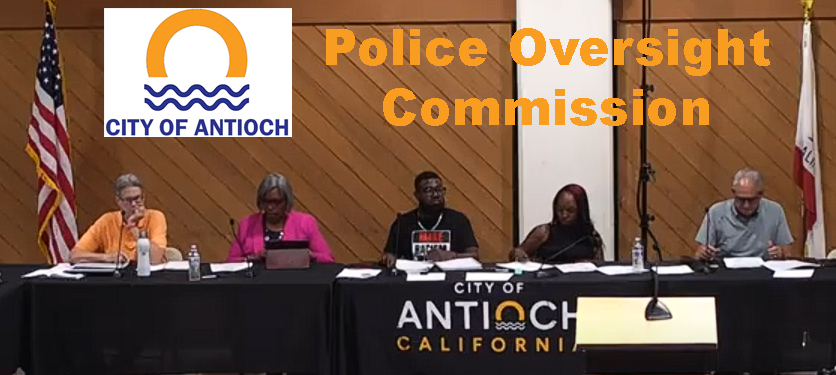
Video screenshot of the Antioch Police Oversight Committee on Sept. 15, 2025.
Would require background process for commissioners, allow current police officers from other agencies or former APD or other agency officers, family members to serve
By Allen D. Payton
During their meeting on Tuesday, Oct. 14, 2025, under agenda Item 1, the Antioch City Council will receive a staff report on the Antioch Police Oversight Commission and consider recommended changes to the ordinance.
According to the City staff report, “On July 7, 2025, staff sought input from the APOC regarding updates to this ordinance. APOC’s suggestions were reviewed and consolidated with the suggestions that staff now presents to the City Council. This collaborative effort aims to ensure that any revisions to the ordinance reflect community values, enhance oversight effectiveness, and support the City’s broader goals of transparency, accountability, and continuous improvement.
“This effort is being carried out in response to City Council direction and aims to identify opportunities to strengthen the Commission’s structure, clarify its authority, and improve its effectiveness. One of the main goals of this review is to ensure consistency with best practices in civilian oversight and to support compliance with the Memorandum of Agreement between the City of Antioch and the U.S. Department of Justice.”
The suggested amendments to the ordinance include the following:
Under Section 4-3.103 MEMBERSHIP AND APPOINTMENT, adding “the Chair, Mayor, and City Manager shall interview applicants and make recommendations to the Council”; adding a background process for commission applicants with information from personal interviews and social media reviews, and have them sworn in by the City Clerk or an authorized member of the Clerk’s Office;
Revise the language to read: “The Mayor and City Council shall strive to appoint and confirm members to the Commission with the intent of ensuring meaningful representation from individuals with diverse backgrounds and perspectives. While not required to include representation from each category listed below, and recognizing that some individuals may reflect more than one category, the following are important Factors to consider when making appointments:”
Delete the following sub-subsections which list the individuals currently ineligible to serve as a Police Commissioner: a) current sworn police officer or his/ her spouse; c) former Department sworn employee or his/ her spouse; or d) current or former employee, official, or representative of an employee association representing sworn police officers or his/ her spouse. The only remaining prohibition would be for a current City employee or his/ her spouse.
Under Section 4-3.104 TERMS OF OFFICE AND REMOVAL FROM OFFICE, adding the City Manager, Mayor, or any member of the City Council has the authority to make the recommendation; under subsection D) Regarding the removal of a Commission member add, “the City Manager, Mayor, or any member of the City Council has the authority to make the recommendation.” (4) – sub-subsection d) Regarding “absences from at least three meetings in a one- year span of time” delete word “unexcused;” (5) – sub-subsection e) Change to “violation of the APOC Rules of Decorum and conduct policy.”
Under Section 4-3.106 MEETINGS, subsection (A) – change to “at least once each month” and delete “July and December” language and that APOC would have the authority to hold additional meetings by majority vote.
Under Section 4-3.108 BUDGET, include a sentence that the funding will be incorporated into the City Manager’s budget, with the specific allocation amount determined during each budget cycle.
Under Section 4-3.109 TRAINING, Add a requirement that each Commissioner complete a police ride-along within the first 30 days of appointment and participate in at least two ride-alongs annually. Additionally, Commissioners must complete use-of-force simulator training within 90 days of appointment and annually thereafter. Commissioners are also required to complete all training outlined in the APOC Training Plan. Add a requirement that all training requests requiring city funding must be pre-authorized by the City Manager.
Under Section 4-3.110 POWERS AND DUTIES, Add “Personnel Complaints” to list of policies. Edit: subsection (B) “Work with the City Attorney to clarify the process for recommending changes to the specified policies. If APOC and the department agrees on the proposed changes, the Police Chief shall amend the policy accordingly. If APOC and the Department disagree, the proposed changes shall be forwarded to the City Council for final approval or rejection.” Under subsection (D) – Discussion of the requirement for APOC to review the proposed budget and conduct at least one public hearing.”
Addition: Temporary pause of APOC. The City Council has the authority to temporarily pause APOC. Such action may only be approved by a majority vote of the City Council and will be based on factors including, but not limited to, the Commission’s effectiveness, compliance with legal obligations, budget constraints, or shifts in city priorities. The temporary suspension cannot exceed three months within a rolling 12-month period. APOC does not have the authority to pause, without City Council Authorization.”
The City Council can also offer additional recommendations.
The meeting will be held in the Council Chambers at City Hall, 200 H Street, in Antioch’s historic, downtown Rivertown. They can also be viewed via livestream on the City’s website and the City’s YouTube Channel, on Comcast Cable Channel 24 or AT&T U-verse Channel 99.
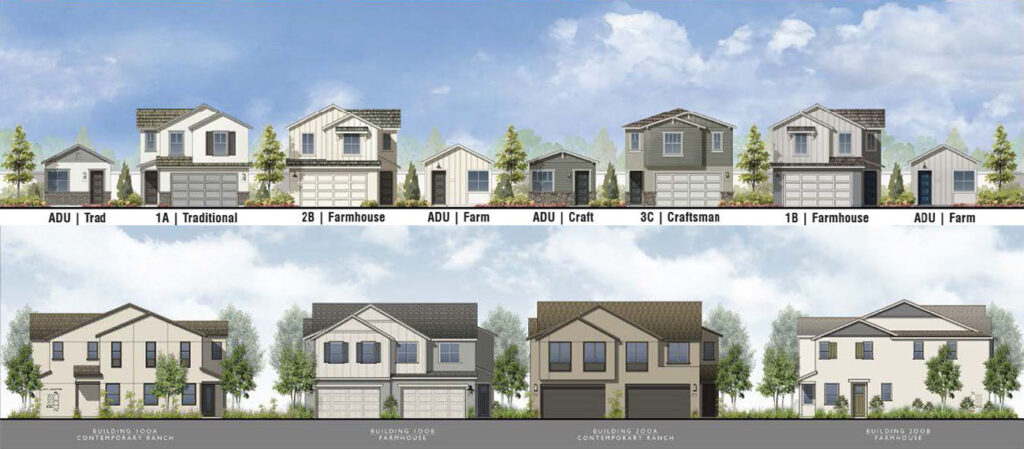
Renderings of the single-family homes and accessory dwelling units (top) and the duplexes (bottom) in the proposed Vineyard Crossing rental housing project. Source: BrightSky Residential
Will discuss $30 million lawsuit by desal plant general contractor
By Allen D. Payton
During their meeting on Tuesday, Oct. 14, 2025, the Antioch City Council will consider approving a 137-unit rental housing project in the northeast part of the city, within the City’s Priority Development Area north of the Antioch BART station. They will also consider spending an additional $245,000 on an Organizational Efficiency Implementation Consultant and splitting the $21 million L Street Pathway to Transit Project into two projects.
City Faces $30M+ Lawsuit by Desalination Plant General Contractor
Before the regular meeting, the council will hold a three-hour Closed Session, beginning at 4:00 p.m., for labor negotiations with the Management Unit, Treatment Plant Employees’ Association, Operating Engineers Local Union No. 3, Confidential Unit, Antioch Police Officers Association, and Antioch Police Sworn Management Association. In addition, the council will discuss two lawsuits, including: Shimmick Construction Co v. City of Antioch, Contra Costa Superior Court Case No. C25-01690 for Unlimited Breach of Contract/Warranty by the General Contractor for non-payment for work on the City’s Brackish Water Desalination Plant in which they are seeking damages of $30 million plus interest; and Antioch Adams Warehouse et al. v. Jason Walker (and City of Antioch), Contra Costa Superior Court Case No. MSC 18-02260 regarding a property dispute on Cesa Lane, as well as anticipated litigation.
Consultant for Organizational Efficiency Implementation Services
According to the City staff report, for Item 2.P., “It is recommended that the City Council adopt a resolution approving a Professional Services Agreement with K. Zelenka Consulting to provide organizational efficiency implementation services and other functions in an amount not to exceed $245,000…that will help the City Manager advance the City’s adopted efficiency review recommendations and ensure continuity in several key initiatives. The
consultant will concentrate on facilitating process improvements, coordinating efforts across departments, and supporting the City’s ongoing commitment to organizational effectiveness and customer-focused service delivery.”
In addition, the report reads, “K. Zelenka Consulting is in the process of completing the City’s comprehensive organizational efficiency audits, which have identified a series of actionable recommendations to improve operations, streamline processes, and enhance overall service delivery.
“The consultant will immediately continue the Operational Assessments with the Human Resources Department (in final draft phase) and will begin assessments for Antioch Police Department (APD) Dispatch Center, Community and Economic Development Department, and Parks and Recreation Services Department this month. The consultant will also identify new opportunities for process improvement, recommend strategies to enhance service delivery, and assist with community engagement and stakeholder communication related to organizational changes. As directed by the City Manager, the consultant may provide policy and program analysis and attend City Council or community meetings to present updates.
“Because K. Zelenka Consulting conducted the original organizational efficiency audits and possesses specialized knowledge of the City’s operations, her continued involvement is essential to maintain momentum and ensure consistency in implementation.
“Funding for this initiative will come from cost savings achieved during the vacancies of the Assistant City Manager and Executive Assistant positions within the City Manager’s office, while recruitment efforts to fill the open roles continue and commence.”
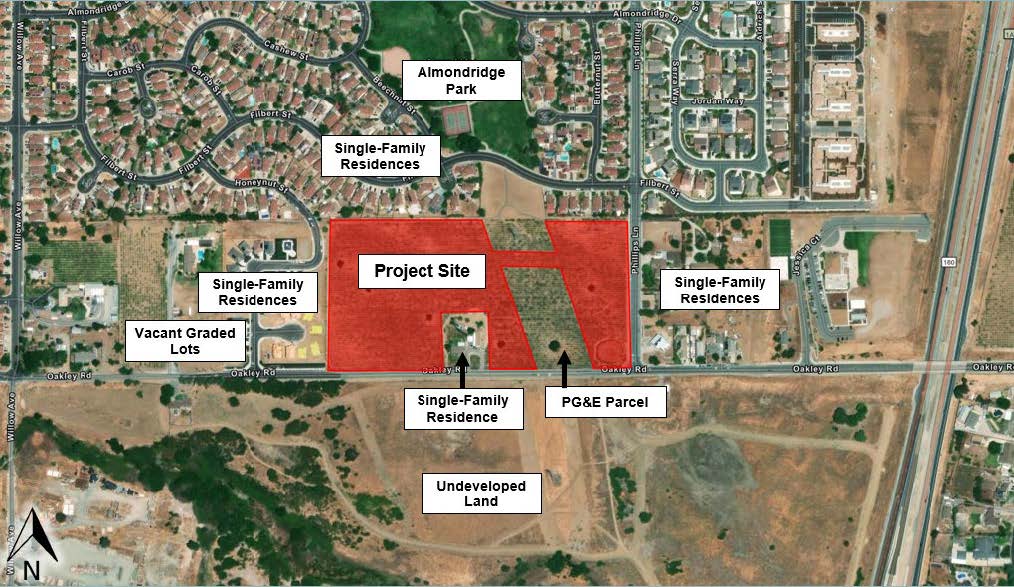
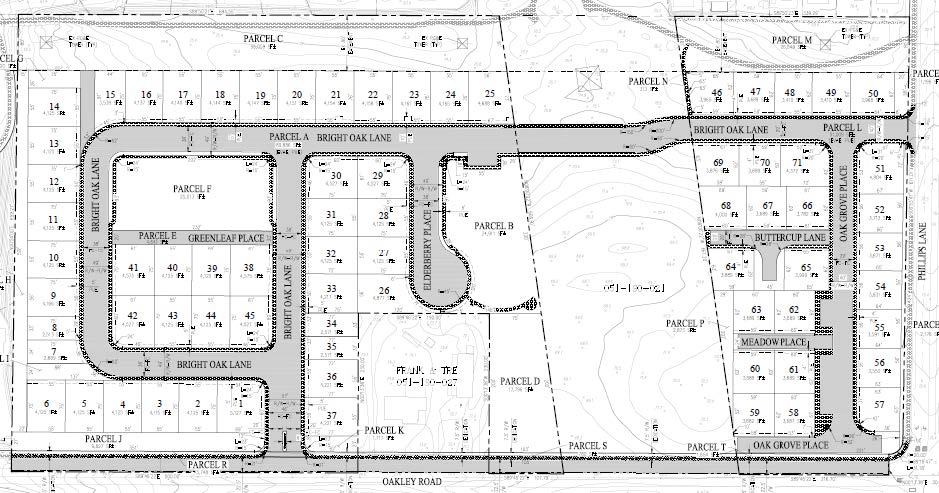
Vineyard Crossing Project Site map. Source: City of Antioch
Vineyard Crossing Rental Housing Project – Part of Almondridge, City’s PDA
Under Item 6, the Council will consider approving a 137-unit housing project by Walnut Creek-based BrightSky Residential on 14.6 acres located northwest of the intersection of Phillips Lane and Oakley Road within the City’s Priority Development Area near the BART Station. According to the City staff report, the proposed project would subdivide the project site into 71 individual lots containing 137 residential units total with 45 single-family residential lots and 40 accessory dwelling units (ADUs) on the western parcel. A condominium map could be recorded for the duplex lots 46-71 on the eastern parcel, for 26 duplex building lots creating 52 condominium lots.
In addition, the “proposed project designates 10% of base units (13 of the ADUs total) as affordable to low-income households to obtain a density bonus of 16 additional units (included in the 137) as well as waivers from certain development standards, in accordance with state density bonus law.” They would be deed-restricted and available for households earning 60 percent of the Area Median Income (AMI). The City’s proposed Inclusionary Housing Ordinance, which would require designating 15% of units in new developments as affordable, cannot apply as the Council has not yet adopted it.
The applicant has indicated that they intend to own and operate the entire project after construction as a rental housing community. However, the proposed Vesting Tentative Map is for condominium purposes for the duplex lots on the eastern parcel and would allow for the possible future sale of each residential duplex unit.
The project site is part of the Almondridge South Planned Development District that was entitled in 1991 but only partially developed since that time. Single-family residences were developed to the west of the project site, but both of the project parcels have remained undeveloped.
As part of the City’s 2003 General Plan, the western project parcel was designated Medium Low Density Residential with a density of up to 6 dwelling units/acre permitted and the eastern project parcel was designated Medium Density Residential with a density of up to 10 dwelling units/acre permitted.
The project applicant submitted a preliminary development plan and received feedback from the Antioch Planning Commission and City Council in December 2023 and January 2024 respectively.
The applicant submitted a Preliminary Application under SB 330 (The Housing Crisis Act of 2019). Through the Preliminary Application process put in place under SB 330, housing developments may only be subject to the ordinances and objective standards in effect at the time when a completed Preliminary Application is submitted. To qualify, projects had to be submitted prior to Jan. 1, 2025.
Rezoning Not Required, ADU’s Not Counted Toward Density per State Law
While the project does not conform to the adopted Planned Development zoning standards for the site such as lot size and setbacks, it is consistent with the density established in the General Plan, and therefore per state law, a rezoning is not required to develop the project. Additionally, per state law, accessory dwelling units are not counted as units for the purposes of determining the proposed density of a project.
As part of Plan Bay Area, each of the 101 cities in the nine-county Bay Area were required to set aside land for a Priority Development Area (PDA) near public transit planned for new homes, jobs and community amenities, including higher-density housing. In order for Antioch to obtain approval for a BART extension and station, the city council had to agree to 2,500 housing units in the City’s 400-acre PDA. It includes the land east of the BART station and north to E. 18th Street.
Amenities located on the western parcel of the site would include a recreation center with an outdoor pool area as well as a children’s play area. Amenities located on the eastern parcel would include an activity lawn area with park benches in the northern portion of the parcel.
Parking
The project provides a total of 408 parking spots. This includes 194 spots within 2-car garages for each single-family home and duplex unit, 130 spots within the single-family home and ADU driveways, and 84 spots on streets. Projects receiving a density bonus are entitled to reduced parking standards, with a maximum parking requirement of 1.5 parking spaces for a 3-bedroom unit (all units proposed for the development, with the exception of the ADU’s are 3-bedroom). The 45 single family homes and 52 duplex units would therefore require 146 parking spots.
The project parking therefore exceeds what is required for a density bonus project, and in fact also exceeds standard municipal code requirements for parking (single family detached – 2 spots per unit in a garage plus 1 guest spot – 135 total – single family attached – 2 spots per unit plus 1 per 5 units for guest parking – 114 spots total).
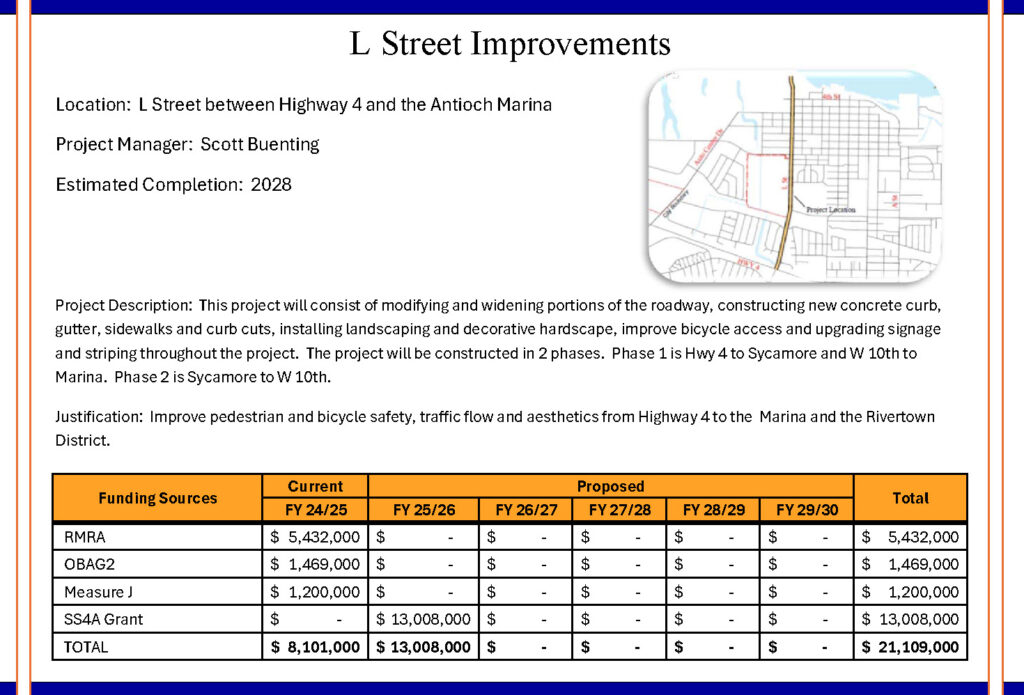
L Street Improvements Plan. Source: City of Antioch 5-Year CIP 2025-30
Split $21 Million L Street Pathway to Transit Improvement Project into Two
Under Item 8 the council will consider splitting the planned $21 million L Street improvement project into two projects to reserve funding.
According to the City staff report for the item, the L Street Pathway to Transit (“Project”) will improve accessibility for all modes of transportation and beautify the L Street corridor between Highway 4 and the Antioch Marina.
“The first phase of work on the Project will consist of modifying portions of the roadway, constructing new concrete curb, gutter, sidewalks and curb cuts, installing landscaping and decorative hardscape, improve bicycle access and upgrading signage, and striping throughout the Project from Highway 4 to Sycamore Drive, and from West Tenth Street to the Marina.
“The second phase of work will consist of widening the roadway to four lanes between West 10th Street to West 18th Street, installation of new sidewalks on the western side of the roadway, ADA-compliant upgrades, signal improvements at the intersection of W. 10th and W. 18th Streets, enhanced bus facilities, and the addition of bike lanes. (P. W. 234-16).
“In order to keep the funding sources separately, staff recommends separating this work into two projects. The first phase will be funded by Measure J funds in the amount of 1,191,465 and the One Bay Area Grant (OBAG2) in the amount of $1,469,000. The second phase will be funded by the state’s Road Maintenance and Rehabilitation Account (RMRA) in the amount of $5,244,167, and a U.S. Department of Transportation’s Safe Streets and Roads for All (SS4A) Grant in the amount of $13,008,000, which has already been budgeted for in the 5 Year Capital Improvement Program 2025-2030.”
The meetings will be held in the Council Chambers at City Hall, 200 H Street, in Antioch’s historic, downtown Rivertown. They can also be viewed via livestream on the City’s website and the City’s YouTube Channel, on Comcast Cable Channel 24 or AT&T U-verse Channel 99.