To boost train ticket affordability and streamline service, Amtrak® San Joaquins℠ will offer savings for two types of travelers – customers booking early and for those that travel on off-peak trains. Beginning November 1, 2023, and concluding June 30, 2024, the pilot will provide a variety of fares with more flexible and affordable options.
Amtrak’s extensive customer research found that introducing a broader range of fares could better serve riders. The Fare Pilot will provide travelers with new flexible and affordable options allowing time for potential passengers to familiarize themselves with the revamped system. The aim of the pilot is to better meet Amtrak San Joaquins customer needs.
“Passenger feedback and data-driven insights are pivotal in shaping our services so that we are serving our passengers in the best way possible,” said David Lipari, Deputy Director of Passenger Experience and Communications. “Recent findings from Amtrak underscore the potential to refine our pricing approach for train trips, ensuring that we not only meet but exceed the expectations of our riders. This new system specifically achieves this goal by building in savings for travelers that book early or travel on off-peak trains.”
Amtrak San Joaquins currently operates under a Reserved System, where tickets must be purchased before the train’s departure. Passengers who opt for both the Thruway Bus and train service are charged a combined fare.
The San Joaquins Joint Powers Authority (SJJPA) in alignment with Amtrak initiated a pilot program to assess its potential positive impact on the service. To provide economic relief for riders and drive incremental ridership and revenue, the San Joaquins will continue to offer many of the Every Day and seasonal discounts.
About the San Joaquin Joint Powers Authority (SJJPA) Since July 2015, SJJPA has been responsible for the management and administration of Amtrak San Joaquins. SJJPA is governed by Board Members representing each of the ten (10) Member Agencies along the 365-mile San Joaquins Corridor. For more information on SJJPA see www.sjjpa.com.
Amtrak San Joaquins is Amtrak’s 6th busiest route with 18 train stations throughout the Central Valley and Bay Area, providing a safe, comfortable and reliable way to travel throughout California. Amtrak San Joaquins is currently running six daily round-trips. In addition to the train service, Amtrak San Joaquins Thruway buses provide connecting service to 135 destinations in California and Nevada including Los Angeles, Santa Barbara, San Diego, Napa Valley, Las Vegas and Reno.
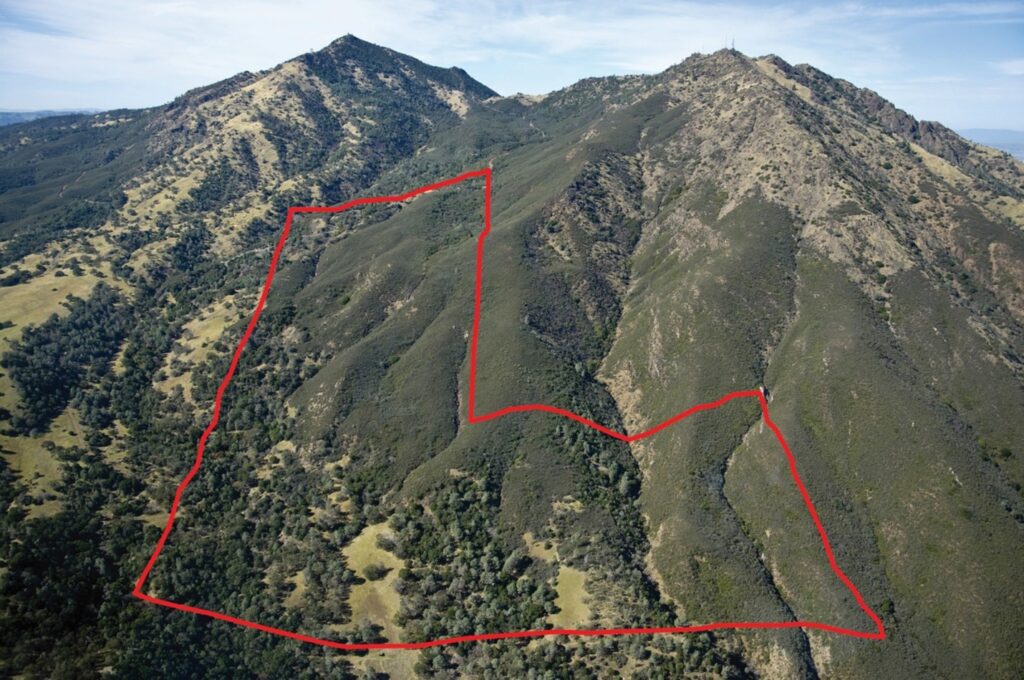
The Viera–North Peak property on Mount Diablo. For eight years, Save Mount Diablo has been trying to transfer the 165-acre Viera–North Peak property on the very slopes of Mount Diablo’s North Peak to Mount Diablo State Park, for free. Photo credit: Scott Hein
“Accept the donated Viera–North Peak and CEMEX properties for starters” – Save Mount Diablo
Asks public to support effort
By Laura Kindsvater, Senior Communications Manager, Save Mount Diablo
Mount Diablo State Park hasn’t added a new property since 2007—16 years ago. For eight years, Save Mount Diablo has been trying to transfer our 165-acre Viera–North Peak property on the very slopes of Mount Diablo’s North Peak, for free. More than a year ago, the CEMEX quarry publicly announced it wanted to donate 101 acres next to the state park’s Mitchell Canyon, including a section of the historic Black Point Trail. We need the public’s help to urge California State Parks to get moving on these critical acquisitions.
Save Mount Diablo’s Executive Director, Ted Clement, stated, “At Save Mount Diablo, we have worked hard to build a large pool of strategic properties waiting to be added to Mount Diablo State Park—properties like the Balcerzak inholding, the Viera–North Peak property, part of Curry Canyon Ranch, and the CEMEX land. We are poised to dramatically increase the size, value, integrity, and stunning splendor of Mount Diablo State Park for more public benefit and connection to nature. Now is the time for action!”
We’ve worked closely with the state for 50 years, helping them acquire land. Mount Diablo State Park’s General Plan includes 7,500 acres of “appropriate future additions,” most on the actual slopes of Mount Diablo’s two main peaks. Sometimes they’d buy property, sometimes we would.
Sixteen years ago, California State Parks stopped making progress on any new additions to Mount Diablo State Park. Save Mount Diablo has stepped in to save threatened properties that should be in the state park until the state could move forward, or they would have been lost.
Within the “appropriate additions” area, we’ve purchased 165-acre Viera–North Peak, 1,080-acre Curry Canyon Ranch, 76-acre Wright Canyon, 20-acre Young Canyon, 95-acre Anderson Ranch, 29-acre Smith Canyon, the 10-acre Balcerzak inholding, and very soon, the 6.69-acre Krane Pond property, locking up eight critical properties worth more than $12 million.
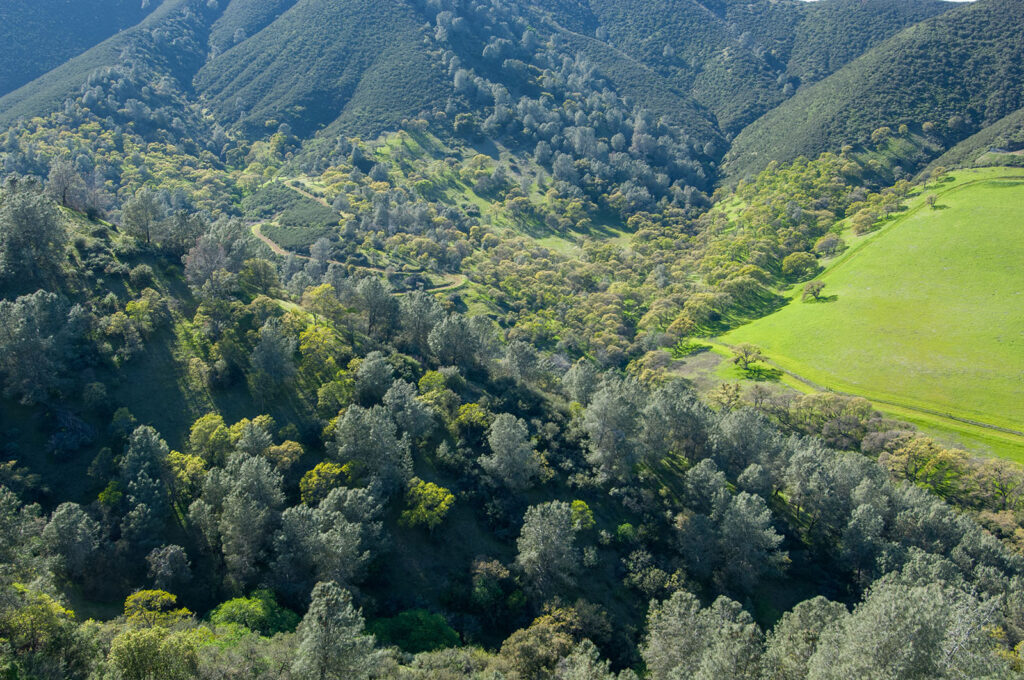
More than a year ago, CEMEX publicly announced it will donate this 101-acre property above Mitchell Canyon to Mount Diablo State Park. It includes a segment of the historic Black Point Trail. Photo credit: Scott Hein
Several more properties make sense as additions, including the 101-acre CEMEX property donation above Mitchell Canyon. Save Mount Diablo negotiated with CEMEX for over six years to have this land donated to Mount Diablo State Park. In 2022, the CEMEX corporation agreed and publicly announced it would make this donation to Mount Diablo State Park.
We take care of and clean up the properties we acquire before conveying these lands to Mount Diablo State Park.
Reasons abound for the logjam. State budget shortfalls during recessions. Proposals to close state parks in 2008 and 2011. Several new State Park Directors and several reorganizations.
One of the biggest problems was the loss of experienced land acquisition staff in Sacramento. But state voters also approved resource bonds in 1998, 2001, 2006, and 2018, each with hundreds of millions of dollars for state parks. The acquisition department should be back up to speed.
As California State Parks faltered, nonprofit land trusts all over the state have stepped in to protect critical properties that might have been lost. We’re told that Viera–North Peak and Curry Canyon Ranch properties are on California State Parks’ top priority list, and park staff urged us to acquire the Balcerzak inholding, which had complicated park management for decades.
We were told that acquisitions might resume if we got funding from other sources, so we did, or helped with management for some time, which we agreed to do. The East Contra Costa County Habitat Conservancy provided all funding for Viera–North Peak. All they require is a conservation easement or a deed restriction to ensure long-term protection—which California State Parks has so far failed to accept.
After eight years without progress on Viera–North Peak—a free, turnkey property on the very slopes of the mountain, an appropriate addition that California State Parks pursued for years before we were finally able to acquire it—we and the public are getting frustrated.
We’ve asked Senator Steve Glazer and Assemblymember Rebecca Bauer-Kahan to help move things forward, which they have kindly been doing, and we’re asking the public to urge state parks officials and the California State Parks Commission to make progress.
We are grateful that a small working group has formed, made up of our terrific partners at California State Parks and the East Contra Costa Habitat Conservancy, to help us get lands added to Mount Diablo State Park. However, we recognize that lands not being added to California State Parks is a large statewide issue, so our small working group also needs the voice and support of the public to further our efforts to break the logjam and get strategic lands added to Mount Diablo State Park.
See video of Save Mount Diablo Executive Director Ted Clement and Land Conservation Director Seth Adams speaking about this issue is available on Save Mount Diablo’s YouTube channel at youtu.be/XndEYOgOas8.
We’re asking the public to please send a message simultaneously to these individuals and agencies using this link: bit.ly/3LXEhq8.
About Save Mount Diablo
Save Mount Diablo is a nationally accredited, nonprofit land trust founded in 1971 with a mission to preserve Mount Diablo’s peaks, surrounding foothills, watersheds, and connection to the Diablo Range through land acquisition and preservation strategies designed to protect the mountain’s natural beauty, biological diversity and historic and agricultural heritage; enhance our area’s quality of life; and provide educational and recreational opportunities consistent with protection of natural resources. To learn more, please visit www.savemountdiablo.org.
The California Highway Patrol (CHP) Contra Costa Area will use grant funding to start a regional campaign in Contra Costa County aimed at stopping drivers suspected of driving under the influence and reducing impaired driving-related crashes. This one-year project ends on September 30, 2024.
The CHP Contra Costa Area will deploy officers to conduct enforcement operations on Interstates 80 and 680, State Routes 4, 24, and 242; and unincorporated roadways within Contra Costa County.
“We are taking a proactive approach to keep our roadways safe,” said CHP Captain Ben Moser, Commander of the Contra Costa Area office. “This campaign will use of combination of education and enforcement to help make Contra Costa County roadways a safer place to travel.”
Source: CHP
According to the CHP’s Statewide Integrated Traffic Records System, there were nine people killed and 170 people injured in traffic crashes involving impaired drivers within the CHP Contra Costa Area’s jurisdiction between October 1, 2020, and September 30, 2021. This CHP traffic safety effort also includes a community-based task force and public awareness and education to help reinforce the dangers of driving while impaired.
The CHP would like to take this opportunity to remind the public, “DUI Doesn’t Just Mean Booze.” Alcohol, cannabis, prescription medication, illegal drugs, and some over-the-counter drugs can affect a person’s ability to safely operate a motor vehicle. Remember to always plan ahead, designate a sober driver, or arrange for other safe alternative transportation, such as public transit or taxi/ride-hailing service.
Funding for this program was provided by a grant from the California Office of Traffic Safety (OTS), through the National Highway Traffic Safety Administration.
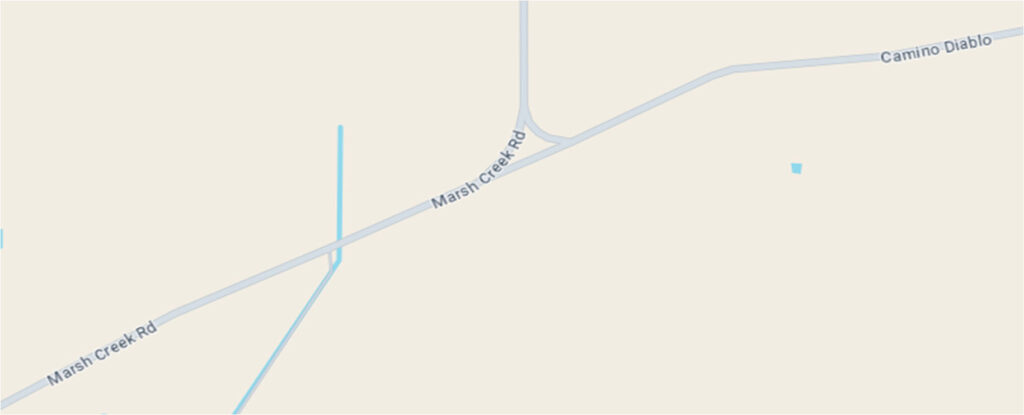
Traffic Control Work Area Map on Nov. 28, 2023. Source: CCCPWD
By Kelly Kalfsbeek, PIO, Community & Media Relations Coordinator, Contra Costa County Public Works Department
November 22, 2023, Clayton and Brentwood, CA- The Contra Costa County Public Works Department will be using traffic control on Marsh Creek Road, approximately .25 miles northwest of the intersection of Marsh Creek Road and Camino Diablo, on Tuesday November 28,2023, barring unforeseen circumstances, for work that will take place between 9:00 a.m. and 2:00 p.m., weather permitting.
Traffic control is being used to ensure the safety of the travelling public during the installation of concrete girders on Bridge 145. Traffic will be stopped in both directions while the girders are being lifted into place.Delays of 15 minutes are expected.
This project is replacing two (2) bridges on Marsh Creek Road with two (2) new concrete bridges. Work is taking place on Marsh Creek Road at Bridges 143 and 145. Bridge 143 is located approximately 1.5 miles northwest of Deer Valley Road near the Clayton Palms Community. Bridge 145 is located approximately 3.0 miles east of Deer Valley Road near the road transition to Camino Diablo. Work also includes reconstruction of the bridge approach and construction of drainage facilities.
Funding for this project is provided by the federal Highway Bridge Program and local Gas Tax funds. To learn more about this project, please visit: www.contracosta.ca.gov/MCR-Bridge
About Contra Costa County Public Works Department:
Contra Costa County Public Works Department (CCCPWD) maintains over 660 miles of roads, 150 miles of streams, channels, and other drainage and over 150 County buildings throughout Contra Costa County. CCCPWD provides services such as Parks and Recreation, Sandbag Distribution and Flood Control throughout the unincorporated areas of Contra Costa County. CCCPWD operates two airports, Buchanan Field Airport in Concord, and Byron Airport in Byron. For more information about CCCPWD, please visit us at: www.cccpublicworks.org Follow us on Facebook, Instagram and X @cccpublicworks.
On Thursday, Nov. 16, 2023, at 11:42pm, CHP Contra Costa was advised of a vehicle vs. pedestrian crash on Highway 4 near Newport Drive in Discovery Bay. An unknown vehicle traveling westbound on Highway 4 struck a pedestrian and the driver of the suspect vehicle did not stop and fled the scene. The pedestrian sustained fatal injuries and was pronounced deceased at the scene by emergency medical personnel.
On Thursday, November 22, 2023, at 3:03pm, CHP Contra Costa Officers arrested Javier Dominguez Ramirez (32-year-old from Antioch) in connection with the vehicle that struck and killed a pedestrian on Nov. 16. This crash occurred on westbound SR-4, west of Newport Drive. He is currently being held on a $50k bail at the Martinez Detention Facility for Felony Hit and Run.
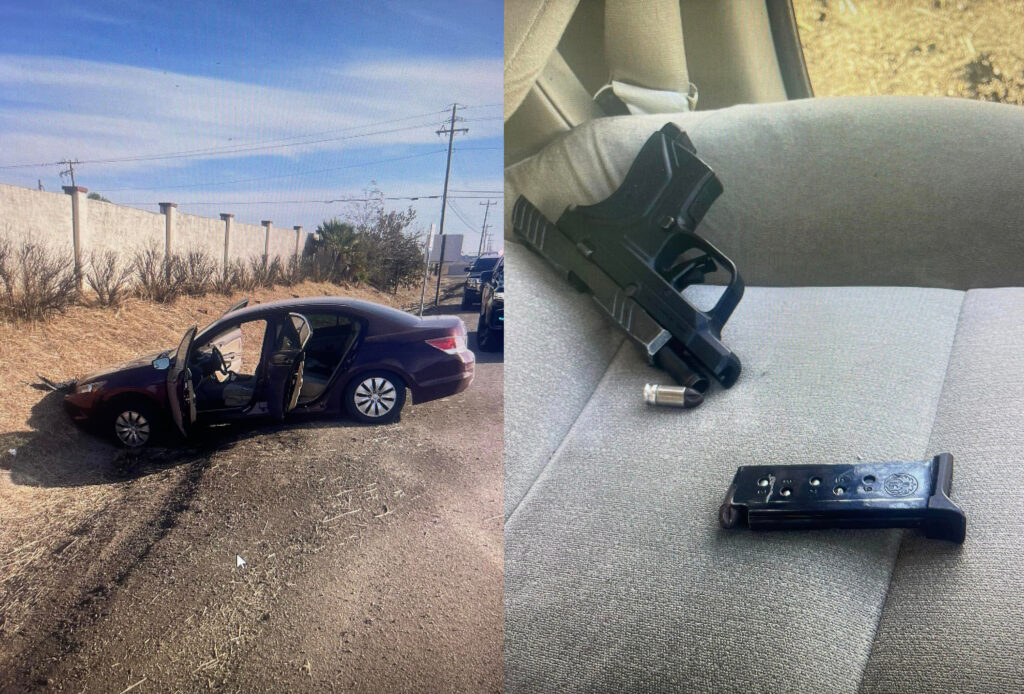
Stolen Honda Accord in Discovery Bay and gun used in carjacking in Antioch on Tuesday, Nov. 21, 2023. Photos: APD
CHP, Sheriff’s Office assist
By Antioch Police Department
On Tuesday morning, Nov. 21, 2023, at approximately 8:50 am, we began getting calls from employees reporting suspicious subjects wearing masks and looking into vehicles in the parking lot of 4041 Lone Tree Way in the Bluerock Center. As our patrol officers were driving to check them out, we got a call from a victim of an armed carjacking. The suspects were armed with a gun and took the victim’s Honda Accord.
Our dispatch center quickly began calling neighboring agencies and our patrol teams began searching the area. The vehicle and subjects were soon located in nearby Discovery Bay.
11/24/23UPDATE: According to Antioch Police spokesman Sgt. Price Kendall, the suspects were both 18-year-old males and booked into the Martinez Detention facility. “That is all we will be releasing,” he added.
We would like to thank all of the witnesses to this incident for quickly calling and to thank both CHP and the Contra Costa County Sheriff’s Office for their assistance leading to the quick arrests of these suspects. This is a great example of our community and neighboring agencies collaborating with us!
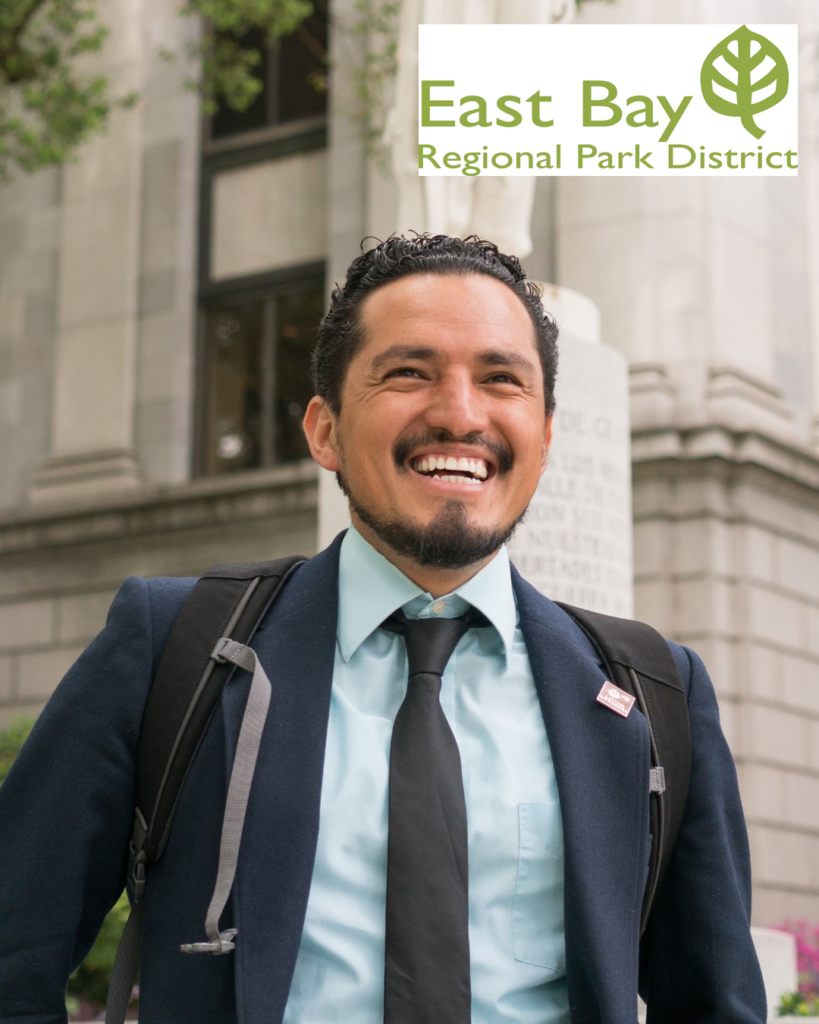
New EBRPD Equity Officer José G. González. Photo: EBRPD
By Dave Mason, Public Information Supervisor, Public Affairs, East Bay Regional Park District
After a nationwide search, the East Bay Regional Park District announces the appointment of José G. González as its new Equity Officer to lead diversity, equity, and inclusion efforts at the public agency. The East Bay Regional Park District’s mission is to preserve a rich heritage of natural and cultural resources and provide open space, parks, trails, safe and healthful recreation and environmental education. An environmental ethic guides the District in all of its activities. González begins in the role on December 18, 2023.
As the largest regional park district in the country, the park system spans Alameda and Contra Costa counties and serves an estimated 30 million visitors a year through park and trail access, visitor centers, and programs. Its workforce provides services that encompass 73 parks, 55 miles of shoreline, and over 1,300 miles of trails.
“We are pleased to share news of this pivotal role and welcome José González to help lead the East Bay Regional Park District to further strengthen its mission and impact and build upon successes as we continue to prioritize a strong, systemic approach to equity both in our workplace and services to the public,” said Sabrina B. Landreth, General Manager at the East Bay Regional Park District.
The new role will work to improve access to and use of the parks’ services for all community members and support inclusive programs, services, and public processes that reflect the tremendous diversity of our community. The position will also lead on programs and activities to help diversify our workforce, eliminate any systemic barriers to employment and promotion, and ensure equitable policies and best practices to make the agency an employer of choice as the District continuously seeks to build and retain a topnotch workforce.
“I am excited to join the East Bay Regional Park District as its inaugural Equity Officer. I look forward to bringing my experience from the local to the national level around equity in the conservation field and community in a way that showcases the opportunity and leadership that the Park District has been developing in this space for all of our community,” said González.
“Equity and inclusion begin from within, so I am thrilled and ready to support and lead the work that the Park District has prioritized for the agency to represent and reflect the diversity of its community,” added González.
González is a professional educator with training in the fields of education and conservation. He is the Founder of Latino Outdoors as well as a consultant at large. As a Partner at the Avarna Group and through his own consulting, his work focuses on Equity & Inclusion frameworks and practices in the environmental, outdoor, and conservation fields. He is also an illustrator and science communicator.
He received his B.A. at the University of California, Davis with teaching coursework at the Bilingual, Multicultural, Education Department at Sacramento State University. He received his M.S. at the University of Michigan School of Natural Resources & Environment. He serves as a board member at Parks CA and Resource Media, and as a Commissioner for the California Boating & Waterways Commission, among other leadership volunteer roles.
According to his profile on parkscalifornia.org, González is the Founder and Director Emeritus of Latino Outdoors. He is an experienced educator as a K-12 public education teacher, environmental education advisor, outdoor education instructor and coordinator, and university adjunct faculty. As a Partner in the Avarna Group and through his own consulting, his work focuses on Equity & Inclusion frameworks and practices in the environmental, outdoor, and conservation fields. He is also an illustrator and science communicator.
The East Bay Regional Park District is the largest regional park system in the nation, comprising 73 parks, 55 miles of shoreline, and over 1,300 miles of trails for hiking, biking, horseback riding, and environmental education. The Park District receives more than 25 million visits annually throughout Alameda and Contra Costa counties in the San Francisco Bay Area.
Paid for primarily by federal stimulus funds, and taxpayer-supported Measure J county sales tax and bridge toll increases
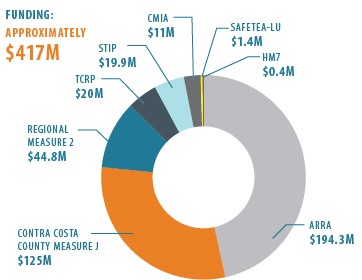
This month, the Contra Costa Transportation Authority (CCTA) commemorates Caldecott Tunnel Fourth Bore’s 10 years of service alleviating congestion on Highway 24. Caldecott’s award-winning fourth bore was constructed on time and under budget at a cost of $417 million and finally allowed two permanently dedicated tunnels to service traffic in each direction. The passage was opened to traffic on November 15, 2013, successfully reducing travel times, enhancing safety for Caltrans maintenance workers, and improving mobility for those driving from east Contra Costa County to Oakland and San Francisco.
At the time of the groundbreaking on January 22, 2010, the shovel-ready Fourth Bore was the largest American Recovery and Reinvestment Act of 2009 stimulus funding in the nation of $194.3 million, a testament to the regional importance of the project and the hard work of the project team. Contra Costa County’s Measure J provided $125 million, the Bay Area Regional Measure 2 Bridge Toll increase provided $44.8 million, and the state provided $19.9 million.
“Ten years ago, we opened the fourth bore with much anticipated fanfare,” CCTA Chair Federal Glover said. “Many drivers today don’t remember when Caltrans workers had to shift the middle bore direction at least twice a day to provide lanes for peak commuters. On some weekdays the direction of the middle bore could change up to six times, which was so inefficient for the 160,000 daily drivers who used the Caldecott each day and unsafe for the workers who were responsible for changing lanes.”
Prior to the tunnel opening, Caltrans reported westbound motorists experienced 52,585 vehicle hours of delay a month. After the fourth bore opened in 2013, the vehicle hours of delay dropped to 12,020 – a 77 percent improvement. CCTA 2023 data shows a continued reduction in delays compared to 2013 data compiled before the tunnel opened. Eastbound delays show a 42 percent reduction of vehicle hours of delay, while westbound delays show an 80 percent improvement – meaning fewer hours drivers waste sitting in traffic. (See Fourth Bore Project Fact Sheet)
Officials and CCTA staff gather for the Caldecott Tunnel Fourth Bore ribbon cutting on Nov. 15, 2013. Photo: CCTA
“The Caldecott Tunnel Fourth Bore is a remarkable project that has served Bay Area drivers well since 2013,” CCTA Executive Director Timothy Haile said. “CCTA’s landmark project will continue to be a legacy for decades to come.”
About the Contra Costa Transportation Authority
The Contra Costa Transportation Authority (CCTA) is a public agency formed by Contra Costa voters in 1988 to manage the county’s transportation sales tax program and oversee countywide transportation planning efforts. With a staff of twenty people managing a multi-billion-dollar suite of projects and programs, CCTA is responsible for planning, funding and delivering transportation infrastructure projects and programs throughout the County. CCTA also serves as the county’s designated Congestion Management Agency, responsible for putting programs in place to manage traffic levels. More information about CCTA is available at ccta.net.