








Calling the Cops: Policing in California schools, third of calls for serious incidents including violence
Thursday, June 6th, 2024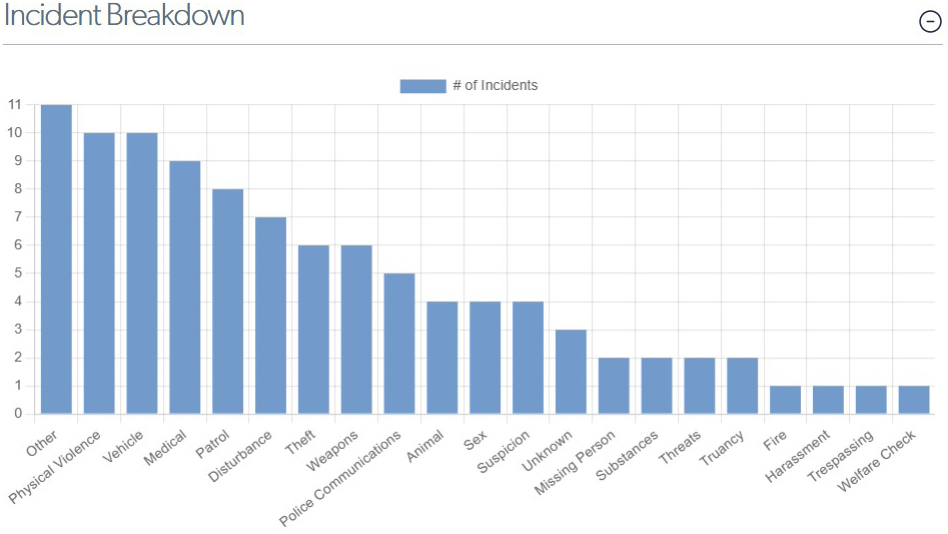
Statewide sampling includes data from 99 incidents at 2 schools in Antioch Unified from Antioch PD Jan. 15 to June 30, 2023
Plus, data from 9 schools, 882 reported incidents in 7 other Contra Costa school districts and from 8 police departments
EdSource Special Report & Analysis
Every school day, police respond to thousands of calls from schools across California. Along with the patrols and security checks are thousands of serious incidents, some of them violent. In this continuing investigation, EdSource offers a rare view of what goes on inside schools that the public rarely gets to hear about because of the state’s strict laws related to disclosing information related to juveniles.
This unprecedented look at school policing reveals the vast presence of police in schools and comes at a time when some school communities, in the years following the police murder of George Floyd, are debating how much and what kind of policing they want and need.
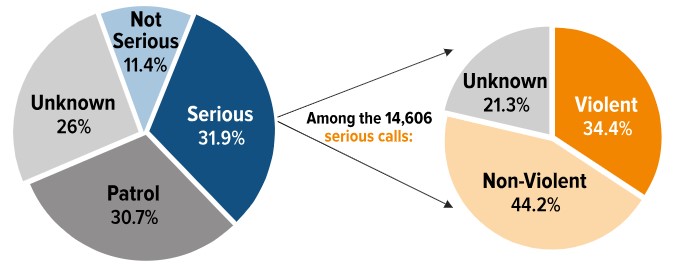
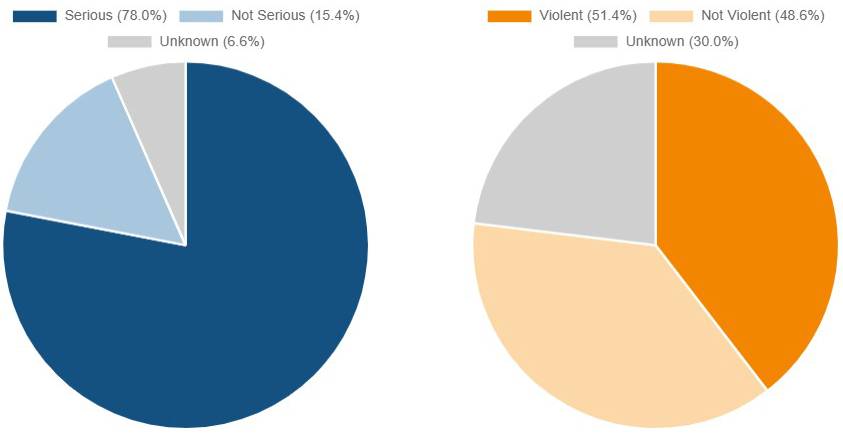
An analysis of nearly 46,000 police calls from 164 police agencies involving 852 school sites – data which EdSource gathered through the state’s Public Records Act – reveals that nearly a third of all calls were about serious incidents that reasonably required a police presence, a definition obtained from experts. Of the serious incidents, more than a third involved violence which is defined as anything involving a violent act.
According to Managing Editor Adam Eisenberg, what EdSource obtained – a sample of all of the police calls daily affecting California schools – offers a raw first blush look at why school staff summon police, reasons that sometimes lead to student arrests, but also reasons that reveal eye-opening issues affecting students like bullying, sexual assaults, unwanted touching and weapons, drugs, physical assault and fights.
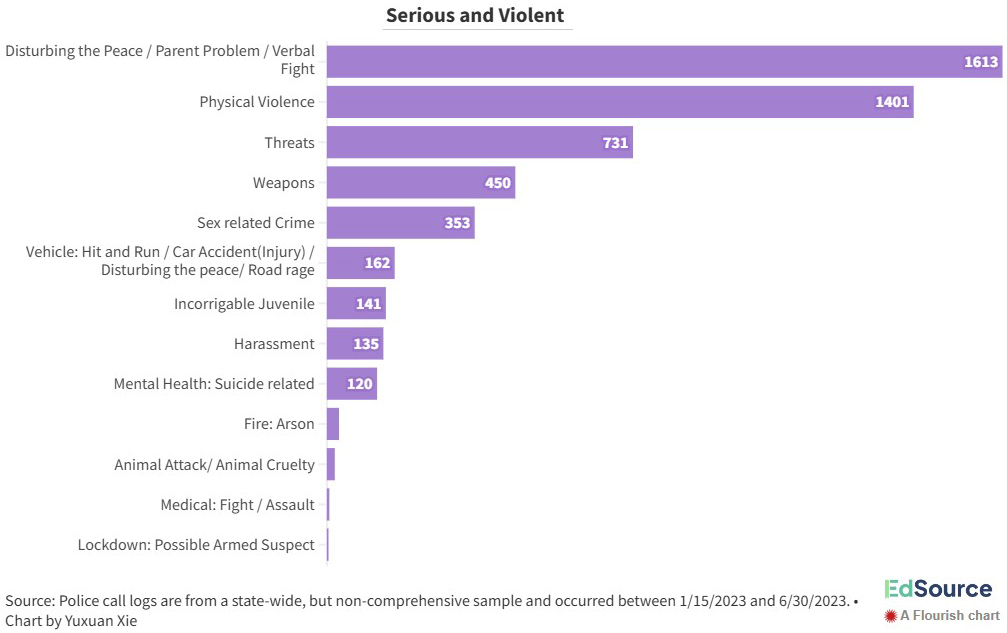
EdSource’s analysis, which included tagging every call record, reveals that about a third of all calls were deemed serious, according to the definition from experts, as those incidents that reasonably required a police presence. Just less than a third of all serious incidents involved violence, including self-harm.
The database, which is fully searchable online at, Calling the Cops (edsource.org), includes information from 57 of the state’s 58 counties but does not include all schools or districts in those counties.
The data can be accessed by category, which offers the best insight into disturbances and incidents in local schools.

When California schools summon police
EdSource analysis: Nearly a third of all calls for police were for serious incidents including violence
By Thomas Peele & Daniel J. Willis, EdSource.org
Middle schooler allegedly attacks classmate twice, choking him severely. Police recommend attempted murder charges to district attorney.
School staff calls police to report squirrel with injured leg in school courtyard.
Unknown man in swimsuit briefs adorned with Australian flag trespassing at high school pool. Lifeguard sees a man follow boys 9 and 12, into the locker room. Man strips, pulls back the shower curtain to see the boy and asks: “Does this make you uncomfortable?” Man flees. Police list indecent exposure and lewd acts as possible offenses.
Officer dispatched to investigate ringing school alarm. Burnt English muffin found in teachers’ lounge.
From Crescent City, Weed and Alturas in the far north to Calexico and El Cajon nearly 800 miles south, all along the Pacific Coast, across the sprawling Central Valley and up into the High Sierra and down into the Mojave Desert, police are dispatched to California schools thousands of times on any given day classes are in session.
Reasons are myriad: Students bringing guns and knives — and even a spear and a bow and arrow — to school, sexual assaults and “perversion reports” and fights. Then there are lost keys, malfunctioning alarms, and dogs — even cattle — loose on school grounds. Once, police were called for help with a swarm of bees.
Cops rush to reports of students attempting suicide and overdosing on drugs, bullying, sexual assault and unwanted touching. They surveil high schoolers leaving campuses for lunch. They break up fights between parents over spots in elementary school pickup queues. They haul drunken adults from the stands at school sporting events. They once investigated a teacher’s claim that someone stole $10,000 from her classroom desk.
Mostly the call logs capture the anguish of youngsters with mental health challenges, victims whose nude photos are showing up on social media for all to see and parents turning to school administrators to deal with it all.
Such details emerged from nearly 46,000 police call logs and dispatch records EdSource obtained from 164 law enforcement agencies in 57 of California’s 58 counties as part of a sweeping statewide investigation into school policing.
The data offered a raw, first-blush look at why school staff summon cops, reasons that sometimes lead to juvenile and adult arrests.
All incidents included in the police logs largely remain out of public view due to state laws that shield juveniles and allow police to withhold information on investigations. As a result, the data collected as a representative sample of the state is also clearly an undercount of what routinely occurs in California schools.
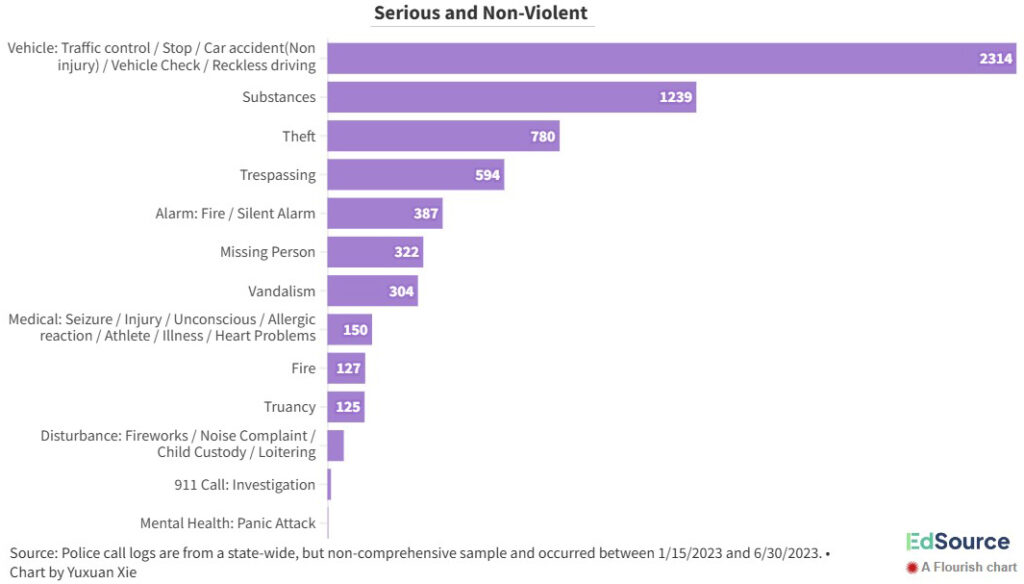
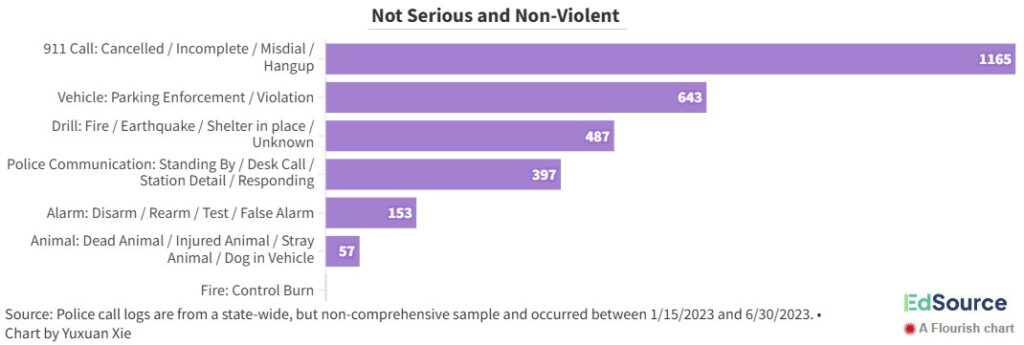
An EdSource analysis found that nearly a third of all calls for police were for incidents deemed serious. After consulting police experts, EdSource tagged the data with a definition for serious incidents as those that reasonably required a police presence. Included among serious incidents are those tagged as violent, which include anything involving a violent act, including self-harm.
The share of serious incidents increases to 4 out of 10 when police patrols are set aside. They make up about a third of all records, but most have little detail on what police were doing at or near the school.
The analysis also showed that high school students in districts with their own police departments are policed at a higher rate than in districts that rely on municipal police and sheriffs.
School police calls across California
Four years after Minneapolis police officer Derek Chauvin murdered George Floyd, igniting a national revolt and the defund-the-police movement, only about 20 of California’s 977 public-school districts made significant changes to school policing.
Most that acted ended contracts with municipal police departments to post cops — commonly called school resource officers — in schools. And three districts that made changes reversed course and brought police back after short hiatuses.
EdSource’s investigation sampled records showing calls from and about schools to city and school district police departments and county sheriffs. In some cases, officers stationed in schools dispatch themselves to a problem by radioing their dispatcher. Schools without campus police often call 911. Typically, police record their activity as “patrol” or “school check,” vague descriptions that raise questions about the use of public resources.
Whenever a school resource officer ran along a corridor, one hand on a radio microphone, or a sheriff’s deputy raced along a country road with lights and sirens on to reach a distant rural school, they contributed to what data showed is a vast, continuing police presence in California’s pre-K to 12 public education, EdSource found.
The records resurfaced a debate lingering years after Floyd’s killing about how much policing schools need and if deploying armed officers does more harm than good.
Similarly to police debates at the municipal level, school policing can be polarizing. Across California, the issue emerges as a political divide, with some seeing the police as necessary to ensure safety and others seeing them as agents of racial injustice.
In 2021, the ACLU of Southern California issued a scathing report that recommended an end to school policing in the Golden State, calling it “discriminatory, costly, and counterproductive.” In schools with regularly assigned cops, students across “all groups” were more likely to be arrested or referred to law enforcement, researchers found.
A 2020 University of Maryland study published in the journal Criminology and Public Policy, found school districts that increased policing through federal grants “did not increase school safety.” Researchers recommended improving safety through “the many alternatives” to police in schools.
In California, school policing is “a structure. It’s part of the budgets, it’s part of the vocabulary of the schools. It’s part of what the expectation is from the parents and the students,” said Southwestern Law School professor Jyoti Nandam, who has researched school policing for 25 years and calls it “completely unnecessary,” adding, America is the lone civilized country where it is practiced.
In rural California, school policing is seen as routine, allowing students to become “comfortable interacting with someone in a uniform, wearing a badge, and carrying a gun, so that as they grew older, they see those people as a friendly face, a resource that they could go to as opposed to someone that they should be afraid of,” Tulare County School Superintendent Tim Hire told EdSource. The practice is spreading in Tulare, where three small districts recently agreed to share a resource officer to travel among them.
Such decisions are often couched as safety matters, a vigilant effort to prevent the next school shooting and avoid the failure of Uvalde, Texas police to stop the gunman who slaughtered 19 students and two teachers in 2022.
When state Assemblymember Bill Essayli, R-Riverside, introduced legislation in February to require an armed police officer in each public school with more than 50 students, he described the need in base terms: “We need good guys and girls with guns, ready to act.”
Essayli’s idea is “a step backward,” Assembly Education Committee member Mia Bonta D-Alameda, said at a hearing where the bill died in April. “We know it to be true that there’s a disproportionate impact on Black and brown students when police officers are in schools.”
A matter of local control
The state Department of Education offers no guidance or best practices, calling policing a local matter, a spokesperson said. There’s little consistency statewide in whether police are deployed in schools. Nineteen school districts have their own police departments, including Los Angeles Unified, which refused to release its police call data, some with only a handful of officers.
Los Angeles Unified cut its police department’s budget by 35% in 2020 and banned officers from being posted in schools. Following reports of escalating violence, the district recently reinstated police to two schools through mid-June. Superintendent Alberto Carvalho had informed the school board that he was planning to return police to 20 schools, but he got community and trustee backlash.
Oakland Unified disbanded its police department in favor of non-police staffers to keep peace in schools and respond to emergencies. Principals were trained on when to call city police only as a last resort. Still, data shows eight of the district’s 18 traditional middle and high schools combined to call city police 225 times, with nearly half of them serious, between Jan. 15 and June 30, 2023. Reasons include assault with a deadly weapon, suicide attempts, battery and terrorist/criminal threats.
Retired Long Beach and San Diego school Superintendent Carl Cohn, who served on the California State Board of Education from 2011 to 2018, said Oakland’s model of deploying people to talk students through peaceful resolutions of disputes can work. In the early 1990s, he ran the Long Beach schools anti-gang task force, hiring people with “street cred,” including former gang members.
They “could stop instantly what was going on on a campus by their mere presence,” Cohn said. “Their credibility with youngsters that might be on the verge of gang affiliation was really powerful.”
Yet Cohn’s “not on board with this notion of ‘let’s abandon the school police altogether.’ It’s the type of thing where ultimately there’s enough bad things from time to time happening that the safety of children has to be front and center.” Police must be well-trained, and school officials must cooperate with them, he added.
Shutting down the Oakland Unified police department of 11 officers and changing its policing culture is tough and ongoing, said a leader of a racial-justice group that pushed for the change.
“There’s still the ideology of policing that exists on campus and is embedded in the infrastructure of schools that we’re also up against,” said Jessica Black, a Black Organizing Project activist. “The criminalization of young people, implicit bias, and anti-Black racist practices” still need to be confronted.
It was only after Floyd’s murder that Dr. Tony Moos, a physician, learned that her four children who had each attended high school in the affluent Santa Clara County city of Los Altos had “negative interactions” with school resources officers “that they’d kept to themselves,” she said.
Moos was motivated to act and got the city to examine school police practices and make changes.
After hearings that included a Black high school teacher saying a resource officer had once pushed her to the ground, the city pulled police from the high school. The city also replaced its police chief in 2022. The new hire, a Black woman, came with much-needed experience.
Out of public view
California law grants police wide powers to withhold documents, including investigatory records, requested under the Public Records Act without revealing how many such records are being withheld. Many departments withheld from EdSource some — or even all — of the school calls they received.
The same is true about what information police can reveal in news releases or public statements about individual school incidents, especially involving juveniles. The public is often then not informed about police activity in schools.
That means that the serious incidents — weapons, death threats, rapes, assaults, fights, drugs — that police are responding to in 3 out of 10 calls often remain confidential.
Police in Crescent City, Del Norte County, for example, didn’t release information about the attempted murder of a student at Crescent Elk Middle School by a classmate who allegedly repeatedly choked him on Jan. 23, 2023, until EdSource asked about the incident more than a year later.
When EdSource asked police in Avenal, Kings County to elaborate on a call record of a late-night report of “shots fired” at the city’s high school, a lawyer responded claiming the information was exempt from disclosure.
“The problem is that (the exemptions) apply to virtually everything law enforcement does. They never expire. So, every police report is potentially covered by the investigatory records exemption,” said David Loy, legal director of the First Amendment Coalition, an open government group. The lack of disclosure of police activity in schools makes it all the harder to determine what the correct level of policing should be, he added.
Given the importance of the issue, the lack of information is troubling, Loy said. The debate over school policing “should be held on the basis of full and complete data and not driven by anecdote.”
A day of policing
The one-day record of police responding to a school for serious incidents was 10, the data sample shows.
That was May 17, 2023, at Burroughs High School in the Sierra Sands Unified School District in Ridgecrest, a desert city of 28,000 in eastern Kern County near Death Valley.
The first occurred at 8:38 a.m. when a school resource officer arrested a student for battery and released him to his parents. District Assistant Superintendent Brian Auld, who’s in charge of security, told EdSource the student “didn’t even go to the police station.”
That was followed at 9:09 a.m. by reports of two students who appeared to be under the influence of drugs. They were evaluated and returned to class. Another report of two students apparently under the influence came in at 10:26 a.m. One student was impaired and released to their parents, Auld said.
Less than 10 minutes later, the resource officer responded to a student in “mental distress” who was taken for a psychological evaluation.
At 1:23 p.m., police were alerted to a terrorist threat that ended up involving a student threatening to beat up someone, Auld said.
About 20 minutes later, two girls began fighting in art class.
One grabbed what Auld called “an art project” — apparently a ceramic object — and allegedly swung it at the other girl’s head. Police called it assault with a deadly weapon, arresting the aggressor. “Deadly weapon sounds like a knife or a gun. The officer made the decision that (the object) could have done serious bodily harm,” Auld said. “I’m not downplaying it.”
At 3:14 p.m. a report of disturbing the peace came in. No details were provided.
At 10:26 p.m, a vandalism report to the police turned out to be benign — police found that soon-to-graduate seniors had decorated the school with toilet paper.
Ridgecrest is “a unique, isolated community” near a military base. The school district considers its relationship with the police as a successful partnership, Auld said.
District officials “have some, or even total, discretion regarding whether or not an arrest is made,” he added. The district has 15 counselors, mental health therapists and a registered behavioral therapist, Auld said. It’s also implementing restorative practices and social-emotional learning to “change behaviors before they result in suspensions, expulsions and arrests.”
The Kings of calls
The most total call and dispatch records in the data for one school that relies on calling 911 was Lemoore High School, in Lemoore, a city of 26,600 in Kings County with 471 calls over a nearly six-month period.
Lemoore police, which refers to school police as youth development officers, provided scant detail on the reasons for the calls, listing hundreds in records as premises checks.
In an interview, Lt. Alvaro Santos, who supervises Lemoore’s school policing, attributed the numbers to the department’s practice of having all available officers “drop what they’re doing” during the times students arrive at school and leave for lunch and later go home, basically surrounding the buildings, some on side streets out of view of students.
“They’re around the school. They could be either parked on a side street or they could be driving by looking for vehicle code violations or anything that would pose a danger to the students,” Santos said. He said the schools are near a main road through the city and that there are concerns about drunk drivers in the area.
More serious calls
Sampled data shows that middle schools have a higher rate of serious incidents reported to police than high schools. At Cesar Chavez Middle School, in East Palo Alto, 41% of calls to police reported violent incidents, threats and sexual misconduct, data shows.
In one of two calls that East Palo Alto police labeled “perversion report,” a student allegedly used a phone to make “a TikTok” of another girl using the restroom, according to a recording of a heavily redacted 911 call to police from a school official. Police refused to release any details.
Fresno’s Gaston Middle School is in a neighborhood plagued by violence, gangs and drugs, all of which follow students through the school doors, both police and Fresno Unified Superintendent Bob Nelson said.
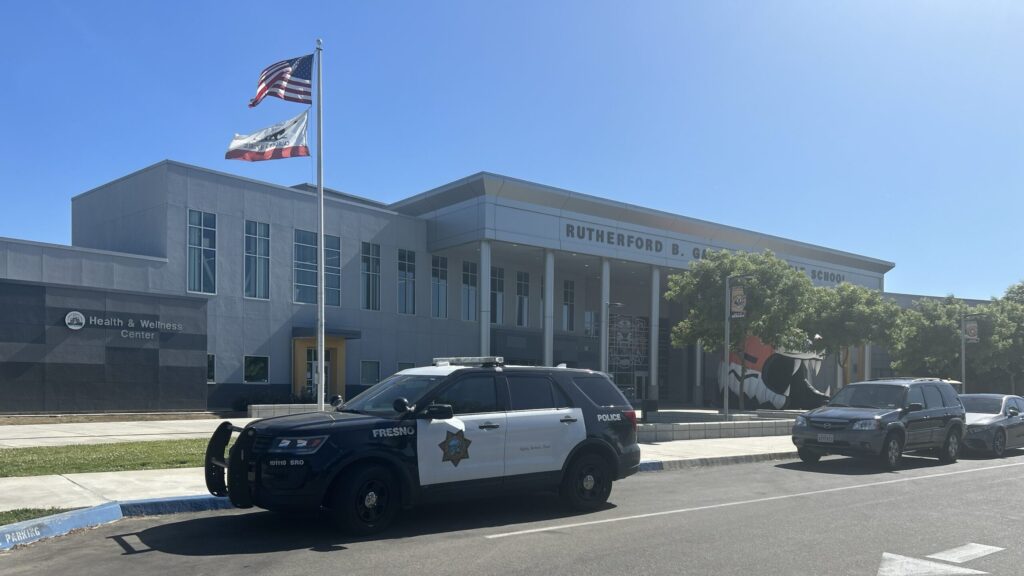
“I would love for there to be no acts of any physical harm on another person, but that’s impossible,” Sgt. Anthony Alvarado said.
Fresno Unified has been debating what level of policing to have in its schools for several years. In 2020 police were pulled from the district’s middle schools but remained in high schools. After several violent incidents, police were returned to some middle schools in 2022 and the rest in 2023.
School “feels like a prison”
The daily presence of Kern High School District police at Mira Monte High in Bakersfield “feels ghetto,” sophomore Jose Delgado said.
The school “feels like a prison. It’s like they don’t trust us at all.”
Still, Delgado said, he understands the need for police, noting a lot of fights at the school. “It’s for the best, but it makes us feel ghetto.”
Data shows 163 police call records at Delgado’s school for the five-and-a-half month period. They describe incidents including assault with a deadly weapon, an irate parent, out-of-control juveniles and resisting a police officer.
Delgado’s sense of school as a prison and not being trusted are among the reasons why the negatives of school policing “completely outweigh the positives,” Nandam, the Southwestern Law School professor said.
The students who police typically interact with “are not the children that are doing well in school,” Nandam said. “Part of why there isn’t an outrage, a global outrage, is because it’s not impacting the people that are in power, the people who have agency.”
Children seeing police in schools can be akin to going to an airport and encountering armed officers at a security checkpoint, said University of Florida education professor Chris Curran, who has studied school policing extensively. “It’s natural to wonder what’s wrong, why are there people with guns?” he said. “You find yourself saying, ‘What do I not know about? What’s this danger that has necessitated assault rifles?’”
No state guidance
When he was a state Assembly member in 2020, California Attorney General Rob Bonta, Assemblymember Mia Bonta’s spouse, clearly came down on the side of removing police from schools when he spoke at a forum after Floyd’s murder.
“It’s just really important to call out this incredible moment,” he said, lauding districts, including Oakland, that ended policing. “There’s a general dehumanization of children of color, a belief that they need to be surveilled and monitored and watched and policed.”
“The outcomes don’t make our students safer,” he said. School policing is “not achieving what we’re seeking,” a video of the forum shows. It was hosted by State Superintendent of Public Instruction Tony Thurmond.
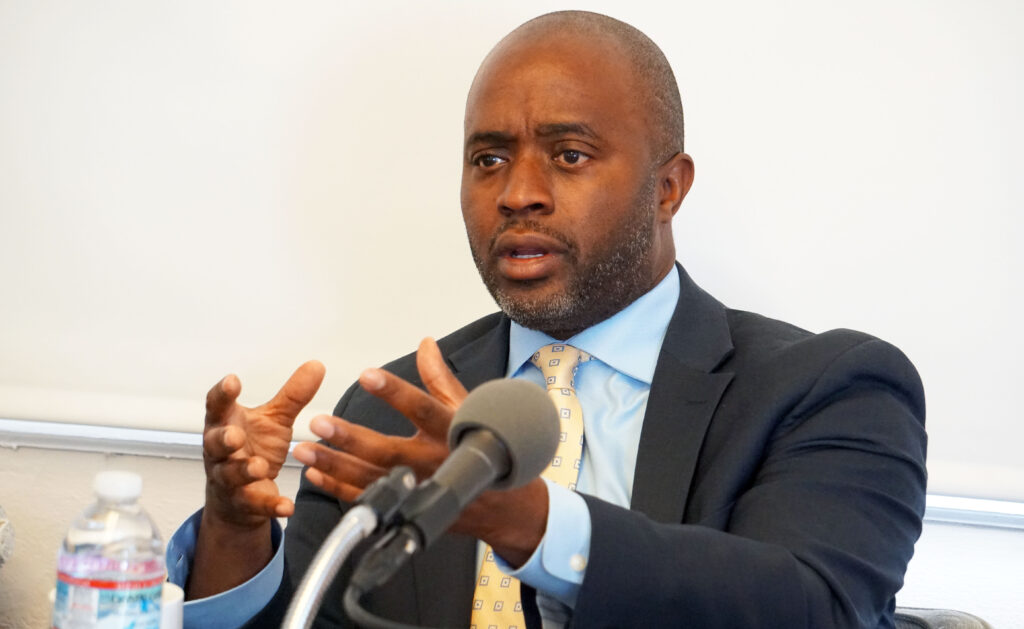
Asked recently if Bonta’s position on school policing as the state’s top law enforcement officer mirrors what he said in 2020, his press secretary replied “no” via email.
Bonta, who’s expected to enter the 2026 governor’s race, “has always believed that there isn’t a one-size-fits-all solution for school safety, and that schools need to work towards data-driven policies that fit their community,” Alexandra Duquet wrote.
“School resource officers can be an important component of ensuring students and school personnel safety,” Duquet wrote. “Their primary focus should be ensuring the safety of all on campus — not discipline — and they be given tools such as implicit bias training that ensure the equitable treatment of all students.”
Thurmond, a declared 2026 gubernatorial candidate, took no position on school policing during the forum. He recently told EdSource he favors “well-trained school resource officers to handle serious situations.” He also called for “more training of school staff so they’re not calling police for something that’s a student discipline matter.”
Thurmond also said that during his time as a member of the West Contra Costa Unified School District board from 2008-2012 he saw police officers help students, calling them “some of the best social workers I’ve worked with.”
State Sen. Nancy Skinner, D-Berkeley, who during Thurmond’s forum praised Oakland’s shuttering of its school police department, said in an interview that school districts should consider alternatives to police the way some cities have started using trained civilians to respond to 911 mental-health-crisis calls.

“Kids are emotional. Kids don’t have impulse control the way adults should, and to bring an officer in, especially since all of our officers are armed, can, rather than defuse the situation, make it worse,” Skinner said. Kids can act out what they experience at home or on the street, she added.
Skinner, the author of several major police accountability bills, also said she saw value in the data EdSource obtained and published.
Police logs can help officials decide if civilian staff should deal with more school incidents at a time when California’s suffering a police shortage, she said. That could leave sworn officers available for “real public safety needs. We never want to prevent a school from calling 911 if that’s needed. However, there might be some appropriate guidelines or boundaries that cities and schools could work out.”
Stopping a police chase
The executive director of the Alabama-based National Association of School Resource Officers, Mo Candy, a retired cop, said districts would be mistaken to remove resource officers from campuses. Police will always be needed to respond to schools, and “we need for students and faculty to be able to feel like this officer is more than just a law enforcement officer, that they really are another trusted adult in that school environment.” A trained and well-known officer, “may be the person who comes into a situation with the coolest head,” he said.
Loretta Whitson, executive director of the California School Counselors Association, has seen what can happen when police approach a student situation lacking the cool-headedness Candy described.
As a school counselor in the Monrovia Unified School District in Los Angeles County, she once worked with a child who ran away from school multiple times. Finally, an exasperated principal called the police, who chased after the student.
“The principal didn’t stop them. I felt as (officers) went on in their rant this kid is getting more damaged. So, I said, ‘Stop, stop,”’ Whitson said. “We already had a very damaged kid, and this wasn’t helping.” The student was later found to need special education services, she said.
Tom Nolan, a retired Boston police lieutenant turned sociologist who’s taught at several universities and studied school policing, said when law enforcement officers are called into a school situation, “they become the shot callers,” deciding what to do whether it is in the child’s best interest or not. Too often, principals are calling them for minor problems like lost keys and disciplinary matters, he said.
“The research is unequivocal in demonstrating that the police coming into schools, or police being assigned to schools, is almost always a bad idea. It has bad outcomes for children. It has bad outcomes for school safety.”
Nolan said police are not school counselors and shouldn’t play that role. “That’s something that’s a very specific skill set that is attained through years of graduate level study by mental health practitioners and clinicians.”
The California Police Chiefs Association declined to make anyone from its leadership available for an interview. In an email, its executive director described school policing as a matter best discussed at local levels.
Brian Marvel, president of the Peace Officers Research Association of California, a powerful federation of police unions, wasn’t available for an interview, a spokesperson said. In a statement, Marvel, a San Diego police officer, said cops assigned to schools “play an important role in” schools. They act as “educators, emergency/crisis managers, first responders, informal counselors, mentors, and model the kind of behavior that builds trust and respect between law enforcement and the communities they serve.”
Data shows that sometimes, regardless of who might be available to counsel or advise a student, one may just do something dumb, like putting a death threat in writing.
On June 15, 2023, James Morris, the county administrator who also acts as Inglewood Unified superintendent, received a death threat via email, police call records show. Morris, a veteran administrator, was brought on to lift Inglewood out of years of state receivership because of fiscal woes.
“I can just say, generally, it was a student,” Morris said when asked about the threat. Police took a report, but Morris said he didn’t want charges filed.
“I’ve been doing this for 44 years. It takes a lot to rattle me,” he said. “It was a young person who just needed help.”
No SRO’s in Antioch Unified
As previously reported, in December 2020 the Antioch City Council voted on a split, 3-2 vote to rescind the previous 3-2 vote to approve acceptance of a U.S. DOJ COPS Hiring Program Grant of $750,000 for six School Resource Officers (SRO’s). They would have been assigned to three of the district’s high schools and three middle school campuses.
Contra Costa County School Police Call Log Data for Jan. 15 – June 30, 2023
Following is the data from the police call logs from eight districts in Contra Costa County included in a sampling of schools representing California for the period Jan. 15 to June 30, 2023. The database does not include all schools or districts.
Antioch Unified School District – 99 incidents at two schools, Antioch High School and Dallas Ranch Middle School
Acalanes Unified School District
John Swett Unified School District
Lafayette Elementary School District
Liberty Union High School District
Mt. Diablo Unified School District
Pittsburg Unified School District
West Contra Costa Unified School District
Data from the Contra Costa County school districts included 11 schools, nine police departments ad 981 incidents reported.

Thomas Peele is an investigative reporter at EdSource.
Daniel J. Willis is an EdSource data journalist.
Allen D. Payton contributed to this report.