Will create $800 million in economic activity and 1,300 construction jobs; Antioch city staff checking to see if program can benefit the Hard House, home of the city’s first mayor.
Sacramento, CA: On Tuesday, October 9th, Governor Gavin Newsom signed SB 451, the California Historic Rehabilitation Tax Credit, adding California to the list of more than 35 states that have passed such incentives. The bill, which passed both the Senate and the Assembly with unanimous approval, will enable the renewal of aging structures and communities throughout the state, and promote the development of affordable housing.
The bill will create a 20% state tax credit for the rehabilitation of historic structures listed on the California Register of Historic Places. An additional 5% bonus can be granted for certain projects, such as affordable housing for lower-income households and projects in transit-oriented developments or regions with high unemployment and poverty rates. All projects must be approved by the California Office of Historic Preservation and the California Tax Credit Allocation Committee to determine if a project qualifies. The tax credit goes into effect on January 1, 2021.
“The California State Historic Tax Credit is an important tool that we can use to revitalize communities throughout California,” said Cindy Heitzman, Executive Director, California Preservation Foundation. “This is a major victory for every Californian who believes that our architectural and cultural heritage is worth protecting.”
The State Historic Tax Credit will help to address the critical need for affordable housing in underutilized historic buildings by providing an important financial incentive. Between 2007 and 2017 over 38% of all federal historic tax credit projects in California created new housing units or improved existing units. Of that amount over half were affordable housing projects, and SB 451 will make even more of these projects feasible.
Since February, the California Preservation Foundation (CPF) and the American Institute of Architects, California Council have led a major coalition to shepherd the bill through the legislature, working directly with California Senate President pro Tempore Toni G. Atkins. The bill received broad support from organized labor, affordable housing groups, historic preservation organizations and local governments. This effort built on the work CPF did in 2014 to pass AB 1999, the first version of this legislation. While it passed both houses of the California legislature, it was ultimately vetoed by then Governor Jerry Brown.
“This legislation will breathe new life into the buildings that give our cities and communities character and charm…Further, the Historic Tax Credit will increase the supply of affordable housing, support growth through infill development and encourage property rehabilitation and maintenance in economically depressed areas,” said Senator Atkins.
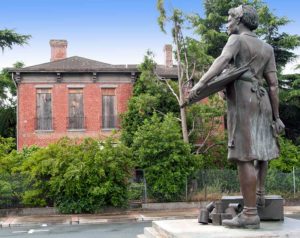
When asked if this is something that could benefit Antioch’s Roswell Butler Hard House, the home of the city’s first mayor, located at 815 West First Street, City Manager Ron Bernal asked Community Development Director Forrest Ebbs to look into it. The home is #93001020 on the National Register of Historic Places. For more information about the Hard House, visit the Wikipedia page or the Facebook page.
About the Federal Tax Credit
Since 1976, the Federal Historic Tax Credit (HTC) has offered tax credits equal to 20 percent of the qualified rehabilitation expenditures (QRE) for the rehabilitation of certified historic buildings, such as those listed on the National Register of Historic Places or architecturally contributing to a National Register district. Over the last 4 decades, more than 35 states have passed their own bills to boost this tax credit, making thousands of projects financially feasible.
From 2002 to 2016, $468.1 million in Federal Historic Tax Credits catalyzed 169 projects in California, totaling $2.8 billion in qualifying rehabilitation expenditures. This activity has generated:
- 39,279 jobs
- $2.8 billion in Gross State Product
- $160 million in state and local taxes
- $493.3 million in federal taxes
- $468.1 million in federal tax credits
SB 451 will provide further incentive for historic rehabilitation, increase the supply of affordable housing, support growth through infill development, and encourage property rehabilitation and maintenance in economically depressed areas. Below are a few examples of the types of projects that will benefit from SB 451, but there are hundreds more stories just like these throughout California. The tax credit will make these kinds of projects more feasible, and will encourage meaningful investments in communities across the state.
For more information:
Bill Text: https://leginfo.legislature.ca.gov/faces/billTextClient.xhtml?bill_id=201920200SB451
Images and additional information: https://californiapreservation.org/tax-credit-press/
Press Release from Senator Toni Atkins on the passage of SB 451: https://sd39.senate.ca.gov/news/20190912-press-release-atkins%E2%80%99-tax-credit-historic-preservation-passes-assembly
Preservation & State Historic Tax Credits overview from the National Trust for Historic Preservation: https://forum.savingplaces.org/learn/fundamentals/economics/tax-credits/state-htc
2017 Report from the National Park Service on the Federal Historic Preservation Tax Credit’s impact: https://www.nps.gov/orgs/1207/htc2017.htm
Case Statement: https://californiapreservation.org/wp-content/uploads/2019/09/Case-Statement.pdf
Allen Payton contributed to this report.