Antioch Black History Month event at Black Diamond Middle School Friday night
Friday, February 25th, 2022












Publisher’s Note: This is the ad that was supposed to run in the special City of Antioch Sesquicentennial edition of the Antioch Herald newspaper, this month. Apologies to Brenda Cato of Rivertown Veterans Thrift Store for inadvertently running the rough draft design of just their business card instead.
To learn more about the City of Antioch Sesquicentennial celebrating the 150th Anniversary of the Incorporation of the City on Feb. 6, 1872, as the county’s original city, click here.
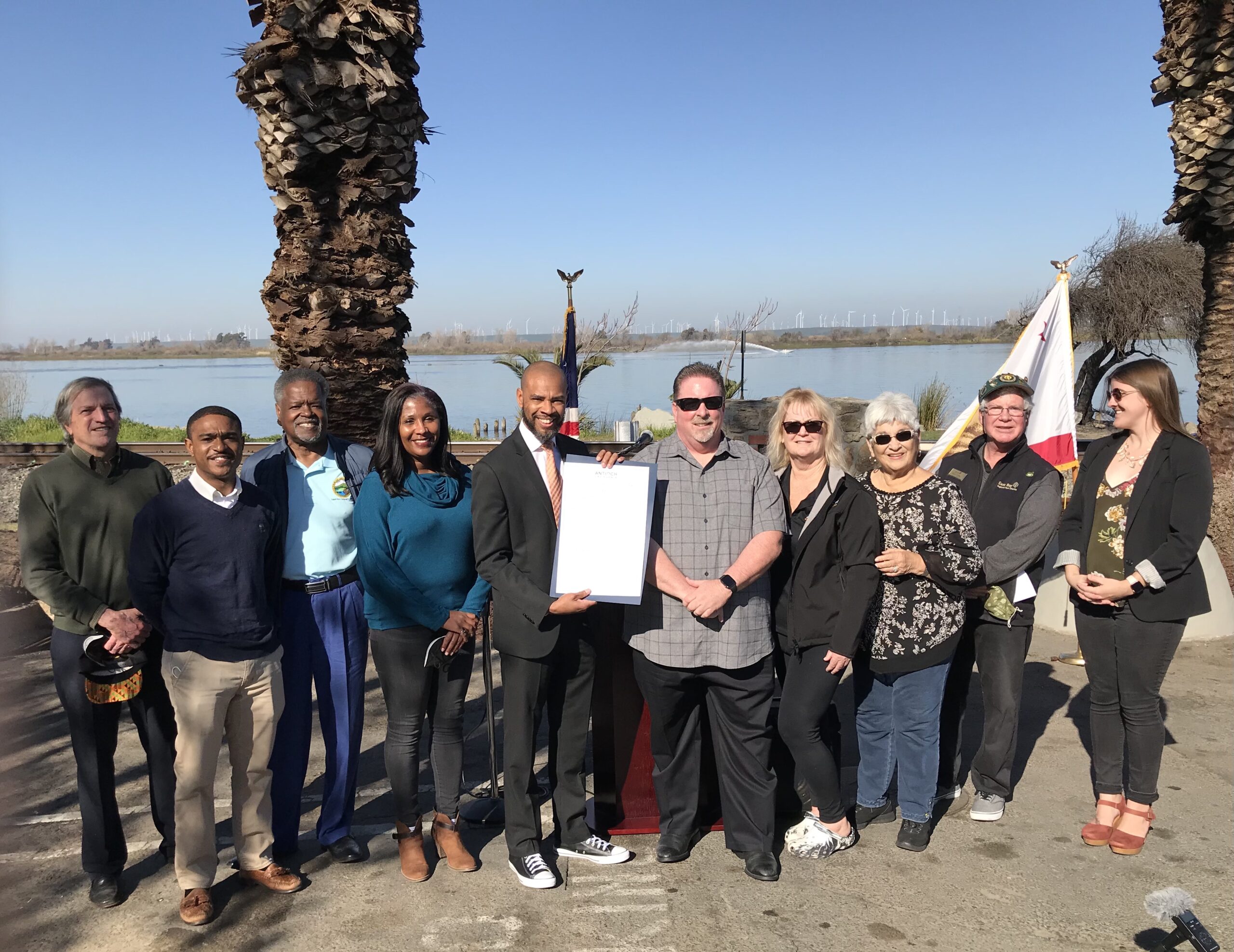
Mayor Lamar Thorpe, holding the proclamation honoring the City’s Sesquicentennial of Incorporation, is joined by other Antioch council members and elected officials on Sunday, Feb. 6, the actual 150th anniversary of the incorporation. Photos (unless otherwise indicated) by Allen D. Payton
An audience of about 50 people enjoyed the City of Antioch Sesquicentennial of Incorporation ceremony on Sunday, Feb. 6, 2022.
By Allen D. Payton
During a ceremony on a clear, sunny afternoon current and former Antioch officials, community leaders and residents celebrated the 150th anniversary, or Sesquicentennial of the City’s incorporation on the actual date it occurred on Feb. 6 in 1872. It marked the official formation of the first city in Contra Costa County, as the Board of Supervisors approved Antioch’s Articles of Incorporation that day. (See related article)
The event was held in front of the Birthplace of Antioch monument at the foot of F Street, overlooking the river and near the BNSF rail line.
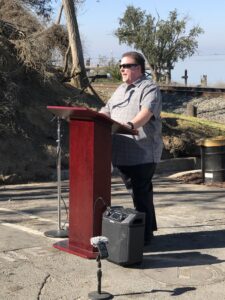
Mayor Pro Tem Mike Barbanica speaks mentioning the City’s Centennial event in 1972.
Antioch Parks and Recreation Director Brad Helfenberger welcomed the audience. Mayor Pro Tem Mike Barbanica spoke, thanking those in attendance, and offering his memories of the city during his life, including the celebration of the City’s Centennial in 1972.
The audience also heard brief speeches from those who represent the City, including current county Supervisor Federal Glover, Congressman Mark DeSaulnier and staff representatives of Supervisor Diane Burgis, State Senator Steve Glazer and Congressman Jerry McNerney, honoring the City’s anniversary. DeSaulnier, Glazer’s and McNerney’s staff presented the council members with proclamations honoring the City’s achievement. The Board of Supervisors honored the City’s Sesquicentennial anniversary with a proclamation at their meeting on Feb. 1. (See related article)
During Glover’s speech, a train carrying rolls of steel and chemicals heading east to the U.S. Steel plant in Pittsburg passed by, which he said was a good thing and an example of the economic strength of Antioch and East County, which helped grow the town, first established in 1849 as Smith’s Landing.
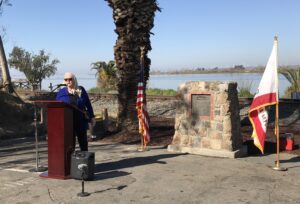
Joy Motts, president of Celebrate Antioch Foundation and leader of the Sesquicentennial Committee shares about this year’s events.
He pointed out that February is Black History Month and mentioned the late, former Antioch Councilman Reggie Moore who was the city’s first African-American member, then spoke of former Mayor Wade Harper, who was in attendance, as the city’s first African-American mayor, and District 4 Councilwoman Monica Wilson, who was the city’s first African-American female member of the council.
Joy Motts, president of Celebrate Antioch Foundation, the City’s partner in organizing this year’s celebration, spoke about the other events planned for throughout the year, highlighting the Independence Day celebration, which is the birthday of the renaming of the community to Antioch during the July 4th picnic in 1851.
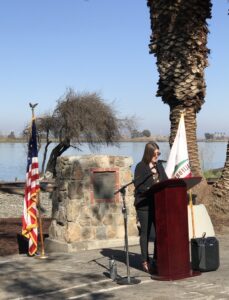
City Clerk Ellie Householder reads the proclamation.
Proclamation Adopted, Read and Signed
The proclamation celebrating the City’s Sesquicentennial and providing the history of the community, was then read by City Clerk Ellie Householder, as Mayor Lamar Thorpe was not yet in attendance. It was adopted by the Antioch City Council on Friday, Feb. 4 on a 3-0-2 vote, as both Barbanica and District 1 Councilwoman Tamisha Torres-Walker were absent. (See related article)
About 30 minutes into the event, Thorpe arrived and signed the proclamation, then apologized for his tardiness saying he was at the opening of a local church in their new building, and that it was appropriate since Antioch was named for the city in Syria, “where the followers of Jesus Christ were first called Christians. So, I thought that was a special honor and I didn’t want to miss that. I think that’s important, and it was important for them,” he said. “I am excited to be here.”
During his speech the mayor said, “I’m so excited to be the mayor during this important year. We’ve come a long way as a city. 150 years ago, the diversity that we see in this crowd, here today did not exist. As time has passed, we’re at a time where, we for the first time we have the first majority African-American council in the city’s history. A majority woman city council in the city’s history, and that’s been for some time.”
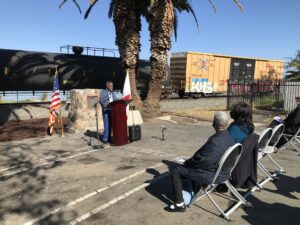
Supervisor Federal Glover speaks as a freight train heads west to Pittsburg temporarily interrupting him.
“As we continue for the next 150 years, it’s important to understand, as these changes occur, there’s always going to be some level of conflict, as that’s the process of maturation,” he continued. “It means we’re growing up as a city. We’re not the same city that we were 10 years ago when I moved here. We’re not the same city that we were when folks who grew up are. We’re a different city.”
“But it’s all good. It’s all good. Because as we continue to be a more progressive, open-minded city, more people come here,” the mayor said. “We continue to be the fastest growing city in the Bay Area. We are now one of the most racially diverse cities in the San Francisco Bay Area, certainly ethnically diverse. So, there’s a lot of heritage and experiences that we’re proud of.”
“A lot of us recognize the importance of our history, so I just want to share a few things that we will be doing in the City of Antioch,” Thorpe said. He then shared about the council’s plans to restore the Hard House, on W. 1st Street, the home of the first mayor of Antioch, Roswell Butler Hard, where the meetings for the first city council were held.
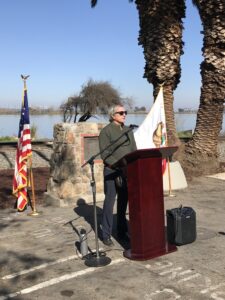
Congressman Mark DeSaulnier spoke to the audience before presenting a proclamation honoring the City’s achievement.
“The Hard House has sat empty for a long, long time,” The history of this city should not stay empty in some building,” he said to applause from the crowd. Thorpe reiterated that the council’s “vision, right now is for council offices, maybe on the second floor, and community space on the first floor, to ensure that the community has access. So, we want to restore that.”
Thorpe then spoke of the Antioch (Beede) Lumber Company yard, the empty lot bordered by W. 2nd, W. 3rd and E Streets and the council’s commitment “to ensure that remains a public space recognizing our history,” to an even greater applause.
Thorpe then turned it into a campaign speech, as he faces possible recall.
“This council, my colleagues, myself, we are committed to, of course, preserving history. But we’re also committed to ensuring that the change that is occurring now, continues,” he stated. “And our foot is on the pedal, and we’re not stopping. It doesn’t matter what the naysayers have to say. I will be here for another three years.” (See video)
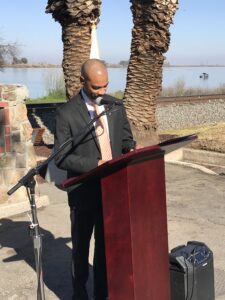
Mayor Thorpe signs the proclamation.
Several photos were taken of Thorpe holding the proclamation, with current council members, all but District 1 Council Tamisha Torres-Walker who was not in attendance and elected officials, Sesquicentennial Committee and Antioch Historical Society leaders, former mayors and council members, and with city staff.
Thorpe later said a framed copy of the proclamation will be given to the Antioch Historical Society for their museum and another will be framed for City Hall.
A reception was then held at the Antioch Senior Center nearby, in which historic photos of the city and copies of the city council’s first minutes and By-Laws, adopted March 14, 1872, were on display. Sesquicentennial calendars were sold for $20 each as a fundraiser to support this year’s activities and hors d’oeuvres were served, catered by Girard’s Catering owned by Antioch resident Linda Jane. Antioch’s First Bylaws.March 14, 1872
Unfortunately, a copy of the City’s Articles of Incorporation could not be located in the City Clerk’s office prior to the event. But the search for a copy will continue and added here, once they are.
Torres-Walker was asked the reason for her absence. She responded simply, “I was with family.”
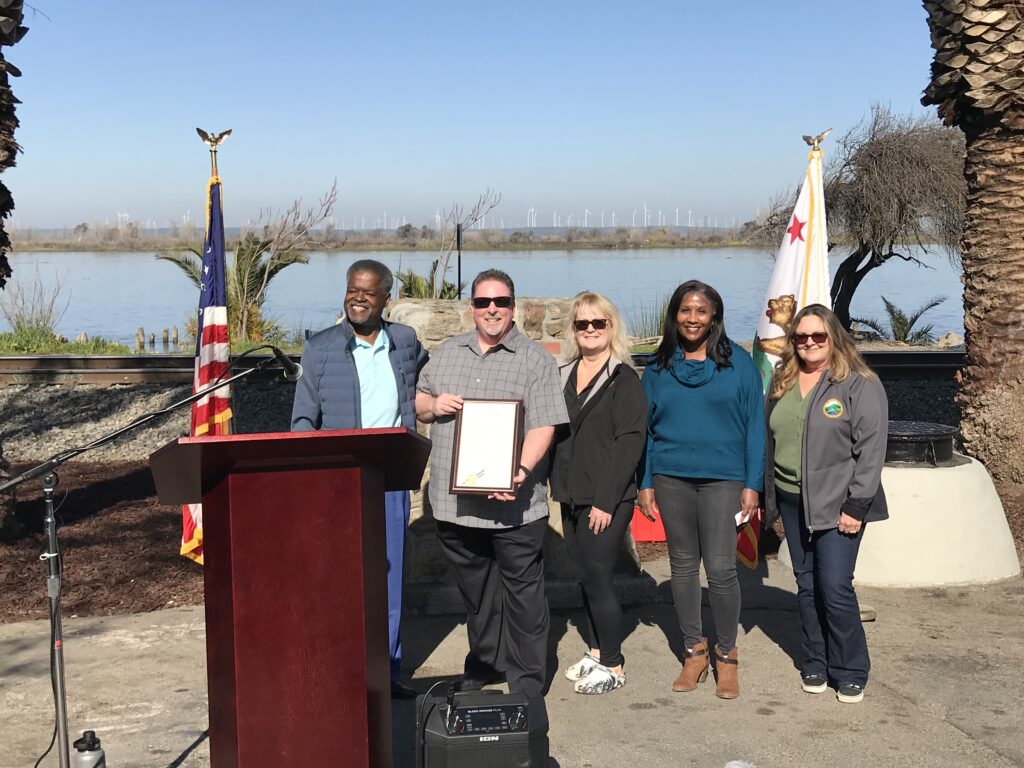
Contra Costa County Supervisor Federal Glover who represents a portion of Antioch was joined by members of the Antioch City Council, Barbanica, Ogorchock and Wilson, and a representative of Supervisor Diane Burgis, who represents the other portion of the city, with a plaque honoring the City’s Sesquicentennial.
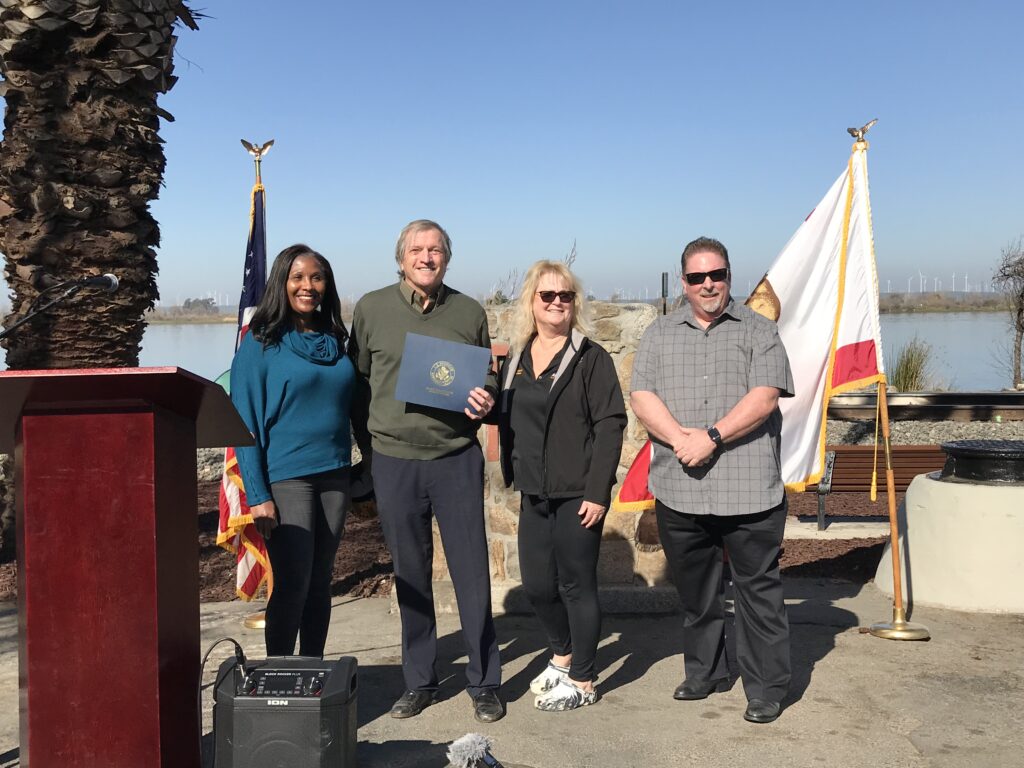
Congressman Mark DeSaulnier who represents portions of Antioch in the U.S. House of Representatives is joined by three members of the Antioch City Council, as he holds a Congressional proclamation honoring the City’s Sesquicentennial.
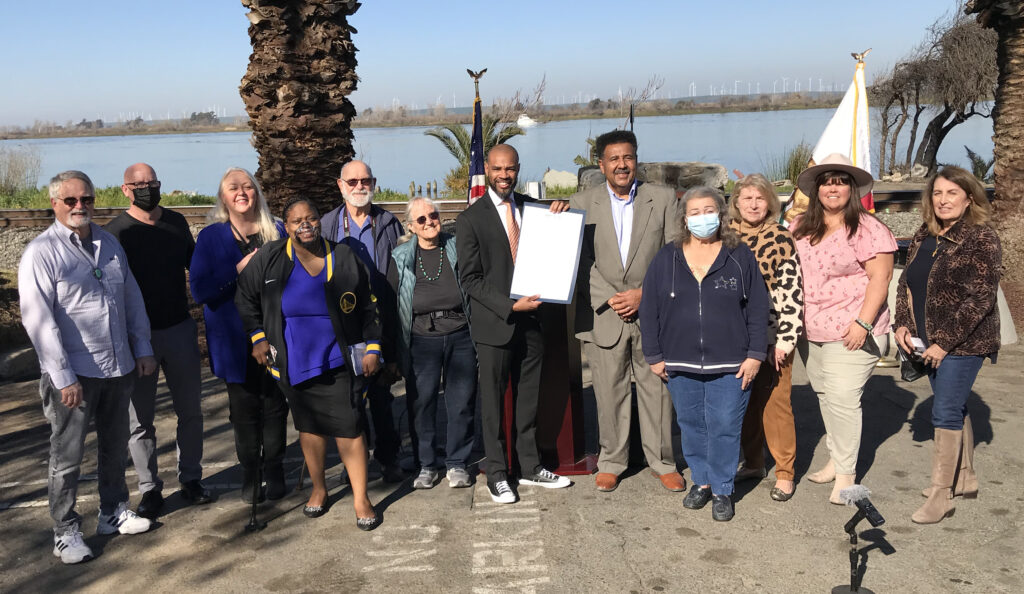
Representatives of Celebrate Antioch Foundation and the Antioch Historical Society join Mayor Thorpe for a photo with the City Council’s proclamation.
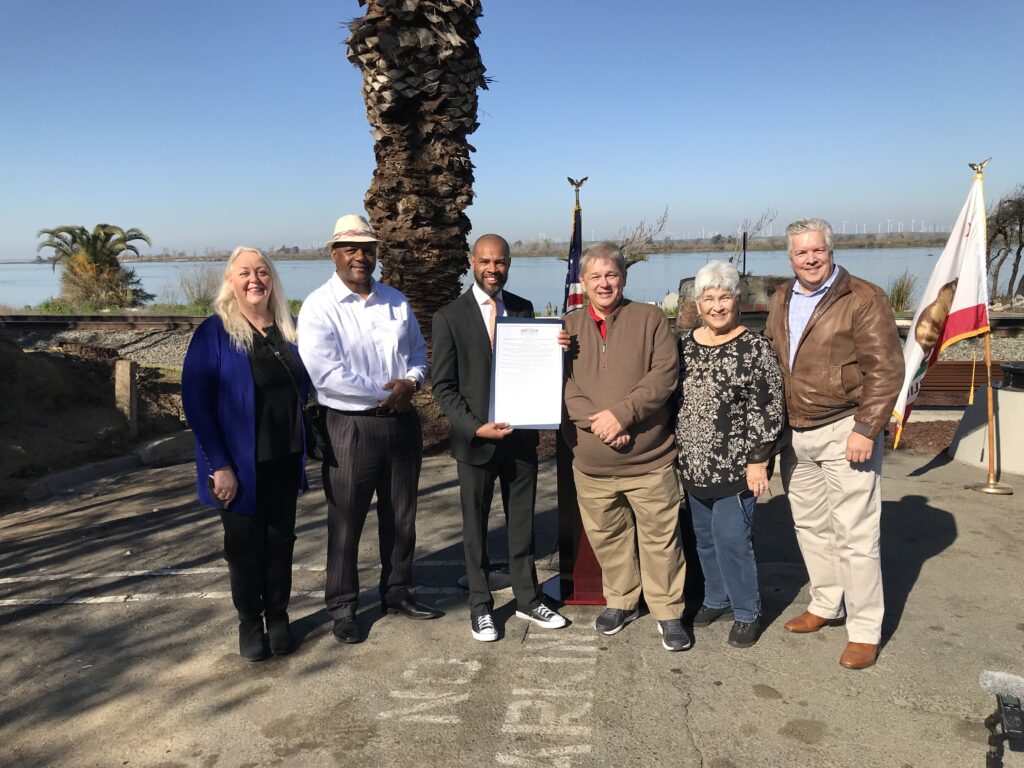
Former Antioch Mayors Wade Harper (second from left), Don Freitas and Mary Rocha, and former Mayor Pro Tems Joy Motts (left) and Allen Payton (right), join Mayor Thorpe with the City Council’s proclamation.
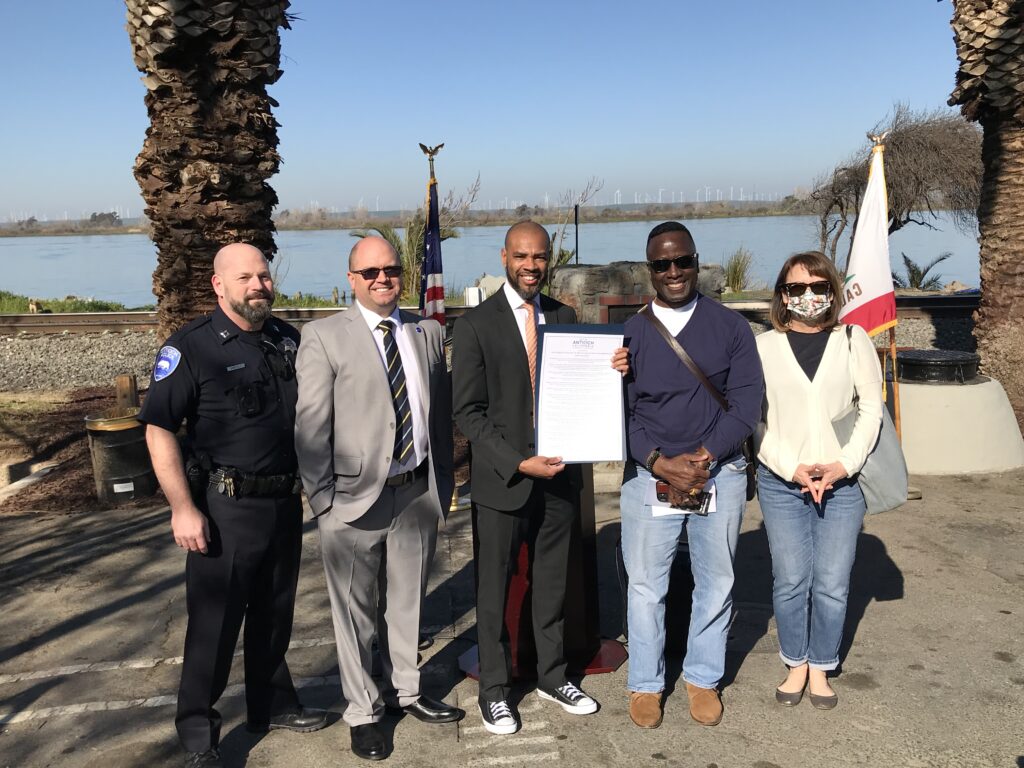
Antioch City staff leadership, Interim Police Chief Tony Morefield, Parks and Recreation Director Brad Helfenberger, Interim City Manager Con Johnson and Assistant City Manager Rosanna Bayon Moore, join Mayor Thorpe with the signed Sesquicentennial proclamation approved by the City Council.
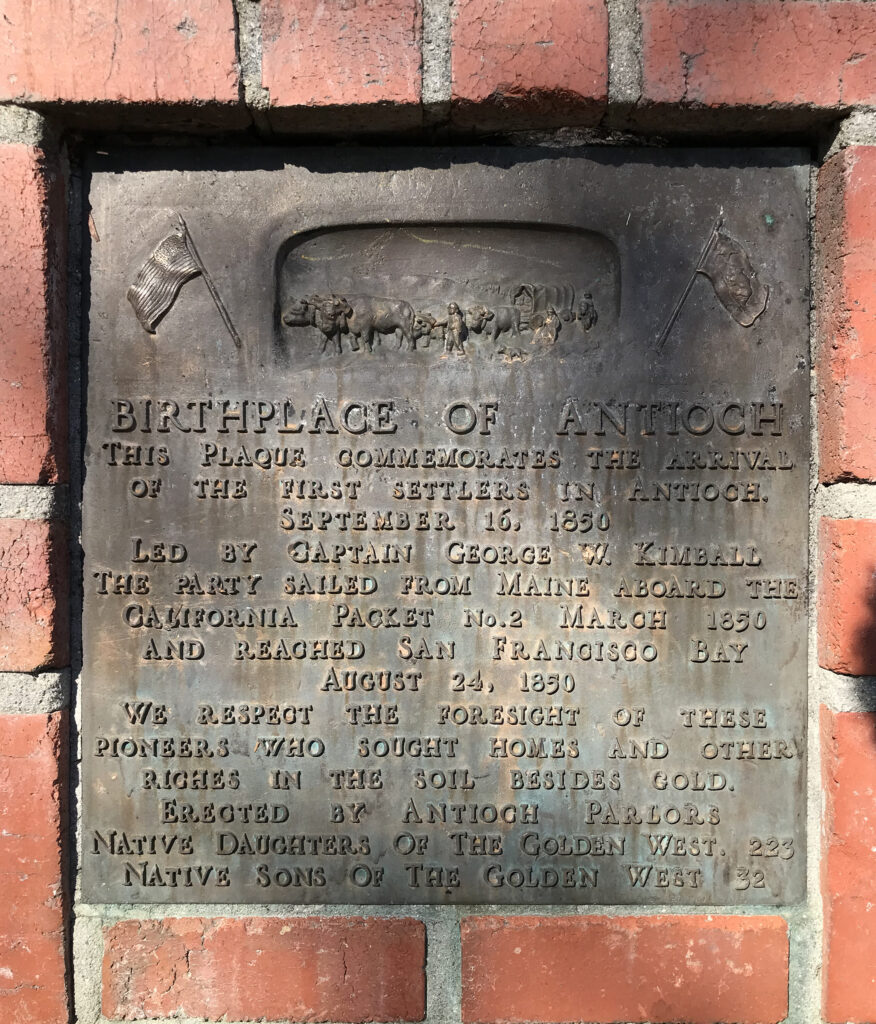
Birthplace of Antioch Marker at the foot of F Street.
Please check back later for any updates to this report.

Source: City of Antioch
By Allen D. Payton
During a special and brief council meeting held Friday afternoon, Feb. 4, 2022, the Antioch City Council, on a 3-0-2 vote approved a proclamation honoring the City’s Sesquicentennial, or 150th anniversary of the day it was incorporated on Feb. 6, 1872. The milestone was celebrated yesterday. (See related article and more about the commemoration, later)
With Mayor Pro Tem and District 2 Councilman Mike Barbanica and District 1 Councilwoman Tamisha Torres-Walker both absent, and District 4 Councilwoman Monica Wilson attending via Zoom, the motion to approve the proclamation. When asked why he wasn’t there, Barbanica said he “had a prior engagement that I could not get out of and it was not a scheduled meeting but a special meeting.” When asked the same, Torres-Walker replied, “I had to work Friday.”
Another proclamation honoring Genesis Church-Antioch recognizing the opening of their new location on the corner of E. 18th Street and Woodland Drive, was also approved by the council. Genesis purchased the building from Golden Hills Community Church which housed their Antioch satellite campus. Both are part of the same Converge denomination, formerly known as the Baptist General Conference, which was founded by Swedish immigrants to America in the 1800’s in Illinois and Minnesota. Genesis Church-Antioch Proclamation 020422
Following is the Sesquicentennial proclamation: Antioch City Council Sesquicentennial Proclamation 020422

WHEREAS, for thousands of years, native indigenous Bay Miwok Tribes such as the Julpun inhabited and thrived on the land now known as the City of Antioch. Each Bay Miwok Tribe knew its land and boundaries intimately and shared the land and its resources;
WHEREAS, Twin brothers William Wiggin Smith and Joseph Horton Smith were hired to build homes and businesses in the region and were offered land in exchange for the development of land owned by Dr. John Marsh.* Later Captain George Washington Kimball and his passengers landed at the foot of ‘F’ Street, on September 16, 1850, where a new community would begin at what is now an area just east of Downtown Antioch;
WHEREAS, the community was initially called Smith’s Landing, but on July 4th, 1851 was renamed after the Biblical town Antioch, modern day Turkey, in honor of Reverend Joseph Horton Smith, who died a year earlier and in recognition that many in the new community were disciples of Christ;
WHEREAS, the town of Antioch was formally incorporated on February 6th, 1872, with the original town limits being ‘A’ Street to the east, ‘L’ Street to the west, and 10th Street to the south;
WHEREAS, at the time of incorporation the early people of Antioch were of European nationalities, including Greek, Portuguese, English, Welsh, German, Italian, and French as well as people of Chinese, Japanese, South East Asian and African descent. Living up to its claim of being a Metropolis where “the Whole World is Invited”;
WHEREAS, Antioch being at the confluence of the Sacramento and San Joaquin Rivers was a deep-water shipping port that attracted paper mills, brick and glass factories, ceramics and distilleries. As well as an agriculture center for farmers and cattle ranchers;
WHEREAS, in 1878 the Empire Coal Mine Company, owned by CW Belshaw and Egbert Judson, built the Empire Railroad Company, transporting coal from Judsonville, West Harley, and Stewartsville, in what is present day Black Diamond Regional Park. This coal was shipped across the region, making it one of the primary energy sources at the time, thus fueling the industrial development of California including the Bay Area;
WHEREAS, in the 1940’s Midwestern, Mexican, and Filipino families came to California looking for work in agriculture, many of whom eventually joined the workforce in Antioch’s paper mill and glass factory;
WHEREAS, although global commerce was welcomed in Antioch, it is also true that historical discrimination in the form of “Sundown Ordinances,” racial housing covenants, redlining, and other forms of systematic oppression was also present in Antioch. Many of the effects of which are still felt by communities today;
WHEREAS, when our Nation went to defend freedom, Antioch residents fought in World War l, World War ll, Korean, Vietnam, Persian Gulf, Afghanistan, and Iraq wars. In support of the US Navy World War ll effort, Fulton Shipyard was the first San Francisco Bay Area company to garner an “E” for efficiency and production excellence while constructing auxiliary vessels;
WHEREAS, the Bald Eagle Bronze Monument, now at the Contra Costa Fair Grounds, is one of six World War l monuments along Victory Highway, America’s first transcontinental road when it was dedicated in 1926. The Antioch Bridge was named the “Golden Link” of Victory Highway, named for its significance in connecting the northern and southern parts of California and was the Country’s first toll bridge;
WHEREAS, the City of Antioch has grown and evolved from a town of agriculture to a town of industry, and is now the fastest growing city in the San Franciso Bay Metropolitan Area and continues to draw people from different parts of the world and today is one of the most racially and economically diverse cities in the Bay Area;
WHEREAS, the City of Antioch is now a community where “Opportunity Lives Here,” a statement that is shown in the City’s investments in its infrastructure like the first Brackish Water Desalination Plant in California, industries like medical services, retail and cannabis, racial reconciliation, and other community initiatives; and
WHEREAS, the City of Antioch now desires to commemorate the milestone of its Sesquicentennial through a series of events that will begin with the anniversary of its incorporation on February 6, 2022, and culminate in a community-wide celebration on July 4, 2022.
NOW, THEREFORE I, LAMAR A. THORPE, Mayor of the City of Antioch, do hereby proclaim February 6, 2022, as the “Sesquicentennial of the Incorporation of the City of Antioch”.
We celebrate our rich history as one of California’s oldest cities with a storied past and bright future.
FEBRUARY 4, 2022
_________________________________
LAMAR A. THORPE, Mayor
The proclamation was signed by Mayor Thorpe during Sunday’s event celebrating the milestone.
Challenge to Second Paragraph of Proclamation
*This sentence is in question and being challenged. Former Antioch Councilwoman Elizabeth Rimbault, who helped write the book entitled Images of America – Antioch by the Antioch Historical Society said she is unaware of that as part of the Smith brothers’ history in Antioch. In addition, this reporter who researched multiple books in writing The History of Smith’s Landing which is on display inside Smith’s Landing Seafood Grille is also not aware of that claim. City Clerk Ellie Householder was asked to cite the source for it and if she perhaps misinterpreted what was written about the Smith brothers early time, here as they founded the community.
By Allen D. Payton
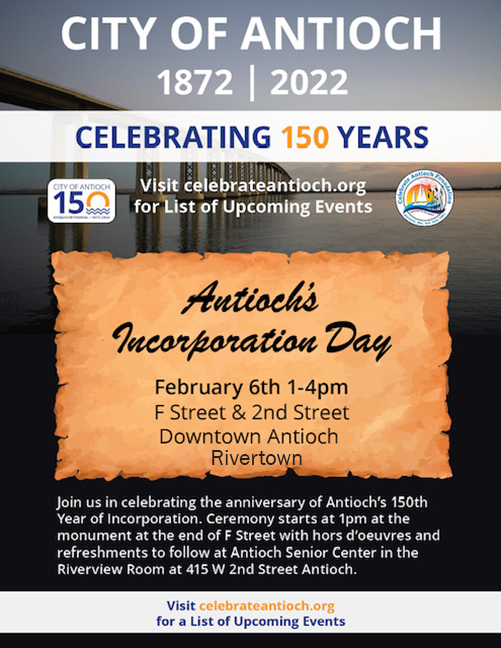
On February 6, 1872, the Contra Costa Board of Supervisors were petitioned by the town of Antioch for incorporation. Antioch was granted incorporation “for police purposes, and other purposes” and became the first city in the county. Next Sunday, Feb. 6, 2022, will be the 150th anniversary or sesquicentennial of that event. To celebrate, City leaders and the Celebrate Antioch Foundation will hold a ceremony to acknowledge Antioch’s incorporation date, Contra Costa County’s original city and one of the oldest cities in California, at the Birthplace of Antioch monument at the foot of F Street. A proclamation will be read, and a rededication held, followed by light snacks and drinks at the Antioch Senior Center.
Antioch’s Incorporation Day event will be held from 1:00 to 4:00 p.m. and is the first of many events, this year to celebrate the City of Antioch Sesquicentennial.
City of Antioch Incorporation History
According to the book entitled, Antioch To The Twenties by Elise S. Benyo and published by the Antioch Unified School District, “the petition for the incorporation of the town of Antioch” submitted to the Board of Supervisors included the names of 101 electors. The document and the names read as follows:
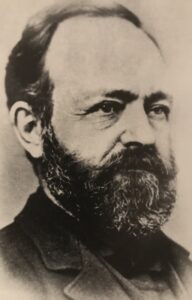
Antioch’s first Mayor Roswell Butler Hard. Source: Antioch Historical Society
“We, the undersigned (being a majority of the Town of Antioch, and qualified electors and residents thereof for more than thirty days last past, the said town containing more than two hundred inhabitants,) do now most respectfully petition Your Honorable Body to incorporate the said town, under the name of Antioch, the same being about one mile in width by about three miles in length (but not exceeding the same), and situated on the San Joaquin River, adjoining the New York grant in this county, as per plate or map hereto attached; said town to be incorporated for police purposes, and other purposes. Pursuant to the statutes of this State. And your petitioners will ever pray, etc.
Donlon, S. Franklin Pitts, Henry N. Baker, Joseph Galloway, J. T. Cossan, Charles Peers, M. A. Morrisey, Van W. Phillips, Ferdinand Stain, Cyrus Cheney, Joseph Ott, W. A. Brunkhorst, William Jones, Robert West, George P. Rockford, Oliver Wolcott, F. Wilkening, George Thyarks, H. Gardner, James Martin, James Conroy, M. S. Levy, G. B. Robbins, George Gruenwald, W. Rountree, William C Johnson, Albert Brinck, J. C. McMaster, James Ewing, G. W. Kimball, Charles Kohn, Frederick Vollmer, T. N. Willis, J. J. McNulty, I. Lobree, D. Mayon, H. W. Fassett, Charles Wein, H. H. Dearien, George Miller, D. McCartney, D. N. Cleaves, G. S. Carman, Joseph Scheirwelup, J. E. Bollinger, R. B. Hard, J. R. Howard, R. J. Wally, Stephen Jessup, H. Rietoro , R. G. Houston, Francis Williams, Oscar M. Jessup, James T. Cushing, Abraham Low, H. L. Farland, John W. Strickler, Stephen Abbott, P. Griffin, George Perry, Job E. Warren, J. H. Lewis, S. S. Pitts, T. O. Carter, A. Brown, J. Nicholson, Jay Tuttle, S. T. Page, M. H. Jacobs, George McCoy, H. W. Brewer, T. Aug. Heinoch, J. A. Chittenden, Joseph L. Smith, John B. Turner, George W. Brown, R. R. Fuller, Thomas Martin, A. M. Marble, Peter Donlon, R. Taylor, H. B. Reed, Christian Humble, S. B. Joslin, J. P. Abbott, Frank McFarlane, Warren Abbott, Joseph Baules, H. A. Foster, M. Homburg, James Gard, P. McDermott, J. Strickfield, John Tappeinen, H. Williamson, G. E. Wright H. Seers, Joseph P. Barron.”
Official Notice of Incorporation, Town Limits
The official notice of incorporation was published in The Antioch Ledger on Saturday, February 10, 1872, and described the city limits.
“It is therefore ordered that said town be, and the same is hereby declared Incorporated, and to be known by the name of Antioch, the corporate limits of said town to be as follows: Commencing at a point on the bank of the San Joaquin river, at the intersection of the line dividing Sections 14 and 15, Township 2 north, Range 1 east, Mount Diablo Base and Meridian, running thence from said point south on the said dividing line between Section 14 and 15, 22 and 23, one and one half miles to the South west corner of the North west quarter of Section 23, thence running East thee miles, to the South east corner of the North east quarter of Section 19, Township 2 north, Range 2 east, thence north, to the San Joaquin river, thence along the line of the ordinary high tides on the South bank of the San Joaquin river in a westerly direction to the point of beginning, and containing three square miles.” (Antioch is now almost 30 square miles).
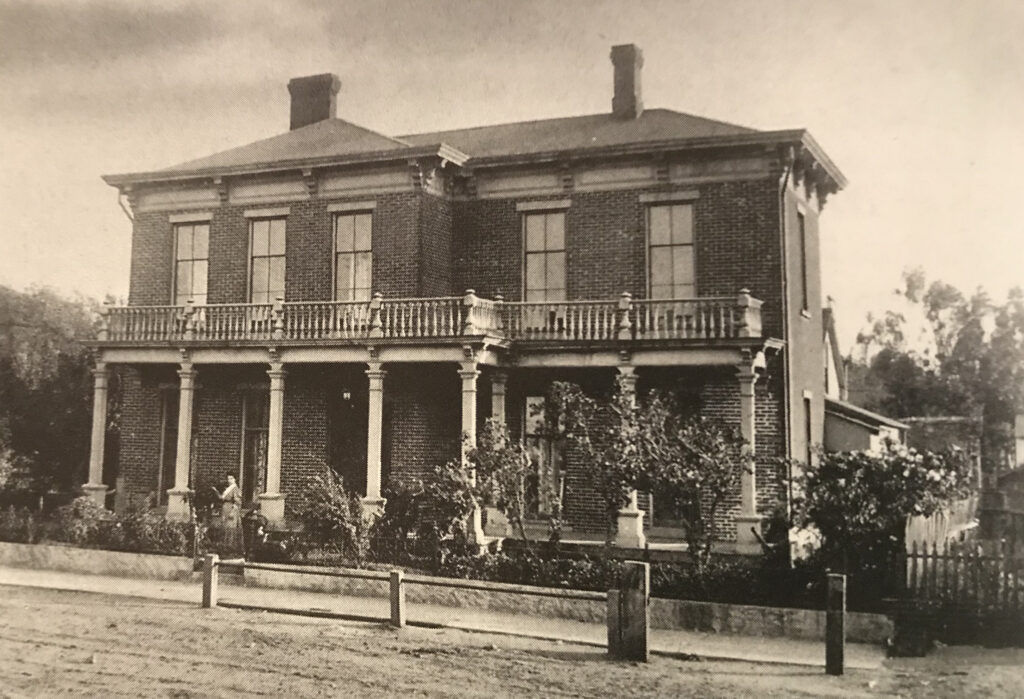
The Hard House on Front (now First) Street was the first meeting place of the Antioch Board of Trustees/City Council in 1872. Photo courtesy of Antioch Historical Society.
First Board of Trustees (City Council) and Meeting Place
An election was held on February 24, 1872, held at the National Hall, on Main Street (now, I Street), according to a notice published in The Antioch Ledger, to elect the five members of the first Board of Trustees, Treasurer, Assessor and Marshal. Roswell Butler Hard, T. N. Willis, James Ewing, J. C. McMaster and George Gruenwald were elected as trustees. M.S. Levy was elected the city’s first clerk.
Hard’s home on Front (now First) Street, which is still standing, today, served as the meeting place of the first board of trustees of the newly incorporated City of Antioch on March 2, 1872. At the meeting, Hard was elected president (mayor).
According to the book entitled, Images of America – Antioch by the Antioch Historical Society, the mayor was “an influential businessman in Antioch. Hard owned six lots and built his large, two-story brick house on Front (First) Street” on one of the lots. “It was considered one of the handsomest and most costly houses in the county.” In addition, “the Hard House was the first building in the city to be recorded on the National Registry of Historic Places.”
Hard had held public office, previously as the elected County Supervisor in 1866 and 1868 and County Sheriff in 1867 and 1869. He held both jobs concurrently.
First Ordinance Prevented Livestock to “Run at Large”
On March 14, of the same year the By-laws were passed. Ordinance No. 1 prohibited owners of (live)stock to suffer (allow) the same to run at large within the limit of the town. An ordinance was passed regulating the use of firearms. A motion was passed to have Mr. Hard to furnish and repair the town prison.
Disincorporated and Incorporated Again
One interesting historical fact is, according to the book entitled, History of Contra Costa County California, Antioch “was first incorporated in 1872. Later it was disincorporated, but was again incorporated in 1890.
Special thanks to Jacquelyn Higgins, Adult/Teen Services Librarian of the Antioch Community Library for her research assistance for this article.
 By Allen D. Payton
On February 6, 1872, the City of Antioch was incorporated “for the purposes of police and other matters”, becoming the first city in Contra Costa County. This year marks the 150th anniversary or what is known as the sesquicentennial of that event and the City, with the leadership of Celebrate Antioch Foundation, will be hosting events throughout the community this year.
While the City is providing most of the funding, more funds are needed to help pay for all the events. Please make a tax-deductible donation on their website, today and enjoy celebrating Antioch’s rich history as Contra Costa’s Original City and fun, family-friendly events all year.
Following is the list of all the official Antioch Sesquicentennial events planned in the city, this year:
February 6th, 2022 1 pm – 4 pm
We are coming together to acknowledge Antioch’s incorporation date, Contra Costa County’s original city and one of the oldest cities in California, at the Birthplace of Antioch monument at the foot of F Street. A proclamation will be read and a rededication held, followed by a light snack and drinks at the Antioch Senior Center.
April 2nd, 2022 12:00 pm
April 16th, 2022 2:00 pm
April 23rd, 2022
May 7th, 2022 12:00 pm – 4:00 pm
Antioch’s Historic Downtown Rivertown
May 14th, 2022
Antioch’s Historic Downtown Rivertown
May 28th, 2022
Black Diamond Mines Regional Preserve
June 3rd, 2022 Times TBA
June 4th, 2022 Open-Close
June 16th, 2022 Dusk
Antioch Community Center at Prewett Family Park
June 19th, 2022 Times TBA
Waldie Plaza, Antioch’s Historic Downtown Rivertown
June 19th, 2022
Antioch’s Historic Downtown Rivertown
June 23rd, 2022 Dusk
Antioch Community Center at Prewett Family Park
June 25th, 2022 7:00 am – finish
Trail off James Donlon Blvd.
June 26th, 2022 7:00 am – finish
Antioch’s Historic Downtown Rivertown
June 30th, 2022 Dusk
Antioch Community Center at Prewett Family Park
July 2nd, 2022 Time TBA
Williamson Ranch Park
July 4th, 2022 Morning-Night
Antioch’s Historic Downtown Rivertown
Hot August Cruise Night and Movie at El Campanil Theatre
August 27th, 2022 Times TBA
Antioch’s Historic Downtown Rivertown
September 10th, 2022 9:00 am – 5:00 pm
Antioch’s Historic Downtown Rivertown
October 1st, 2022 6:00 am – 5:00 pm
Antioch’s Historic Downtown Rivertown
October 29th, 2022 11:00 am – 3:00 pm
Antioch’s Historic Downtown Rivertown
November 11th, 2022 Times TBA
Antioch’s Historic Downtown Rivertown
December 3rd, 2022 Times TBA
Antioch’s Historic Downtown Rivertown
Please see the Antioch Sesquicentennial page of this website for more details on each event which will be added as they are provided.

Contra Costa County 2022 Humanitarians of the Year Gigi Crowder and Kaia Morgan speak during the annual MLK celebration on Tuesday, Jan. 18, 2022. Video screenshots.
During Contra Costa County’s virtual, community 44th Annual Dr. Martin Luther King, Jr. Celebration and Humanitarian Awards, on Tuesday, January 18, 2022, Humanitarians of the Year, Gigi Crowder and Kaia Morgan were honored. The theme of this year’s celebration was “One People, One Nation, One Dream.” (See video) (See related article)
The event featured keynote speaker, former San Ramon Mayor H. Abram Wilson, who was the City of San Ramon’s first elected African American mayor. This year’s program also featured special guest California State Superintendent of Public Instruction Tony Thurmond, a Richmond resident.
Entertainment was provided by Grown Women Dance Collective and Contra Costa School of Performing Arts with a Spoken Word performance by Samara Desmond, Seon Lettsome and Anthony Josa of “The Artist Dreams”, written by Desmond.
2022 MLK Adult Humanitarian Gigi Crowder
Congratulations to our 2022 Contra Costa County Humanitarian, Gigi Crowder, an Antioch resident. Crowder is the mother of two biological children, 30 years old twin sons, and has served as a foster mom and mentor to many more through divine interventions. Crowder served for over nine years as the Ethnic Services Manager for Alameda County Behavioral Health Care Services and has worked in the Behavioral Health Care field for more than 32 years, after completing her studies at the University of California, Berkeley.
As a family member of several loved ones who have received private and public mental health services, she strongly advocates promoting culturally responsive behavioral health services for all peers and family members. She is unapologetic about addressing the needs of African Americans. Crowder became the Executive Director for NAMI Contra Costa in 2018. She is also the FaithNet Coordinator and has advanced efforts statewide to reduce mental health stigma by training Faith Leaders using the Mental Health Friendly Communities training curriculum she co-designed.
Her current focus is addressing the needs of those living with mental illness who are often criminalized for living with a medical condition. Highlights of her career include being inducted into the Alameda County Women Hall of Fame; developing programs to enhance employment opportunities for individuals with psychiatric challenges; and receiving the 2013 MHAAC Mental Health Achievement Award. She also received the 2016 Multi-Cultural Outreach Award from NAMI California and the 2020 “Making a Difference Award” from the Interfaith Council of Contra Costa County. Crowder is also credited for positioning NAMI Contra Costa to win the NAMI 2021 Multicultural Outreach Award.
Crowder is being recognized for her impact and work to improve the mental health and wellbeing of Contra Costa residents.
2022 MLK Student Humanitarian Kaia Morgan
Congratulations to our 2022 Contra Costa County Student Humanitarian Kaia Morgan of Pittsburg, a senior at Ygnacio Valley High School. After gaining awareness of them online, Morgan became interested in confronting social issues and quickly became passionate about addressing injustices against minorities.
In February of 2020, Morgan was inspired by a class lesson on the harm of Native mascots to use her voice to speak out against racism on a more local level, starting with the Native mascot at her high school. She started the Change the Mascot Committee at Ygnacio Valley High School that month, and as of December 2021, their mascot is now the Wolves.
She made a change.org petition and got that circulating widely in her community. Morgan spoke to the school board and she helped to organizer her peers and met with me regularly to strategize. Morgan’s efforts and those of the students and teachers she inspired along the way resulted in a new measure, passed at the School Board level, where not only did her own school’s mascot and racist imagery get the approval for the change, but a district-wide approval was granted wherein all racist and disturbing imagery and mascots throughout the entire district will now be removed and replaced with those which truly honor our students and their heritages by no longer using the oppressed as mascots or their oppressors as mascots or inspirations.
Morgan is being honored for demonstrating the determination, perseverance, and strength to create change in the spirit of Dr. Martin Luther King, Jr. She lives with her parents and two siblings. Morgan plans to attend college in the fall and study psychology.
Past Recipients of the Humanitarian of the Year Award
2021—Velma Wilson, 2020—Tamisha Torres-Walker, 2019—Reverend Donnell R. Jones, 2018—Phil Arnold, 2017—James Noe, 2016—Terri Porter, 2015—Bishop Edwina Perez-Santiago, 2014—Sister Ann Weltz, 2013—Doug Stewart, 2012—Lorrine Sain, 2011—Laura Johnson
Past Recipients of the Student Humanitarian of the Year Award
2021— Kimyatta Newby, 2020—Christina Mazzi, 2019—Yassna Ahmadi, 2018—Sienna Camille Terry, 2017—Paige Godvin, 2016—Davis Bullock, 2015—Tyler Page, 2014—Anand Kannappan, 2013—Casey Leonard, 2012—Andrew Gonzales, 2011—Mario Alvarado

Grown Women Dance Collective performs during Contra Costa County’s virtual MLK celebration on Tuesday, Jan. 18, 2022. Video screenshot
 About Grown Women Dance Collective
Grown Women Dance Collective, established in 2009, creates cross-cultural, intergenerational, and cross-class connections by encouraging dialogue, empowering thought and action, and building cross-racial alliances through concert dance and wellness programs. The group is comprised of retired dancers from world renowned companies, including Alvin Ailey American Dance Theater, Cleo Parker Robinson, and Dance Theatre of Harlem. The performances challenge stereotypes and create artistic work that is relevant, accessible, and inspiring to diverse and under-resourced audiences.
 About Contra Costa School of Performing Arts
The Contra Costa School of Performing Arts mission provides for an outstanding, pre-professional experience in performing arts within a college and career preparatory setting. The school believes in fostering a culture of excellence with the core values of rigor, relevance, resilience, and relationships.
About The Honorable H. Abram Wilson

Former San Ramon Mayor Abram Wilson speaks during the virtual MLK celebration on Tuesday, Jan. 18, 2022. Video screenshot
Abram Wilson is married to Dr. Karen B. Wilson. They have been residents of the City of San Ramon for over thirty years. The Wilsons’ have two children, Natasha A. Wilson-Cruz, Esq., and P. Nathan Wilson, and are blessed with three grandchildren.
Wilson was instrumental in setting forth a framework to develop a disaster preparedness plan for the City of San Ramon and businesses, schools, and cities in the Tri-Valley and San Ramon Valley areas. Wilson is the 2005 recipient of the National Music Educator Association, State Legislator of the Year award for his support of music education.
Wilson is a member of the Board for the Sentinels of Freedom Organization that has helped provide services to men and women who have been disabled in Iraq with housing, employment, and transportation. Wilson is a veteran of the U.S. Army.
Wilson worked as a federal funds trader at Wells Fargo when he returned to civilian life. He was elected to the San Ramon City Council in November 1999, appointed mayor in 2002, and became the City of San Ramon’s first elected and first African American mayor in 2003. He was re-elected in 2005. Wilson was the 2005 recipient of the National Music Educator Association, State Legislator of the Year award “for his support of music education in the schools.”
Wilson is a 2007 honoree from the California Congress of Parents, Teachers, and Students for his outstanding service to children and youth. His contribution to the Honorary Service Award Program Fund provides scholarships for students and individuals to further their education.
He also received a Certificate of Support from the East Bay Leadership Foundation for “Making a difference in the lives of Bay Area Students.”

State Superintendent of Public Instruction Tony Thurmond speaks during the Contra Costa County virtual MLK celebration on Tuesday, Jan. 18, 2022. Video screenshot.
About The Honorable Tony Thurmond
Tony Thurmond was sworn in as the 28th California State Superintendent of Public Instruction on January 7, 2019.
Superintendent Thurmond is an educator, social worker, and public school parent who has served the people of California for more than ten years in elected office. Previously, he served on the Richmond City Council, West Contra Costa Unified School Board, and in the California State Assembly representing District 15.
Like many of California’s public school students, Superintendent Thurmond came from humble beginnings. His mother was an immigrant from Panama who came to San Jose, California, to be a teacher. His father was a soldier who didn’t return to his family after the Vietnam War. Thurmond met his father for the first time when he was an adult. After his mother died when he was six, Thurmond and his brother were raised by a cousin who they had never met.
Superintendent Thurmond’s family relied on public assistance programs and great public schools to get out of poverty, and public school education allowed him to attend Temple University, where he became student body president. He went on to earn dual master’s degrees in Law and Social Policy and Social Work (MSW) from Bryn Mawr College and began a career dedicated to service.
Much of Superintendent Thurmond’s social service work has focused on improving the services provided to foster youth and directing programs that provide job training to at-risk youth. He also led programs to provide help for individuals with developmental disabilities. He has 12 years of direct experience in education, teaching life skills classes, after-school programs, and career training.
Over the course of Thurmond’s tenure since being sworn in as State Superintendent, he has championed and created many historic initiatives on behalf of California’s students.
Superintendent Thurmond lives in Richmond with his two daughters, who attend local public schools. They are his inspiration and a constant reminder about the promise of our neighborhood schools and the strong future that every child deserves.
2022 Committee Members
This year’s celebration committee members were Antoine Wilson, Chair; Andi Bivens, Manny Bowlby, Lissette Davis, Jennifer S. Hopkins, Gayle Israel, T’ni Jackson, James Lyons, Vincent Manuel, Savitha Sivakumar, Susan Shiu, Chris Verdugo, Derrick West, Chris Wikler, Shannon Winston and Traci Young.
Allen Payton contributed to this report.
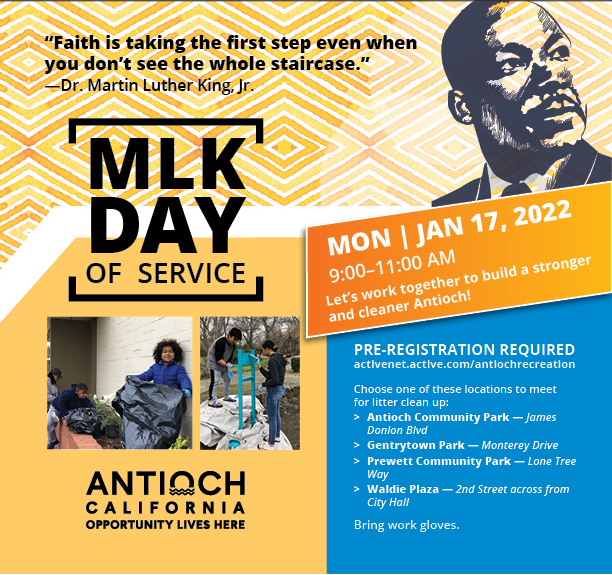
Every third Monday in January of each year is observed as “a day on, not a day off,” MLK Day in honor of the Rev. Dr. Martin Luther King, Jr., is the only federal holiday designated as a national day of service to encourage all Americans to volunteer to improve their communities!
On January 17, 2022, join the Antioch community in restoring, beautifying, and cleaning up our parks, including Antioch Community, Gentrytown Park, Prewett Family Park, and Waldie Plaza!
Registration required at activenet.active.com/antiochrecreation.
Antioch Black History Month event at Black Diamond Middle School Friday night
Friday, February 25th, 2022Rivertown Veterans Thrift Store honors City of Antioch’s Sesquicentennial
Tuesday, February 8th, 2022Antioch celebrates 150th anniversary of incorporation in 1872 as county’s first city Sunday
Tuesday, February 8th, 2022Antioch Council approves proclamation honoring City’s Sesquicentennial of incorporation
Monday, February 7th, 2022Antioch to celebrate Sesquicentennial of Incorporation Day with ceremony Sunday, Feb. 6
Saturday, January 29th, 2022Antioch to celebrate its Sesquicentennial, the 150th anniversary of cityhood all year
Saturday, January 22nd, 2022Contra Costa Supervisors honor Humanitarians of the Year during 44th annual MLK Celebration
Wednesday, January 19th, 2022Volunteer today for Antioch’s annual MLK Day of Service Monday, Jan. 17
Friday, January 14th, 2022















© 2026 Antioch Herald - Entries (RSS) - Comments (RSS) - Log in
Theme design by Christian Gnoth - 