Archive for the ‘Health’ Category

Contra Costa supervisors agree to hire pollster for possible half cent sales tax measure, extend ban on evictions to November

Wednesday, May 27th, 2020

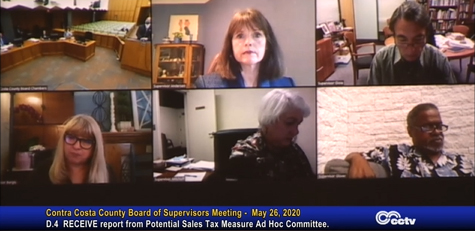
Screenshot of the Contra Costa County Board of Supervisors’ online meeting on Tuesday, May 26, 2020.

County Health Services using Remdesivir for COVID-19 patients; get glimpse of COVID-19 era libraries

By Daniel Borsuk

The Contra Costa County Board of Supervisors discussed possibly placing a half-cent sales tax measure to fund health and social services on the November ballot and approved hiring a pollster on a split vote. The tax measure would be in addition to a proposed Bay Area-wide half-cent sales tax measure for transportation expected to be on the November ballot, as well.

Approve Hiring Pollster for Half Cent Sales Tax Study

In response to the Contra Costa Needs Assessment from the county’s Sales Tax Working Group a countywide half-cent sales tax is being proposed “to shore up access to medical and behavioral health services, and bolster county safety-net programs.” BOS 052620 Contra Costa Needs Assessment

At least for now, it is uncertain if the board will move forward with a sales tax increase measure for the November ballot. Supervisors voted 4-1, with Board Chair Candace Andersen casting the lone, dissenting vote, to spend as much as $60,000 to hire a pollster to test whether voters would support one. But since the outbreak of COVID-19, public support for such a tax measure might have waned.

“We need further direction and getting results from a poll will help,” said Supervisor Karen Mitchoff. “Before COVID, support for a tax increase was optimistic, but with COVID it might be different.”

District 1 Supervisor John Gioia, a big booster of a sales tax increase, said it would cost $30,000 to $40,000 to poll 600,000 to 800,000 prospective voters. Mitchoff said a more realistic cost is $60,000.

Both Gioia and Mitchoff serve on the Potential Sales Tax Measure Ad Hoc Committee.

“Right now, is not the time to spend county funds for a poll,” said chair Andersen of Danville.

Extend Temporary Ban on Evictions and Residential Rent Increase Moratorium

With the supervisors’ month-old ordinance that imposed a temporary ban on evictions and a residential rent increase moratorium at the end of May, supervisors acted to extend the ordinance through July 15. Supervisors also imposed a one-year grace period and defined a commercial real property eligible for the ordinance “…as an independently owned and operated business that is not dominate in its field of operation, has its principal office in California, has 100 or fewer employees, and has average annual gross receipts of $15 million or less over the previous three years.”

Figuring the economy will not recover quickly to restore jobs, some speakers asked supervisors to extend the rent increase moratorium one year.

“Keep pace with Alameda County,” said Dick Offerman of Pleasant Hill. “See that no one is evicted in our county. Extend the moratorium one year.”

Mitchoff took time to warn landlords who are violating the county ordinance. “Landlords know about this ordinance. There are some bad actors who take advantage of people who speak English as a second language, this must stop,” she said.

County Health Uses Remdesivir for COVID-19 Patients

Contra Costa County Public Health Officer Dr. Christopher Farnitano informed supervisors that Contra Costa County Public Health has begun administering the anti-viral drug Remdesivir to COVID-19 patients. A total of 105 dosages were given last week, Dr. Farnitano said.

“The company that is making it (the drug) is giving this to the United States.” Dr. Farnitano said that the drug is “This drug is somewhat beneficial.”

Dr. Farnitano said there were as of Tuesday 13 COVID-19 patients in Contra Costa Medical Center, compared to 19 patients two weeks ago. Since the outbreak of the pandemic in March, 37 persons have died from COVID-19 in the county, four deaths occurred in the past week with one of the deaths in the person’s early 30’s, which is uncommon.

So far, the county is COVID-19 testing daily 95 people per 100,000 residents when the daily goal should be 200 people per 100,000 residents.

This drew Supervisor Mitchoff to question the testing.

“We’re about halfway there,” she said. “I did not want to test, but now I want to test in order to get our numbers up.”

Board Vice Chair Supervisor Diane Burgis of Brentwood asked why the COVID-19 test takers at county sites have to wait for results as long as 10 days when persons at three state sites get results within five days.

Contra Costa County Health Department Director Anna Roth said the average turnaround for COVID-19 results is three to five days, but it could be up to 10 days.

Get Glimpse of COVID-19 Era Libraries

took a glimpse of what the COVID-19 era might look like on Tuesday visualizing the 26 public libraries could offer some type of front door service for patrons to pick up checked out books in bags and when libraries do open doors possibly on June 15 seating capacity will be reduced 20 percent at each location right when outdoor temperatures are peaking above 100 degrees and libraries often serve as cooling centers for the public.

Supervisors unanimously approved the Contra Costa County Library Pandemic Preparedness Plan presented by County Librarian Melinda Cervantes that promotes hygiene, social distancing, and reduced seating. BOS 052620 CCCL Pandemic Preparedness Plan Draft Final

“We plan to begin service as soon as possible,” Cervantes told supervisors during the teleconferenced board meeting.

During the presentation, supervisors learned 36 library accounting positions might be eliminated because of COVID-19 related revenue losses. The potential loss of the library jobs will undermine library book purchasing.

“We need to get through the state budget,” responded county administrator David Twa, who said the 36 library accounting jobs are “potential job layoffs” and are subject to the meet and confer process. The state budget will be unveiled in mid-June.

Approve Purchase of DA’s Office Mobile Forensic Vehicle

In other action, the supervisors approved the District Attorney’s Office request to execute an agreement with the City of San Jose for the expenditure of up to $200,000 to procure a mobile forensic vehicle for the Silicon Valley Internet Crimes Against Children Task Force. The vehicle is expected to cost $48,285.

Payton Perspective: Gov. Newsom isn’t really allowing places of worship to reopen, his guidelines are too restrictive

Tuesday, May 26th, 2020

Some churches to participate in civil disobedience this Sunday and open for services.

“Simply put, there is no pandemic exception to the U.S. Constitution and its Bill of Rights”… “the Constitution calls for California to do more to accommodate religious worship” – 5/19/20 US DOJ letter to Gov. Newsom.
By Allen Payton

Yesterday, Monday, May 25, 2020 – Memorial Day, the day we honor and commemorate those who died for our freedoms, some of which are seriously limited, right now – California Governor Gavin Newsom issued guidelines for reopening places of worship. At first, I was hopeful that he was doing something good in response to President Trump’s directive to all the governors and the directive to California from U.S. Attorney General William Barr and the Department of Justice, last week.

But the guidelines don’t really allow most places of worship to reopen. Why? Because they’re too restrictive, limiting attendance to just 25% of building capacity or 100 people whichever is less. Plus, Newsom is leaving it up to each unelected county health officer to approve of the guidelines or not.

Now, it’s worse because they’re allowing more and more businesses to reopen – which is great – but not the churches. Our officials already considered all the vice serving businesses, including all the locations of the nation’s top abortion provider, Planned Parenthood, liquor stores, and marijuana dispensaries essential. But not the churches or other places of worship. And as of today, the governor said barber shops and hair salons can reopen.

Which part of “shall make no law…prohibiting the free exercise” of religion and the other First Amendment right of freedom of peaceful assembly, don’t our officials get?

Civil Disobedience

Following in the footsteps of the black Christian ministers who led the efforts during the civil rights movement, it appears some churches will be participating in some civil disobedience with the ministers leading the effort for their rights, when they hold services this next Sunday, May 31st in defiance of state and local orders. Those in attendance will probably only be issued citations and the maximum fine is $1,000, which they can collectively fight. Plus, with $0 bail, right now none of them will go to jail. Most likely only the ministers will be cited and fined. But who knows? The Lord does and we will see just how far the government officials will take this and just how much they want to continue this fight.

Time to Elect New Leaders

It’s definitely time we elected only those who agree that places of worship are essential, not only to those who attend, but society as a whole, and will actually uphold their oaths of office, in which they swore to defend the Constitution against all enemies foreign and domestic. Event the CDC recognized that in the statement for its Interim Guidance for Communities of Faith, unlike our governor in the statement included with his guidelines. The CDC wrote, “Millions of Americans embrace worship as an essential part of life. In addition, we note that while many types of gatherings are important for civic and economic well-being, religious worship has particularly profound significance to communities and individuals, including as a right protected by the First Amendment. State and local authorities are reminded to take this vital right into account when establishing their own re-opening plans.”

What did the governor include in the statement about his guidelines? Just more warnings about how public gatherings can cause more deaths. That statement includes, “There have been multiple outbreaks in a range of workplaces, indicating that workers are at risk of acquiring or transmitting COVID-19 infection. Examples of these workplaces include places of worship, long-term care facilities, prisons, food production, warehouses, meat processing plants, and grocery stores.”

“Further, it is strongly recommended that places of worship continue to facilitate remote services and other related activities for those who are vulnerable to COVID19 including older adults and those with co-morbidities. Even with adherence to physical distancing, convening in a congregational setting of multiple different households to practice a personal faith carries a relatively higher risk for widespread transmission of the COVID-19 virus, and may result in increased rates of infection, hospitalization, and death, especially among more vulnerable populations. In particular, activities such as singing and group recitation negate the risk-reduction achieved through six feet of physical distancing,” Newsom’s statement continues.

Nothing about our First Amendment rights which should be protected or that corporate worship or even churches being essential to at least some Californians or society as a whole.

Legal Efforts

We also need to support the legal efforts of those suing the state and governor to get the courts to force him to allow the churches to reopen. One way you can do that is by supporting the Center for American Liberty, based in San Francisco and led by my friend, attorney Harmeet Dhillon and her fellow attorney, Mark Meuser, a former Contra Costa resident. Read about their cases and make a contribution, here – https://libertycenter.org/pf/covid-19-litigation/.

Another lawsuit by churches in California against Newsom and the state, which was joined by Dhillon, lost last week at the 9th Circuit Court of Appeals on a 2-1 decision of a three-judge panel. Not surprising the judges who voted with the governor were appointed by Clinton and Obama, and the one judge that voted with the churches was appointed by Trump.

“These are emergency appeals,” Dhillon explained on Monday. “We filed for an appeal to the U.S. Supreme Court” in the recent case before the 9th Circuit.

“The DOJ sent a letter to the governor that his policies were discriminatory against churches,” she continued. “Today’s guidelines are still limiting. They’re totally arbitrary. There is no limit of 100 people for any retail establishment. Retail has a 50% capacity limit for some and none for others.”

“To tell people how they can worship, this is more unconstitutional and very problematic,” Dhillon added.

DOJ Letter to Newsom

In the DOJ letter to Newsom about “several civil rights concerns with the treatment of places of worship” due to the governor’s stay-at-home order, as well as “documents relating to the California Reopening Plan” it states “Simply put, there is no pandemic exception to the U.S. Constitution and its Bill of Rights.” USDOJ 5.19.20 Ltr. to Hon. Gavin Newson

“Laws that do not treat religious activities equally with comparable nonreligious activities are subject to heightened scrutiny under the Free Exercise Clause of the First Amendment,” the letter continues.

“Places of worship are not permitted to hold religious worship services until Stage 3” of Newsom’s reopening plan, the letter explains. “However, in Stage 2, schools, restaurants, factories, offices, shopping malls, swap meets and others are permitted to operate with social distancing. And as noted, ecommerce and entertainment industry activities are already permitted with social distancing. This constitutes precisely the kind of differential treatment the Supreme Court identified” in the decision of another case “in which the government is not willing to impose on certain activities the same restrictions it is willing to impose on constitutionally protected religious worship.”

“Religious gatherings may not be singled out for unequal treatment compared to other nonreligious gatherings that have the same effect on the government’s public health interest…” the letter states.

It then refers to the recent case before the 9th Circuit and states, “Other decisions around the country…make clear that reopening plans cannot unfairly burden religious services as California has done.”

“We believe…that the Constitution calls for California to do more to accommodate religious worship, including in Stage 2 of the Reopening Plan.”

An email has been sent to the DOJ asking for their views on Newsom’s guidelines and if they comply with the May 19th letter. (Please check back later for updates to this column.)

Time for Action

It’s time for action and to stop living in fear, my friends. The governor’s guidelines are too restrictive and continue to clearly violate our God-given – the meaning of “unalienable” – and constitutionally protected rights of both freedom of religion and assembly. Until Newsom complies with the directives from the federal government, churches should feel free to reopen within the guidelines applied to nonreligious activities and businesses.

As the DOJ letter states, “Religious communities have rallied to protect their communities from the spread of this disease by making services available online, in parking lots, or outdoors, by indoor services with a majority of pews empty, and in numerous other creative ways that otherwise comply with social distancing and sanitation guidelines.” Local churches can do the same. We shall see if any actions are taken against the ministers and those who attend this Sunday’s services.
 

DOJ Letter to Governor Newsom

               U.S. Department of Justice 

Civil Rights Division


________________________________________________________________________________


Office of the Assistant Attorney General                                                                   Washington, D.C. 20530

May 19, 2020


The Honorable Gavin Newsom

Governor of California

1303 10th Street, Suite 1173

Sacramento, CA 95814


Dear Governor Newsom:

We are writing to you to raise several civil rights concerns with the treatment of places of worship in Executive Orders N-33-20 and N-60-20 and documents relating to the California Reopening Plan.

Of course, we recognize the duty that you have to protect the health and safety of Californians in the face of a pandemic that is unprecedented in our lifetimes. You and other leaders around the country are called on to balance multiple competing interests and evaluate the constantly changing information available to you about COVID-19, and make your best judgment on courses of action.

Attorney General William P. Barr recently issued a statement on Religious Practice and Social Distancing, in conjunction with a Mississippi case in which the Department of Justice participated regarding restrictions on worship. In the statement, the Attorney General emphasized the need to practice social distancing to control the spread of COVID-19. He also noted that temporary restrictions that would be unacceptable in normal circumstances may be justified. But, “even in times of emergency, when reasonable and temporary restrictions are placed on rights, the First Amendment and federal statutory law prohibit discrimination against religious institutions and religious believers. Thus, government may not impose special restrictions on religious activity that do not also apply to similar nonreligious activity.” Simply put, there is no pandemic exception to the U.S. Constitution and its Bill of Rights.

Laws that do not treat religious activities equally with comparable nonreligious activities are subject to heightened scrutiny under the Free Exercise Clause of the First Amendment. Church of the Lukumi Babalu Aye v. City of Hialeah, 508 U.S. 520 (1993). Laws that are not both neutral toward religion and generally applicable are invalid unless the government can prove that they further a compelling interest and are pursued through the least restrictive means possible. Religious gatherings may not be singled out for unequal treatment compared to other nonreligious gatherings that have the same effect on the government’s public health interest, absent the most compelling reasons.

Executive Order N-33-20 (March 19, 2020) ordered Californians to remain at home except to engage in authorized necessary activities as laid out by the Public Health Officer at the time and as modified going forward. The Public Health Officer’s April 28 “essential workforce” list does not appear to treat religious activities and comparable nonreligious activities the same.

The list includes “faith-based services” but only if “provided through streaming or other technologies.” In-person religious services are thus apparently prohibited even if they adhere to social distancing standards.

The list of nonreligious workers who are not so restricted by the Executive Order and essential workforce list when telework “is not practical” is expansive. For example, the list includes “Workers supporting the entertainment industries, studios, and other related establishments, provided they follow covid-19 public health guidance around social distancing.” Likewise, “workers supporting ecommerce” are included as essential, regardless of whether the product they are selling and shipping are life-preserving products or not. This facially discriminates against religious exercise. California has not shown why interactions in offices and studios of the entertainment industry, and in-person operations to facilitate nonessential ecommerce, are included on the list as being allowed with social distancing where telework is not practical, while gatherings with social distancing for purposes of religious worship are forbidden, regardless of whether remote worship is practical or not.

Even more pronounced unequal treatment of faith communities is evident in California’s Reopening Plan, as set forth in Executive Order N-60-20 (May 4, 2020), and in the documents the California Department of Public Health produced pursuant to it, including the “Resilience Roadmap” (https://covid19.ca.gov/roadmap/) and “County Variance Attestations” (https://www.cdph.ca.gov/Programs/CID/DCDC/Pages/COVID-19/Local-Variance-Attestations.aspx). Places of worship are not permitted to hold religious worship services until Stage 3. However, in Stage 2, schools, restaurants, factories, offices, shopping malls, swap meets, and others are permitted to operate with social distancing. And as noted, ecommerce and entertainment industry activities are already permitted with social distancing. This constitutes precisely the kind of differential treatment the Supreme Court identified in the Lukumi decision in which the government is not willing to impose on certain activities the same restrictions it is willing to impose on constitutionally protected religious worship. While it is true that social distancing requirements applied to places of worship may inevitably result in much smaller congregations than some faith groups would like, in our experience with other controversies around the country, many places of worship are quite content to operate at 15-25% of capacity in a way that allows for social distancing between family groups.

The Department of Justice does not seek to dictate how States such as California determine what degree of activity and personal interaction should be allowed to protect the safety of their citizens. However, we are charged with upholding the Constitution and federal statutory protections for civil rights. Whichever level of restrictions you adopt, these civil rights protections mandate equal treatment of persons and activities of a secular and religious nature.

We recognize that three U.S. District Courts have denied Temporary Restraining Orders (TRO’s) sought by plaintiffs against Executive Order N-33-20, Abiding Place Ministries v. Wooten, No. 3:20-cv-00683 (S.D. Cal. April 10, 2020) (no written opinion); Gish v. Newsom, No. 5:20-CV-755 (C.D. Cal. Apr. 23, 2020); Cross Culture Christian Ctr. v. Newsom, No. 2:20-CV-00832 (E.D. Cal. May 5, 2020), and one denied a TRO against the Reopening Plan, which is now on appeal to the Ninth Circuit. South Bay United Pentecostal Church v. Newsom, No. 3:20-cv-865 (S.D. Cal. May 15, 2020) (oral transcript ruling). These TRO decisions do not justify California’s actions. The Abiding Place, Gish, and Cross Culture TRO decisions do not address the Stage 2 reopening, and South Bay United Pentecostal does not describe why worship services can be distinguished from schools, restaurants, factories or other places Stage 2 permits people to come together. Other decisions around the country have followed Lukumi to make clear that reopening plans cannot unfairly burden religious services as California has done. See, e.g., Robert v. Neace, No. 20-5465 (6th Cir. May 11, 2020).

Religion and religious worship continue to be central to the lives of millions of Americans. This is true now more than ever. Religious communities have rallied to protect their communities from the spread of this disease by making services available online, in parking lots, or outdoors, by indoor services with a majority of pews empty, and in numerous other creative ways that otherwise comply with social distancing and sanitation guidelines. We believe, for the reasons outlined above, that the Constitution calls for California to do more to accommodate religious worship, including in Stage 2 of the Reopening Plan.

Thank you for your prompt attention to this matter. Should you wish to discuss further, please contact United States Attorney for the Eastern District of California McGregor Scott at

(916) 554-2730 or mcgregor.scott@usdoj.gov.

Sincerely,

           Eric S. Dreiband

                            Assistant Attorney General

               Civil Rights Division


McGregor W. Scott

United States Attorney

Eastern District of California


Nicola T. Hanna

United States Attorney

Central District of California


David L. Anderson

United States Attorney

Northern District of California


Robert S. Brewer

United States Attorney

Southern District of California


cc: The Honorable Xavier Becerra

Attorney General of California

Gov. Newsom issues guidelines Monday for reopening places of worship

Monday, May 25th, 2020

Limited to 25% of capacity or a maximum of 100 attendees whichever is lower; requires county health officer’s approval

By Allen Payton

In response to pressure from President Trump and U.S. Attorney General Barr, last week, and under pressure from a variety of churches and religious groups suing the state, California Governor Gavin Newsom issued guidelines, today, Monday, May 25, 2020, for reopening places of worship, providers of religious services and cultural ceremonies.

https://covid19.ca.gov/pdf/guidance-places-of-worship.pdf

However, the guidelines require approval of the county health officer but will have little or no benefit for most churches, as they limit attendance to just 25% of building capacity or 100 attendees maximum whichever is less.

The guidelines were issued “to support a safe, clean environment for employees, interns and trainees, volunteers, scholars, and all other types of workers (referred to collectively as “staff”) as well as congregants, worshippers, visitors, etc. (referred to collectively as “visitors” or ‘congregants’).

This guidance does not obligate places of worship to resume in-person activity. Further, it is strongly recommended that places of worship continue to facilitate remote services and other related activities for those who are vulnerable to COVID19 including older adults and those with co-morbidities. Even with adherence to physical distancing, convening in a congregational setting of multiple different households to practice a personal faith carries a relatively higher risk for widespread transmission of the COVID-19 virus, and may result in increased rates of infection, hospitalization, and death, especially among more vulnerable populations. In particular, activities such as singing, and group recitation negate the risk-reduction achieved through six feet of physical distancing.

Places of worship must therefore limit attendance to 25% of building capacity or a maximum of 100 attendees, whichever is lower. This limitation will be in effect for the first 21-days of a county public health department’s approval of religious services and cultural ceremonies activities at places of worship within their jurisdictions.

Upon 21-days, the California Department of Public Health, in consultation with county Departments of Public Health, will review and assess the impact of these imposed limits on public health and provide further direction as part of a phased-in restoration of activities in places of worship.”

Among other things, the guidelines also require places of worship to “Perform thorough cleaning of high traffic areas such as lobbies, halls, chapels, meeting rooms, offices, libraries, and study areas and areas of ingress and egress including stairways, stairwells, handrails, and elevator controls. Frequently disinfect commonly used surfaces including doorknobs, toilets, handwashing facilities, pulpits and podiums, donation boxes or plates, altars, and pews and seating areas.”

Efforts were made to the county health spokesperson asking for comment from County Health Officer Dr. Chris Farnitano on the guidelines and how soon places of worship in Contra Costa can expect to reopen. Please check back later for updates to this report.


President Trump issues proclamation honoring the victims of the Novel Coronavirus pandemic

Friday, May 22nd, 2020

The White House

May 22, 2020

Our Nation mourns for every life lost to the coronavirus pandemic, and we share in the suffering of all those who endured pain and illness from the outbreak.  Through our grief, America stands steadfast and united against the invisible enemy.  May God be with the victims of this pandemic and bring aid and comfort to their families and friends.  As a mark of solemn respect for the victims of the coronavirus pandemic, by the authority vested in me as President of the United States by the Constitution and the laws of the United States of America, I hereby order that the flag of the United States shall be flown at half-staff at the White House and upon all public buildings and grounds, at all military posts and naval stations, and on all naval vessels of the Federal Government in the District of Columbia and throughout the United States and its Territories and possessions until sunset, May 24, 2020.  I also direct that the flag shall be flown at half-staff for the same length of time at all United States embassies, legations, consular offices, and other facilities abroad, including all military facilities and naval vessels and stations.

IN WITNESS WHEREOF, I have hereunto set my hand this twenty-first day of May, in the year of our Lord two thousand twenty, and of the Independence of the United States of America the two hundred forty-fourth.

DONALD J. TRUMP

Contra Costa Coronavirus 5-22-20 Update: 1,259 cases, 83.9% recovered, 36 total deaths in county, only 9 hospitalized

Friday, May 22nd, 2020

By Allen Payton

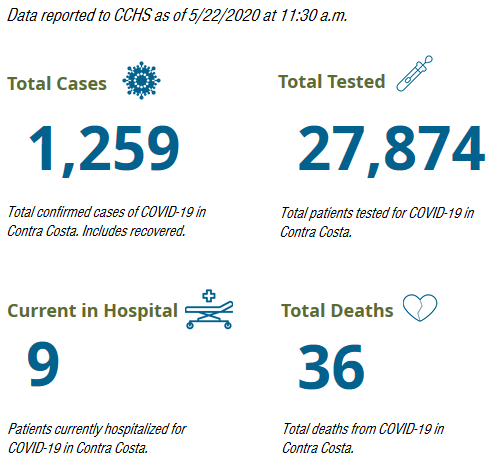
As of this morning, Friday, May 22, 2020 at 11:30 a.m. Contra Costa Health Services (CCHS) is reporting a total of 1,259 cases of COVID-19/coronavirus, and a total of 36 deaths in the county. A total of 1,056 have recovered, which is 83.9%, consistent with the previously reported number of those who have tested positive for the virus and recovered.

There were 25 new cases reported in the past 24 hours, but only 9 people diagnosed with the virus currently hospitalized.

A total of 27,874 people have been tested for the virus in the county.

To see the all the statistics provided by CCHS, click here.

May 31st no longer end date for shelter-in-place in Contra Costa, will reopen on gradual basis

Tuesday, May 19th, 2020

“It’s encouraging. We’re wanting it to continue going down. It certainly isn’t going up.” – County Health Officer, Dr. Chris Farnitano regarding COVID-19 statistics curve in Contra Costa.

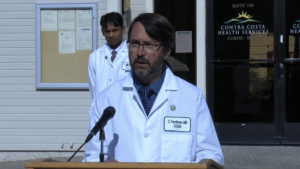
Contra Costa County Health Officer Dr. Christ Farnitano speaks during a press conference on Friday, March 20, 2020 as Dr. Rohan Radhakrishna, Deputy Health Officer, Contra Costa Health Officer waits to speak. Screenshot of YouTube video.

By Allen Payton

Due to the positive results over the past few weeks with the COVID-19 statistics in Contra Costa County, Health Officer Dr. Chris Farnitano issued a new order, yesterday, Monday, May 18, 2020 that went into effect, today allowing certain retail and other businesses to reopen, within certain guidelines.

But, concerns from the representative of a major retail property management company in the county, asking how it’s supposed to work raised questions.

Asked if he or his staff spoke with retail store owners or shopping center property managers about the order before issuing it and how it’s supposed to work, Dr. Farnitano replied, “We’ve been getting feedback from different stores and businesses. We haven’t specifically asked them to review this particular language. This comes from state guidelines. So, our guidelines are in line with the state’s Phase 2. They allowed it on the 8th of May, 11 days ago.”

“It may be more helpful for small retail stores that don’t have an online presence, not a larger store that does,” he added. “Like craft breweries that weren’t allowed prior, or other products that folks that people were used to going to the retail store for.”

“The other big changes are the associated manufacturing and logistics, which pretty much covers any manufacturing that wasn’t already allowed, like refineries, or agricultural product manufacturing,” Farnitano continued. “The Tesla plant in Alameda County is one example.”

“We might be going in a slightly slower pace than the state,” he shared. “But there’s less variability from one county to the next for the particular rules for a business to reopen.”

When asked if the shelter-in-place order still ends on May 31st, Dr. Farnitano answered, “the new order that was issued yesterday and went into effect, today doesn’t have an end date. That’s really not practical or the intent, which was to reevaluate the situation before that date.” (See related article)

“What we’re really doing is to make a change, give it some time to see the affects of that change, and see the impact on our matrix,” he continued. “We did that the last time two weeks ago on May 4 and because of the positive results from that we’re able to open up more.”

So, the reopening will be through a gradual, step by step process “driven by the data,” Dr. Farnitano added.

“It’s been pretty flat,” he said about the curve. “We’ve been looking at seven-day averages. We’ve been running at 10 to 15 new cases a day for the past two weeks, and 15 to 20 in the hospital, each day”

“It’s encouraging. We’re wanting it to continue going down. It certainly isn’t going up,” Dr. Farnitano stated.

Asked when will the next order for more reopening be issued,” We don’t really have a time or particular day,” he said. “We give it a couple weeks which is the incubation period for someone to be exposed and then experience symptoms.” Then they reevaluate the situation at that time.

So, we can expect another update and hopefully more reopening of businesses and activities the first week of June.

Contra Costa County to begin allowing curbside retail on Tuesday, May 19

Monday, May 18th, 2020

Thanks to progress made in containing the spread of COVID-19, Contra Costa County will relax restrictions in its shelter-in-place order to allow retail stores and their suppliers to reopen on Tuesday.


On May 19 at 6 a.m., retail stores in Contra Costa County may offer curbside sales or other outdoor pickups of orders as long as they abide by certain safety measures to prevent the spread of COVID-19.

Stores may not display merchandise for sale on tables or otherwise outside the stores. Customers may not enter the store or interior of any indoor shopping mall. Stores must also employ reasonable measures to require customers to comply with social distancing requirements at the pickup areas, including marking locations at six-foot intervals for customers to stand while waiting in line.

“While this is not a return to normal, it is one step in that direction” said Dr. Chris Farnitano, Contra Costa County’s health officer. “We will be closely monitoring the effects of allowing curbside retail on the spread of COVID-19 in the community.”

Contra Costa will also allow businesses that manufacture retail goods and provide warehousing or logistical support to retail stores to operate, but they must limit the number of staff in enclosed areas so that personnel can comply with social distancing requirements.

The changes mark a shift from allowing people only to shop at essential businesses, such as grocery stores and pharmacies. Dr. Farnitano said encouraging progress has been made in the two weeks since the most recent shelter-in-place order in reaching five goals or “indicators” went into effect:

  • The number of new cases of COVID-19 has been stable or decreasing, even with increased testing
  • The number of hospitalized patients with COVID-19 is stable, and we have adequate hospital capacity. As of May 17, there were 19 COVID-positive patients in Contra Costa hospitals – down from a high of 44 in mid-April.
  • More COVID-19 tests are being performed in our region each day
  • Hospitals are reporting improved supply of Personal Protective Equipment (PPE), though shortages continue in other healthcare settings
  • There is increased capacity for case investigation and contact tracing.

Residents are still required by health order to stay home as much as possible, wear face coverings when they leave home, and to follow the precautions that have helped Contra Costa make progress to slow the spread of COVID-19, such as regular handwashing and social distancing. COVID-19 continues to pose a very significant risk to our communities, and continued vigilance is necessary to ensure that we do not see an increase in spread as more activities resume.

Contra Costa, other Bay Area Health Officers: significant progress on COVID-19 indicators, next steps for reopening

Monday, May 18th, 2020

Thanks to the steadfast commitment of our residents to stay home, practice social distancing, and follow public health guidance, we have seen sustained progress on several key indicators regarding containment of COVID-19. This has remained true a full incubation period after the reopening of construction, outdoor businesses, and certain outdoor activities on May 4, 2020. Region-wide progress on the COVID-19 Indicators jointly set by Bay Area Health Officers includes:

  • The trend of new cases of COVID-19 has been stable or decreasing, even with increased testing;
  • The number of hospitalized patients with COVID-19 is stable or declining, and hospital capacity is sufficient for both COVID-19 patients and other patients who need hospital care;
  • More COVID-19 tests are being performed in our region each day;
  • Hospitals are reporting improved supply of Personal Protective Equipment (PPE), though shortages continue in certain healthcare settings; and
  • There is increased capacity for case investigation and contact tracing.

While much work remains to be done, in light of this progress, we are issuing a new order today that allows retail establishments to offer storefront pick-up, and also allows the manufacturing, warehousing, and logistical operations that support retail to resume. We are counting on these businesses to consistently follow social distancing protocols and public health guidance to protect their employees and customers as these activities resume. COVID-19 continues to pose a very significant risk to our communities, and that continued vigilance is necessary to ensure that we do not see an increase in spread as more activities resume.

As we reopen certain sectors, Bay Area residents are still required by health order to stay home as much as possible, wear face coverings, and follow the precautions that have helped the region make progress to slow the spread of COVID-19. As we move forward, we will continue to be guided by our COVID-19 Indicators and other data related to the spread of COVID-19 in our region.