







Archive for the ‘Police & Crime’ Category

President Trump issues Executive Order on safe policing for safe communities

Tuesday, June 16th, 2020

Law & Justice

Issued on: June 16, 2020

By the authority vested in me as President by the Constitution and the laws of the United States of America, it is hereby ordered as follows:

Section 1.  Purpose.  As Americans, we believe that all persons are created equal and endowed with the inalienable rights to life and liberty.  A fundamental purpose of government is to secure these inalienable rights.  Federal, State, local, tribal, and territorial law enforcement officers place their lives at risk every day to ensure that these rights are preserved.

Law enforcement officers provide the essential protection that all Americans require to raise their families and lead productive lives.  The relationship between our fellow citizens and law enforcement officers is an important element in their ability to provide that protection.  By working directly with their communities, law enforcement officers can help foster a safe environment where we all can prosper.

Unfortunately, there have been instances in which some officers have misused their authority, challenging the trust of the American people, with tragic consequences for individual victims, their communities, and our Nation.  All Americans are entitled to live with the confidence that the law enforcement officers and agencies in their communities will live up to our Nation’s founding ideals and will protect the rights of all persons.  Particularly in African-American communities, we must redouble our efforts as a Nation to swiftly address instances of misconduct.

The Constitution declares in its preamble that one of its primary purposes was to establish Justice.  Generations of Americans have marched, fought, bled, and died to safeguard the promise of our founding document and protect our shared inalienable rights.  Federal, State, local, tribal, and territorial leaders must act in furtherance of that legacy.

Sec. 2.  Certification and Credentialing.  (a)  State and local law enforcement agencies must constantly assess and improve their practices and policies to ensure transparent, safe, and accountable delivery of law enforcement services to their communities.  Independent credentialing bodies can accelerate these assessments, enhance citizen confidence in law enforcement practices, and allow for the identification and correction of internal deficiencies before those deficiencies result in injury to the public or to law enforcement officers.

(b)  The Attorney General shall, as appropriate and consistent with applicable law, allocate Department of Justice discretionary grant funding only to those State and local law enforcement agencies that have sought or are in the process of seeking appropriate credentials from a reputable independent credentialing body certified by the Attorney General.

(c)  The Attorney General shall certify independent credentialing bodies that meet standards to be set by the Attorney General.  Reputable, independent credentialing bodies, eligible for certification by the Attorney General, should address certain topics in their reviews, such as policies and training regarding use–of-force and de-escalation techniques; performance management tools, such as early warning systems that help to identify officers who may require intervention; and best practices regarding community engagement.  The Attorney General’s standards for certification shall require independent credentialing bodies to, at a minimum, confirm that:

(i)   the State or local law enforcement agency’s use-of-force policies adhere to all applicable Federal, State, and local laws; and

(ii)  the State or local law enforcement agency’s use-of-force policies prohibit the use of chokeholds — a physical maneuver that restricts an individual’s ability to breathe for the purposes of incapacitation — except in those situations where the use of deadly force is allowed by law.

(d)  The Attorney General shall engage with existing and prospective independent credentialing bodies to encourage them to offer a cost-effective, targeted credentialing process regarding appropriate use-of-force policies that law enforcement agencies of all sizes in urban and rural jurisdictions may access.

Sec. 3.  Information Sharing.  (a)  The Attorney General shall create a database to coordinate the sharing of information between and among Federal, State, local, tribal, and territorial law enforcement agencies concerning instances of excessive use of force related to law enforcement matters, accounting for applicable privacy and due process rights.

(b)  The database described in subsection (a) of this section shall include a mechanism to track, as permissible, terminations or de-certifications of law enforcement officers, criminal convictions of law enforcement officers for on-duty conduct, and civil judgments against law enforcement officers for improper use of force.  The database described in subsection (a) of this section shall account for instances where a law enforcement officer resigns or retires while under active investigation related to the use of force.  The Attorney General shall take appropriate steps to ensure that the information in the database consists only of instances in which law enforcement officers were afforded fair process.

(c)  The Attorney General shall regularly and periodically make available to the public aggregated and anonymized data from the database described in subsection (a) of this section, as consistent with applicable law.

(d)  The Attorney General shall, as appropriate and consistent with applicable law, allocate Department of Justice discretionary grant funding only to those law enforcement agencies that submit the information described in subsection (b) of this section.

Sec. 4.  Mental Health, Homelessness, and Addiction.  (a)  Since the mid-twentieth century, America has witnessed a reduction in targeted mental health treatment.  Ineffective policies have left more individuals with mental health needs on our Nation’s streets, which has expanded the responsibilities of law enforcement officers.  As a society, we must take steps to safely and humanely care for those who suffer from mental illness and substance abuse in a manner that addresses such individuals’ needs and the needs of their communities.  It is the policy of the United States to promote the use of appropriate social services as the primary response to individuals who suffer from impaired mental health, homelessness, and addiction, recognizing that, because law enforcement officers often encounter such individuals suffering from these conditions in the course of their duties, all officers should be properly trained for such encounters.

(b)  The Attorney General shall, in consultation with the Secretary of Health and Human Services as appropriate, identify and develop opportunities to train law enforcement officers with respect to encounters with individuals suffering from impaired mental health, homelessness, and addiction; to increase the capacity of social workers working directly with law enforcement agencies; and to provide guidance regarding the development and implementation of co-responder programs, which involve social workers or other mental health professionals working alongside law enforcement officers so that they arrive and address situations together.  The Attorney General and the Secretary of Health and Human Services shall prioritize resources, as appropriate and consistent with applicable law, to support such opportunities.

(c)  The Secretary of Health and Human Services shall survey community-support models addressing mental health, homelessness, and addiction.  Within 90 days of the date of this order, the Secretary of Health and Human Services shall summarize the results of this survey in a report to the President, through the Assistant to the President for Domestic Policy and the Director of the Office of Management and Budget, which shall include specific recommendations regarding how appropriated funds can be reallocated to support widespread adoption of successful models and recommendations for additional funding, if needed.

(d)  The Secretary of Health and Human Services shall, in coordination with the Attorney General and the Director of the Office of Management and Budget, prioritize resources, as appropriate and consistent with applicable law, to implement community-support models as recommended in the report described in subsection (c) of this section.

Sec. 5.  Legislation and Grant Programs.  (a)  The Attorney General, in consultation with the Assistant to the President for Domestic Policy and the Director of the Office of Management and Budget, shall develop and propose new legislation to the Congress that could be enacted to enhance the tools and resources available to improve law enforcement practices and build community engagement.

(b)  The legislation described in subsection (a) of this section shall include recommendations to enhance current grant programs to improve law enforcement practices and build community engagement, including through:

(i)    assisting State and local law enforcement agencies with implementing the credentialing process described in section 2 of this order, the reporting described in section 3 of this order, and the co responder and community-support models described in section 4 of this order;

(ii)   training and technical assistance required to adopt and implement improved use–of-force policies and procedures, including scenario-driven de-escalation techniques;

(iii)  retention of high-performing law enforcement officers and recruitment of law enforcement officers who are likely to be high-performing;

(iv)   confidential access to mental health services for law enforcement officers; and

(v)    programs aimed at developing or improving relationships between law enforcement and the communities they serve, including through community outreach and listening sessions, and supporting non profit organizations that focus on improving stressed relationships between law enforcement officers and the communities they serve.

Sec. 6.  General Provisions.  (a)  Nothing in this order shall be construed to impair or otherwise affect:

(i)   the authority granted by law to an executive department or agency, or the head thereof; or

(ii)  the functions of the Director of the Office of Management and Budget relating to budgetary, administrative, or legislative proposals.

(b)  This order shall be implemented consistent with applicable law and subject to the availability of appropriations.

(c)  This order is not intended to, and does not, create any right or benefit, substantive or procedural, enforceable at law or in equity by any party against the United States, its departments, agencies, or entities, its officers, employees, or agents, or any other person.

DONALD J. TRUMP

THE WHITE HOUSE,
June 16, 2020.

 

Antioch Police Officers respond to call for police reform ad hoc committee, ask public’s help

Friday, June 12th, 2020

By Antioch Police Officers Association

The amazing men and women of the Antioch Police Department need the support of our citizens. Council members Lamar Thorpe and Monica Wilson are attacking the great work being done by the Antioch Police Department. The special meeting set for Tuesday is nothing more than two council members searching for power and using this platform to push their agenda and further their political careers. (See related article)
The APOA believes we can always do better, and will always embrace conversation and positive change to strengthen the relationship with our community. The proposed ad hoc committee is going to give politicians power to create policies within the Police department. No Council should have that power. The department head (chief of police) should be the only one making policies for the police department.

The Antioch Police Department has always maintained a high level of transparency, and will continue to do so under SB 1421. Additionally, The Antioch Police Department has some of the strictest hiring standards in the Bay Area, and will continue to maintain that high standard.

Lamar Thorpe wants power and control over the police department, a profession he knows nothing about and a department he should not be creating policy for.

Please send in your comments to the council showing support for the Antioch Police Department and letting the council know there is no need for an ad hoc committee.

Sean Wright- swright@ci.antioch.ca.us
Joy Motts- jmotts@ci.antioch.ca.us
Lamar Thorpe- lthorpe@ci.antioch.ca.us
Lori Ogorchock- logorchock@ci.antioch.ca.us
Monica Wilson- mwilson@ci.antioch.ca.us

Antioch Police make three separate arrests for mail theft, stolen cars Thursday night

Friday, June 12th, 2020

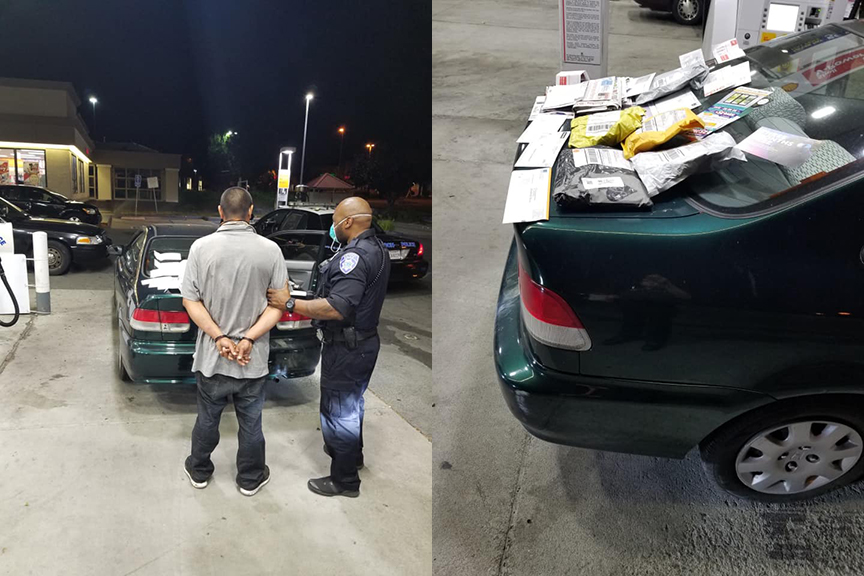
Suspect arrested and stolen mail on stolen car in Antioch, Thursday night, June 11, 2020. Photos by APD.

Some mail stolen from Brentwood, one car stolen in Pleasant Hill

By Antioch Police Department

You’ve probable read how diligent #APDNightShift is in keeping watch of our city while you sleep — and they did not disappoint last night! Officers found a total of three occupied stolen vehicles and made three separate arrests, including one of particular note:

A little after 2:00 am, an officer spotted a Honda reported stolen from Pleasant Hill in the area of Hillcrest Avenue and East Tregalllas Road. After a stop was made, officers searched the car and found several pieces of mail stolen from our good neighbors over in Brentwood. BrentwoodPD showed up to help-out and took possession of the stolen mail, with the intention of returning it to the victims. The driver was arrested and given free shuttle service (courtesy of an APD chauffeur) to the County Jail, where he was booked on the stolen vehicle plus mail theft charges.

Mail theft continues to be a huge problem across the East Bay. If you haven’t already, please consider using a locking mailbox and signing up for Informed Delivery. Victims of mail theft often have their identity stolen and used to open fraudulent credit accounts (it’s a big headache). Never place outgoing mail in yours, and instead drop it off at the Post Office or a blue Postal Service delivery bin. Informed Delivery is a service from the Post Office that provides daily emails with scanned images of the mail being delivered to your address. You can sign up for this free service by visiting this link: https://informeddelivery.usps.com/…/pages/intro/start.action

#AntiochPD   #BrentwoodPD   #CVC10851


Antioch Council to hold special meeting Tuesday to discuss forming police reform ad hoc committee

Friday, June 12th, 2020

Police Crime Prevention Commission Chairman questions need, accuses Thorpe of playing politics

By Allen Payton

The Antioch City Council will hold a special meeting Tuesday night, June 16, 2020 to discuss and consider forming a Police Reform Ad Hoc Committee. It’s being done at the request of Councilman Lamar Thorpe who stated his desire to place the matter on a future council meeting agenda, at the end of this past Tuesday night’s regular council meeting. 
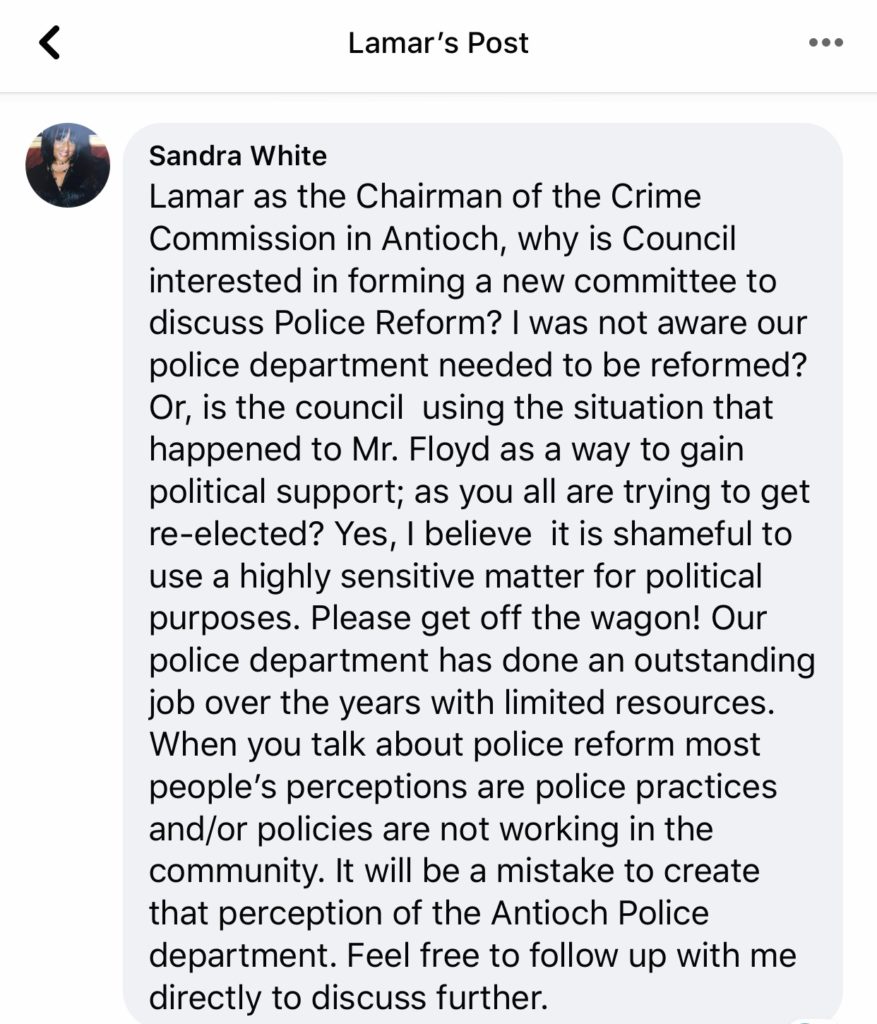
However, Police Crime Prevention Commission Chair Sandra White, in a comment on Thorpe’s personal Facebook page, questioned the need for it.

“Lamar as the Chairman of the Crime Commission in Antioch, why is Council interested in forming a new committee to discuss Police Reform?” she asked. “I was not aware our police department needed to be reformed? Or, is the council using the situation that happened to Mr. Floyd as a way to gain political support; as you all are trying to get re-elected?”

“Yes, I believe it is shameful to use a highly sensitive matter for political purposes,” White continued. “Please get off the wagon! Our police department has done an outstanding job over the years with limited resources. When you talk about police reform most people’s perceptions are police practices and/or policies are not working in the community. It will be a mistake to create that perception of the Antioch Police department.”

“Feel free to follow up with me directly to discuss further,” she concluded.

Antioch Police Crime Prevention Commission Chair Sandra White’s comment on Councilman Lamar Thorpe’s Facebook post on Wednesday, June 10, 2020.

However, her comment has been deleted. When reached for comment Thorpe wrote in a text about White and her comment, “She is not my friend on FB (Facebook). I delete all comments from people who are not my friends on FB. She’s more than welcome to comment on my public profile.”

Asked if his post was still on his personal page and why not use the Police Crime Prevention Commission instead of forming a council ad hoc committee, Thorpe did not respond.

Earlier this week, while speaking with the Herald about the eight reform recommendations he offered on Monday as part of the national 8 Can’t Wait campaign, and about what Antioch Police Chief T Brooks shared that the department was already implementing five of them and didn’t recommend implementing the other three, Thorpe said, “I want all eight.”

According to the staff report on the single item agenda, the council it is recommended they “Discuss and consider formation of a Police Reform Ad Hoc Committee including whether it shall review existing policies, rules, practices, customs, and general orders of the Antioch Police Department and make recommendations including but not limited to:

A. Prevention of excessive use of force by police officers against members of the public, including banning police from using carotid artery restraints and chokeholds;

B. Elimination of military equipment from the police department (“Demilitarization”);

C. Required use of conflict de-escalation approaches by all sworn officers when interacting with the public;

D. Increased police accountability, including the process for receipt and review of public complaints against the police for excessive use of force, racial and/or ethnic profiling, and other police misconduct;

E. Improvement of police officer candidate recruitment, screening, training and hiring practices including an analysis of policies concerning implicit bias, candidate diversity and candidate background checks; and

F. Police department budget appropriations.

2) Confirm the appointment of two (2) members for the Police Reform Ad Hoc Committee, if the ad hoc committee is desired;

3) Confirm the duration of the Police Reform Ad Hoc Committee, if the ad hoc committee is desired;

4) Adopt the resolution to form the Police Reform Ad Hoc Committee, if the ad hoc committee is desired; and

5) Determine whether to hold study sessions to discuss and consider the findings and recommendations of the Police Reform Ad Hoc Committee and, if so, when to schedule the study sessions.”

The council meeting will begin at 7:00 p.m. and can be viewed on Comcast Cable Channel 24 or via livestream on the city’s website. Use the form on that same page to submit a comment either for general public comments on topics not on the agenda or on the one agenda item, to be read during the meeting. Comments are limited to 350 words.

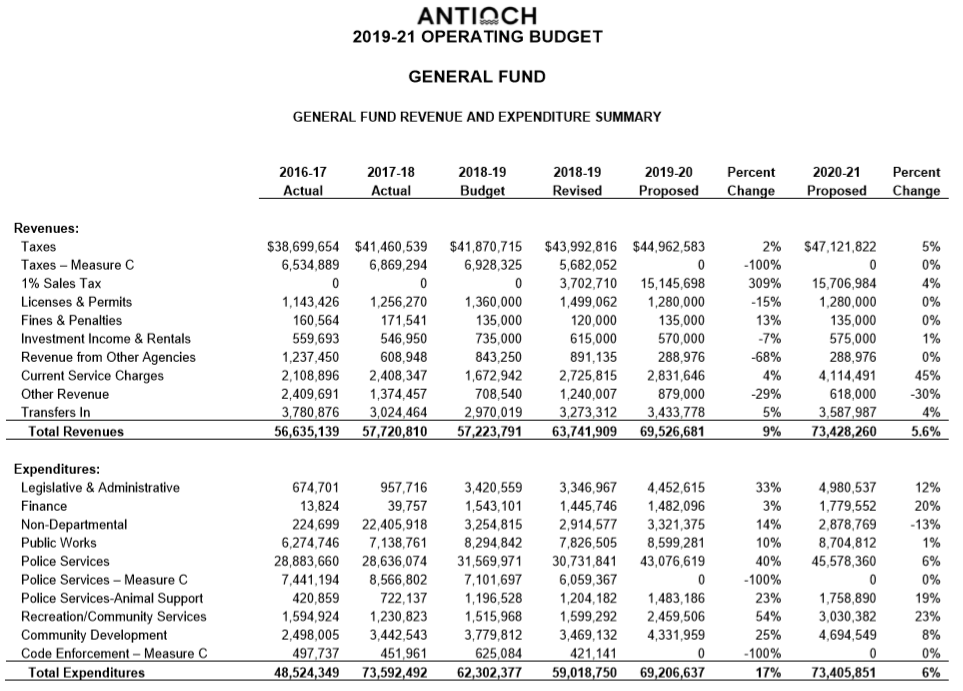
Antioch Police services are just 27.3% of overall city budget, not 62%

Tuesday, June 9th, 2020

From page 55 of the City of Antioch’s Adopted Budget for 2019-21 (page 70 of the overall document).

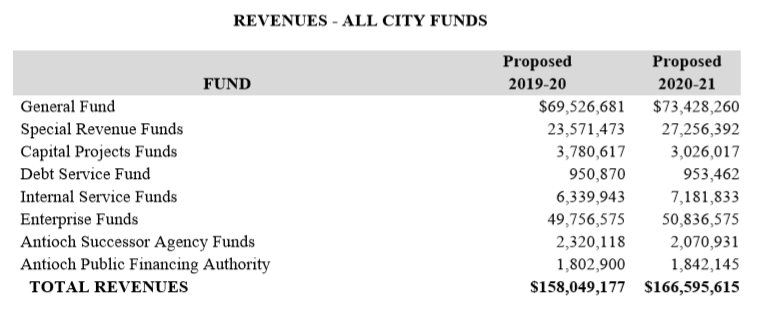
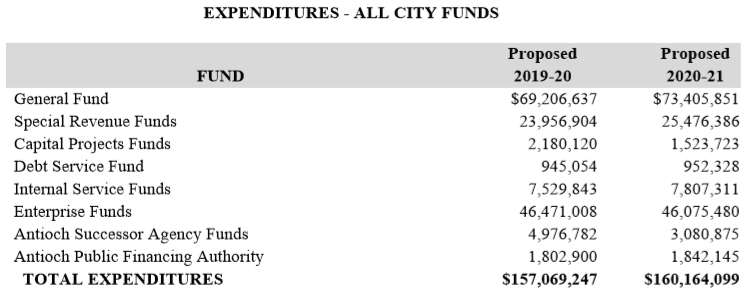
With total annual budget revenues of $158 million the City of Antioch spends $43 million on police services.

By Allen Payton

This is in response to public comments during the Antioch City Council meeting on Tuesday, June 9, 2020 which included calls for the defunding of the police department claiming it takes up 62% of the city’s budget. In addition, copies of the city’s General Fund pie chart were distributed to participants during a Black Lives Matter protest held in Antioch on Tuesday. Hopefully, this will help educate them so they make policy suggestions in the future based on the facts, not rumor and misinformation.

From page vi of the City of Antioch’s Adopted Budget for 2019-21 (page 10 of the overall document).

What all of those people didn’t do was their homework, which could have been accomplished with a simple online search to learn about the actual details in the city’s two-year budget for the 2019-2020 and 2020-21 fiscal years. Please click here to view and see pages vi (10) and vii (11) of the 330-page document that can be found on the Finance Department’s page on the City’s website. (NOTE: This last sentence has been corrected. The previous pages referred to the June 25, 2019 Antioch Council meeting agenda in which the proposed two-year budget was included for council adoption and was 776 pages long).

In the current 2019-20 fiscal year ending on June 30th, the General Fund makes up just 44% of the city’s overall budget. That figure is projected to rise slightly to 44.1% in the next fiscal year beginning July 1st. Of that 62% was spent on police and public safety this year and 62.1% is budgeted in the 2020-21 fiscal year. So, that means only 27.3% to 27.4% of the city’s budget was and will be spent on police services during the current two-year budget cycle.

From page vii of the City of Antioch’s Adopted Budget for 2019-21 (page 11 of the overall document).

What the people who spoke during the council meeting also don’t seem to understand, remember or be aware of – most likely because they are young and couldn’t vote when the ballot measures passed or don’t live here – is that the voters of Antioch voted twice to pass a sales tax increase and spend most of the additional revenue on more police and public safety.

As a result, the City of Antioch has been hiring more police since 2013, and just last year, finally fulfilled the promise made in 2013 by the then-mayor and council members of 22 more police officers, immediately. That was when there were 89 sworn officers on the force and Antioch now has 115 sworn officers.

Then, with the passage of Measure W in 2018, increasing the sales tax to one percent, the voters told the council to spend most of the funds to “restore the number of police officers patrolling City streets” and “to increase investment in code enforcement, clean up blight, road repairs, support youth and senior services, and attract new business and jobs to Antioch.” The priorities for use of the Measure W sales tax funds are as follows:

  • Continuing to maintain 911 police response and restore the number of police officers patrolling City streets
  • Ensuring water quality and safety
  • Maintaining Antioch’s quality of life and financial stability
  • Cleaning up illegal dumping
  • Restoring after-school and summer programs for youth

Going back to the City’s original formation documents in 1872, the City of Antioch was incorporated for the purpose of “police and other matters.” Police services and public safety have always been the number one reason the city government exists and the top budget priority. But, it does not make up more than a majority of the City’s overall budget. It’s closer to one-fourth.

Antioch Police Chief responds to councilman’s eight police reforms showing five have already been implemented

Tuesday, June 9th, 2020

Provides reasons he doesn’t recommend implementing all of them

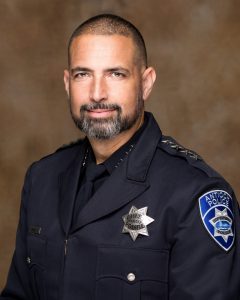
Chief Tammany Brooks. Photo by APD.

The following was issued on Tuesday, June 9, 2020 in response to questions from the public and media about eight proposed reforms for the Antioch Police Department, explaining how five of the eight have already been implemented. (See related article)

Message from Chief Tammany Brooks

In the past few days, I have received numerous inquiries from the media and the public regarding a national campaign called 8 Can’t Wait. As such, I wanted to provide some clarifying information so our community can be more informed on the reality of how our current policy compares to the recommendations made by the 8 Can’t Wait campaign. I will also explain why I do not believe at this time it would be prudent to follow all eight of the recommendations.

Three things I want you to consider before I go through each of the 8 Can’t Wait recommendations:

  • The entire Antioch Police Department Policy Manual is accessible for anyone to review through our police department website, and has been for about two years.
  • The Antioch Police Department uses Lexipol software to continually update our policies. Lexipol is the nation’s leading provider of public safety policy and training solutions for law enforcement. This system ensures that all policies are aligned with State and Federal law and policies are continuously updated as laws change.
  • In 2019, California passed two pieces of legislation that are important to this conversation. AB 392 (Weber) set a new legal standard for police officers’ use of deadly force here in California. SB 230 (Caballero) set national precedent by establishing a minimum use of force policy standard for ALL departments.

Now let’s look at each 8 Can’t Wait recommendation, and whether it is currently in use at the Antioch Police Department:

De-Escalation Requirement: Yes

This recommendation, while not directly articulated, is part of the legal standard for all California police departments. SB 230 requires that “officers utilize de-escalation techniques, crisis intervention tactics, and other alternatives to force when feasible.

Use of Force Continuum: No

The use of force continuum is an outdated model that has proved impractical, even dangerous, when applied in real life situations. Instead, our policy focuses on various factors used to determine the reasonableness of force in any situation, as set forth in the training and policy requirements of SB 230.

Restrict Chokeholds and Strangleholds (including carotid restraint): Yes

During my 25 years here at APD, chokeholds and strangleholds have never been authorized uses of force. However, our current policy as seen on our website allows for the use of the carotid restraint. However, Last Friday, Governor Newsom instructed California POST to cease training officers in its use and stated he intended to sign pending legislation that would ban its use throughout the entire state. Because of this, I have already issued a departmental directive, immediately prohibiting the use of the carotid restraint by our officers. This will be formally updated in an upcoming update to our use of force policy.

Require Officers to give verbal warning when possible before using deadly force: Yes

This is already included in our current policy in section 300.4, and reads, “Where feasible, the officer shall, prior to the use of force, make reasonable efforts to identify themselves as a peace officer and to warn that deadly force may be used, unless the officer has objectively reasonable grounds to believe the person is aware of those facts.”

Prohibit Officers from shooting at people in moving vehicles: No

I do not believe outright prohibitions in all circumstances is reasonable or accounts for situations where the driver of a vehicle may be threatening death or great bodily injury to others. Section 300.4.1 of our current policy already limits when an officer can shoot at a moving vehicle. It reads, “Officers should move out of the path of an approaching vehicle instead of discharging their firearm at the vehicle or any of its occupants. An officer should only discharge a firearm at a moving vehicle or its occupants when the officer reasonably believes there are no other reasonable means available to avert the threat of the vehicle, or if deadly force other than the vehicle is directed at the officer or others.”

Require Officers to exhaust all other reasonable alternatives before using deadly force: No

This language was previously suggested in AB 392, but was removed due to its ambiguity, no clearly defined means of objectively deciding what other alternatives might be reasonable in every situation, and concerns associated with the second-guessing of split-second decisions with the benefit of hindsight 20/20. Officers’ decisions concerning any use of force alternatives should be judged based on the totality of the circumstances and reasonable officer standard in AB 392.

Require Officers to intervene: Yes

This is already in our current policy in section 300.2.1, and reads, “Any officer present and observing another officer using force that is clearly beyond that which is objectively reasonable under the circumstances shall, when in a position to do so, intercede to prevent the use of unreasonable force. An officer who observes another employee use force that exceeds the degree of force permitted by law should promptly report these observations to a supervisor.”

Require comprehensive reporting: Yes

Comprehensive reporting on cases involving use of force is covered in our current policy in sections 300.5, 300.5.1, and 300.5.2. Additionally, SB 230 already requires “comprehensive and detailed requirements for prompt internal reporting and notification regarding a use of force incident.”

The Antioch Police Department takes great pride in serving our community with integrity and compassion. As I have previously mentioned, our officers undergo continuous training, covering topics such as proper use of force, fair and impartial policing, interpersonal communications, crisis intervention training, and de-escalation techniques.

These types of trainings have helped us minimize the need to use force in many situations. In 2019, Antioch Police Officers responded to more than 94,600 calls for service – of which, only 0.1% required a use of force. As noted in our current policy, each reportable use of force is tracked in a system called Blue Team, and reviewed and evaluated by a supervisor and members of my command staff to ensure the use of force (and circumstances surrounding it) are in legal compliance and within policy.

I hope this helped answer any questions you may have had.

Sincerely,

Chief T Brooks

Council candidate says Antioch councilman’s police reform efforts grandstanding for political gain

Monday, June 8th, 2020

Claims Thorpe knew Antioch Police already implementing five of eight reforms before releasing his proposal

Mike Barbanica.

In a press release on Monday evening, Antioch City Council candidate Mike Barbanica slammed Antioch Council Member Lamar Thorpe, who is up for re-election in November, for his proposal to call for an ad hoc committee to deal with what he labels “so-called reforms at the Antioch Police Department”. Thorpe listed eight reforms endorsed by the national 8 Can’t Wait Campaign and four actions the council can take promoted by the Obama Foundation on its website. (See related article)

“Antioch residents want change – real change – so we can honestly address racism in our community,” said Barbanica, candidate for city council in District 2. “We don’t need another Antioch bureaucracy led by politicians who claim to know what’s best for our community.”

Barbanica stated that the Antioch Police Department has already implemented five of the eight reforms advocated by 8 Can’t Wait and is in the process of reviewing the other three for possible implementation.

He added that Thorpe was advised of this information by the APD before he sent out his press release.

“Shame on Mr. Thorpe for grandstanding on this issue for his own political gain,” Barbanica said. “What we need is more ongoing thoughtful communication between our police officers, our community, Antioch’s faith leaders and business owners – not the establishment of some shill of a committee that exists for the purpose of promoting a politician’s own political agenda.”

Barbanica, a longtime Antioch resident, local business owner and retired police lieutenant from the neighboring City of Pittsburg, said he is proud of the hard work and dedication of Antioch’s police officers, noting that, under Police Chief Tammany Brooks, Antioch PD has been responsive to the needs of our community.

“Can we do better? We can always do better and we need to come together, as a community, to better understand the needs of our African American and Latino residents,” he said. “But establishing a committee of politicians who will use it as a pedestal to pontificate about the causes of racism is not the answer.”

Barbanica added that George Floyd’s murder, and the protests that have followed, have awakened all of us to the need for social justice reform that can only begin in earnest by us initiating honest dialogue, by our listening and communicating with one another, so we can re-create a society that is fair and just for all persons who live here.

6/9/20 UPDATE:  When reached for comment, Councilman Thorpe said “what I knew was that I asked the chief to get clarity on this, and he sent me an email response and he said ‘in spirit we do some of these. We have officially two on the books so far. But I can look into and we can do these things in spirit.’”

“He had some concerns about other ones,” he continued. “What I did was call on the chief to adopt all of them. The issue is not whether not I knew. The fact of the matter is they’re not written in our policies. There’s a difference between researching and considering adopting them.”

“I’m calling for the remaining six to be implemented,” Thorpe stated. “Let’s make it about policy. Five of them doesn’t complete the eight. I’m saying all of them.”

Allen Payton contributed to this report.

Antioch Councilman proposes police reforms, to call for ad hoc committee at Tuesday’s meeting

Monday, June 8th, 2020

Thorpe seeks six of eight immediate policy reforms, claims only two have already been implemented

Video screenshot of Antioch Councilman Lamar Thorpe during a protest in Antioch on Sunday, June 7, 2020. From his Facebook page.

By Allen Payton

In response to the death of George Floyd at the hands of four former Minneapolis Police Officers, and the ensuing protests in Antioch and throughout the country, Antioch Councilman Lamar Thorpe has jumped on the bandwagon of a nationwide effort led by the Obama Foundation, to limit police interactions with suspected criminals by proposing a list of reforms for the Antioch Police Department he wants the rest of the council to consider.

In a press release he issued on Monday, Thorpe said he “fully endorses the enactment of eight specific policy recommendations that are part of the national 8 Can’t Wait Campaign” and claims “two of eight recommendations are policy in Antioch.”

Thorpe is calling on Antioch Chief of Police to enact the remaining six.

“Something is happening with the consciousness of America. People all over the country and here in Antioch are saying ‘enough is enough,’ and they expect change,” Thorpe said. “After 15 days of sustained protest, demonstrations and civil unrest, it’s time to take action, before one more senseless killing takes place. Let’s think globally and act locally.”

The most controversial of the remaining six recommendations is the banning of chokeholds and strangleholds, including a technique Antioch police use called the carotid restraint, which involves placing pressure on a person’s neck to restrict blood flow. In an independent autopsy, medical examiners determined that pressure placed on Floyd’s carotid artery impeded blood flow to his brain and contributed to his death.

More than a dozen California cities have banned carotid restraints following Floyd’s murder. Assembly Bill 1196, introduced last week by state Assemblyman Mike Gipson, D-Carson, would make the carotid restraint illegal in California. Thorpe is calling on Gov. Gavin Newsom to sign the bill.

Following are the eight policy recommendations:

  1. Ban police use of chokeholds and strangleholds, including the carotid restraint
  2. Require officers to de-escalate situations whenever possible
  3. Require officers to exhaust all options before shooting, including less lethal force
  4. Ban officers from shooting at moving vehicles
  5. Establish a use of force continuum that restricts using the most severe force to most extreme situations
  6. Require comprehensive reporting for each time an officer fires or points their weapon at someone
  7. Require verbal warnings before using deadly force (already an Antioch policy)
  8. Require officers to intervene to stop excessive force by other officers (already an Antioch policy)

According to the Obama.org website, “More than 1,000 people are killed by police every year in America, and Black people are three times more likely to be killed than White people.” That’s because, as a CNBC article on police violence in America reports, “according to Mapping Police Violence, one research group…Black people accounted for 24% of those killed, despite making up only about 13% of the population.” But the article also reports that, “no comprehensive official database exists for tracking police violence, though there have been efforts at the federal level to create one.”

That article further reports, “the data from Mapping Police Violence is sourced from three databases — killedbypolice.net, fatalencounters.org and the U.S. Police Shootings Database — as well as original research focused on social media, obituaries, criminal records databases, police reports and other sources, according to the group.”

At the Tuesday, June 9, 2020 Antioch Council meeting, Councilmember Thorpe will call for the formation of a City Council Ad-Hoc Committee on Police Reforms to be composed of council members, legal advisers, police leaders, police union representatives and community advocates. The role of the committee will be to examine potential long-term reforms in the following areas:

  1. Demilitarize our local police
  2. Increase police accountability
  3. Improve police hiring practices
  4. Excessive use of force
  5. Budget appropriations

“While it’s important for our city to take immediate preventative steps, such as banning use of carotid restraints, creating successful police reforms will require the involvement of the entire community,” Thorpe said. “The ad-hoc committee approach is one of the best tools we have as city councilmembers to create lasting policy change that works.”

Additionally, he has signed the Obama.org’s “My Brother’s Keeper Alliance Pledge”, to have Antioch become an “MBK Community” which asks local officials to:

  1. Review the police use of force policies in my community
  2. Engage my community by including a diverse range of input, experiences, and stories in our review
  3. Report the findings of our review to my community and seek feedback within 90 days of signing this pledge
  4. Reform my community’s police use of force policies based on findings

When asked for his thoughts on Thorpe’s proposed reforms, Antioch Police Chief T Brooks responded, “I look forward to hearing the discussion between Councilman Thorpe and the rest of the city council on this proposal.  I am especially interested in what specific reforms they believe are necessary at the Antioch Police Department.”

A question to the chief asking if there any of the other six reforms on the proposed list have been implemented by the Antioch Police Department went unanswered prior to publication time.

The online Antioch City Council meeting begins at 7:00 p.m. and can be viewed on Comcast Local Cable Channel 24 or via livestream on the city’s website at www.antiochca.gov/government/city-council-meetings/live/.

Please check back later for any updates to this report.