Antioch Unified School District is hosting a Winter Clothing Drive. We are looking for new or gently used coats, hats, gloves, blankets, umbrellas, scarves and socks. The donation dates will be from November 2nd through November 20th.
Drop off locations are the Mission Elementary School, Carmen Dragon Elementary School, Belshaw Elementary School, and Deer Valley High School Front Offices. You can also drop them off at Prospects High School with the counselor, Wanema Cornell.
Finally, you are more than welcome to drop them off at the District Office with Barbara Aguilar located in Portable D in the back.
If you have any questions, please feel free to reach out to Barbar directly at 925-779-7500 ext. 53402 or email her at barbaraaguilar@antiochschools.net.
With Dr. Brian Keum, Associate Professor, UC Berkeley School of Public Health & Dr. Supreet Mann, Director of Research, Common Sense Media
By Mairead Glowacki, Communications Director, Office of Congressman Mark DeSaulnier
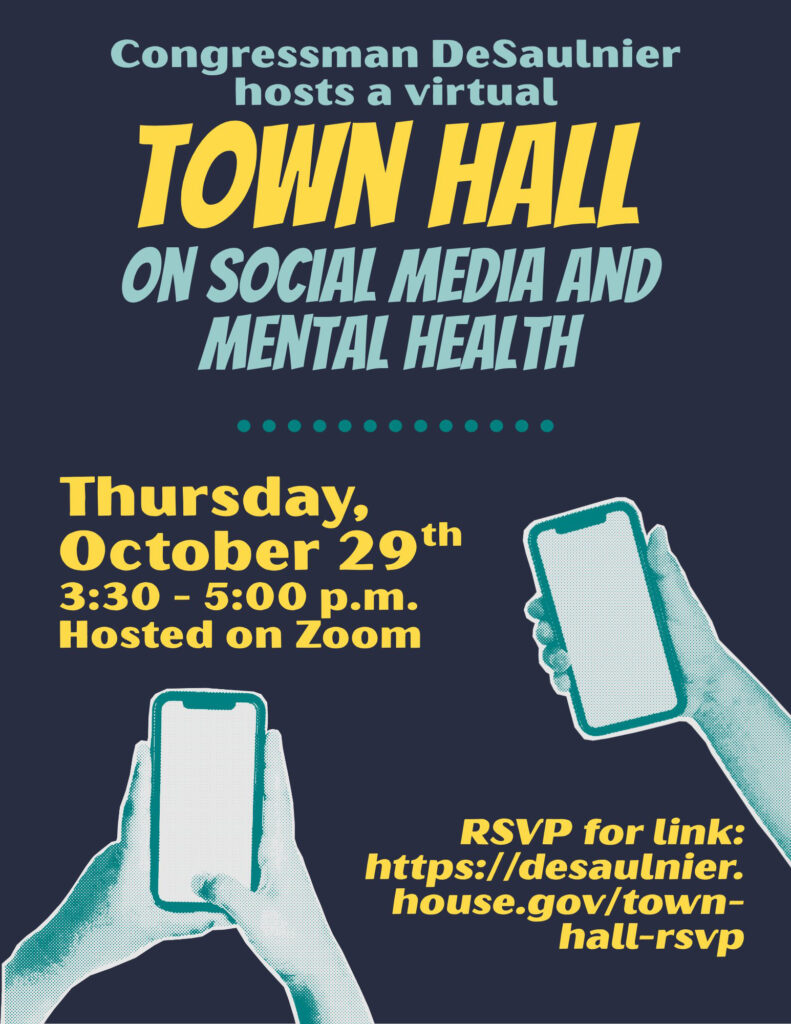
Walnut Creek, CA – Congressman Mark DeSaulnier (CA-10) will host a virtual Town Hall on Social Media and Mental Health on Thursday, October 29th at 3:30 p.m. PT. In 2023, then-Surgeon General Vivek Murthy issued a public health warning linking the youth mental health crisis with social media use. Since then, social media usage has increased and recent lawsuits are an indication that more needs to be done. The Congressman will be joined by expert special guests from the UC Berkeley School of Public Health and Common Sense Media to discuss the latest research on this link and innovative policy solutions to protect American kids and families.
Virtual Town Hall on Social Media and Mental Health
Thursday, October 29th
3:30 – 5:00 p.m. PT
Hosted on Zoom
Panelists include:
Dr. Brian Keum, Associate Professor, UC Berkeley School of Public Health
Dr. Supreet Mann, Director of Research, Common Sense Media
Our office is hosting a Virtual Military Service Academy Nomination Information Night on Thursday, October 29th from 5:30 to 6:00 p.m. Join us for an opportunity to learn more about the nomination process and ask any questions you may have.
This meeting is open to CA-10 students and parents. District 10 includes portions of Antioch. See District and information map here.
RSVP to ryan-thomas.brown@mail.house.gov or call Congressman DeSaulnier’s office at (925) 933-2660 for the Zoom login information.
Showed up at local hospital early Tuesday; Pittsburg Police assist
By Lt. Michael Mellone, Antioch Police Department
On October 27, 2026, at 3:28 a.m., Antioch Police officers were notified that a 16-year-old with a gunshot wound had been brought to a local hospital by private transportation.
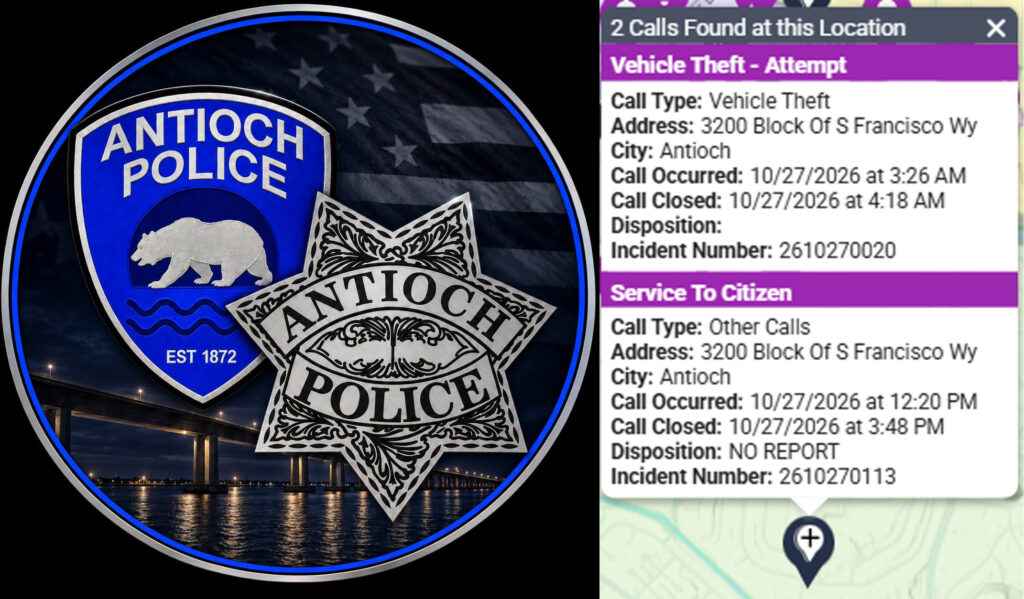
Around the same time, APD dispatch received a 911 call reporting an attempted vehicle theft at a residence in the 3200 block of South Francisco Way. Responding officers located evidence of a shooting. Preliminary information indicates the two incidents may be related.
Officers have detained individuals of interest, and investigators are interviewing witnesses and gathering additional information. At this time, there is no known ongoing threat to the community.
According to the APD CitizenRIMS Crime Map, the call regarding the attempted vehicle theft occurred at 3:26 AM and was closed at 4:18 AM. Incident Number: 2610270020. A second call that appears at the same location at 12:20 PM labeled “Service to Citizen” was “a call that was created to give a witness a ride,” Lt. Michael Mellone explained.
Anyone with information about this incident is asked to contact Detective Ibanez at (925) 779‑6890 or ribanez@antiochca.gov. Tipsters may remain anonymous.
The Antioch Police Department thanks South Francisco Way residents for their cooperation and the Pittsburg Police Department for its assistance during this incident.
The dominating Black & Gold Yoc Boyz look to defeat their long-time rivals
By Allen D. Payton
This Friday night, Oct. 30, 2026, the 7-1 Antioch High Panthers Varsity Football Team takes on the 5-3 Pittsburg Pirates at home in Eells Stadium at 7:00 p.m. The JV game begins at 4:30 p.m.
So far this season, Antioch has dominated all but one of their opponents by defeating Dublin High 29-7, Bear Creek 54-14, Heritage 24-6, Emerald 54-0, Deer Valley 40-12, Hercules 62-0, and Freedom 52-18. The team’s only loss was a nailbiter with a score of 20-21 against San Leandro.
Friday night’s game is the second-to-last for the season with the Panthers’ final game to be played against Liberty on Friday, Nov. 6th.
The California Department of Education this week released the annual California School Dashboard, the state’s multidimensional, multicolored look at student, school and district achievement.
The dashboard was designed to offer parents a quick look at student results, as well as to provide data for guiding school improvement and for holding districts accountable. Trying to serve these different purposes has created a data system that’s complex and comprehensive, often useful, but also daunting for first-time parent users.
The California Department of Education has translated the dashboard into multiple languages and produced dozens of flyers, videos, and an annually updated Dashboard Communications Toolkit. This is a good place to start.
Here are some answers and tips to help parents navigate the dashboard experience.
What’s the purpose of the state dashboard?
The dashboard gives an extensive look at every school, charter school and school district’s yearly performance as measured by ratings on eight state indicators. They are standardized test scores, of course — English Language Arts and math in grades 3 through 8 and grade 11, English learners’ progress, and, in 2026 for the first time, science.
Along with high school graduation rates, there are ratings for chronic absences, though only through grade 8, and suspension rates; both measures underscore the importance of engagement and school climate to student success.
There is also a measure of how well high schools prepare students for college and careers. It has expanded to include 14 measures. They include:
Satisfying the A-G course requirements for admissions to UC and CSU campuses
Passing multiple AP and International Baccalaureate courses
Successfully completing two semesters of credit-bearing college or CTE courses
Attaining a seal of biliteracy or a seal of biliteracy
Completing a CTE pathway or pre-apprenticeship program
Passing the Leadership/Military Science and Armed Services Vocational Aptitude Battery Test
Demonstrating work-based learning.
What’s the point of using colors?
Rating performance by color serves a double purpose. There are five: blue signaling the highest achievement, green, yellow, orange, and red signaling the lowest performance. Each color reflects a blend of two factors, evenly weighted: the current year’s test score or rate, and the change from the preceding year to credit improvement or signal a decline deserving attention.
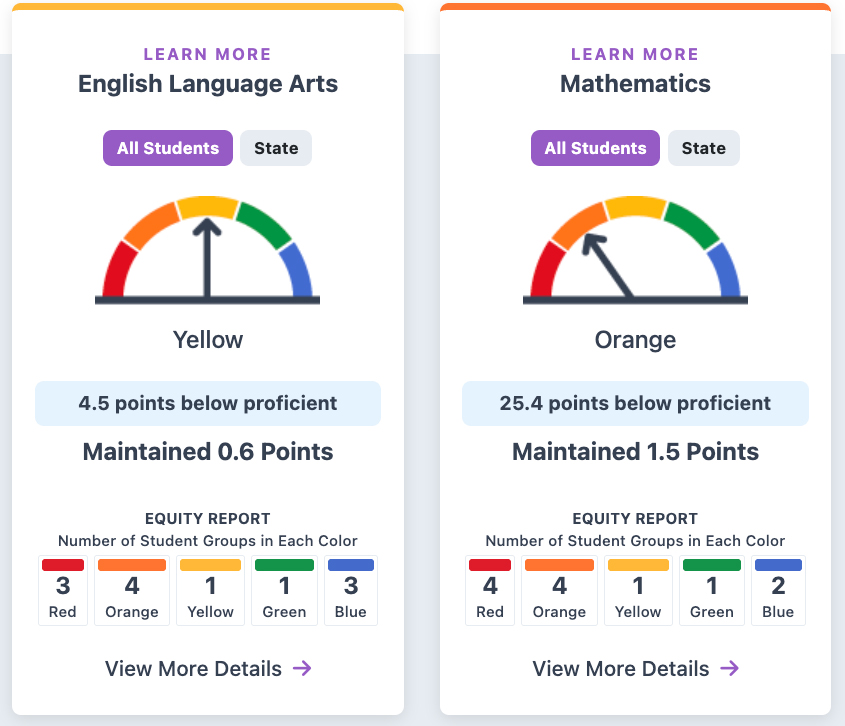
Screenshot of San Jose Unified’s dashboard from the 2026 California School Dashboard
A school’s goal is to achieve green or blue for any indicator, but a sharp change from the results of students the year before can elevate an otherwise yellow score to green or lower it to orange.
For example, clicking the math score “odometer” for San Jose Unified reveals that students averaged 25.4 scale points below the threshold for proficiency or “meeting standard” in math in 2025-26 — a significant gap. Its students also gained 1.5 points from the year before. The combination is rated orange, two levels below green. The same template applies to other indicators.
Why is there no overall rating for a school’s or district’s performance?
Unlike other states’ dashboards, the State Board of Education chose not to give a summative or top number or rating for a school or district, in order not to overemphasize test scores, at the expense of other important measures. It also wanted to draw attention to achievement gaps among student groups, which would be hidden by focusing on an average score for all students.
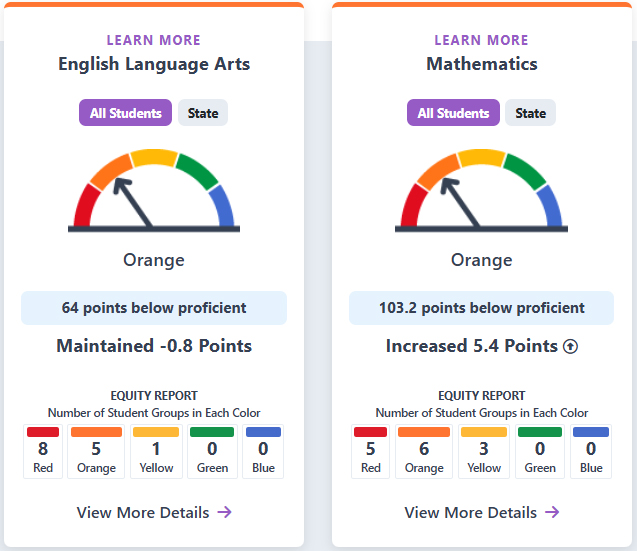
Screenshot of Antioch Unified’s English Language Arts and Mathematics 2026 Dashboard
How do student groups factor into the dashboard?
Tracking achievement gaps among 15 different student groups, including eight racial and ethnic groups, drives the dashboard. Every student group with a statistically valid number (usually a minimum of 30) receives a color rating on every indicator in every school and district.
While five of San Jose Unified’s student groups scored in the orange range, English learners, foster youth, long-term English learners and students with disabilities scored in the red band. White students achieved a green rating, and Asian students and students with two or more races were rated blue.
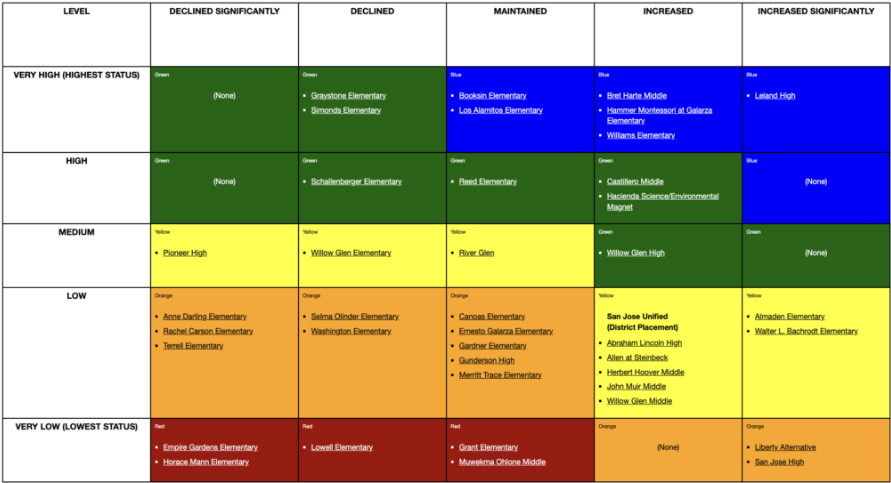
Screenshot of San Jose Unified 5×5 schools report for math scores
Every district’s dashboard includes grids — the 5×5 Placement Reports — that lay out the color rating for every school in the district on every indicator. Here’s the 2025 math 5×5 grid for San Jose’s Unified, for example (The 2026 grid will be released Dec. 15). It shows that of the district’s 40 schools on the grid, 12 rated orange, 10 were yellow, seven were green, six were blue and five were red.
As with all districts with student groups receiving a red rating on an indicator, San Jose Unified must then address low achievement in its Local Control and Accountability Plan, better known as the LCAP. That’s the three-year improvement plan in which districts must list, among other requirements, an action item, including funding, for every student group with a red rating.
Can you compare districts’ ratings on the state dashboard?
No, but you can compare schools within each district.
Other organizations have included a comparison tool in modifying the state dashboard.
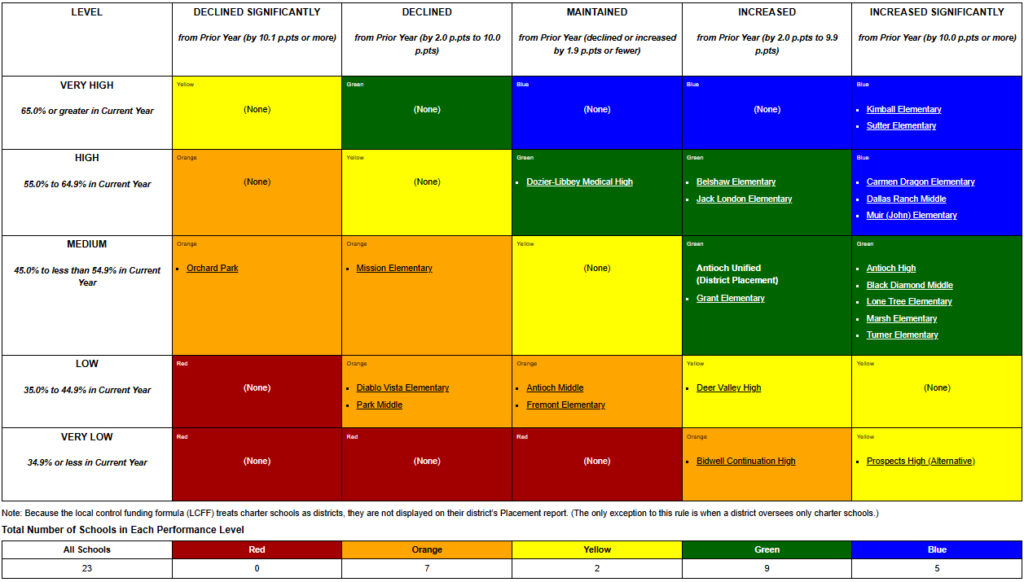
Screenshot of Antioch Unified’s 5×5 Report Chart from the California School Dashboard
What are local indicators?
The dashboard includes priorities for which there are no statistically valid comparable statewide data or assessments, but nonetheless are vital for successful schools. These include family engagement, school climate and access to a broad course of study.
The State Board of Education requires that districts analyze each local priority and report back to the public annually. Examples are the results of local school climate surveys and the district’s actions to improve public engagement. For example, county offices of education must report on how well they are coordinating services for foster youths and expelled students.
How does dashboard information drive improvement?
Districts in which at least one student group is rated red on two or more priority areas, such as low reading scores and high chronic absenteeism, are designated eligible for “Differentiated Assistance.” They are encouraged to seek guidance from county offices of education or the California Collaborative for Educational Excellence, a small state agency, on how to improve. Differentiated Assistance is voluntary and applies only to districts.
Since the dashboard’s first year, in 2017-18, more than three-quarters of districts, charter schools and county offices have qualified for differentiated assistance, with more than 80% of those identified two or more times.
In 2026, only 144 school districts will qualify for differentiated assistance, down from 418 last year. Recognizing a need to focus on fewer districts with more intensive, effective help, the State Board revised the criteria, and districts will receive assistance for three years, instead of one year.
Districts are selected based on poorly performing subgroups as well as districts’ overall scores receiving red ratings. Most of those qualified because of the low ratings for students with disabilities and long-term English learners, and in some charter schools, for low ratings of Hispanic students, according to Department of Education analysis.
John Fensterwald writes about education policy and its impact in California.
– Student proficiency in math and English language arts rose slightly, though remains below pre-Covid levels, according to newly released California standardized test scores.
– Achievement gaps persist between Black and Latino students and white and Asian students.
– It’s likely still too early to see improvements from investments in early literacy.
California students’ proficiency in math and English language arts follows the same trend in 2026 as the past few years: incremental improvement from the year prior, with the majority of students below grade-level standards.
The state’s release of 2025-26 student test scores on Thursday showed slight growth in several areas, but California still hasn’t reached the elusive milestone of raising scores back to pre-Covid levels.
In English language arts, 49.3% of students scored proficient or advanced in 2025-26, up just a half percentage point from the previous year, according to the latest standardized test results released Thursday.
In math, the number of students earning a proficient or advanced score increased by 1.2 percentage points, with 38.4% earning proficient or advanced.
Prior to the pandemic, in 2018-19, 51.7% of California students met or exceeded state standards in English language arts, and 39.7% were proficient in math.
Fewer students — 36% — achieved a proficient or advanced score on the science test, though it was the subject with the most improvement. The portion of students meeting standards in science rose 3.3 percentage points since last year, and 6.1 points since before the pandemic.
“Today’s results tell a story of continued progress, but also of the work that remains ahead,” Linda Darling-Hammond, president of the State Board of Education, said in a statement. “Our responsibility now is to build on this momentum and ensure that progress reaches every student and every community.”
Black and Latino students made larger gains than white and Asian students but yawning racial and ethnic achievement gaps remain. Black students were the only group to surpass pre-pandemic proficiency levels in both math and English.
While education leaders are often encouraged by academic growth, the pace of growth — half a percent to a little over a percent in most cases — is “unacceptable,” said Troy Flint, chief information officer at the California School Boards Association.
“It does not suggest that we have the right strategic or operational infrastructure in place to properly support our school districts and county offices of education in accelerating student achievement,” Flint said. “We need serious reforms to state level education governance and operations and assessment, or we will never deliver for our kids at the level that we need.”
Disparities persist among different racial, ethnic, socioeconomic groups
The number of proficient Black and Latino students remains far below their white and Asian peers, and similar gaps exist between students based on income.
The number of Black students reaching proficiency in English language arts increased 0.9 percentage points from last year to 33.7%. The number of proficient Latino students rose to 39.6%, a gain of 0.8 percentage points from last year. Asian students’ proficiency fell by 0.9 percentage points to 73.5%. About 61.7% of white students scored proficient in English language arts, a figure essentially flat from the prior year.
In math, about 21.5% of Black students scored proficient, a 1.5 percentage-point improvement from 2025, the highest jump across the four student groups. About 27% of the state’s Latino students scored proficient, 1.2 percentage points higher than 2025. Asian students (70.5% math proficiency) and white students (51.4%) saw more modest growth.
Although socioeconomically disadvantaged students improved in both subjects, most still did not meet standards. About six in 10 (61.1%) did not meet the English standards. Nearly three in four (72.6%) did not meet the math standards.
The achievement gap between students who are socioeconomically disadvantaged and the rest of their peers remains at about 30 percentage points in both subjects.
Melissa Valenzuela-Stookey, research director at EdTrust West, called the test scores “sobering.”
“Once again, the results show glaring gaps in outcomes for Black and Latino students, Native American students, English learners and students from low-income households, which suggests that our systems still aren’t providing the supports and opportunities they need to reach their full potential,” Valenzuela-Stookey said.
No improvement in early reading yet
The percentage of California third graders who scored proficient or advanced on the English language arts test stayed flat, from 44.2% in 2024-25 to 44.1% in 2025-26.
The state has invested millions in improving how schools teach children to read, but it is likely too soon to see many results from the new policies. Last year, schools began screening all students in grades K-2 for risk of reading difficulties to provide support for kids who need it.
The children who benefited from that last year won’t take standardized tests until this school year. The State Board of Education only recently approved a list of literacy training programs for districts to use.
“While the state has gotten a lot more focused on improving reading, it’s not surprising it wouldn’t have an impact yet,” said Marshall Tuck, CEO of EdVoice and one of the advocates that pushed for the reading reforms. “The earliest you would see impacts from those policies directly would be this school year.”
English language proficiency
More than 133,000 English learners —15.4% — tested as proficient on the English Language Proficiency Assessment for California (ELPAC) in 2025-26. Under a new state law, those students are now eligible to be automatically reclassified as fluent and proficient in English. The percentage of English learners who achieved proficiency was similar to last school year.
English learners who have not yet achieved proficiency in English tend to do poorly on standardized tests, but once they are reclassified as fluent in English, they often do better on tests than native English speakers.
In 2025-26, 60.9% of former English learners achieved proficiency in English language arts, compared to 53.5% of native English speakers.
Martha Hernandez, executive director of Californians Together, a nonprofit advocacy group for English learners, said the scores show that the state needs to do more work to make sure English learners have full access to the curriculum in all subjects and to move more students to proficiency.
“Students who become proficient in English do not stop becoming part of the English learner success story,” Hernandez said.
Dashboard released simultaneously
For the first time this year, the California Department of Education released the test scores at the same time as the “dashboard,” the state’s accountability system. The dashboard measures schools’ improvement over time on test scores and on other measures, such as graduation, college and career readiness, suspension and chronic absenteeism.
The state gives schools a color of the rainbow ranging from red (signaling the least achievement or improvement), orange, yellow, green and blue (signaling the highest achievement).
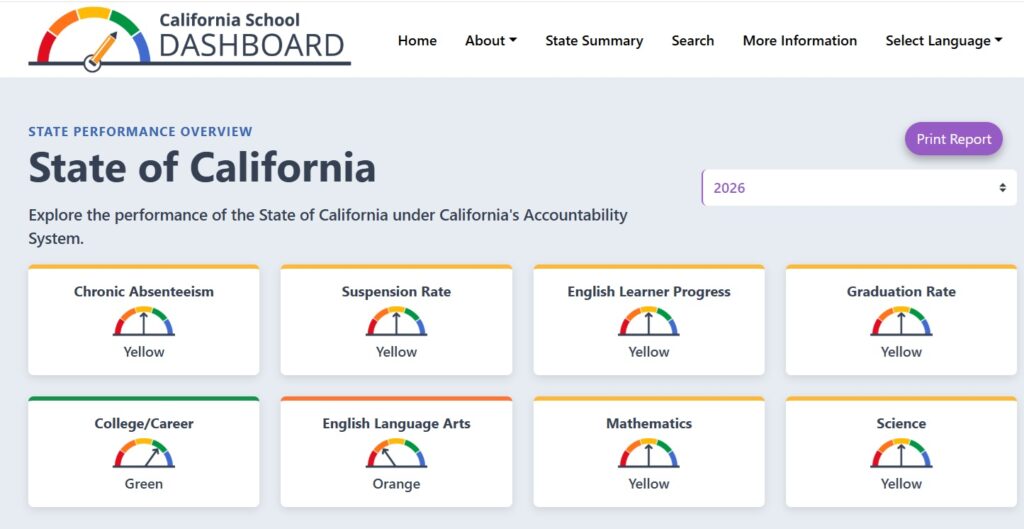
The state gave schools an overall score of orange for English language arts, and yellow for math and science.
Jessica Sawko, director of education at Children Now, advocated for science to be included in the state’s accountability system because she said science helps prepare students for college and career.
She said it was “heartening” to hear that there was improvement in science scores, but the percentage of students achieving proficiency is much too low.
“Here we are at not even 40% of kids achieving proficiency or better. That’s more than half of the kids not there yet, and yet we’re at a yellow?” she said.
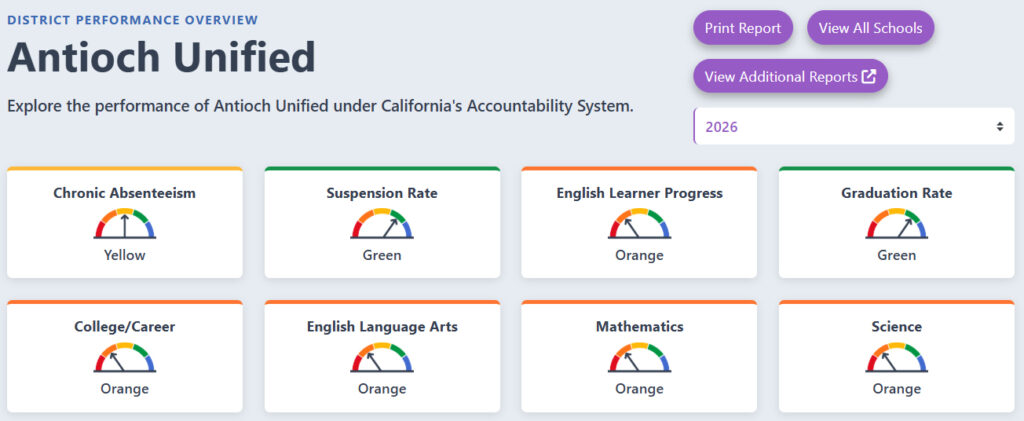
Antioch Unified School District’s Performance OverviewChart
Discuss 2027-28 General Fund Budget with projected $11.2M deficit, consider closing Marina due to annual subsidy
Receive reports on APD Reform, Youth Services, Delta Landing homeless hotel in Pittsburg, vote on 3% COLA for final employee group
By Allen D. Payton
During their meeting Tuesday night, Oct. 13, 2026, the Antioch City Council will deal with 315 pages of a full agenda with 18 items, including 16 items on the Consent Calendar. They will begin with a Special Meeting at 5:00 p.m. to discuss and give input to staff on development of the Fiscal Year 2027-2028 General Fund Budget. Then at 7:00 p.m. their Regular Meeting will begin.
2027-28 General Fund Budget Development
During their Special Meeting, the Council will discuss the 2027-28 General Fund Budget Development which shows the City facing a $16.25 million deficit before a $5 million transfer from the Budget Stabilization Fund for a projected net $11.25 million deficit for the fiscal year.
One item of controversy is the possible closing of the Antioch Marina. According to the City staff report, “as mentioned at the August 25th session, the non-departmental budget reviewed included a reduction in the subsidy to close the Marina and provide for only debt service repayment and the existing full-time staffing at the Marina, which would need to be re-assigned to other areas within Public Works. If the Marina were closed, this could potentially provide $185K in budget savings in 2027/28, however the loss of a recreational facility and potential harmful business impact to the restaurant at the Marina may negate the financial savings.”
Presentations
Toward the beginning of the Regular Meeting the Council will be provided with three presentations including:
Delta Landing: Program Operations, Service and Outcomes report by Contra Costa Health for the homeless hotel in Pittsburg at the former Motel 6 site on Loveridge Road.
Consent Calendar
Under the Consent Calendar the Council will vote on accepting completion for the Antioch Water Park Concrete improvements 2026 Project (Item 15.L.) and Pool Resurfacing Project (Item 15.M.). Plus, they will vote on rejecting all bids and re-evaluating the scope of the Installation of Park Signage Project (Item 15.N.) because the lowest responsive bid that could be accepted was over $86,000 more than budgeted. Finally, the Council will vote on approving the Memorandum of Understanding between the City of Antioch and the Confidential Unit for a 3% COLA at a total cost of $111,883, with $92,419 from the General Fund, and approving a Fiscal Year 2026/27 budget amendment to cover the additional costs (Item 15.P.). As previously reported, the Confidential Unit includes a variety of staff positions: the Deputy City Clerk, Account Specialists, Analysts, Assistants, Coordinators, Specialists and Technicians. The 26 employees in the Unit have been working without a contract since September 30, 2025. See City’s Master Salary Schedule.
Reestablishing Economic Development Department
Under Item 16, the Council will vote on reestablishing a standalone Economic Development Department separate from Community Development, determine funding for an Economic Development Director position with an amended job classification and amended salary range, an Economic Development Specialist, and assigning a Department budget.
Downtown Security Services
Finally, under Item 17, the Council will give direction to staff on reestablishing private security services for downtown Rivertown. That includes initiating a competitive Request for Qualifications (RFQ) process for private security services; determining the geographic scope of services, including whether coverage should be limited to City-owned properties and designated public areas in the Rivertown/Downtown area or include additional areas throughout the City; and determining the days and hours of operation for private security services. The council will decide on a budget during a future meeting.
Meeting Details
The Special Meeting begins at 5:00 p.m. and Regular Meeting begins at 7:00 p.m., both in the Council Chambers at City Hall, 200 H Street, in historic, downtown Rivertown and can be viewed via livestream on the City’s website, on Comcast cable TV channel 24 or AT&T U-verse channel 99 or on the City’s YouTube channel.
See the complete agenda packet with staff reports here.