County residents opposed to project work to limit impact and secure benefits if it is built
“I feel in a lot of ways this committee is just going through the motions. I’m starting to feel like a pawn in a chess game.” – Antioch resident Jim Cox.
By Allen Payton
What was planned as two tunnels beneath the California Delta to divert fresh water from north of the Delta to areas south, is now a single tunnel plan that is referred to as the Delta Conveyance Project (DCP). The effort is being led by the Delta Conveyance Design and Construction Authority (DCA) which was formed by and makes recommendation to the California Department of Water Resources (DWR).
In the first part of this two-part series, you read about the background and latest efforts to move the project forward. In this part, you will hear from local voices who serve on the Stakeholders Engagement Committee (SEC) and what they are doing to both fight the tunnel, and if it is built to limit its impact and to secure any benefits for our county and the Delta.
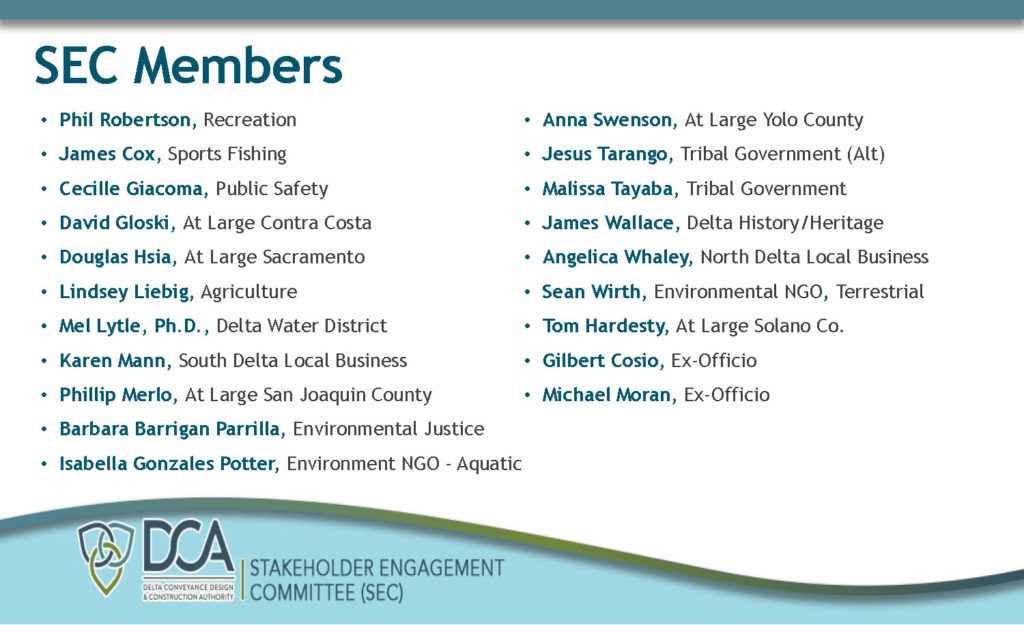
Stakeholders Engagement Committee – Local Voices
Because Contra Costa County and the water districts in the county either oppose or are neutral on the Delta tunnel project, no agency from the county is part of the DCA. But there are three people who live and one who works in Contra Costa County and serve on the Stakeholder Engagement Committee. They are Bethel Island resident and retired engineer David Gloski, Discovery Bay resident and real estate appraiser Karen Mann, Antioch resident Jim Cox, a retired fishing boat captain, and Oakland resident Michael Moran, who works for the East Bay Regional Park District as Supervising Naturalist at Big Break Regional Shoreline Visitor Center at the Delta in Oakley.
David Gloski, The Engineer – At Large Member
“I don’t want to understate that I’m against it and I appreciate the people fighting it,” said Gloski, who volunteered to be part of the SEC at the urging of others who also oppose the tunnel. “But I, having a home on the water and having an engineering background – and this DCA SEC group is more engineering focused – we want to make sure they don’t screw anything up.”
“The majority of the people on the stakeholder committee are probably against the tunnel,” he stated. “It includes the lady (Barbara Barrigan-Parrilla) from Restore the Delta. We’ve been effective in preventing them from doing things that don’t make sense and would negatively affect people in Contra Costa.”
“To me, they walk and chew gum at the same time. They’re working on designs and plans without having the permits. They have to do some of it or they don’t know what they’re asking to permit,” Gloski explained. “Similarly, we aren’t doing ourselves any benefit by just opposing it. Because if it does go through, we can get a lot of things done, like new roads, and parks. But you have to participate.”
“I’ve raised my hand to say, ‘if you’re going to build it, let’s get good things out of it, and make sure they don’t screw things up,” he reiterated. “I think the county is mistaken for not being more involved. The DCA made changes because of our inputs. Unfortunately, I’m not sure the inputs are the best from the county’s perspective. For example, an original plan included road and bridge improvements which were eliminated when we were successful in having a maintenance shaft moved further away from Discover Bay. So, you might have won the battle but lost the war.”
“I think we might benefit from more representatives. But right now, the county is just fighting it,” Gloski added.
To give your input to David Gloski, you can join his Facebook page, David Gloski DCA Stakeholder.
Karen Mann – South Delta Local Business
Mann, an appraiser in Discovery Bay, is another member of the stakeholders committee who opposes the tunnel, as the issue literally hits close to home for her like Gloski.
“I’m fighting for our Delta,” she said. “As I’m talking to you my grandchildren are loading the boat, because that’s what we do as a family. We spend time on the Delta.”
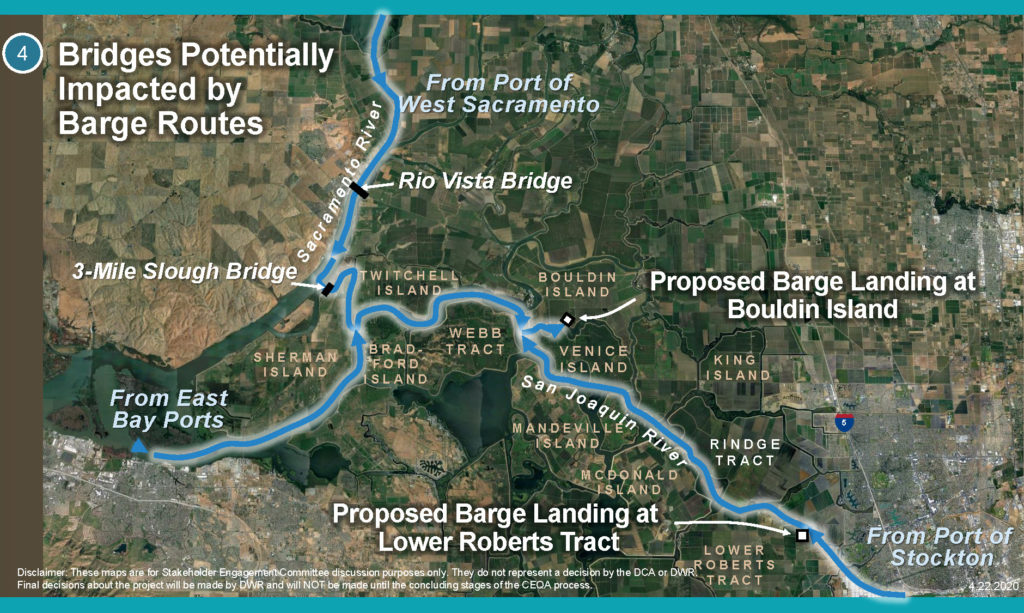
“I’m an active boater. I skipper my own 37-foot boat. I’m a very able-bodied skipper. My dad had me at the helm since I was 9 or 10 years old in San Pablo Bay,” Mann explained. “So, I’ve described to this group the terror that I had when I encountered a barge in the middle of Old River. That left me about 25’ (to get by it). My boat is 12-feet-wide. I could feel the propellers of the tugboat drawing me toward that barge. My boat weighs 22,000 lbs. Imagine if that was a ski boat with inexperienced skiers or a family with a father and his kids on board.”
“The number of barges every day that they were talking about loading, I told them ‘you better think twice. You will have lives of families and boaters on your hands,’” she continued.
Effort to Postpone Meetings & Work Due to COVID-19 Unsuccessful
“Through this whole pandemic thing, myself and a bunch of others have said ‘let’s hold off on these meetings’ because we can’t meet with our people,” Mann stated. “The chief engineer said, ‘we’re going to move forward, and we hate to leave you behind. But that’s how it goes. Governor Newsom wants this going.’”
“I piped up and said ‘it appears to me Gov. Newsom his been very busy with this pandemic thing and his three-hour-long press conferences each day, and the Delta tunnel is probably not at the forefront of his thinking,” she shared. “For us to be told, ‘no, that’s out of the question, we’re on a timeline’, this is just not right.”
 According to a report by the Sacramento News & Review, the effort to postpone the committee meetings and the work got a Sacramento County Supervisor and the Delta Protection Commission involved.
“The dust-up has caused Sacramento County Supervisor Don Nottoli to challenge one state official about transparency, while the Delta Protection Commission has officially asked California planners to halt their work on the tunnel during the virus outbreak. So far, that hasn’t happened,” reported the SN&R.
Contra Costa County Supervisor Diane Burgis serves on the Delta Protection Commission, which “is supposed to safeguard the environmental and community health of the estuary as part of California’s landmark 1992 Delta Protection Act.”
But the committee meetings are continuing, just online for now, as most if not all other government meetings are currently throughout the state.
No Project Funding or Route, Yet
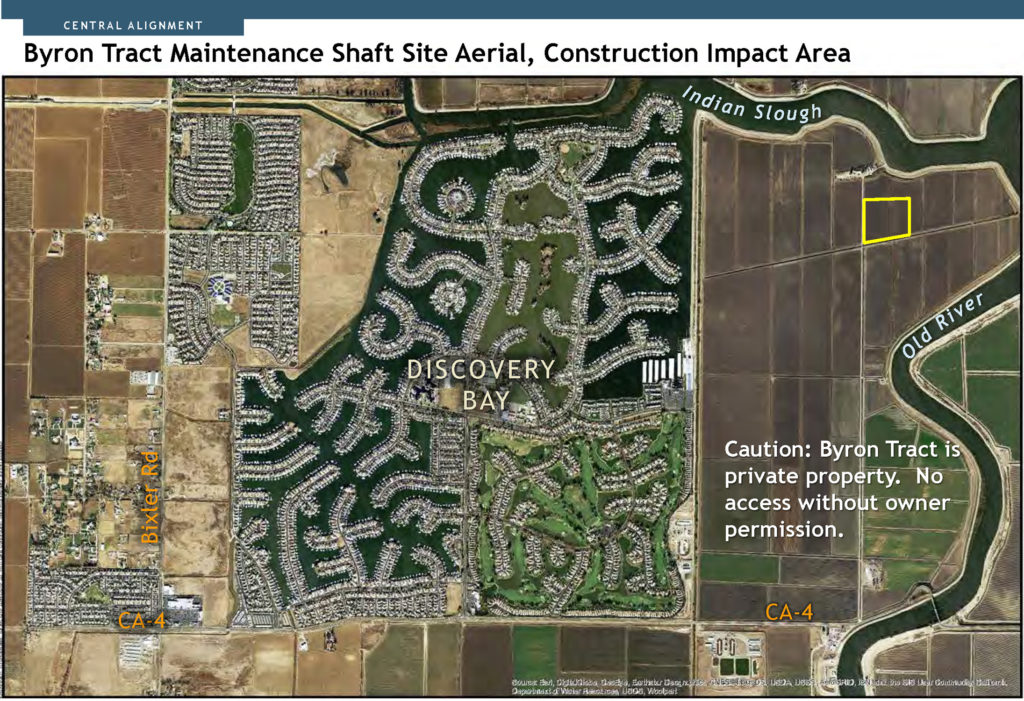
“I asked them where are we getting the money from? Apparently, there’s no checkbook. There’s no limit. There’s no talk about expenses. It’s like carte blanch. Money is no object,” Mann stated. “There isn’t an official route, yet. Because they’re trying to decide if there is going to be a central corridor which would be within 600 feet of the Discovery Bay water treatment plan and homes on the golf course.”
“That’s not the best of it,” she continued. “The best of it is they’re using their maps of that central location they would have taken that tunnel underneath the only waste treatment plant in the area.”
“They would also be going through our artesian wells,” Mann added.
“If there were any problems, “they would shut off the water and waste treatment for Discovery Bay. How could we live here? We’re not a third world country,” she said with a laugh.
“I’ve been very passionate about those two items,” Mann stated.
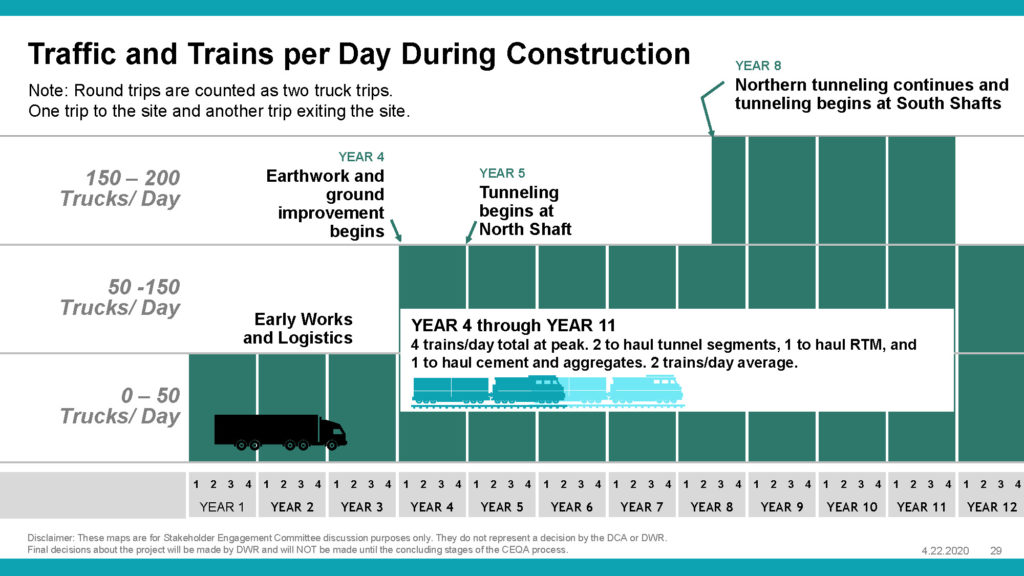
She, Cox and Moran all expressed concerns about trucks on Highway 4 east of Discovery Bay and how the committee’s efforts got that stopped.
“There was also going to be a maintenance shaft near Discovery Bay which would require truck traffic on Highway 4. Heavy duty trucks carrying the muck and dirt. Those bridges are old and couldn’t handle it,” she explained.
“Now they’re talking about using the eastern corridor closer to Stockton. But they told us ‘don’t get too excited. Nothing is decided. We’ll take your recommendations, but we will make our own decisions.’” That didn’t sit well with Mann.
“Is this how government is supposed to work?” she asked. “I will say they did listen on the barge issue. I think health and safety got them.”
Fire Marshal, DB Town Manager Shocked
“We took that information to the fire marshal and Discovery Bay Town Manager and they were shocked,” Mann shared. “Neither one of them knew about any of it. They both wrote impassioned letters. We have three fire stations that serve 128 square miles. The engineers thought we had nine stations.”
“So, who’s going to handle the issues…with a project like this?” she asked. “Someone’s going to get hurt and they’re going to need EMT’s. I guarantee you one of their trucks will have an accident and block traffic for hours, if not kill someone.”
“I’ve been sending the chief engineer photos of truck accidents and concerns that we have for our health and safety,” she continued. They had no idea of traffic count. They’re using traffic counts from five years ago from San Joaquin County and they don’t keep track of traffic on Highway 4 and the bridges in our county. So, their traffic counts are completely inaccurate.
“So, I’m wondering who’s really in charge here,” Mann said. “We’re supposed to trust them with building a tunnel 150 feet under ground? If they don’t have this basic information how can they handle the bigger issues?”
“The Delta has been something in my family since I was a child,” she shared. “It’s a way to keep families together. So, when you say Delta you’re talking about families. This life is too short, and you have to enjoy it while it lasts.”
Mann is both a residential and commercial appraiser, which is why she represents the business community on the committee.
She’s also the president of Save the California Delta Alliance.
“We have an attorney that got them to back out of the other tunnel project,” Mann shared.
“It’s just a bunch of homeowners. This is our home. The waterway is our backyard. Our playground. Don’t mess with it,” she concluded before heading out into the Delta for the weekend on the family boat.
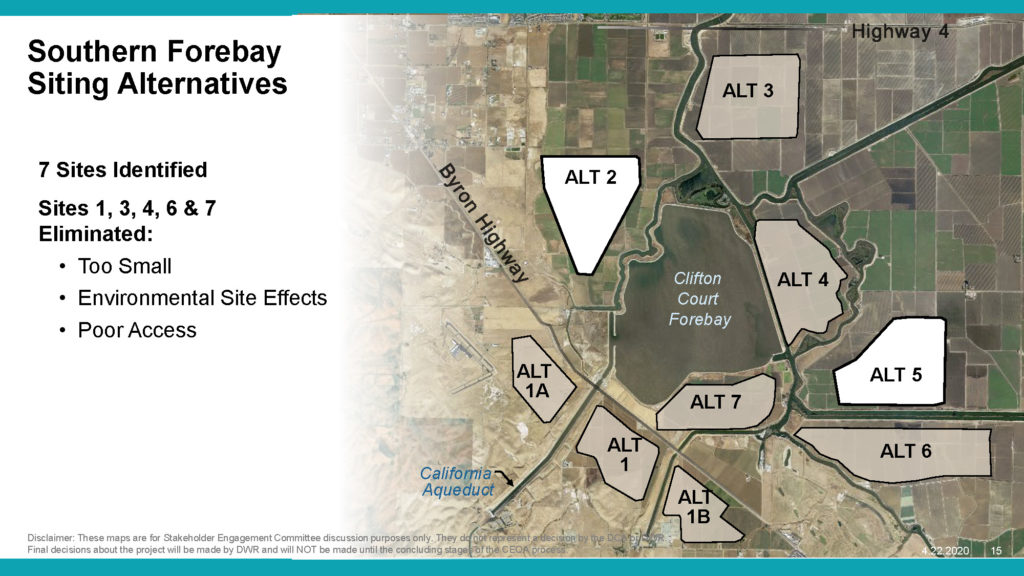
From 2020-04-22-SECMeetingPresentation.
“Same Old Song and Dance” on Fish Protections Says a Frustrated Jim Cox – Sports Fishing
Antioch resident Jim Cox ran a six-pack, sport fishing charter boat for 23 years and has been in the Delta since the early 1980’s and is now retired.
“I’m there representing fishing interests,” he shared. “It’s been a very frustrating thing to be involved in. They want us to come back with input from our constituents. The most common thing I hear is ‘what’s going to happen with Clifton Court?’”
The Clifton Court Forebay is where the water is collected south of the Delta before being pumped further south.
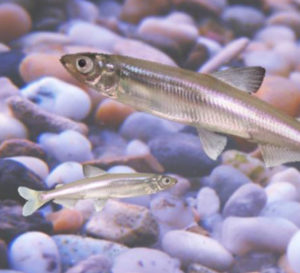
“When the current is flowing in there, it’s so strong the fish can’t get out,” Cox explained. “The screens on the pumps are not designed that well. Estimates are anywhere from 15-50,000 striped bass that are trapped in there. They’re only 8 or 9 inches but they’re fully matured fish.”
“They say Clifton Court Forebay is a separate project,” he continued. “I’ve had conversations with Terry Buckman from DWR. The Delta Improvement Act of 2009 has the two goals of habitat restoration and less reliance for water supply. They’re definitely focused on the water supply.”
“They call it EcoRestore, which is part of DWR and the ironic thing is they say ‘we’re not working on that for another year or so.’ This committee will be disbanded before then,” Cox stated.
“This is the same song and dance that fishermen have been told for the past 25 years,” he complained. “In 1994 there was the CalFed agreement. The water contractors were supposed to build state of the art screens across Clifton Court so fish couldn’t get in. But it’s still never been built. “
‘Most of these DWR folks are in their 40’s so they weren’t around…and they’re taking the word for it from others at DWR,” said Cox.
“The real problem is predation (preying of one animal on another), primarily for striped bass,” he continued. “It is a problem because the current flows in there, year-round, 24 hours a day. Larger fish just stick around at the entrance and pick off the smaller fish. They try to make it sound like it’s the striped bass. It’s not. It’s the fact they never built the screens.”
“We were told Fish and Game have plans to remove predators. They have no plans for any such thing. They say it’s a useless idea. Once you get rid of one predator another species will move in,” Cox shared. “Then they said the problem is the outer screens. There aren’t any outer screens. It consists of rabbit wire fence to keep boats and floating logs out of Clifton Court. It has nothing to do with fish.”
“They won’t say anything of how they’re going to make it better. This is why it’s becoming a frustrating endeavor for me,” he stated. “On the one hand they are being responsive to some complaints. But it all revolves around building the tunnel.”
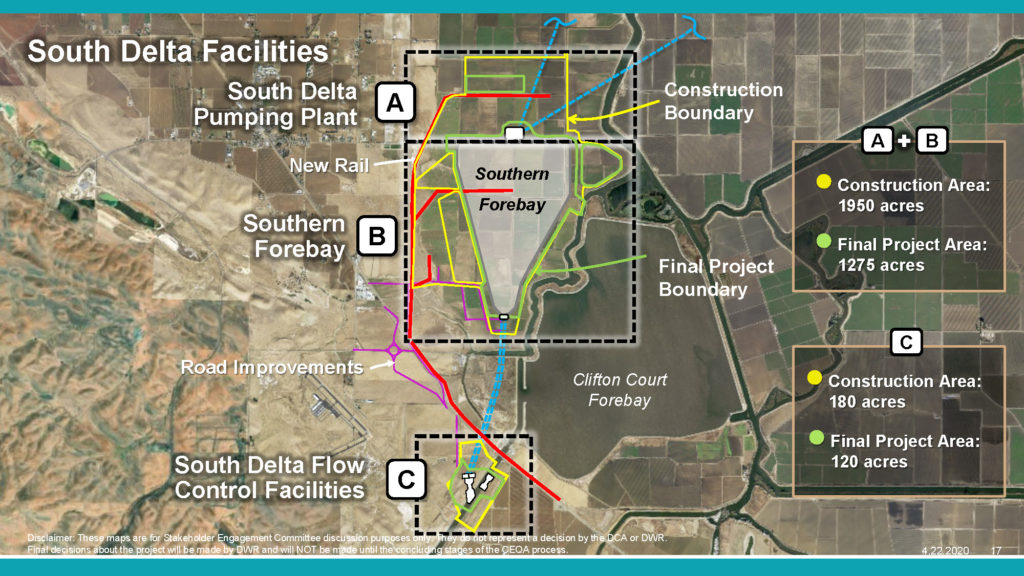
From 2020-04-22-SECMeetingPresentation.
“They won’t even listen to the fishermen. I’ve been tempted to resign a couple times over this. But, if I’m not there who’s going to bring this up?” Cox asked, rhetorically. “First, they talked about having the committee a year. But now they’re talking about extending it.”
“It’s very frustrating trying to get them to listen,” he added.
On finances Cox said “we get told things in bits and pieces. The plan is for all of this to be paid for by the water users, the water contractors. The fine print is they’ve agreed to this in theory, but not in reality. They’re not going to agree to anything until they see the final plan. Over the last year, they’ve been trying to do what took them three years originally on the twin tunnels, to finalize this plan, to be able to move forward.”
“When this COVID thing hit, they said everyone wants to continue to work on this. That’s BS,” he said echoing Karen Mann’s comments. “No one wanted to continue to do this. But they kept pushing on this because they have financing deadlines. So, nope. They’re going to keep on going.”
“I feel in a lot of ways this committee is just going through the motions. I’m starting to feel like a pawn in a chess game,” he said with a chuckle.
Another financial issue Cox shared about was the pay for the DCA’s executive director Kathryn Mallon, who is earning $47,000 per month in her role. That’s in spite of the $54 billion deficit the state is projecting due to the impacts of the COVID-19 pandemic.
Another report by the Sacramento News & Review covers that issue and the opposition from the water agencies that are expected to reimburse the state for her compensation.
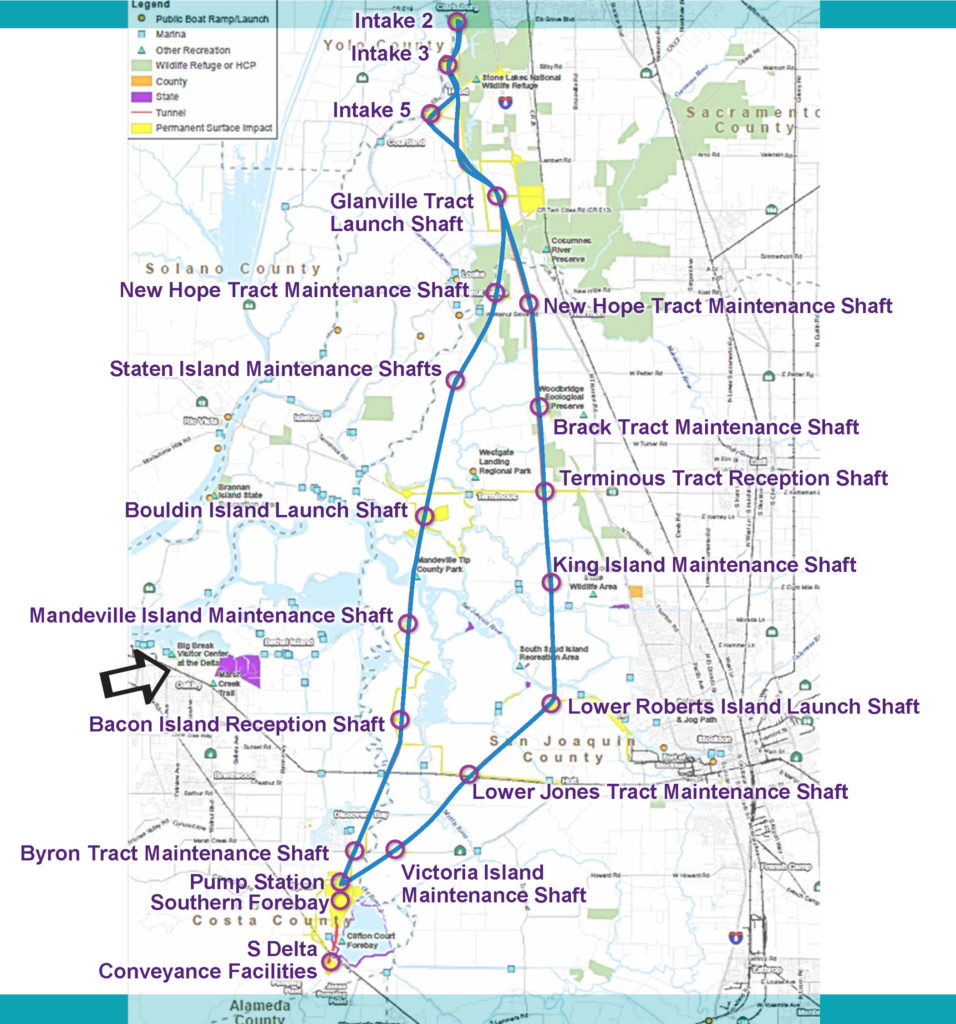
Proximity of proposed sites to existing recreation facilities. Arrow points to Big Break in Oakley. From 2020-04-22-SECMeetingPresentation.
Parks District Employee Offers Different Perspective: Mike Moran – Ex-Officio
Mike Moran, although an Oakland resident, represents Contra Costa County interests on the SEC, having worked in Eastern Contra Costa County for 26 years, as of August 1st. He works for the East Bay Regional Park District at the Big Break Regional Shoreline in Oakley.
“Big Break was an asparagus farm that flooded in 1927,” he shared. It’s a 1,688 acre park that’s mostly under water. The East County trail runs through there. Plus, they have a 1,200 square foot model of the Delta on the ground.
“In my position at the park commission and the SEC, we don’t take a pro or a con on this issue. We try to interpret this thing and why it’s being proposed, why it’s being opposed, and not just build it or don’t build it,” Moran explained. “I’m an ex-officio giving folks’ perspective from the East Bay Regional Parks point of view. There’s not a direct correlation on the tunnel.”
“We have land out here and we have folks paying taxes to get access to that land. So, what does this mean? What is the impact going to be where our constituents live?” he asked.
Moran also studied fisheries in grad school. Asked about the fish and Clifton Court Forebay that Jim Cox is concerned about, he said, “It’s part of the state water project, right now. The new forebay would be right next to Clifton Court, built to the west.”
However, Cox responded with, “The fact is that they still intend to use Clifton Court fifty-percent of the time. If the tunnel water was the only water heading into the canal then it would be fine, but that is not the case. Clifton Court will still be part of the water system and that is why I feel improvements to it should be part of the project, not a separate project.”
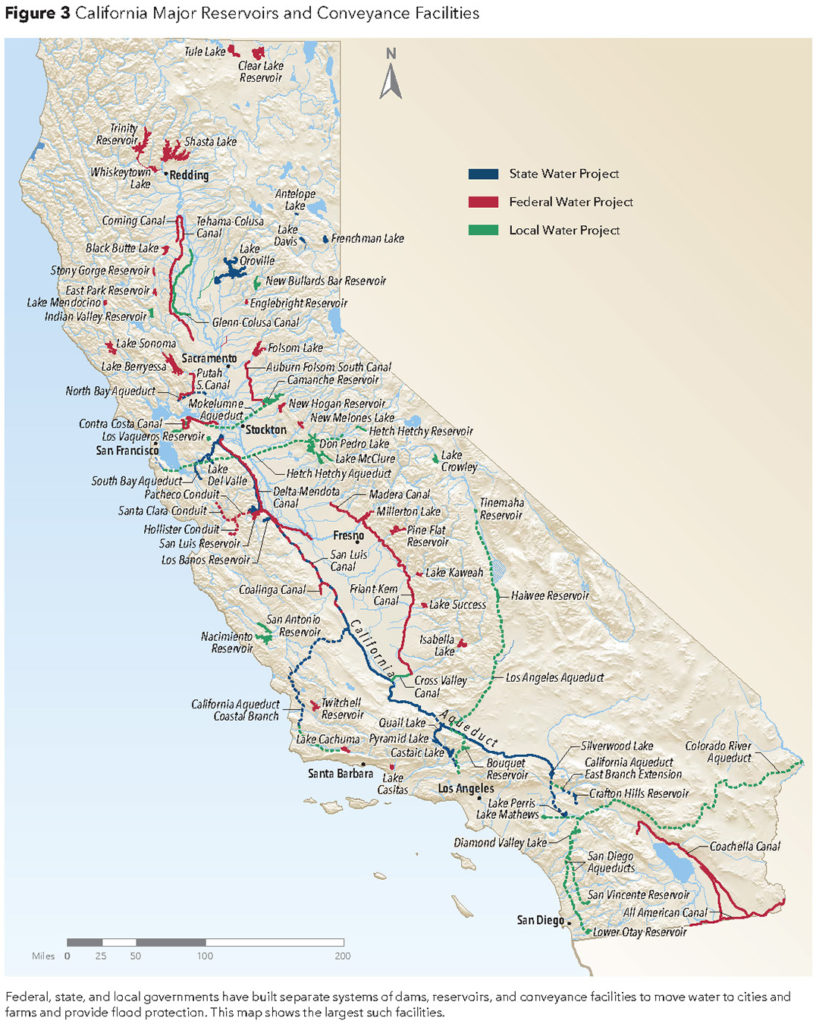
“The Harvey Banks Pumping Plant is part of the State Water Project. That water is sent through the California Aqueduct and the South Bay Aqueduct serving Alameda and Santa Clara Counties,” Moran explained.
“The feds will require an Environmental Impact Study on the project because it affects federal waters. That’s the Jones Pumping Plant, which is part of the federal water project. That water is pumped through the Delta Mendota Canal,” he shared.
“At the Clifton Court Forebay, as the water is drawn in, there’s a screen that screens out the fish. But it’s old school. It’s an old screen,” Moran explained. “Jim’s saying if we’re going to put in these high-tech screens north of the Delta, let’s do it at Clifton Court.”
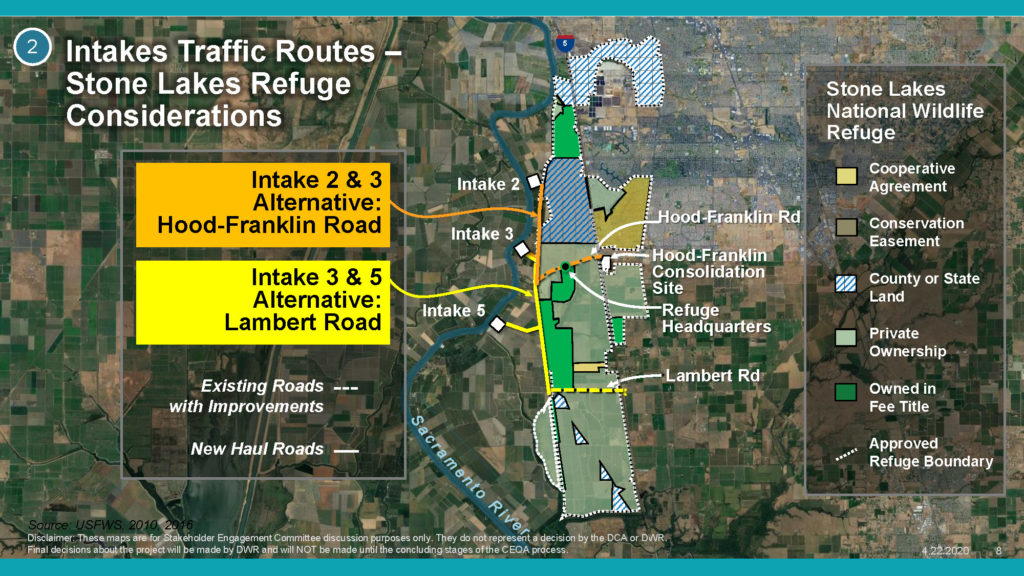
Proposed intakes near Hood. From 2020-04-22-SECMeetingPresentation.
“The screening for the proposed tunnel will be located in Hood (north of Elk Grove) on the eastern side of the Sacramento River. There will be three intakes and those would have brand new, top of the line fish screens,” he continued. “So, no fish will be put in that tunnel beyond those screens.”
“That’s one of the selling points for this whole project,” Moran stated. “What we have now, is the diversion is over the surface across the Delta. So, we’re bringing in both water and fish.”
He provided some history to the diversion of Delta water.
“The idea of diverting water, moving water from the north and east, through the Delta is from the 1910’s,” Moran shared. “A lot of the facilities we have now, are not the same thing, but they’re based on Robert Marshall’s plans. He ran the national parks and was pushing this big project of moving water around California. So, that’s part of the rationale of what we have, now.”
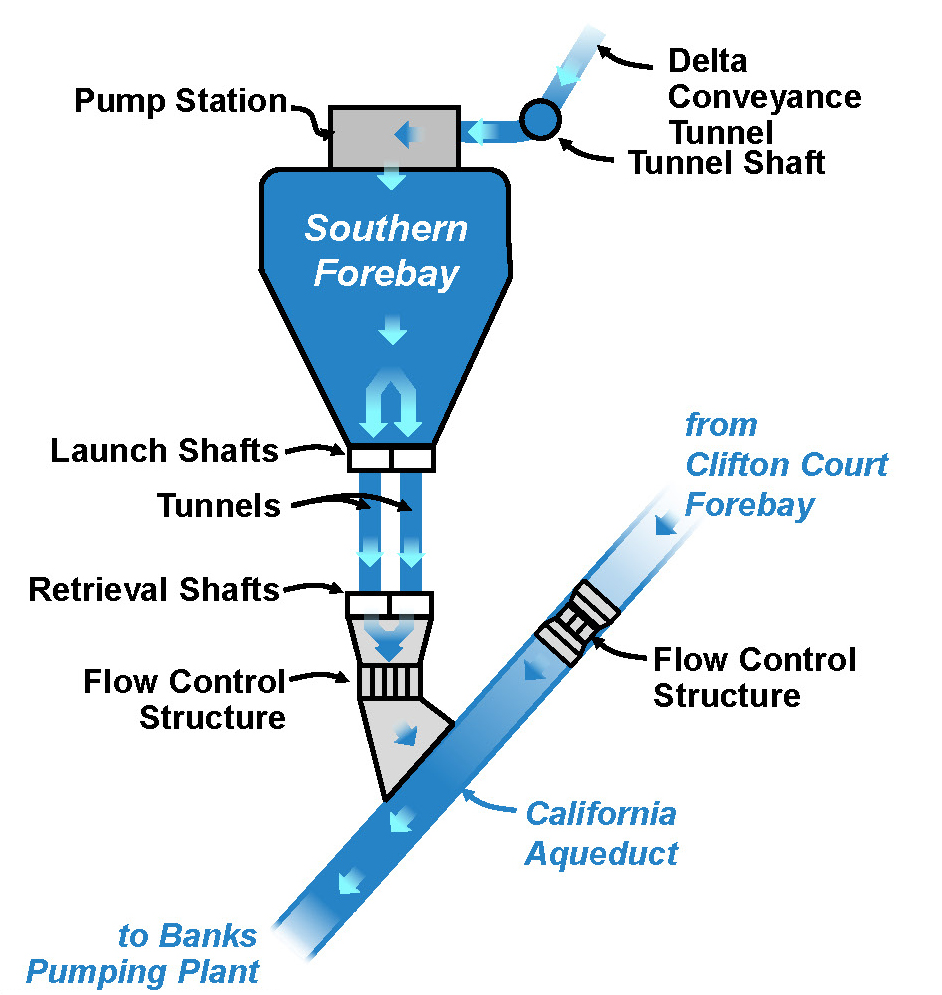
Proposed South Delta Facilities. From 2020-04-22-SECMeetingPresentation.
He also shared that “Antioch sued upstream water users in 1921 because of too much saltwater. So, this is nothing new.”
“Antioch is way ahead of the game putting in a brackish water plant. That’s a big, bold move,” Moran state. “But what are we going to do with saltwater intrusion up to CCWD?” (See related article)
Asked how the tunnel is a solution to the saltwater intrusion he answered, “It’s coming. If we divert or not, saltwater is coming. How do we prepare for that? In Antioch we build a desal plant. For those south of the Delta it’s a tunnel.”
“The way we’re doing things now, is water flows from the Sacramento River to the rest of the Delta. The pumps in Byron then pump it south,” Moran continued. “This water used to flow down the river and out into the Bay. Sometimes during the year, we have reverse flow, with the water from both the Sacramento and San Joaquin Rivers. When folks started taking water out in the Central Valley, less water comes out of the San Joaquin River. It was dry for 60 miles as recently as 1994. That was rectified through a court case.”
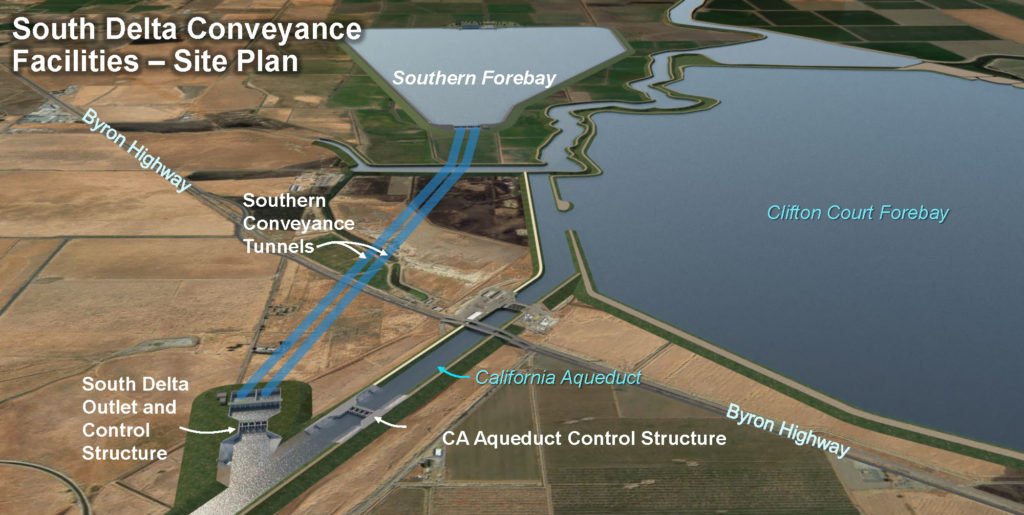
Proposed South Delta Conveyance Facilities Site Plan. From 2020-04-22-SECMeetingPresentation.
Because the San Joaquin River is diverted before it reaches and “punches through the Delta”, farmers in the Delta have been relying on Sacramento River water.
“The Sacramento River, high quality, great water, it’s pulled down to the pumps. Not all the water, it’s less than half,” he said. “That goes against the natural flow and messes up the ecology.”
“We’ve gotten a lot of benefit over the past 100 years,” with the current system, Moran shared.
“So, if we don’t do something, if saltwater comes up, or if a levee breaks or a beaver chews through, that’s going to stop the flow of water.”
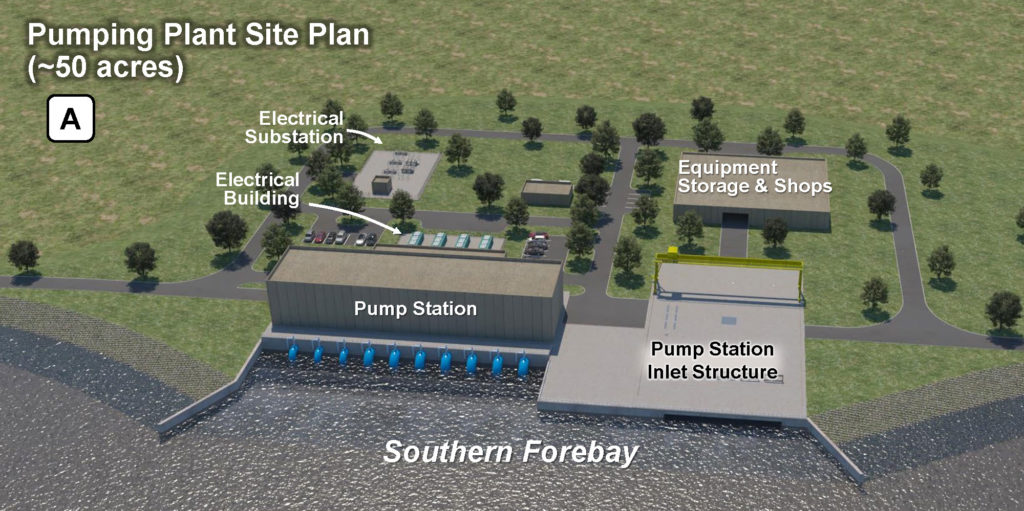
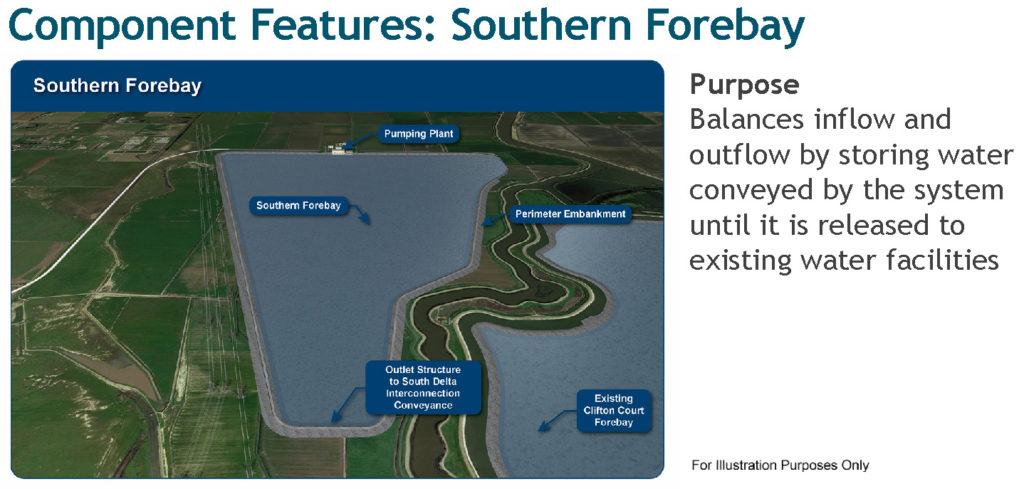
Rendering of proposed Pumping Plant Site Plan at the Southern Forebay. From 2020-04-22-SECMeetingPresentation.
“Much of the land in the Delta is under sea level because of that peat soil, which is great for farming,” he explained. “But because of decisions made over 100 years ago, because people in the Delta communities and economies, and their way of life, it’s not sustainable.”
“We’re only taking water out when there’s enough to come through,” said Moran. “Like we’re doing, now when there’s Delta Smelt at the pumps, and we have water quality going down the tubes, the feds tell them to stop pumping.”
“It’s these local folks who are members of the committee saying, ‘wait a minute, we have lives that will be affected, too,’” he shared about his fellow SEC members. “The premise is let’s pretend this is getting built. If that’s the case, all you folks around the Delta who have this local experience and expertise, to advise the experts from the DWR.”
“So, that the water can be used all year round. That’s the point of it,” Moran continued. “Is there enough storage south of the Delta? If you’re going to pump water out of the Delta where are you going to store it? There’s the San Luis Reservoir, are we going to raise the height?”
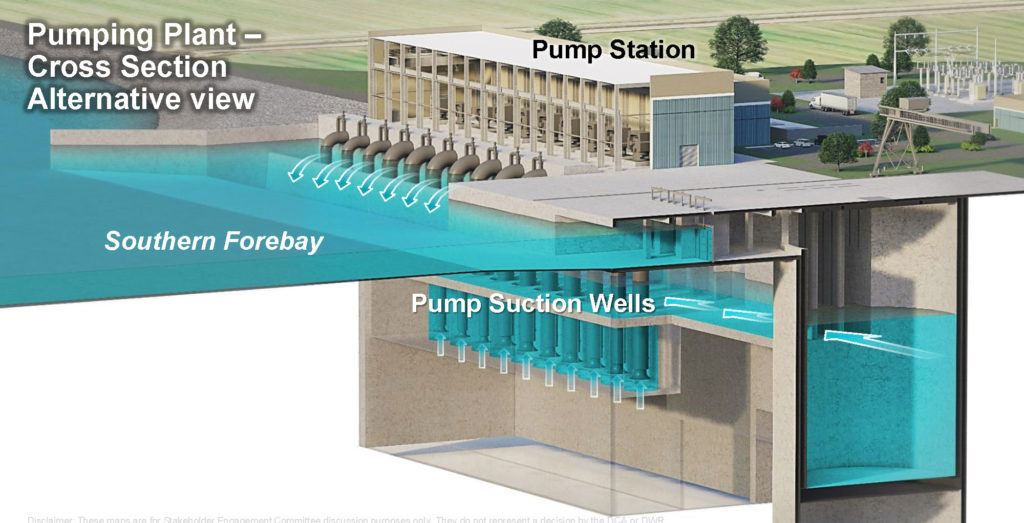
Rendering of proposed Pumping Plant at the Southern Forebay. From 2020-04-22-SECMeetingPresentation.
“Every governor has dealt with it, but Newsom is getting more traction,” he shared. “They have this portfolio plan which includes storage, moving water and ground water restoration. Not just sticking straws in the Delta and sucking it.”
“When it’s a common pool and we all have to drink out of the Delta and we all have to be responsible for it including maintaining the levees, and agriculture in the Delta,” Moran concluded.
No Committee Member Supports the Tunnel
 Asked about the members of the stakeholders committee and how they were chosen, Nazli Parvizi, the Stakeholder Engagement lead for the DCA, said, “There is not a single member on the committee who supports this project. That’s based on what they wrote in their applications and others, what they’ve said over and over during the meetings.”
“It was an individual application. Not everybody represents their area of work. The requirement was if you live, work or recreate in the Delta in certain categories,” she explained. “If you have an ag person you balance it out with an environmental person. So, I think we have a good broad representation.”
“What we’re excited about Karen…she’s as reliable a source on waterways and boating as Jim Cox would be,” Parvizi shared.
“It’s not a voting body. We don’t make decisions as the DCA,” she explained. “We try to come up with the best engineering and design, the concepts and drawings and give them to Department of Water and it’s up to them.”
“We’re doing our best to take into account the Delta as place,” Parvizi continued. “So, they don’t just make sense from an engineering standpoint, but also as Delta as place. The folks who lead the DCA are representatives from DWR and the agencies that are members of the DCA. Kathryn Mallon, the Executive Director of the DCA is listening and took into consideration the Delta as place. The SEC is the result of that.”
About the committee members’ involvement, she said, “It’s trying to make the best of the worst, while at the same time trying to make sure it doesn’t happen. Karen has done a great job for Discovery Bay and boaters.”
“So, fight on your own time, protest, sue us, whatever and we’re OK with that and several are suing us,” said Parvizi. “We do want to make sure we are respectful of what you care about. They give us incredibly valuable feedback.”
“They fight their war, but on the battles they’re very collaborative,” she stated. “We give them all this information, being transparent as possible and half of them send it to their lawyers, which is fine. But they tell us which is better, A, B or C, and we make our recommendations to DWR.”
“We haven’t seen two groups fight it out,” Parvizi said, and explained how the members of the SEC work collaboratively. “If you move it (the tunnel) this way, it’s good for fish, but if you move it here, it’s good for birds. Or it’s good for animals. But if you put it here, it’s good for business.”
“We can come up with the pros and cons and I think that’s very valuable,” she added.
Opposition Efforts Continue
 Efforts continue to stop the new Delta tunnel by groups such as Restore the Delta that have been fighting since the twin tunnels plan was first proposed. They along with Contra Costa County and the other members of the Delta Counties Coalition, Delta residents, Delta business owners, tribal representatives, fishing and non-governmental organizations and other Delta community-based organizations have all asked the Department of Water Resources (DWR) to pause Delta tunnel planning processes that require public participation due to the impact of the coronavirus pandemic. The Department of Water Resources has refused.
Contra Costa is represented on the DCC by County Supervisor Karen Mitchoff.
In their letter dated April 7, 2020, the DCC wrote California Natural Resources Agency Secretary Wade Crowfoot, “The Delta Counties Coalition (DCC) respectfully requests that you direct the Department of Water Resources (DWR) to pause all Delta Conveyance Project planning and engineering design processes that require Delta stakeholder engagement during the COVID-19 crisis, until the public can fully participate. We request that you ask the Delta Conveyance Design and Construction Authority (DCA) to pause its processes that require public participation, including Stakeholder Engagement Committee meetings, so that the Delta tunnel engineering design can be informed by meaningful public input. We also ask that you direct DWR and other resource agencies to extend public comment periods by at least 45 days beyond the end of the declared emergency.” 2020-04-07-Delta Counties Coalition-Letter-to-Secty-Crowfoot-re-Stay
The Secretary Crowfoot and the Department of Water Resources has refused, but have instead allowed the DCA and SEC to hold their meetings online.
Upcoming Meetings
The next meeting of the 20-member DCA Stakeholder Engagement Committee will be held on Wednesday, July 22, 2020 from 3-6 PM. Topics are expected to include: Scoping Update (DWR), Rehabilitation of construction impacted land, Final temporary and permanent boundaries, and Intakes Update (*subject to change). Ring Central Video Conference. Information Join from PC, Mac, Linux, iOS or Android: https://meetings.ringcentral.com/j/1489140415; iPhone one-tap: US: +1(916)2627278,,1489140415#; or Telephone: US: +1(623)4049000 Meeting ID: 148 914 0415.
Ways to Stay Informed
To stay informed of plans and progress on the Delta Conveyance Project visit https://water.ca.gov/Programs/State-Water-Project/Delta-Conveyance; Twitter @CA_DWR; email DeltaConveyance@water.ca.gov; or call the Project Hotline at 866.924.9955.












 The California Department of Public Health on Friday announced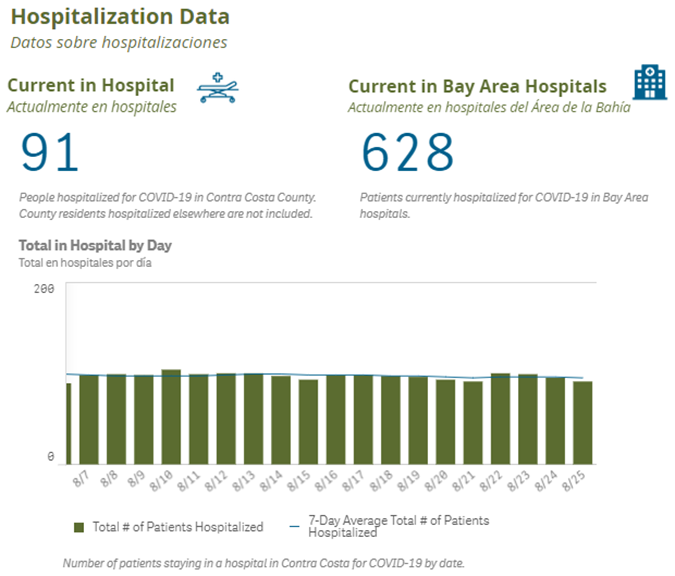
 Daily hospitalizations due to COVID-19 and the percentage of COVID-19 tests returning positive remained steady or fell slightly in Contra Costa County during early August, reflecting recent local progress in slowing the spread of a deadly virus. The seven-day rolling average number of patients hospitalized with COVID-19 in Contra Costa dropped slightly, from 103 on Aug. 5 to 96 on Aug. 24. The average percentage of tests administered in the county that come back positive, meanwhile, has fallen from 8.8% on Aug. 6 to 7.4% on Aug. 24.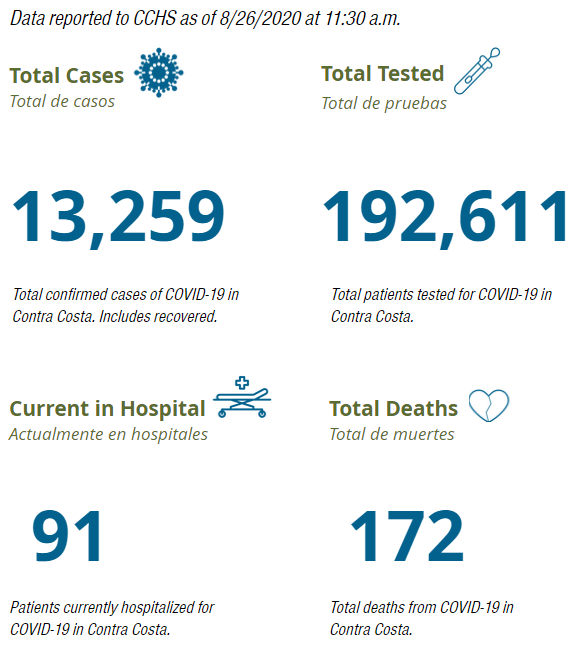
 By Allen Payton