East Bay Furniture Outlet to celebrate Grand Opening of their new location in Antioch this weekend
Monday, February 19th, 2018












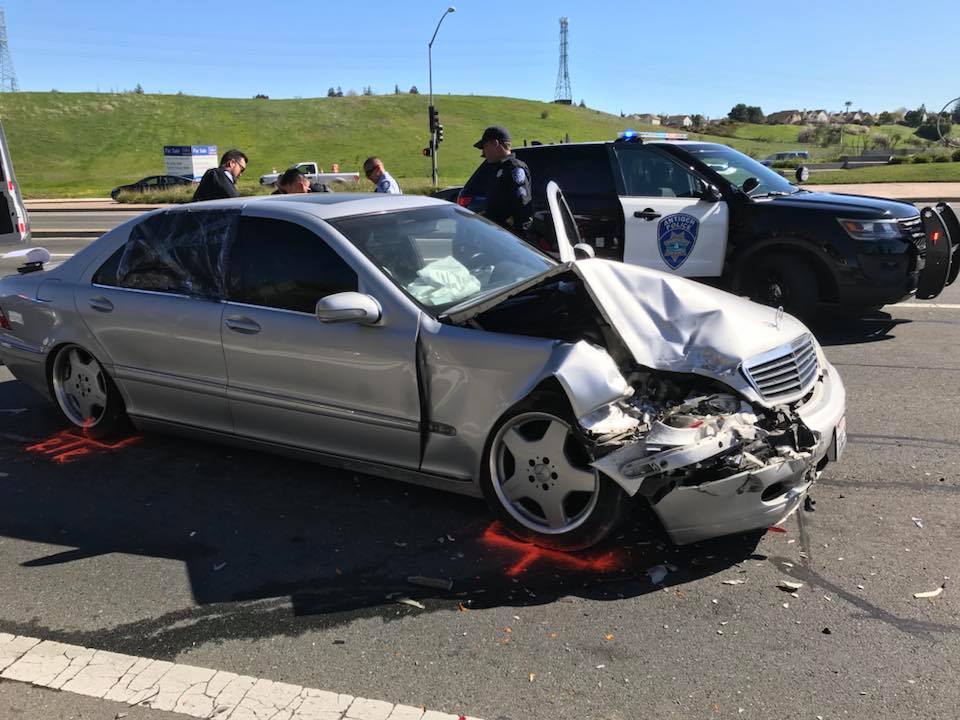
The car in which the driver who died and passenger were traveling, which struck the car in front at the intersection of Hillcrest Avenue, Davison Drive and Deer Valley Road, Friday, Feb. 16, 2017. Photos by Allen Payton
By Acting Lieutenant Rick Martin #3343, Antioch Police Field Services Bureau
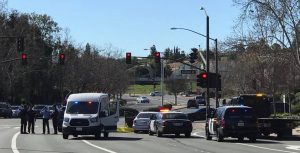
Antioch Police on the scene of the accident, preparing to remove the driver’s body from the scene.
On Friday, February 16, 2018 at approximately 9:30 am Antioch Police Officers responded to the intersection of Hillcrest Avenue and Davison Drive on a report of a vehicle collision. Upon arrival, one of the drivers involved appeared to have a medical emergency. ConFire and paramedics arrived a short time later and conducted life saving measures. The 49-year-old male from Berkeley was later pronounced deceased at the scene. Drugs or alcohol do not appear to be a factor in this case.
According to Antioch Police on the scene, the driver of the silver Mercedes (pictured), is believed to have died prior to the accident. A worker with Fernandez Towing on the scene said, “A passenger in the car said he felt bad and fell over and had a heart attack.”
The passenger said the driver “stayed up the street in Antioch,” and that he “all of a sudden slumped over, his eyes rolled back. I tried to put my foot over and tried to hit the break, but it was too late. He accelerated, and we hit the car in front of us. Then I seen him move so I thought he was OK. A lady from the other car – who had a baby in there – came over. I told her my friend is sick. But he was gone.”
All three vehicles had to be towed from the scene.
Anyone with information regarding this incident is encouraged to call the Antioch Police at (925) 778-2441 or Traffic Officer Robert Solari at 925-779-6900 ext.82372. You may also text a tip to 274637 (CRIMES) using key word ANTIOCH.
Allen Payton contributed to this report.
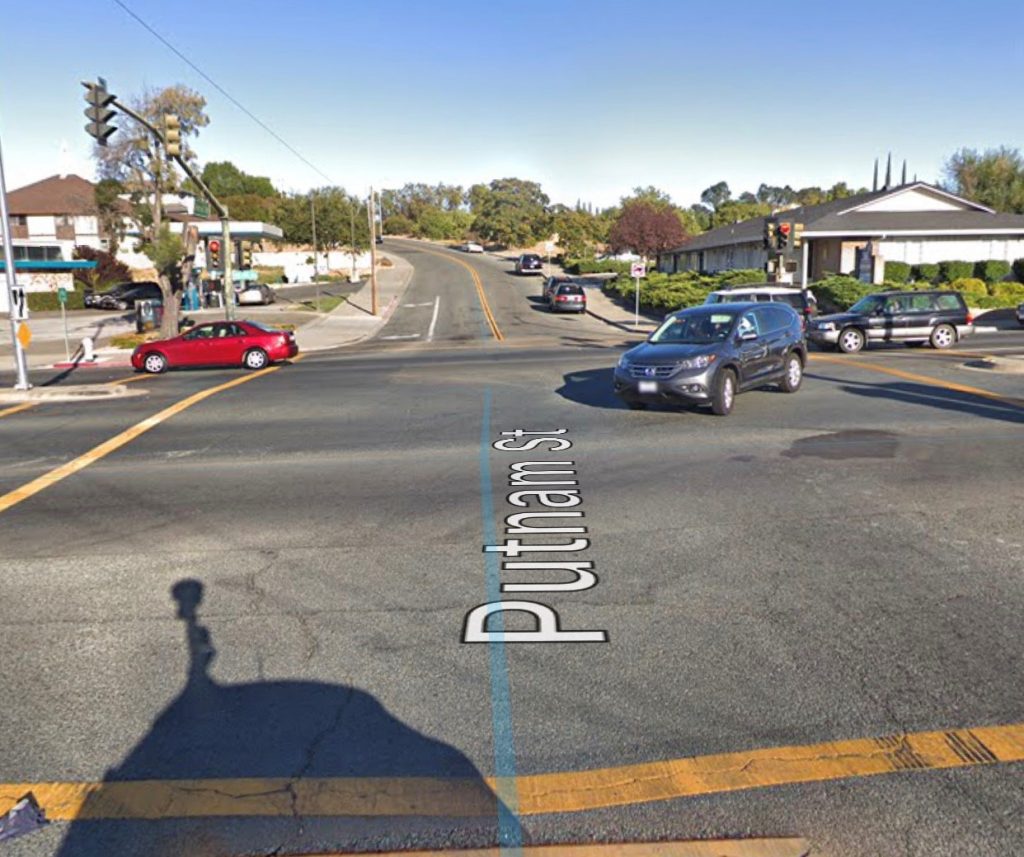
The accident occurred at the intersection of Lone Tree Way and Putnam Street. Screenshot of Googlemaps.
By Acting Lieutenant Rick Martin #3343, Antioch Police Field Services Bureau
On February 16, 2018 at approximately 7:35 am, Antioch Police Officers responded to the intersection of Lone Tree Way and Putnam Street on a report of a vehicle collision involving a pedestrian. Upon arrival, officers located a juvenile male with injuries. The driver of the vehicle remained at the scene and was cooperative with the investigation. The child was transported to a local hospital with non-life-threatening injuries. Speed does not appear to be a factor in this case.
Anyone with information regarding this incident is encouraged to call the Antioch Police at (925) 778-2441. You may also text a tip to 274637 (CRIMES) using key word ANTIOCH
 Stage Right Conservatory Theatre will hold auditions for “Charlie and the Chocolate Factory” on March 5th and 6th at the Nick Rodriguez Community Center, 213 F Street in Antioch. This classic tale of Charlie Bucket on his adventurous tour of Willy Wonka’s world-famous chocolate factory is based on the book by Roald Dahl and produced by special arrangement with The Dramatic Publishing Co. Directed by Rio Teixeira, there are many great roles available for actors ages 8-18. No experience is necessary.
To receive your audition time, you must register online at www.srctgrp.org. Performance dates will be April 20th, 21st, 22nd, 27th, 28th & 29th. There is a $75 participation fee if cast. For more audition and show information call (925) 216-4613.

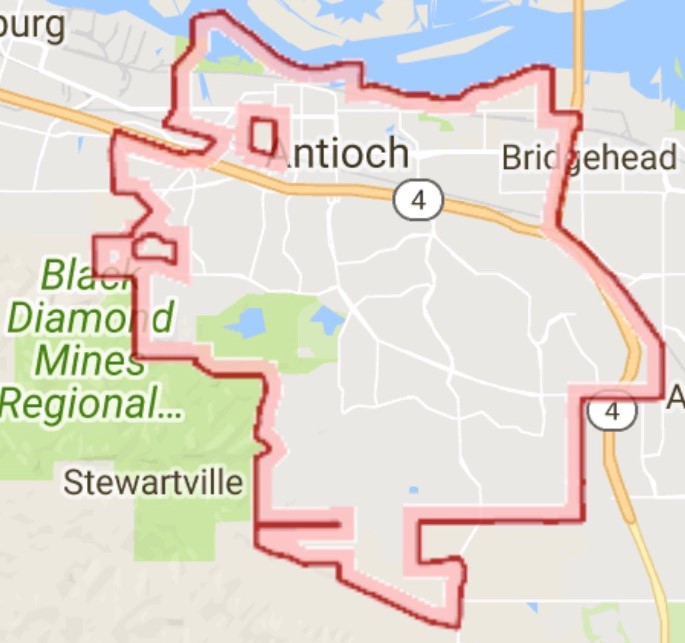
How should the City Council divide Antioch into four equal districts? Create your own map and offer your input now through April 10.
Next hearing Thursday night, Feb. 15 at 7:00 p.m. at Antioch Community Center in Prewett Park
By John Crowder
The City of Antioch held it’s first of two public hearings on Districting on Tuesday, February 13 and not all residents are happy about it. Districting is the process that may result in changing from the current system of at-large elections for city council members to one in which representatives are elected from four districts, by voters who live in each district. (See related articles, here and here).
When the agenda item was reached, late in the meeting, Interim Antioch City Attorney Derek Cole explained the process
According to Cole, it was the first of five meetings the City would undertake as part of the process to convert from at-large elections of City Council members to elections held by District. However, the mayor would still be elected citywide under the new system. Cole introduced Karin MacDonald, Principal Consultant of Q2 Data and Research, the consulting firm tasked with leading the districting process for the city. Q2 was the same firm selected as the consultant to the California Citizens Redistricting Commission for the statewide decennial effort in 2011.
MacDonald provided a slide presentation explaining the districting process. As she explained, the 2001 California Voting Rights Act (CVRA) made it easier for members of a protected class to prove that at-large elections ‘dilute’ their voting strength. In November 2017, the Council received a ‘demand letter’ asserting a violation under the CVRA. As a result, in January 2018, the Council passed a resolution of intent to move from at-large to by-district elections.
According to MacDonald, the strict timeline and constraints imposed by the CVRA require the entire process be completed in 90 days, that five hearings take place, and that two of these hearings occur prior to creating a draft map. At the final hearing, the Council can adopt the Council District Boundaries.
Besides explaining the process, the February 13 hearing would serve as the first of two hearings designed to gather community input. The second will take place on February 15, at 7:00 pm, at the Prewett Community Center.
The third meeting is scheduled for March 10, at 9:00 am at the Nick Rodriguez Community Center. During that meeeting, consultants will present the input received and outline draft maps and options. The Council will be able to create a draft map during the meeting. The draft map will be available for comment online and elsewhere around March 12.
The final two meetings will be held on March 27 and April 10, both at 7:00 pm in the City Hall Council Chambers. At these hearings the ordinance will be read. At the final hearing, it is anticipated that a vote will take place on the ordinance.
MacDonald noted that there are five criteria used for drawing districts; equal population, compliance with the Federal Voting Rights Act (FVRA), contiguity, compactness, and respect for communities of interest. Not to be considered are incumbents, candidates, and political parties. Elections could be undertaken by districts as early as November 2018.
During the hearing, a handful of speakers weighed in, some supporting and some opposing the idea of district elections.
Nancy Fernandez, the first speaker, stated her opposition to district elections. “They don’t function because each council member is trying to please his voting constituents and not doing the business of the city as a whole,” she said.
Planning Commissioner Jim Conley also spoke in opposition. After stating that Antioch has a diverse community and a diverse city council, he said that districting makes council members very parochial and leads to backroom deals being done. “The City doesn’t matter,” he said, “It’s your district that matters.”
Planning Commissioner Kerry Motts expressed support for district elections. He said that districts have worked elsewhere and will solve a major problem of underrepresentation in the northern part of Antioch.
Two members of the East County Regional Group spoke in favor of district elections. They argued that district elections would make running for office more accessible, and asked that the number of immigrants, low-income, families, and people of color be considered in forming districts.
Representing the Rivertown Preservation Society, Joy Motts also spoke in favor of district elections. She said that members of the Rivertown community do not feel they are represented or listened to and said that the creation of a path for a North Rivertown representative should be a priority. She dismissed the idea that elected officials would be parochial, saying, “Quality leaders will work together.”
The last to speak from the public was long-time resident Larry Harrison. Calling the move to district elections, “utter nonsense,” he said that it was, “a solution without a problem.” He advocated banding together with other cities that oppose moving to district elections and working to overturn the law that was forcing the change.
During Council discussion, Mayor Pro Tem Lamar Thorpe began by saying, “This is not a done deal.” He went on to say that, while the Antioch City Council is diverse, other elected offices must be considered, and other factors besides race should be taken into account. (Mac Donald responded that race could not be considered in drawing districts.) Thorpe also said that the process had created more competitive elections in other electoral races.
Council Member Tony Tiscareno noted that the demand letter was based on lack of Latino representation, yet, “we have Latino’s living throughout the city.” He also raised the concern that data from the 2010 census would be used to draw the maps. “Right now, it’s very confusing to me,” he said.
Mayor Sean Wright agreed with Tiscareno that the process, and the premise behind it, were confusing. “The confusion for all of us, is that we’re threatened because we’re ‘racially polarized.’ It just does not make sense,” he said.
Council Member Lori Ogorchock expressed concern with the lack of attendance. “There’s maybe forty people here,” she said. “We really need to hear everybody’s point of view. We want everybody to have their voices heard.” She encouraged those present to share information with their neighbors.
Following the hearing, the lead consultant, Ms. MacDonald, emphasized the need for as much public input as possible to create, “lines that will work.” She asked that City residents go to the City Website and to the Districting page, http://districtelections.ci.antioch.ca.us/, and share their comments and even create their own draft maps using the interactive city map.
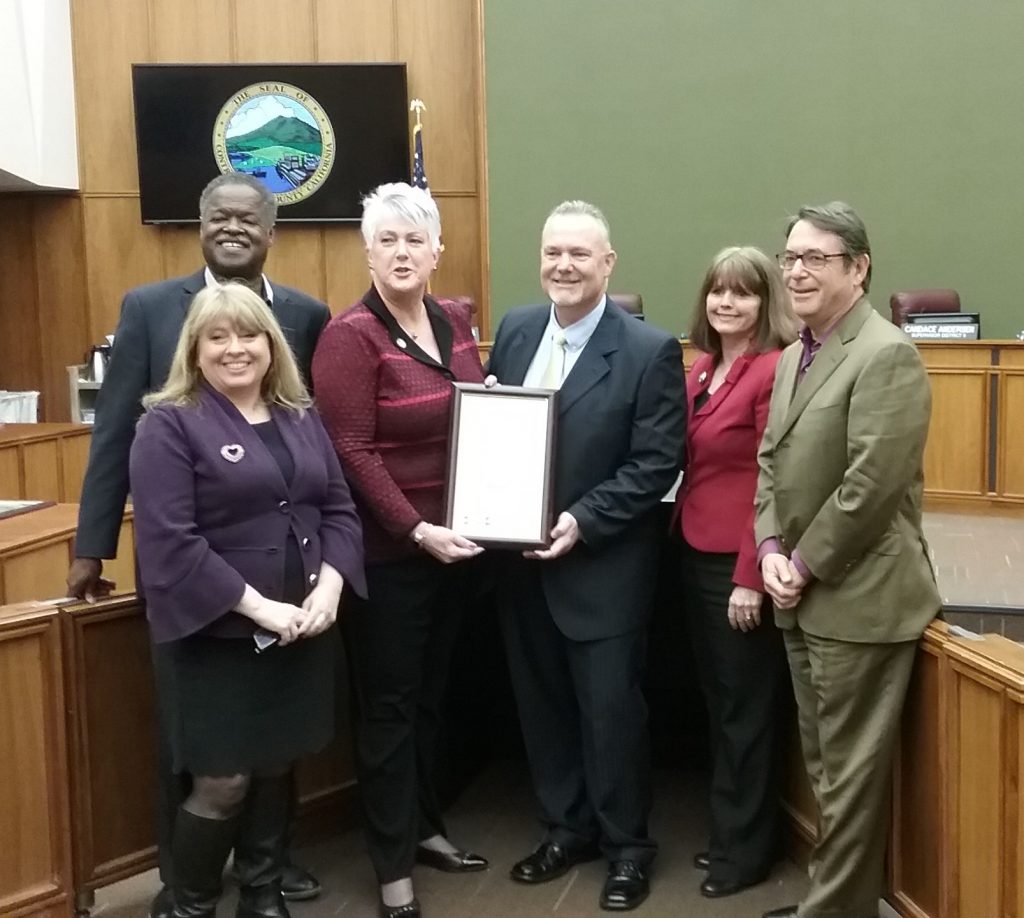
Supervisors honor County Auditor-Controller Robert Campbell for his 30 years of service. Shown are from left: District 3 Supervisor Diane Burgis, District 5 Supervisor Federal Glover, Chairperson and District 4 Supervisor Karen Mitchoff, Campbell, District 2 Supervisor Candace Andersen and Vice Chairperson and District 1 Supervisor John Gioia. Photo by Daniel Borsuk
By Daniel Borsuk
With scant protest, Contra Costa County Supervisors unanimously approved Contra Costa County Clerk-Recorder Joe Canciamilla’s request Tuesday to replace the county’s aging ES&S voting system with a system made by Dominion Democracy Voting Systems, Inc.
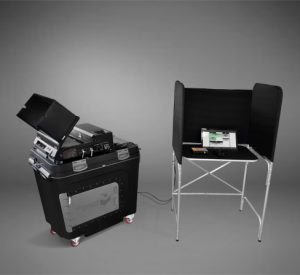
Courtesy of Dominion Democracy Voting Systems, Inc.
The new voting system, the Democracy Suite System made by Dominion will be delivered in time for the special March election for the East Contra Costa Fire Protection District and will be widely put into service for the June gubernatorial election, Canciamilla said.
The county has used the ES&S voting system since 2005.
Supervisors, particularly Chairperson Karen Mitchoff and District 4 Supervisor Candace Andersen, said they had received several emails from citizens questioning the fiscal validity of acquiring a new voting system in an era of election system security vulnerability.
Andersen wanted to know why the county did not put out a request for proposal (RFP), and Scott Konopasek, assistant county registrar, answered that the Secretary of State has to certify voting equipment suppliers. There are few voting equipment suppliers that meet rigid state requirements. It happens that both Dominion Democracy Voting Systems and ES&S are voting equipment suppliers the Secretary of State has certified and an RFP is unnecessary.
But in the county’s evaluation, Dominion Democracy took top honors, said Konopasek.
In evaluating the Dominion Democracy and ES&S systems, Dominion Democracy came out on top with a score of 39 points out of 60 possible points. Dominion Democracy scored highest, especially in the areas of integrated software, ballot marking device, central count equipment and precinct count system. ES&S did not prevail in any of the 11 evaluation categories.
Canciamilla told supervisors that the Office of the Clerk-Recorder has $4.7 million to pay Dominion Democracy Voting Systems. Beginning in the second year of the contract, the office will pay $360,000 a year for six years to cover maintenance and licensing costs, Konopasek explained.
Canciamilla said the current ES&S system is rapidly deteriorating to the point that it needs to be replaced, especially now that elections will need to accommodate three languages: English, Spanish, and, starting this year, Chinese. Furthermore, ballots are bulkier with more ballot measures.
In this era of national inquiry about Russian meddling in our elections, Konospasek said the Dominion Democracy Voting Systems passes the cyber security test.
Supervisor Diane Burgis of Brentwood questioned the vulnerability of the Dominion Democracy Voting System to cyber security threats.
“We have always had great security” Canciamilla said. “We have designated a person to manage our security.”
Voters will see no difference. They will continue to receive and fill-in-the-bubble ballots that will be tabulated by digital imaging. Poll workers will also see no difference with the new voting machines.
Before supervisors voted on the request to acquire the Dominion Democracy system, Canciamilla informed supervisors that he plans to eventually present a request to the board for the county to spend about $14 million to restore 3 million historic documents and 20 million maps that are now housed in inadequate storage. Canciamilla did not state when he will present this request or how he plans to fund the request.
“We are excited to be bringing in this new equipment that will make our operation more cost effective and reliable and ensure a secure, accessible and transparent process,” said Canciamilla.
Supervisors Authorize Agricultural Planning Hearings
At the request of District 3 Supervisor Diane Burgis of Brentwood, supervisors voted 5-0 to authorize the Conservation and Development Department to conduct meetings with farmers and residents with agricultural interests to assist the county in a policy review and the creation of new ideas to promote an “incentive” for agricultural sustainability and economic vitality in Contra Costa County.
The county has $150,000 to spend on agricultural planning, John Kopchick, chief of the Contra Costa County Department of Conservation and Development told supervisors. He suggested that the department conduct a series of forums where 15 to 20 persons per forum can express ideas ranging from agricultural tourism to bed and breakfast establishments.
“How does cannabis get involved in this?” asked Board Chairperson Mitchoff.
“Cannabis is a background topic,” answered Kopchiick because the county does not yet have a marijuana ordinance on the books.
The department plans to conduct its first forum in April.
County Auditor-Controller Campbell Honored
The Supervisors also gave special recognition to the county’s elected Auditor-Controller Robert Campbell for his 30 years of service to the county on Tuesday.
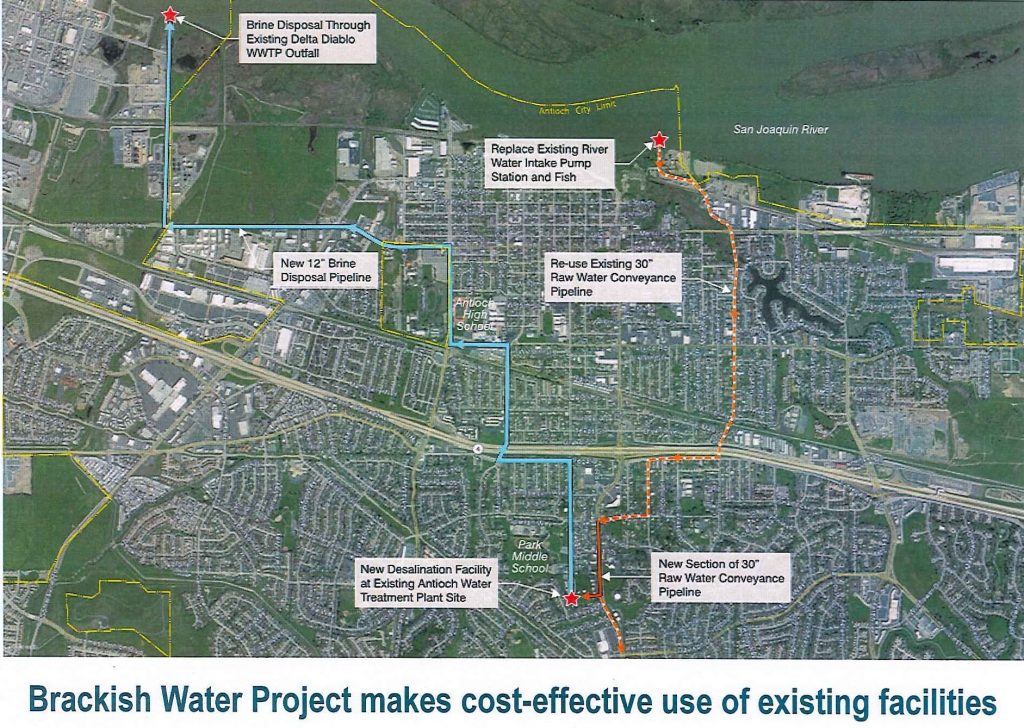
Map of current and proposed pipelines for the Brackish Water Desalination Project in Antioch.
Frazier: Project great example of alternative to disastrous tunnels
The City of Antioch’s plan to build a brackish water desalination plant on the San Joaquin River received a boost from the State Department of Water Resources (DWR), which is recommending a grant of $10 million in Proposition 1 Water Bond funds to the city for construction of the project.
It is one of eight projects on the listed the DWR released in its draft funding awards for the fourth round of Proposition 1 Desalination Grants. The projects are recommended for funding to receive a total of $34.4 million of available funds.
The Antioch City Council unanimously voted to pursue the grant for the $60 million desalination plant at their meeting on December 12, 2017. (See related article.)
“I am pleased to see the hard work we put into passing the Water Bond paying off on a local project that will improve the quality and reliability of fresh water for Antioch residents,” said Assemblymember Jim Frazier, D-Discovery Bay. “This is the type of project we envisioned in the Legislature when we passed the Water Bond legislation and asked voters to approve it.”
Officially titled the Water Quality, Supply and Infrastructure Act and known as Proposition 1 when voters approved it in 2014, the legislation authorized $7.545 billion in general obligation bonds to fund ecosystems and watershed protection and restoration, storage and water supply infrastructure projects and drinking water protection.
“This project creates new fresh water and is a great example of an alternative to the proposed foolhardy Delta tunnels project, which does not create a single drop of new water,” Frazier added. “This plant will use brackish water that is currently not utilized to increase our overall supply of fresh water. This is the type of water project California should be investing in – creating new water with minimal impact on the environment and unambiguous benefit to end users.”
When completed, Antioch’s proposed plant would desalinate up to six million gallons of brackish water per day using a reverse osmosis treatment system. The plant – estimated to cost about $62 million total – would be contained inside the city’s current water treatment facility boundaries on Putnam Street.
Allen Payton contributed this report.
East Bay Furniture Outlet to celebrate Grand Opening of their new location in Antioch this weekend
Monday, February 19th, 2018Berkeley man dies while driving in Antioch, causes three-car collision Friday morning
Friday, February 16th, 2018Boy struck by car in Antioch Friday morning, has non-life-threatening injuries
Friday, February 16th, 2018Stage Right to hold auditions for “Charlie and the Chocolate Factory” play in Antioch
Friday, February 16th, 2018Family fun at Community Car and Motorcycle Show in Antioch Sunday, Feb. 18
Friday, February 16th, 2018Supervisors OK $6.75 million purchase of new county voting system
Wednesday, February 14th, 2018State recommends $10 million in water bond funds for Antioch desalination plant
Tuesday, February 13th, 2018
















© 2026 Antioch Herald - Entries (RSS) - Comments (RSS) - Log in
Theme design by Christian Gnoth - 