






Author Archive

Analysis: Sawyer-White falsely claims racism for removal of her campaign signs where they aren’t allowed or didn’t have permission

Saturday, October 3rd, 2020
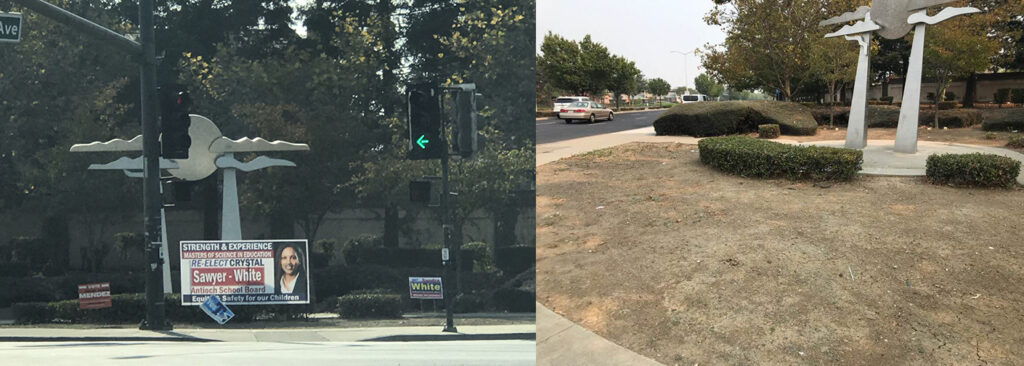
Campaign signs placed on city property at the corner of Hillcrest Avenue and Lone Tree Way on Wednesday, Sept. 30, 2020. Photo by Allen Payton. After signs removed on Friday, Oct. 2, 2020. Photo from Crystal Sawyer-White’s Facebook page.

By Allen Payton

Antioch School Board Trustee Crystal Sawyer-White, who is running for re-election in Area 3, and has had two of her large 4’ x 8’ campaign signs on city property in the public right-of-way for more than the past two weeks, and placed another on private property where she didn’t have permission, is now falsely claiming “racism” because they’ve been removed.

Yet, this is the second time she’s run for office so she should know the rules, that candidates and campaigns aren’t allowed to place their signs on public property, and can only be placed on private property where they have permission. It’s pretty common sense, and campaign 101 kind of stuff.
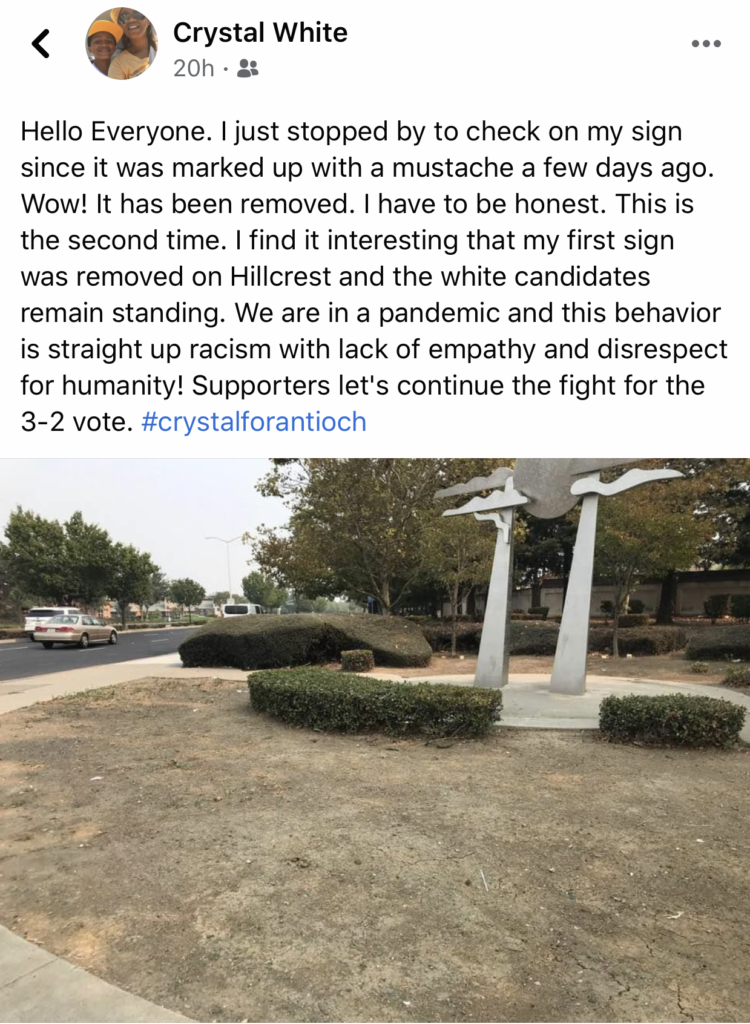
Post on Crystal Sawyer-White’s personal Facebook page on Friday, Oct. 2, 2020.

Sawyer-White has known since at least Thursday, Sept. 17 that two of her signs were on city property in the public right-of-way. Yet, after city staff did a sweep on Friday, Oct. 2 and took down all campaign signs on city property on the corners of Lone Tree Way and Hillcrest Avenue (not sure about other locations at this point), she posted a complaint on her personal Facebook page, Friday afternoon calling the removal of her signs “racism”.

She wrote, “Hello Everyone. I just stopped by to check on my sign since it was marked up with a mustache a few days ago. Wow! It has been removed. I have to be honest. This is the second time. I find it interesting that my first sign was removed on Hillcrest and the white candidates remain standing. We are in a pandemic and this behavior is straight up racism with lack of empathy and disrespect for humanity! Supporters let’s continue the fight for the 3-2 vote.”

Yet, during a phone call to this reporter on Sept. 17 Sawyer-White asked why her large campaign sign on Hillcrest Avenue near KFC had been removed. I told her that was private property, where the Wildflower Station development is under construction, and asked her if she had permission from the property owner. Sawyer-White said she hadn’t. I explained to her that she had to get permission from property owners before placing her signs and that the other candidates whose signs were there did have permission. I also told her that the developer – whom is a friend of mine and I’ve known since high school – would not have her sign thrown away, and that all she needed to do was go speak with his project manager to get her sign back.

I also told her in our Sept. 17 phone conversation that her large signs on the corner of Hillcrest Avenue and Lone Tree Way, as well as her sign at the corner of James Donlon Blvd. and Lone Tree Way were on city property, in the public right-of-way where they’re not allowed. I reminded her that campaign signs can only be placed on private property with permission. Sawyer-White told me she would have her husband go pick up those two signs.

For Sawyer-White to claim racism when all the signs of all the candidates were removed from both corners of Lone Tree Way and Hillcrest Avenue, and two of the candidates whose signs are placed on the Wildflower Station property with permission are Sandra White, who is Black, and Manny Soliz, who is Hispanic, is completely irresponsible, false and must be condemned. Frankly, throwing around such a serious accusation actually undermines real cases of racism when they unfortunately occur.

As for having her sign marked up with a mustache, that’s not uncommon and people also did that to some of my large campaign signs when I ran for city council in 1994. I jokingly thanked those who did so, because at that time I couldn’t grow a full mustache.
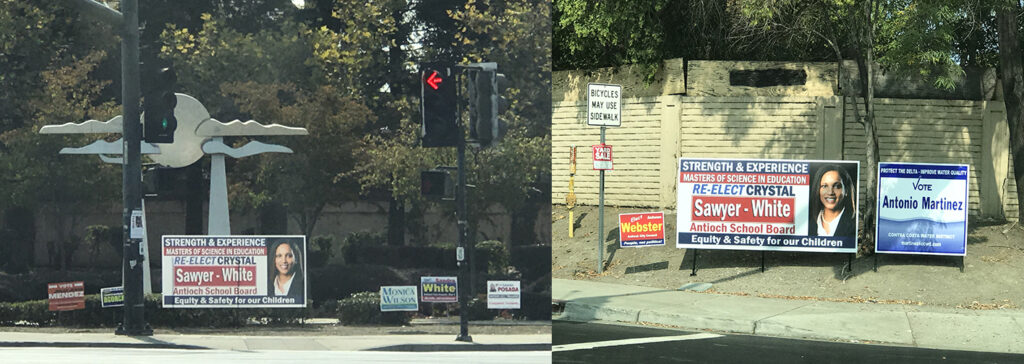
Illegally placed campaign signs on Thursday, Sept. 17, 2020. Photos by Allen Payton.

Over the following two weeks since Sawyer-White’s call to me, inquiries were made to Antioch Code Enforcement staff, Community Development Director Forrest Ebbs, who oversees Code Enforcement, and City Manager Ron Bernal. On Thursday, Sept. 24, Ebbs told the Herald that city staff would be picking up the signs that day or the next.

That same day, the director of Code Enforcement, Curt Michael explained the process.

“The campaign signs, the way that it works, is we identify candidates who have signs on city property,” he said. “We notify our admin staff to make a courtesy call requesting that they remove the signs within 10 days. If they do not remove them then the public works crews or the abatement team will remove them and then we store them out at the corp yard (on W. 4th Street).”

On Thursday, Oct. 1, in an email, in response to the third inquiry by the Herald earlier that day, since the signs had still not been removed from city property, Bernal wrote to Ebbs, “Forrest- will you please have Code Enforcement do a sweep of City properties for campaign signs?”

Ebbs, responded to the Herald and Bernal that day, “We will have all of the signs removed from the corner of Lone Tree and Hillcrest as that is City property. We will take a closer look at Lone Tree and James Donlon. The City does not own any separate property there and the homeowners actually own the slope below the wall on the SW corner as you can see in the photo below. There is some landscaped right-of-way on the NW corner. The NE and SE corners are all privately owned. If it’s in the Right-of-Way, we will have it removed.”

However, the signs placed by Sawyer-White and Antonio Hernandez, who is running for the Contra Costa Water District Board of Directors, were on the northwest corner of James Donlon Blvd. and Lone Tree Way, on city property, in the right-of-way.

An email was sent to Ebbs and Bernal, today, Saturday, Oct. 3 asking about the 10 days Michael mentioned, as that’s the rule for removing campaign signs after the elections are over, and shouldn’t the rule during the campaign be just two days or 48 hours? Please check back later for any updates to this report.

Why Does This Matter?

Why is this so important? As one candidate for mayor asked, “aren’t there more important issues to deal with?” Of course, there are. But this is pretty basic. If candidates can’t follow the rules while they’re running for office, how can the public trust they will follow them once they’re elected? Also, it’s about respect for private property rights. Just because another candidate has their sign placed on someone’s property doesn’t give other candidates permission to do so. How would they like it if someone placed a sign in their front yard promoting something they don’t agree with, or even if they do agree with it, doing so without their permission?

It’s pretty basic and common sense.

Candidates need to know the rules and follow them, and let their volunteers know, especially if you’re running for a second, like Sawyer-White. And they shouldn’t have to wait more than two weeks to comply or force city staff to waste their time and our tax dollars removing their illegal signs.

If you see a campaign sign you believe is on city or any public property, in the right-of-way contact Code Enforcement with he location at (925) 779-7042.
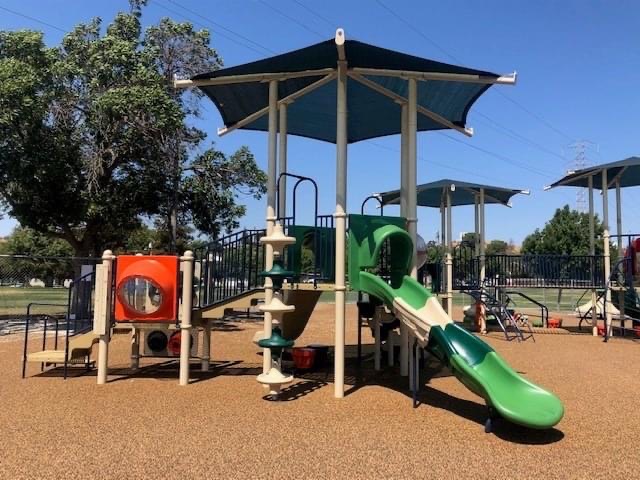
Antioch re-opens playgrounds following state announcement

Saturday, October 3rd, 2020

Photo by City of Antioch.

Get out and play….safely!

Playgrounds begin re-opening in Antioch!!! Remember to wear masks, maintain social distance from other children, keep that hand sanitizer handy, and be mindful of all park visitors.

Playgrounds provide a multisensory experience and having them closed during the pandemic made it more challenging for youth to be active, meet other children, and spend heartwarming time with parents and family. The State of California has issued guidance and direction on the usage of outdoor playgrounds and outdoor recreational facilities to support a safe environment for children and families. After reviewing the State guidelines, the City of Antioch is pleased to announce that staff is proceeding with the re-opening of playgrounds in all neighborhood and community parks. The Public Works and Recreation Departments will begin removing “closed” signage currently found at playgrounds, installing the swings that were removed for health and safety, and re-activating the regular cleaning and maintenance schedule for playgrounds.

“Play teaches social skills: sharing, cooperating and collaborating as part of a group,” says Nancy Kaiser, Parks and Recreation Director. Antioch’s parks and play areas, along with inclusive playgrounds, provide a place for all children to have an enjoyable experience within the community. “We welcome back all our parents and know that they will take the lead to ensure that kids learn and grow while playing in our parks.”

Antioch park signage directing park usage has been up since July and the State has issued seven simple steps to keep playgrounds safe, open and fun. Playground and park visitors should follow these guidelines:

  • Wear a mask; everyone 2 years and older should wear a face covering
  • Maintain social distancing – at least 6 feet – from different households; prevent crowding of children
  • Do not eat or drink in the playground area; do not share food when visiting a park
  • Wash or sanitize your hands before and after use
  • Plan and visit playgrounds at different times or days to avoid crowds
  • Stay home if you feel sick
  • Share space; limit visits to 30 minutes when other families are present

Park visitors are also reminded to put litter in its place. Use garbage cans and help park workers keep all green spaces clean and attractive for everyone’s enjoyment. Caregivers and adults that supervise children must always actively supervise each child to make sure that face coverings remain in place and social distancing is followed.

Residents are encouraged to stay connected with the City of Antioch by following the daily announcements posted on the website www.antiochca.gov. For more information about park use and the activities allowed at this time please call the Recreation Department at 925-776-3050.

Glazer’s bill allowing Contra Costa half-cent sales tax increase signed by governor

Friday, October 2nd, 2020

Votes for Measure X will now count; sales taxes in the county could go to 10.75%, highest in California; Glazer’s second tax increase measure on November ballot

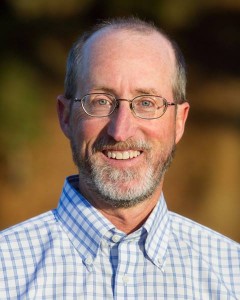
State Senator Steve Glazer. From his campaign Facebook page.

By Allen Payton

On the last day possible, Gov. Gavin Newsom signed into law a variety of bills on Thursday, including SB1349 by State Senator Steve Glazer, allowing a countywide half-cent sales tax increase which is designated Measure X on the November ballot in Contra Costa. The votes on that measure will now count. Had the governor vetoed the bill the votes would not have counted. He also had the option of not signing it by the Sept. 30th deadline and the bill would have become law.

The ballot language for Measure X reads as follows: “To keep Contra Costa’s regional hospital open and staffed; fund community health centers; provide timely fire and emergency response; support crucial safety-net services; invest in early childhood services; protect vulnerable populations; and for other essential county services, shall the Contra Costa County measure levying a ½ cent sales tax, exempting food sales, providing an estimated $81,000,000 annually for 20 years that the State cannot take, with funds benefitting County residents, be adopted?”

Glazer introduced the bill in the State Senate on February 21, 2020 focusing on “State responsibility area fire prevention fees”. He changed it to, “Transactions and use taxes: County of Contra Costa” on April 8, 2020 after the March Primary election was decided and the countywide additional half-cent sales tax increase for transportation failed.

It took some maneuvering in the State Senate Governance & Finance Committee to get the bill to the floor for a full vote. The bill first failed on a 3-2-2 vote on May 21. A motion to reconsider the bill then passed 7-0 on May 28 and a final committee vote was held on June 3 with just enough to pass by a vote of 4-2-1. It then passed the full Senate on June 11 by a vote of 27-11-2 with both Glazer and State Senator Nancy Skinner, who represents all of West County, voting in favor.

In the Assembly, Member Tim Grayson carried the bill which passed 48-23-8, with the other three Assemblymembers representing Contra Costa County, Jim Frazier, Rebecca Bauer-Kahan and Buffy Wicks not voting.

The Contra Costa County Public Managers Association was coordinating the effort to get the bill passed and the City Managers were the ones who endorsed it, not the various city councils.

The state has a sales tax rate of 7.25%, decreased from 7.5% on January 1, 2017, and state law prevented counties from charging more than 9.25% prior to the bill becoming law. That includes the half-cent sales tax for BART and the additional half-cent sales tax for transportation through the Contra Costa Transportation Authority. That leaves 1% remaining by which the county can increase its sales tax.

The Board of Supervisors considered a sales tax increase that would have only applied to unincorporated areas outside the 19 city limits. But that was quietly set aside.

According to the Senate Governance & Finance Committee Bill Analysis the earlier version of the bill that passed the Senate the first time, would have allowed a possible increase in the countywide sales tax rate to 11.75% in cities that already have a 1% sales tax such as in Antioch, and as high as 12.25% in El Cerrito which has a 1.5% city sales tax. However, the governor’s office said that went too far and the final bill was scaled back.

California’s sales tax rate is high compared to other states, especially when incorporating locally imposed district taxes. Tax experts argue that sales and use taxes are regressive, meaning that the tax incidence falls more on low-income individuals than high-income individuals because those of lesser means generally spend a greater percentage of their income on taxable sales, instead of intangible products or services which are not taxed.

By removing the current Contra Costa Transportation Authority and BART taxes as counting against the cap, in the final version of SB 1349, which passed the Senate the second time and signed by Newsom, allows an additional 1% of room for the county and each of its 19 cities to impose another district of up to 1% in sales tax. If voters approve the 1/2% allowed under Measure X, when it states that existing taxes do not count against the cap, the combined rate would increase to 8.75% countywide, plus any current city rates. The bill also grants Contra Costa County an additional authorization for another 1/2% sales tax increase, such as for the Contra Costa Transportation Authority, thereby boosting the maximum countywide rate to 9.25%, plus any current city rates.

That could result in a rate as high as 10.75% in the City of El Cerrito, where an additional 1.5% rate currently applies, and a 10.25% rate in the City of Antioch where they have a current 1% sales tax.

Glazer had the support of his bill from the California Labor Federation, California Professional Firefighters, California Teamsters Public Affairs Council, Contra Costa County Board of Supervisors, Contra Costa Transportation Authority, International Federation of Professional and Technical Engineers Local 21, Office and Professional Employees International Union Local 29, and SEIU California.

Those opposed to SB1349 were the Alliance of Contra Costa Taxpayers, California Taxpayers Association, Contra Costa County Taxpayers Association, Howard Jarvis Taxpayers Association and the Transportation Solutions Defense and Education Fund.

In spite of campaigning as a fiscal conservative, touting a hold the line approach to new taxes, this is Glazer’s second measure on the November ballot that will increase taxes if passed. The other is statewide Prop. 19, which will increase taxes on inherited homes or commercial property. According to Ballotpedia, “The ballot measure would eliminate the parent-to-child and grandparent-to-grandchild exemption in cases where the child or grandchild does not use the inherited property as their principal residence, such as using a property a rental house or a second home. When the inherited property is used as the recipient’s principal residence but has a market value above $1 million, an upward adjustment in assessed value would occur. The ballot measure would also apply these rules to certain farms. Beginning on February 16, 2023, the taxable value of an inherited principal residential property would be adjusted each year at a rate equal to the change in the California House Price Index.”

Following is the Legislative Counsel’s Digest and text of Glazer’s bill:

Senate Bill No. 1349

CHAPTER 369

An act to amend Section 29140 of the Public Utilities Code, and to amend Section 7291 of the Revenue and Taxation Code, relating to taxation.

[ Approved by Governor  September 30, 2020. Filed with Secretary of State  September 30, 2020. ]

LEGISLATIVE COUNSEL’S DIGEST

SB 1349, Glazer. Transactions and use taxes: County of Contra Costa.

Existing law authorizes various specified cities and counties, subject to certain limitations and approval requirements, to levy a transactions and use tax for general or specific purposes, in accordance with the procedures and requirements set forth in the Transactions and Use Tax Law. A provision of the Transactions and Use Tax Law prohibits the combined rate of all taxes that may be imposed in accordance with that law in a county from exceeding 2%.

Existing law authorizes the Contra Costa Transportation Authority to impose a transactions and use tax for the support of countywide transportation programs at a rate of no more than 0.5% that, in combination with other transactions and use taxes, exceeds the above-described combined rate limit of 2%, if certain requirements are met, including a requirement that the ordinance proposing the transactions and use tax be submitted to, and approved by, the voters. Existing law repeals this authorization on December 31, 2020, if an ordinance proposing a transactions and use tax has not been approved by that date.

Existing law, the San Francisco Bay Area Rapid Transit District Act, creates the San Francisco Bay Area Rapid Transit District, which comprises a territory that includes the County of Contra Costa, and, among other things, authorizes the board of directors of the district to impose transactions and use taxes in conformity with the Transactions and Use Tax Law for specified purposes, subject to periodic legislative review and amendment, as provided.

This bill would provide that, notwithstanding the combined rate limit under the Transactions and Use Tax Law, neither a transaction and use tax rate imposed in the County of Contra Costa by the transportation authority under the above-described authority nor a transactions and use tax rate imposed by the San Francisco Bay Area Rapid Transit District, as specified, will be considered for purposes of that combined rate limit within the County of Contra Costa. The bill would declare that the changes made with regard to taxes imposed by the Contra Costa Transportation Authority for countywide transportation programs are declaratory of existing law.

This bill would make legislative findings and declarations as to the necessity of a special statute for the County of Contra Costa.

<hr size=1 width=1209 style=’width:907.1pt’ noshade style=’color:#333333′>

BILL TEXT

THE PEOPLE OF THE STATE OF CALIFORNIA DO ENACT AS FOLLOWS:

SECTION 1.

Section 29140 of the Public Utilities Code is amended to read:

29140.

(a) The board shall, by ordinance, impose transactions and use taxes in conformity with Part 1.6 (commencing with Section 7251) of Division 2 of the Revenue and Taxation Code for the purposes specified in Sections 29142 and 29142.2, subject to periodic legislative review and amendment.

(b) (1) Notwithstanding Section 7251.1 of the Revenue and Taxation Code, a transactions and use tax rate imposed pursuant to subdivision (a) on or before January 1, 2020, that applies within the County of Alameda shall not be considered for purposes of the combined rate limit within the County of Alameda established by that section.

(2) Notwithstanding Section 7251.1 of the Revenue and Taxation Code, a transactions and use tax rate imposed pursuant to subdivision (a) on or before the effective date of the act adding this subdivision that applies within the County of Contra Costa shall not be considered for purposes of the combined rate limit within the County of Contra Costa established by that section.

SEC. 2.

Section 7291 of the Revenue and Taxation Code is amended to read:

7291.

(a) Notwithstanding any other law, the Contra Costa Transportation Authority may impose a transactions and use tax for the support of countywide transportation programs at a rate of no more than 0.5 percent that would, in combination with all taxes imposed pursuant to Part 1.6 (commencing with Section 7251), exceed the limit established in Section 7251.1, if all of the following requirements are met:

(1) The Contra Costa Transportation Authority adopts an ordinance proposing the transactions and use tax by any applicable voting approval requirement.

(2) The ordinance proposing the transactions and use tax is submitted to the electorate and is approved by the voters voting on the ordinance pursuant to Article XIII C of the California Constitution.

(3) The transactions and use tax conforms to the Transactions and Use Tax Law, Part 1.6 (commencing with Section 7251), other than Section 7251.1.

(b) (1) Notwithstanding Section 7251.1, a transactions and use tax rate imposed pursuant to subdivision (a) shall not be considered for purposes of the combined rate limit established by Section 7251.1.

(2) This subdivision does not constitute a change in, but is declaratory of, existing law.

SEC. 3.

The Legislature finds and declares that a special statute is necessary and that a general statute cannot be made applicable within the meaning of Section 16 of Article IV of the California Constitution because of the unique fiscal pressures being experienced in the County of Contra Costa.


Ribbon cutting for Amazon Fulfillment Center at Logistics Center in Oakley Oct. 7

Friday, October 2nd, 2020

Contra Costa DA Becton won’t prosecute certain first-time criminals

Thursday, October 1st, 2020

Including drug offenders arrested with small amounts or for other crimes such as shoplifting, petty theft, disorderly conduct   

To “divert low-level recreational users out of the criminal justice system and into health care system”

“Reducing strain in the courts” at presiding judge’s request

By Scott Alonso, Public Information Officer, Office of the District Attorney, Contra Costa County

Contra Costa County District Attorney Diana Becton announced last week, misdemeanor filing considerations for the DA’s Office regarding . Originally initiated as a pilot, the considerations are now formal policy for the Office. The DA’s Office will no longer file charges against most people arrested or cited solely for the possession of small amounts of drugs. The idea is to divert low-level recreational users out of the criminal justice system and into the health care system with the goals of both reducing the strain in the courts and on law enforcement, and also by providing treatment options for the user.

Last year District Attorney Becton and Public Defender Robin Lipetzky were contacted by the presiding judge of the court who stressed the need to reduce the significant backlog of low-level, non-violent misdemeanors in the court system. The backlog of cases was slowing down court operations and proving to be an immense burden on the budgets of various law enforcement agencies and the courts.

Furthermore, there have been significant changes in the laws governing personal drug use that have changed the dynamics of prosecuting low-level drug cases. The aim of these considerations is to stop chronic patterns of arrest and to connect individuals to community based behavioral health services. For a first-time offender we will refer the person to health care services in our community. The policy allows the DA’s Office to focus our efforts on cases that may pose significant public safety concerns such as criminal street gangs, drug dealers, violent criminals, and cases involving firearms.

“When I took Office, I realized we had to change our perspective on filing cases, especially low-level drug cases. From my experience as a judge I saw first-hand how individuals were cycling through our system. Now as the District Attorney, I worked with several law enforcement partners throughout the county to build a plan and gain consensus on how best to proceed with these types of cases. We cannot prosecute ourselves out of this growing trend of low-level offenses being submitted to our Office for a filing decision,” said DA Becton.

Prosecutors will use their discretion on these low-level non-violent offenses to determine if criminal charges are appropriate. Pre-filing diversion is also available for individuals in lieu of a formal criminal complaint.

DA Becton stated, “As I do with all of my Office’s policies, I will periodically review this policy and work with my justice system colleagues to ensure its effectiveness and to modify it when necessary.”

In several situations, the policy may not apply. The exceptions include: the person has been arrested on three previous occasions in the past year for a misdemeanor drug offense, the theft is more than $300 in value, or the subject is on probation.

Misdemeanor Filing Considerations

FIRST-TIME AND STAND-ALONE OFFENSES

For the offenses below, do not file a case predicated upon these statutes if the individual is a first-time offender or this is a stand-alone charge. Consider use of CAPS, Infracting, or a Probation Violation as appropriate.

If an individual becomes a repeat offender, review all cases to include any previously unfiled incidents.

Note: For any of the below offenses, these considerations do not apply if:

  • There are multiple violations (2 or more within a 12-month period)
  • Theft cases: amount of stolen items is $300 or more
  • Defendant is currently on probation
  • Low net weight cases of controlled substances will generally not be filed unless there are three or more misdemeanor drug offenses or another qualifying exception within a 12-month period

The misdemeanor charges these considerations encompass are as follows:

STATUTE                 NAME OF STATUTE

BP 4060                      Possession of Controlled Substance

BP 4140                      Possession of Hypodermic or Syringe

HS 11357                    Possession of Marijuana

HS 11364                    Possession of Drug Paraphernalia

HS 11350                    Possession of Controlled Substance

HS 11377                    Possession of Controlled Substance

HS 11550                    Under the Influence of Controlled Substance

PC 415                        Disturbing the Peace

PC 459.5                     Shoplifting

PC 466                        Possession of Burglar Tools

PC 484                        Petty Theft

PC 602                         Trespass

PC 647(f)                    Disorderly Conduct

PROBATION VIOLATIONS

If an individual is already on Probation, consider electing to file a Probation Violation in Lieu of a new docket. Consult with your supervising DDA as appropriate.

SUSPENDED LICENSES

Infract the below vehicle code offenses. Note: this does not apply to VC 14601.2 and VC 14601.5 offenses.

STATUTE                 NAME OF STATUTE                                              ACTION

VC 12500                    Unlicensed Driver                                                       INFRACT

VC 14601.1                 Non-DUI Suspended or Revoked License                  INFRACT

Contra Costa County now offers free flu shots at COVID testing sites

Thursday, October 1st, 2020

Starting today, October 1, the County will begin offering free flu shots to people who come in for COVID testing at several testing sites in Contra Costa.

Making flu shots available at COVID testing sites is part of the County’s larger effort to get more people vaccinated before flu season arrives. Contra Costa Health Services will also be hosting a series of free one-day flu vaccination clinics in October.

“We want to make it as easy as possible for people to get their flu shots this year,” said Dr. Chris Farnitano, Contra Costa County’s health officer. “Offering flu vaccine at COVID testing sites will let people cross two things off their to-do list at once.”

With COVID-19 and the upcoming flu season overlapping, county health officials say it’s more important than ever to get vaccinated against influenza this year.

Health officials are worried about a so-called “twindemic” or “double surge” in the coming months where hospitals are overwhelmed by having to care for both flu patients and COVID-19 patients.

Flu vaccination is the best protection against influenza. Another reason to get vaccinated: people can get sick with COVID and the flu at the same time, which may increase the risk they will need hospitalization.

Flu season in the Bay Area tends to peak in January or February, but it can be unpredictable – which is why it’s best to get vaccinated as soon as possible.

“Getting a flu shot is one thing we all can do to ease our minds during COVID,” said Dr. Farnitano. “Getting vaccinated this year means having one less thing to worry about.”

Influenza and COVID are respiratory illnesses with similar symptoms, such as congestion, cough and fever. People who have these symptoms when flu season arrives should be tested for COVID to help ensure a correct medical diagnosis. The County offers free COVID testing to residents.

There is currently no vaccine for COVID. The best way to prevent the spread of COVID is to practice physical distancing, wear face coverings when around people who don’t live with you, wash your hands regularly and stay home if you’re sick. These measures also help reduce the spread of the flu as well.

County health officials also recommend that essential workers and others with frequent close contact with people outside their own household get tested once a month for COVID, even if they don’t have symptoms.

A list of testing site offering free flu shots can be found on our Get Tested page. There are currently five testing locations offering flu vaccine: Antioch, two in Concord, Richmond and San Ramon. We expect to make flu shots available at more testing sites in the near future.

For more information about influenza, visit cchealth.org/flu.


Governor Newsom signs bills ending police chokeholds, implementing other reforms

Thursday, October 1st, 2020

Main graphic by Carotid Restraint Training Institute.

Requiring independent investigations of officer-involved shootings; reforming juvenile justice and probation systems to aid in rehabilitation and reentry

SACRAMENTO – In the wake of nationwide demonstrations against structural racism and systemic injustice, Governor Gavin Newsom on Wednesday signed a series of bills into law initiating critical criminal justice, juvenile justice and policing reforms in California. Delivering on his promise this summer to sign a bill ending the use of the carotid restraint, Governor Newsom signed AB 1196 by Assemblymember Mike Gipson (D-Carson) which bans the practice statewide. The maneuver known as a chokehold, was banned by District Attorney Diana Becton for her Investigative Unit in June. (See related article).

Newsom also signed AB 1506 by Assemblymember Kevin McCarty (D-Sacramento) requiring the California Attorney General to conduct investigations into officer-involved shootings of unarmed individuals that result in death. He also took action on legislation that reforms the juvenile justice system to put more emphasis on rehabilitation and education, as well as creating a more just probation system.

“Americans across the country took to the streets this summer rightfully demanding more and better of our criminal justice system – and of ourselves,” said Governor Newsom. “We heard those calls for action loud and clear and today are advancing reforms to improve policing practices by ending the carotid hold and requiring independent investigations in officer-involved shootings. We are also taking important steps to break the school-to-prison pipeline. Still, we can and must do more. Working with our youth, faith and community leaders, law enforcement, the Legislature and countless others demanding change, my Administration remains committed to the important work ahead to make our criminal and juvenile justice systems fairer and safer for all Californians.”

Today’s action builds on Governor Newsom’s record enacting major change on criminal justice reform during his first years in office – from enacting one of the nation’s strongest police use-of-force standards, to putting a moratorium on the death penalty and shutting down California’s execution chamber, to closing prisons. The Administration will continue to work with the Legislature on additional reforms, including efforts to increase transparency in peace officer records and broader decertification measures to create accountability for officers with a history of misconduct.

Governor Newsom also took action today on important juvenile justice reforms. Building on the Governor’s commitment to end juvenile imprisonment as we know it, he signed several bills to support young people coming out of the criminal justice system and to disrupt the school-to-prison pipeline. SB 823 by the Committee on Budget and Fiscal Review takes the first, formal step of closing the Division of Juvenile Justice, which will help to provide youth rehabilitative services closer to home.

Other bills the Governor signed today that support youth include AB 901 by Assemblymember Mike Gipson (D-Carson), which will end the practice of referring youth who are having problems at school to probation programs. Additionally, SB 203 by Senator Steven Bradford (D-Gardena) requires that children under age 17 have an opportunity to consult with legal counsel before interrogation, and SB 1290 by Senator Maria Elena Durazo (D-Los Angeles) will cancel certain fees assessed on juvenile offenders and their families.

Finally, Governor Newsom signed AB 1950 by Assemblymember Sydney Kamlager (D-Los Angeles), which caps probation terms to a maximum of one year for misdemeanor offenses and two years for felonies.

Governor Newsom also signed:

  • AB 646 by Assemblymember Kevin McCarty (D-Sacramento) – Elections: voter eligibility.
  • AB 732 by Assemblymember Rob Bonta (D-Alameda) – County jails: prisons: incarcerated pregnant persons.
  • AB 846 by Assemblymember Autumn Burke (D-Inglewood) and Assemblymember Jacqui Irwin (D-Thousand Oaks) – Public employment: public officers or employees declared by law to be peace officers.
  • AB 1304 by Assemblymember Marie Waldron (R-Escondido) – California MAT Re-Entry Incentive Program. A signing message can be found here.
  • AB 1775 by Assemblymember Reginald Byron Jones-Sawyer, Sr. (D-Los Angeles) – False reports and harassment.
  • AB 2321 by Assemblymember Reginald Byron Jones-Sawyer, Sr. (D-Los Angeles) – Juvenile court records: access.
  • AB 2425 by Assemblymember Mark Stone (D-Scotts Valley) – Juvenile police records.
  • AB 2512 by Assemblymember Mark Stone (D-Scotts Valley) – Death penalty: person with an intellectual disability.
  • AB 2606 by Assemblymember Sabrina Cervantes (D-Riverside) – Criminal justice: supervised release file.
  • AB 3043 by Assemblymember Reginald Byron Jones-Sawyer, Sr. (D-Los Angeles) – Corrections: confidential calls.
  • AB 3234 by Assemblymember Philip Ting (D-San Francisco) – Public Safety. A signing message can be found here.
  • SB 480 by Senator Bob Archuleta (D-Pico Rivera) – Law enforcement uniforms.
  • SB 1126 by Senator Brian W. Jones (R-Santee) – Juvenile court records.
  • SB 1196 by Senator Thomas Umberg (D-Santa Ana) – Price gouging.


Supervisors pass third COVID-19 era ordinance prohibiting residential and small business evictions, rent hikes over landlords’ protests

Thursday, October 1st, 2020

Approve consent decree for enhanced psychiatric and medical services for county jail inmates

By Daniel Borsuk

With the COVID-19 pandemic having caused 16,896 cases and 209 deaths in Contra Costa County since March, the Contra Costa County Board of Supervisors on Tuesday passed its third temporary ordinance banning evictions of commercial and residential tenants on Tuesday, the same day the county’s Public Health Department quietly announced its promotion from Purple ranking to Red, allowing more businesses to open.

According to the staff report on the agenda item, the urgency ordinance authorizes a temporary prohibition on certain “at-fault” evictions of residential tenants in the county and continues a temporary prohibition on certain evictions of small-business commercial tenants in Contra Costa County impacted by the COVID-19 pandemic.

Supervisors had previously approved similar temporary ordinances on April 21 and July 14 and voted unanimously to enact a new ordinance that would stay in effect through January 31, 2021.  On a separate vote, 4-1, supervisors rejected inserting additional protections to tenants that Supervisor John Gioia wanted to be included in the ordinance.

“I wanted broader protections,” said Supervisor Gioia of Richmond who cast the one dissenting vote.  “I wanted to limit evictions to health and safety.  There are landlords who don’t exercise good faith behavior.”

But Supervisor Karen Mitchoff, speaking on behalf of both landlords and tenants. wanted to monitor properties that have tenants who don’t put out trash for collection or keep unsafe rental property.

“I am willing to go through January 31, but I am tired of accommodating the bad actors. I won’t support an ordinance that bars landlords from entering property for any reason,” said Mitchoff.

At the same time, the supervisor from Pleasant Hill scolded landlords who do not accept a tenant’s payment for rent. “That is not OK,” she said.

While supervisors listened to a number of renters encouraging the supervisors to provide necessary protections during the ongoing pandemic, the elected officials for the first time heard more landlords loudly object to the residential and commercial ordinance under review.

“You’re taking away property owners’ rights,” Concord property owner Blaine Carter protested. “The sky is not falling.  We don’t need to strip away individual property owner rights.”

Concord homeowner Ed White said he could live with the ordinance.  “I work with my tenant,” said White, whose long-term tenant of his three-bedroom house, has been a good occupant even though the tenant had lost their job due to the pandemic.  The tenant has recently been reemployed and is back making monthly rental payments, White said.

“For someone who has been on both sides of this issue, I can support the proposed ordinance,” said District 5 Supervisor Federal Glover of Pittsburg, who is up for re-election Nov. 3 against Contra Costa County Assessor Gus Kramer.

“This is another way to get property into the hands of government,” said landlord Marilyn Blander.  The long-term economic effects will be terrible because government is a terrible way to provide housing.”

PLO Consent Decree for County Jail Inmates OK’d

In another action, supervisors unanimously approved an agreement with the Prison Law Office that will enhance psychiatric and medical services for inmates held at the Martinez Detention Facility and the West County Detention Facility in Richmond.  Four years in negotiations, the PLO-Contra Costa County consent decree will be in effect for five years.  The consent decree can be mutually ended.

It will cost the county $43.7 million a year to provide improved mental and medical care and pharmaceutical services to prisoners housed in the two county detention facilities.  Those costs reflect the addition of the eventual hiring of 125 fulltime Health Services Department employees and 63 fulltime equivalent Sheriff’s Department employees.

So far, the county has hired 42 fulltime equivalent Health Department and 41 fulltime Sheriff’s Department employees.

“This is a roadmap for positive change, one that moves the county forward in further improving the physical space and services provided” said Board Chair Candace Andersen.  “We want to stop those with mental illness from repeatedly cycling through our jails.  If we can provide them with much needed treatment while incarcerated and ensure that they have supportive services upon re-entry to the community, their lives will substantially improve.”

Prison Law Office Executive Director Donald Spector called and thanked the supervisors for approving the five-year consent decree.