Author Archive

Following death threat, protests Supervisor Mitchoff drops COVID-19 business fines hike proposal

Wednesday, December 16th, 2020

Reads unedited profanity laced email during Tuesday meeting

Unlikely radioactive material dumped at Keller Canyon Landfill in Pittsburg

Prioritize teachers for COVID-19 vaccine

By Daniel Borsuk

Supervisor Karen Mitchoff, choking back tears after receiving an emailed death threat and listening to an avalanche of protests to her proposal to boost county public health fines on small businesses violating COVID-19 orders, requested the idea be dropped at Tuesday’s Contra Costa County Board of Supervisors meeting.

Supervisors earlier heard from a number of anonymous callers, presumably restaurant owners largely hit by county health inspections and penalty fines.  Most of the speakers protested that the current fines of $250 for the first offense, $500 for the second offense and $1,000 for each additional violation within one year of the initial violation were too extreme.  If a violation continues for more than one day, each day is treated as a separate violation.

At the Board’s December 8 meeting, Mitchoff had proposed the county dramatically increase fines in order to send a message to businessowners thinking of violating county ordinances.  At that meeting the supervisor had said, “I would like to see, $10,000, $15,000, and $20,000 fines.  We have to do something different.  If they want to stay open and spread COVID they have to pay the price.”

Prior to receiving the threatening email or listening to anonymous businessowners torpedo her proposal Tuesday, Mitchoff said “If we do not do something, we’ll lose credibility.  I see many businesses in Concord and Pleasant Hill obey county orders and are closed, but restaurants in Danville are open.”

A group of Danville and San Ramon restaurant owners have stirred up most of the protests.

“We receive 13 complaints a day including customers not wearing masks or not social distancing,” Contra Costa County District Attorney Dianna Becton told the supervisors.  The DA has assigned two inspectors for health code violations.

“Small businesses are really suffering,” said Supervisor Diane Burgis of Brentwood, who said one small busines owner pleaded with her for help because he had difficulty paying his property taxes.  “I am not going to support higher fines.  I am not in support of higher taxes. It won’t work.”

Later, Mitchoff caved into the public protests and especially upon receiving a sort of “interesting”, profanity-laced message during the meeting that she received from Ricky Gunz and read verbatimm:

“F— you Bi—. Sleep lightly. There are some bad people out there.  Karma is a motherf—r.  Keep trying to fine business and see what happens.”

“We hear the pain and the frustration,” said Supervisor John Gioia of Richmond. “It is all about saving lives and slowing the spread of COVID-19 to the 15 percent intensive care unit (ICU) capacity level.  We’re trying to save ICU capacity.”

Earlier supervisors learned from Contra Costa County Public Health Officer Dr. Chris Farnitano that Contra Costa had 181 COVID-19 patients in local hospitals, but more crucially, 133 patients were occupying ICU beds.  There are a total of 183 ICU beds in the county.

“That’s a significant increase,” said Farnitano. “Our case rate is 36 cases per day.  December will be our deadliest month.  Of 500 patients, five will die of COVID19,” he warned.

Keller Canyon Landfill Probe: “Unlikely that radiological materials were disposed of at Keller Canyon”

Supervisors also voted 5-0 to accept a two-page report on an investigation whether any radioactive materials from the Hunters Point Naval Shipyard were transported to the Keller Canyon Landfill in Pittsburg.  The report, prepared by TRC Solutions, Inc. was initiated after news reports initially published on April 21, 2018 in the San Francisco Chronicle and later picked up by other news outlets including the Contra Costa Herald about allegations of improper dumping of radioactive materials had occurred in the landfill.

“TRC’s forensic audit started in October 2018 and concluded in May 2019.  Documents reviewed by TRC included special waste authorizations, soil analytical data reports, Hunters Point work plans and reports, Standard Operating Procedures, portal monitor calibration records, and landfill data to ascertain if radiologically contaminated materials were received by KCL from Hunters Point Naval Shipyard.  In addition, site visits were performed at both KCL and HPNS in April 2019,” the report stated.

“Based on this review, of data, reports, logs, interviews, and site visits, it is concluded that it is very unlikely that radiological materials of concern (i.e., radionuclides specific to Hunters Point contaminations and in exceedance of background) were disposed of at Keller Canyon. To obtain certainty that no radiologically contaminated material from Hunters Point was received at Keller Canyon, limited environmental field sampling could be performed at Keller Canyon.”  Republic Services of Contra Costa operates the landfill.

Pittsburg City Manager Garret Evans said the city will continue to monitor the landfill based on the history of landfill’s previous issues about allegedly poor inaccurate data about air monitors and lead.

“Keller Canyon has been very cooperative.  This has been an important and thorough study that has gone through several community meetings, “said Supervisor Federal Glover of Pittsburg, whose District 5 includes the landfill.

Resolution Prioritizes Private and Public Teacher Receive COVID-19 Vaccines

Supervisors passed a resolution urging Gov. Gavin Newsom, the California Department of Public Health and all other state health officials to ensure that all public, parochial and private classroom teachers and staff receive the COVID-19 vaccine at no cost in order to assist school officials to reopen schools when it becomes safe to do so.

Two Cannabis Community Benefit Agreements Approved

Supervisors approved the community benefit agreements with two cannabis retail outlets – The Artist Tree V storefront commercial cannabis dispensary in El Sobrante and the Authentic 925 in Pacheco.  The two items acted on consent items.

The actions mean applicants for the two businesses are nearing approval of use permits whereby the owners will be required to pay the county community benefit taxes based on prospective retail sales.  In the case of SGI Pacheco, doing business as Authentic 925, the county will receive on an annual basis, $150,000 or 1.5 percent of the business’s gross profits, whichever is greater.

In the case of The Artist Tree V, the community benefit is based on percentages of annual gross sales of 2 percent or 3 percent depending on whatever will be gross sales during the operating year.


Antioch Council votes to rescind DOJ grant for six School Resource Officers on split vote

Wednesday, December 16th, 2020

Over 220 public comments, mostly in favor of rescinding the grant, of which about 80 were the same repeated message

By Anthony Dorado

During their Tuesday, Dec. 15 meeting, the Antioch City Council voted on a split, 3-2 vote to rescind the previous 3-2 vote to approve acceptance of a U.S. DOJ COPS Hiring Program Grant of $750,000 for six School Resource Officers (SRO’s). The council also approved of a series of virtual roundtable discussions on a broad range of topics pertaining to policing and racial disparities within policing. CORRECTION: In addition, the council discussed a $50 million budget increase for the Brackish Water Desalination Plant increasing it to $110 million, and the first construction contract of $87 million. But that was postponed until next Tuesday night. (See related article)

Rescind Grant for SRO’s

The most controversial item on the agenda was the reconsideration of the U.S. DOJ COPS Hiring Program Grant that would have provided for six new School Resource Officers in the City of Antioch. This appeared to be the only matter that the Council held split views on. While Council Members Barbanica and Ogorchock saw this as an important step towards building trust between the youth and the police, Mayor Lamar Thorpe, Mayor Pro Tem Monica Wilson, and Council Member Tamisha Torres-Walker did not believe this would adequately address the problem of youth violence and educational failure.

Council Member Mike Barbanica stressed his own personal relationship with an SRO growing up, detailing how they would, “play football together,” and how it was overall a, “positive experience.” He also detailed his time interviewing particular administrators and teachers in the area and expressed how he had not spoken with a single one of them that was against receiving this grant. Thorpe however recounted his own time as a schoolteacher and stressed the importance of, “not treating our young people with contempt,” and joining Wilson and Torres-Walker in the opinion that the community and schools should focus on greater mental health support and not policing.

In addition, the cost for the six SROs would not be completely covered by the grant. It would provide a total of $750,000 over the course of three years, at $250,000 each year. The city council and the Antioch School Board agreed that they would split the cost 50/50, but the net cost to the city by would be in excess of $2,000,000 for the fourth year as part of the agreement with the DOJ. The council members who opposed the grant did not believe it was money worth spending on the six additional police officers for the department.

While the Council may have been split, the community members voicing their opinions were not so divided. This particular item received 227 public comments, the vast majority were in opposition to the addition of SROs on the Antioch campuses, and about 80 of the comments were the same message verbatim. In the end, the community opinion alongside the opinion of the new council majority prevailed, and the resolution to rescind the grant was passed on a 3-2 vote, with Thorpe, Wilson and Torres-Walker voting in favor, and Ogorchock and Barbanica voting against.

Desalination Plant Budget Increase & Contract Approval Postponed

The second item on the agenda was the aforementioned approval of a budget increase on the Brackish Water Desalination Plant. While the City Council appeared ready to cast their votes on the matter, John Samuelson, the City Engineer for the City of Antioch, requested that the Council vote to postpone the matter to a later date and meeting on account of a further consideration of the bid protest against Shimmick Construction Company Inc. brought forward by Overaa Co.  The Council unanimously voted to postpone the vote to a later date to be determined.

Bridging the Gap Roundtable Discussions

The third item on the agenda was a serious of roundtable discussions, entitled Bridging the Gap, that are planned for 2021. These virtually held roundtable discussions, begun earlier this year, are intended to give Antioch residents the opportunity to voice their opinions on their own experiences and understanding of racial relationships and conflict within the realm of policing. The goal is to raise awareness of racial disparities within policing, to foster community engagement and unity, and to shine a light on the steps needed to move forward towards racial equity. They will be hosted by CNA, a non-profit 501(c)(3) with professional experience assisting public agencies in the realm of public safety services.

The council all voted in the affirmative, but not without particular hesitations. Barbanica was the first to voice his hesitation that this would turn out to be an, “academic exercise that led nowhere,” and Wilson also joined him in her concern that this would simply be a, “dog and pony show that led to no results.” While Ogorchock, Torres-Walker and Thorpe agreed, they decided they would nevertheless give the process a chance, as well. The dates for the roundtable discussions have yet to be specified, but are expected to be held sometime in early 2021. The council voted in favor of the series of online community meetings on a 5-0 vote.

Increase Council Chamber Remodel Budget to $1.9 Million

In other action, the council authorized a third amendment increasing the contract with Saboo Inc. for the City Hall Council Chambers Remodel by $147,983.84 totaling the contract to $1,862,008.15. This contract would utilize Public, Educational, and Government (PEG) funds. Accepting work and authorizing a Notice of Completion. This agenda passed with unanimous consent, concluding in a 5-0 vote in the affirmative.

Council Committee Appointments

The fifth and final item on the agenda was the appointment to City Council and Ad Hoc Committees. Thorpe appointed Barbanica and himself to the transitional housing committee stating that he would begin meeting mid-2021 once they had worked through some housing proposals for the homeless. Wilson will remain on the Cannabis Committee. Torres-Walker also expressed interest in participating on the Cannabis Committee. The City – School Board Committee appointments were left to be dealt with after the school board elects their new leadership, which is expected at their meeting, tonight. All appointments were approved on a 5-0 vote by the council.

Contra Costa DA Becton issues new policy on civil asset forfeiture cases

Wednesday, December 16th, 2020

Doubles minimum cash amount to $1,000; notices must be issued in multiple languages; plus more requirements

By Scott Alonso, Public Information Officer, Office of the District Attorney, Contra Costa County

Martinez, Calif. – On Monday, Dec. 14, 2020, Contra Costa County District Attorney Diana Becton formalized a new policy for civil asset forfeiture cases within the DA’s Office. In June 2019, DA Becton implemented an interim policy to address growing concerns with certain types of civil asset forfeiture cases. This interim policy is now permanent for the DA’s Office and applies to the entire county. Civil asset forfeiture cases are a civil procedure for law enforcement to seize cash and other property from suspects alleged to have ties to drug trafficking and drug sales.

The policy covers the following items:

  • A new threshold for any case, the amount seized must total at minimum $1,000 for the DA’s Office to consider using the civil asset forfeiture process. Previously, under prior administrations, the amount seized could be as low as $500 for the office to initiate civil asset forfeiture proceedings.
  • The seizing law enforcement agency must serve a Notice of Non-Judicial Forfeiture Proceedings and a Claim Opposing Forfeiture on any person who has, or may have, an interest in the seized property. Under this new policy and for the first-time, this notice is now required to be translated into multiple languages, including Spanish and Mandarin.
  • A criminal case will accompany any civil asset forfeiture proceeding. This will align the DA’s Office charging standards to mirror all criminal cases. Some exceptions include:
  • If the property is abandoned or not claimed, then our policy would not apply.
  • Where the property subject to forfeiture is claimed by a third party who does not appear to own the property or have an interest in the property.

“The community rightfully has tremendous concerns about the use of the civil asset forfeiture process by law enforcement. I have listened to the concerns and instituted this new policy on a permanent basis. We must only use civil asset forfeiture when absolutely necessary and in conjunction with a criminal case,” Becton stated.


Hernandez, Lewis take their oaths of office as new Antioch School Board trustees

Tuesday, December 15th, 2020

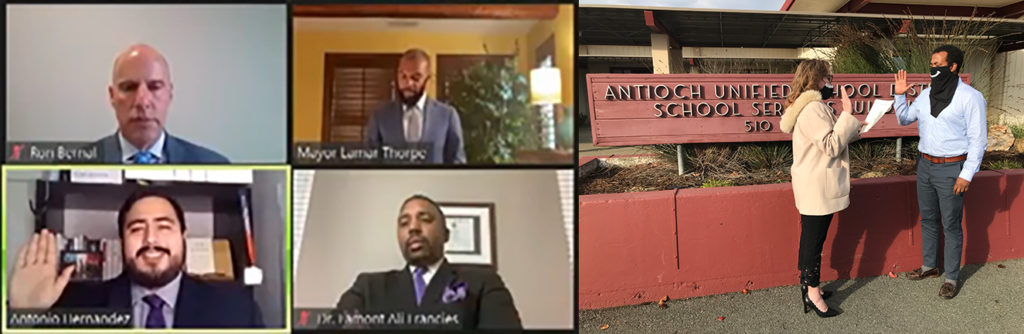
Video screenshot (left) of Antonio Hernandez taking his oath of office administered by Mayor Lamar Thorpe during an online ceremony on Friday, Dec. 11. Dr. Clyde Lewis (right) takes his oath of office outside the school district offices on Tuesday morning, Dec. 15 administered by Superintendent Stephanie Anello. Photo by Allen Payton

But Hernandez’s probably requires a do over

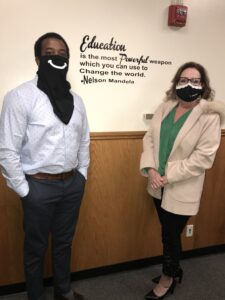
New Antioch School Board Trustee Lewis with Superintendent Anello in front of the quote by Nelson Mandela inside the school board chambers, following his oath of office, Tuesday, Dec. 15, 2020.

By Allen Payton

On Friday, Dec. 11 during an online ceremony, Antonio Hernandez too his oath of office administered by Mayor Lamar Thorpe, to become a new Antioch School Board Trustee representing Area 1. (See Facebook video, beginning at 1:04:30) On Tuesday morning, December 15, in front of the Antioch School District offices and sign, Dr. Clyde Lewis took his oath, administered by Superintendent Stephanie Anello.

Following his oath, Hernandez said, “I’m so excited to be here and so excited the voters have given me this opportunity. I could not have imagined this is where I would be, today.” He then thanked his family who helped his campaign, as well as his campaign manager.

After the brief ceremony on Tuesday, Lewis said, “I want to thank the citizens of Antioch for electing me and I look forward to serving and supporting the students and community of Antioch in reaching it’s potential.”

One hiccup in the process is, according to former Antioch City Clerk Arne Simonsen who explained the need for last Tuesday afternoon’s oaths of office by the seven city officials, oaths of office must be done in person. In addition, Government Code Title 1, Division 4, Chapter 2, Article 4, Section 1362 reads “the oath may be taken before any officer authorized to administer oaths.” The question is the definition of “before” and if that requires in-person.

Assistant Contra Costa Registrar of Voters Scott Konopasek was asked if oaths of office are required to be in person or are allowed online, this year due to the COVID-19 pandemic. The Contra Costa Elections Division oversees Antioch School Board elections. He responded, “The code anticipates oaths being administered in-person but that doesn’t take the pandemic into consideration.”

So, it appears Hernandez’ oath that Thorpe administered to him online during Friday’s Zoom event, does not qualify and Hernandez must get sworn in officially in person before Wednesday night’s school board meeting if he wants to participate in it.

An email to Hernandez, Thorpe and Anello was sent Tuesday evening asking if they can provide anything that shows online oaths of office are allowed. Please check back later for any updates to this report.

COVID-19 vaccine will be distributed first to frontline health workers in county

Tuesday, December 15th, 2020

Then will follow federal, state framework

Joint Statement of the Bay Area Health Officers

As Bay Area nurses, doctors and other healthcare workers caring for COVID-19 patients receive the first, small batches of a rigorously tested vaccine, the region’s Health Officers see hope: we now have a critical tool to help fight this pandemic.

These vaccinations in acute care hospital settings follow a federal and state framework adopted locally that will also soon protect those living in skilled nursing facilities, settings where elderly, vulnerable members of our communities are more likely to have severe illness and die from COVID-19.

As vaccine supplies grow to eventually include other groups, the Bay Area’s Health Officers and federal officials believe these safe and effective vaccines will work in tandem with the daily habits and essential public health work that will ultimately end the pandemic.

Those key steps to fight the pandemic include public health work to protect high-risk groups and health care workers, identifying and isolating cases, and also tracing and quarantining contacts. For the public that means wearing face coverings, avoiding gatherings, postponing travel, and staying home whenever possible.

“This first batch of vaccines will protect our front-line healthcare workers so they can help our hospitals withstand the current winter COVID-19 wave and save as many lives as possible,” said Dr. Chris Farnitano, Contra Costa County’s health officer. “Now is the time to double down on our efforts to slow the spread of the pandemic so that we can all stay alive and healthy until there is enough vaccine for everyone.”

The 12 health officers for the counties of Alameda, Contra Costa, Marin, Monterey, Napa, San Benito, San Francisco, San Mateo, Santa Clara, Santa Cruz, Sonoma and the City of Berkeley support the state’s vaccine distribution guidelines, which now prioritize healthcare workers in acute care facilities. Each jurisdiction will use that roadmap to implement the distribution of vaccines in this first phase, which may take several months as supplies increase. Vaccines for the general public may be available by early summer.

All of the region’s health officers plan to take the vaccine when the opportunity comes.

These early doses of COVID-19 vaccine come amidst an unprecedented surge of cases regionally and statewide. As hospitals’ intensive care units near capacity, stay at home orders are either in place or anticipated soon throughout the region.

Staying home saves lives.

“In this darkest hour, the vaccine gives us a beacon to show the direction we’re headed,” said Dr. Lisa B. Hernandez, Health Officer for the City of Berkeley. “The actions and daily habits we each take increase the light on that path and improve safety for all.”

Learn more about the state’s guidelines for the first phase:

California Department of Public Health: COVID-19 Vaccine Phase 1A distribution guidelines


Antioch Council to consider cancelling grant for six School Resource Officers Tuesday, Brown Act violations alleged

Tuesday, December 15th, 2020

All six positions are ready to be filled, today; Questions to both elected officials and city staff ignored

Desalination plant budget increase by $50 million and contract on agenda

Discussion on roundtable meetings on racial injustice and police-community relations also on agenda

By Allen Payton

During the first and special meeting of the new Antioch City Council, tonight, Tuesday, December 15, at 6:00 p.m., they will consider rescinding the vote by the previous council of accepting a federal grant to help fund six police officers on Antioch middle and high school campuses. The three-year, $750,000 grant from the U.S. Department of Justice COPS (Community Oriented Policing Services) Hiring Program, along with matching funds from the Antioch School District, approved by the school board, earlier this year, would pay for the officer. (See related article, here)

The issue was a matter of controversy when the school board considered voting on the matching funds, with the first meeting being interrupted by a protest, including protesters pounding on the windows and door, and even breaking into the school district offices during the meeting. That meeting was abruptly ended and continued a few days later during which the SRO’s were approved on a 3-2 vote. (See related articles, here, here and here)

In an email sent Sunday night to Mayor Lamar Thorpe he was asked, “while you voted against accepting the grant, during the campaign you repeatedly stated you are not for defunding police. Yet, if you now vote to rescind the approved $750,000 grant to help pay for six police officers on Antioch middle and high school campuses, aren’t you in effect voting to defund police?” He did not respond prior to publication time.

In addition, during a campaign interview Walker said, “Right now, everyone deserves quality policing services. If we are always in opposition…it’s because we’re not talking to each other” referring to the police and community. She was asked since the intent of the SRO’s is to create community policing on the campuses, and develop communication and relationships between Antioch police officers and students, why would she not want the SRO’s on the campuses? Walker did not respond.

Questions About Who Can Place the Item On Agenda and Others Go Unanswered

Additional questions were emailed Sunday night to City Attorney Thomas Smith, City Clerk Ellie Householder and City Manager Ron Bernal including how does it work within both state law and Robert’s Rules of Order for a council member to bring back something for reconsideration that was already passed/approved/adopted by the council?

If a motion fails, it takes one of those who voted for the motion to bring back the item for reconsideration. They were all asked does the same apply to an item that was approved? Who requested the item to be placed on Tuesday’s agenda? Was it Mayor Thorpe and/or another council member? Finally, what is the deadline for the city to rescind the funds?

Instead of answering the questions, on Monday morning, Householder referred them to the city’s Public Information Officer (PIO) Rolando Bonilla writing, “I’m CC’ing the City’s PIO, Rolando, to this email. He can address your questions.”

The same questions were sent again to the same four plus Thorpe, Monday night. But still no response.

Bonilla has not responded to the questions either in the 24 hours since he received them.

However, it was learned Tuesday morning from an official who chose to remain anonymous, that it was Thorpe who requested the item be placed on the agenda.

The question remains, if it requires someone who voted for the motion to bring it back for reconsideration, that could only be Councilwoman Lori Ogorchock, because she’s the only remaining council member who voted for the grant, along with former Mayor Sean Wright and former Mayor Pro Tem Joy Motts, both of whom lost their bids for re-election.

Possible Open Meeting Law Violations

In  addition, it has been alleged that the state’s Brown Act open meeting law has been violated by both Mayor Lamar Thorpe and District 1 Councilwoman Tamisha Walker, for having serial meetings, which means speaking with more than one other council member about an agenda item before it’s discussed in public. It’s alleged that Thorpe spoke to both Walker and District 2 Councilman Mike Barbanica. Walker is accused of also speaking to District 3 Councilwoman Lori Ogorchock, after she spoke with Thorpe.

Although Thorpe, along with Mayor Pro Tem Monica Wilson voted against the council’s approval of the grant also on a 3-2 vote, he claimed repeatedly during his recent campaign that he was not for defunding police. Asked if a vote to rescind was, in effect, defunding police he responded,

Asked if he had spoken to both Walker and Barbanica about the SRO’s before tonight’s meeting, Thorpe did not respond to multiple attempts to contact him for this report.

When asked if she spoke with both Thorpe and Ogorchock about the agenda items Walker responded, “I took the oath of office December 7th and have not talked to anyone concerning this or any matter before the council.”

However, the Brown Act applies to candidates who were elected beginning on Election Night. So, a follow up question was asked if Walker had spoken to any other council member about the SRO’s since Election Night. She did not respond as of publication time.

An attempt to reach Ogorchock, asking if she had spoken to Walker about rescinding the grant for the SRO’s, but she too did not respond as of publication time. Attempt to reach Barbanica, asking if he had spoken to Thorpe about rescinding the grant for the SRO’s, were unsuccessful before publication time.

Hiring Process Has Already Started, All Six Positions Could Be Filled, Today

The hiring process for the six SRO’s has begun, according to Antioch Police Chief T Brooks. He was also asked if any of the grant money had been spent, yet, and if there is a deadline for rescinding the grant.

“We’ve already selected all six SRO’s, because they were all police officers with us, already,” he stated. “So, basically the grant is to hire additional positions. I am authorized 115 officers. With the grant, that would raise my sworn authorized to 121 because I would have had to create new positions for it. I would be able to pay for the new officers by using the grant money to offset the costs. The remaining portion is being split 50/50 with the school district.”

“They were interviewed and the interview process involved members of the police department, staff of the AUSD, teachers union and students,” Brooks explained. “They were all selected and chosen for which school they were going to work at. We were just waiting for the schools to open.”

“None of the grant money has been spent, yet,” he continued. Regarding the deadline he said he didn’t know.

“The grants actually became effective July 1, 2020. But we haven’t started drawing on them,” Brooks shared. “So, we would be able to extend it on the back end. The COPS office, due to the pandemic would allow us to apply for extensions for use of the funding.”

The department was authorized by the city council to overhire by five additional officers, earlier this year, for a total of 120 sworn officers who are currently on the force. Plus, there is one prospective officer currently in the academy. So, all six positions could be filled, today.

Desalination Plant Budget Increase & Construction Contract

In addition, the council will consider increasing the budget for the brackish water desalination plant by $50 million to a total of $110 million and approve the construction contract of $86,689,000.

Roundtable Meetings on Racial Injustice & Police-Community Relations

Plus, the council will be asked to provide direction to city staff on getting back on track the planned Bridging the Gap community roundtable discussions on racial injustice and police-community relations. The city has hired a consulting firm to help facilitate the virtual meetings. According to the staff report on the item, three roundtable discussions are proposed to begin early next year with the topics of 1) Police Oversight, Accountability and Transparency; 2) Racial Disparities in Policing; and 3) Police-Community Engagement.

Making a Public Comment

The item is number 4 on the council’s agenda. For those wanting to submit a public comment to be read during the meeting, click here or email cityclerk@ci.antioch.ca.us prior to the Mayor announcing that public comment is closed, and the comment will be read into the record at the meeting (350 words maximum, up to 3 minutes, at the discretion of the Mayor). IMPORTANT: Identify the agenda item in the subject line of your email (i.e. “Public Comments” or a specific Agenda Item number).

For those who want to call in and speak live during the public comment period on the item, click here. You will be asked to enter an email address and a name. Your email address will not be disclosed to the public. After registering, you will receive an email with instructions on how to connect to the meeting. – When the Mayor announces public comments, click the “raise hand” feature in Zoom. For instructions on using the “raise hand” feature in Zoom, visit: https://www.antiochca.gov/raise_hand. The meeting can be viewed via livestream on the city’s website, or on Comcast/Xfinity local cable Channel 24 beginning at 6:00 p.m.

Please check back later to any updates to this report.


Antioch man charged with distribution and aggravated possession of child pornography

Tuesday, December 15th, 2020

By Scott Alonso, Public Information Officer, Office of the District Attorney, Contra Costa County

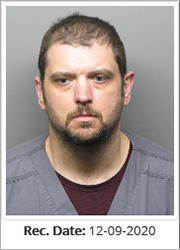
Shawn Jamison Prichard. Photo: CCDA

Martinez, Calif. – On Thursday, December 10, 2020, the Contra Costa County District Attorney’s Office filed felony child pornography charges against 41-year-old Antioch resident Shawn Jamison Prichard. Prichard is charged with three counts of distribution of child pornography and one count of aggravated possession of child pornography.

Aggravated possession is defined as any person who, with knowledge of its contents, possesses one hundred (100) or more separate materials depicting child pornography shall be, upon conviction, guilty of aggravated possession of child pornography.

On December 9, 2020, the Internet Crimes Against Children Task Force served a search warrant in the 2400 block of Mammoth Way in Antioch. During the service of the search warrant, several items of digital evidence were reviewed which contained child pornography. As a result, Prichard was taken into custody and booked the Martinez Detention Facility. Prichard’s bail was set by the court at $1,000,000. Prichard remains in the custody of the Contra Costa County Sheriff’s Office. Prichard appeared in court for his arraignment on Friday December 11, 2020.

The Silicon Valley Internet Crimes Against Children Task Force is managed by the San Jose Police Department. In Contra Costa County, detectives and investigators from the Walnut Creek, Concord, Martinez, Brentwood and Moraga Police Departments, the Contra Costa County Sheriff’s Office, Contra Costa County Probation Department and Contra Costa County District Attorney’s Office participate in the task force along with Special Agents from the United States Department of Homeland Security and the United States Secret Service.

Parents are encouraged to discuss online safety with their children and can visit the website www.kidsmartz.org for further information. If you believe your school or community organization would benefit from a smartphone and social media awareness presentation, please contact the District Attorney’s Office at DA-Office@contracostada.org.

Anyone with information about this investigation is encouraged to contact Senior Inspector Darryl Holcombe at 925-957-8757 or dholcombe@contracostada.org.

Case information: People v. Prichard Docket Number 04-200770-6

Allen Payton contributed to this report.

Special Report: Controversial Dominion Voting Systems technology used in Contra Costa elections since 2018

Saturday, December 12th, 2020

From Dominion’s Democracy Suite brochure.

“There haven’t been ‘glitches’ anywhere in the county.  It’s fake news.” – Assistant Registrar of Voters Scott Konopasek

Soros connections to Dominion and Contra Costa DA Becton

Contra Costa Machines not connected to internet, but flash drives used

Clause allowing altering of votes included in Contra Costa’s contract

By Allen Payton

It was rumored, recently that controversial Dominion Voting Systems technology was used for elections in Contra Costa County. The election services company, their software and equipment have come under scrutiny, following a variety of challenges in other parts of the country with elections offices using the technology, and accusations of votes being switched from President Trump to former Vice President Biden. That rumor proved true.

When asked if Dominion technology is used in Contra Costa elections and if so, how can the voting public in our county trust that there haven’t been any problems or “glitches” as there have been elsewhere in the country with those using Dominion products, Contra Costa County Assistant Registrar of Voters Scott Konopasek responded, “There haven’t been ‘glitches’ anywhere in the county. Its (sic) fake news.” Asked, again if the county uses Dominion technology, he responded simply, “Yes.”

In light of all the recent testimony during hearings on the elections where Dominion technology was used in other states and the problems and controversies associated with it, the following questions were sent to Konopasek and County Clerk-Registrar of Voters Deborah Cooper.

Dominion’s ImageCast X equipment purchase and used by Contra Costa Elections. From company brochure.

First Purchased in 2018, Software & Hardware Used

Asked when did the purchase of the Dominion technology by our county first occur/how long has our county been using their technology, Konopasek responded “the system was purchased in 2018 and used in all elections that year, including the statewide Primary and General elections.”

Asked which software and hardware of Dominion’s is used in our elections he shared, “Software – Dominion Democracy Suite 5.10a, Remote Accessible Vote By Mail (RAVBM) 5.10a. Hardware – ICE Optical Scanner, ICX (Imagecast X) Ballot Marking Device, Canon G1130 Scanner, InoTec H12 Hipro Scanner.”

Use of Dominion’s ImageCast-X. From 2020 brochure.

Asked if any of the Dominion equipment is connected to the internet or accessible by computers in the county or elsewhere and could that equipment be hacked and votes switched either in the county elections office or remotely, Konopasek responded, “No devices in the voting system network are connected to the internet or any county computer.  Votes cannot be ‘switched’ remotely. Layers of physical security, cyber hygiene, internal and public audit processes exist to prevent or discover ‘hacking’ or ‘tampering’ with result totals.”

He further explained, “RAVBM is a hosted website that military, civilian overseas, and voters that need an accessible ballot can access to mark and print their own ballot (similar to a ballot on a ballot marking device).  The printed ballot is returned in an envelope the same as all other vote by mail ballots.  Election staff access this site to set it up and maintain it through the county network and not through the voting system network.”

Dr Shiva, Phil Evans & Bennie Smith who discovered a weighted algorithm in the Dominion software. Video screenshot.

Weighted Race Algorithm That Transfer Votes from One Candidate to Another

Konopasek was asked if there is a weighted race feature in the software that Contra Costa County uses, as has been discovered in the Dominion software, elsewhere. He responded simply, “We do not know what you are referring to with this question.”

Additional information was shared with him, as explained by MIT educated Dr. V.A. Shiva Ayyadurai, as well as software engineer, data analyst and elections commissioner Bennie Smith and Phil Evans, an inventor, engineer and data analyst. They claim their analysis of the Michigan election results show “a computer algorithm that linearly transferred the votes from Trump to Biden.” It’s the same pattern found in Pennsylvania, according to a report by the Gateway Pundit.
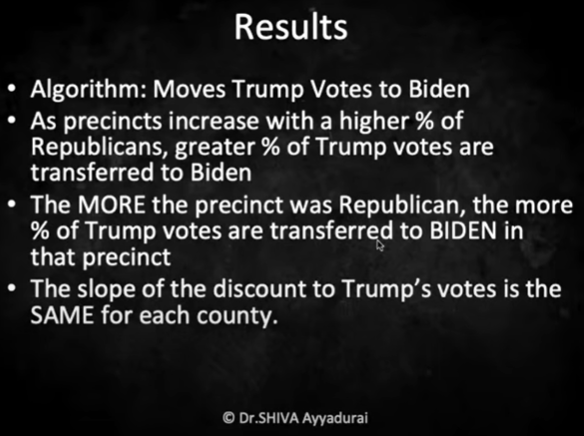
Results from Dr. Ayyadurai’s analysis. Video screenshot.

In addition, a report by The Spectator claims,All major voting machine vendors, including Dominion, have this feature. This system breaks votes down into fractions and then weights them for some reason. Dominion said the feature was built in for their condo or land ownership customers who may want to tabulate votes based on the amount of land each participant may own.”

Asked if the machines Contra Costa County use save images of all ballots that are inserted and run through the machines, Konopasek responded, “Yes, all scanned ballot images and audit records are saved and stored.”

County’s Agreement Allows Staff to Adjust Tally, More

Santa Clara County Elections also uses the Dominion Voting Systems technology. According to a report on NTD news, a 2019 agreement between Santa Clara County and Dominion shows the system allows staff to adjust the vote tally based on a review of scanned ballot images.

Konopasek was asked if that clause is also in the Contra Costa County’s contract with Dominion. He responded, “Yes, the clause is in our contract as well.  This is in reference to the adjudication process, wherein ballots that are flagged by the scanners with an issue (blank ballots, overvotes, write-ins, voting positions with marks falling below a certain filled threshold) are sent to be reviewed by election staff.  After review of the ballot the staff member makes a determination as to the voters’ intent and informs the system how to count the flagged vote.  The decisions are added to the audit log of each ballot image along with a user and date/time stamp.”

Copies of Agreements Provided

A copy of the complete Contra Costa County has with Dominion Voting Systems was requested on Thursday, Dec. 3. Cooper’s executive secretary, Melissa Hickok provided both a copy of  the 2018 contract and 2020 extension on Wednesday, Dec. 9 before the 10-day requirement for public records requests. They can be viewed here Dominion Contract_030118 and here Dominion_2ndAmendment_022520

Approved by Canciamilla and Supervisors, Contract Increased This Year

An extension to the contract with Dominion for an $183,000 to the original contract and $348,700 more for two additional machines, was signed by Konopasek on Feb. 25, of this year. It was countersigned by a staff member of the County Counsel’s office. Konopasek’s signatures raised the question of why he signed the contracts and not then-County Clerk/Registrar of Voters Joe Canciamilla in 2018 and the current Clerk/Registrar Cooper, who was appointed to fill the position in January, following Canciamilla’s resignation.

Konopasek responded, “I signed the contracts because I am one of the Clerk-Recorder’s authorized designees.”

Asked who approved the contracts, he responded, “The contract was approved by Joe, the CAO (County Auditor-Controller), County Counsel, and the Board of Supervisors in a public meeting.  Joe and I presented the proposal to the Board, took their questions and responded to public comments before they approved it.  All public record, in plain view and according to the book.”

Another question asked of Konopasek was will the county consider purchasing equipment from an American-based company to avoid concerns about using equipment from a foreign-owned company in U.S. elections and something different with all the flaws discovered with the Dominion technology. Rather than answer the question, he responded, “Dominion is a US Delaware Corporation headquartered in Denver.  Where are you getting your information?” (In response, the information below was provided to him).

Foreign Company

Although its headquarters is in Denver, Colorado, according to a form filed with the State of California in 2014, Dominion was first formed in 2003 in Toronto and then in 2009 in Denver. The company’s principal officers and mailing address, in 2014 were CEO John Poulos, CFO Ian MacVicar, and VP of Product Line Management James Hoover at 215 Spadina Avenue in Toronto.

Purchased in 2018 the Year Soros-Backed Becton Elected DA

The first contract for over $4.1 million was signed by Konopasek on March 1, 2018 and Contra Costa purchased the Dominion technology and used it in the elections, that year. That’s when current District Attorney Diana Becton was elected with the backing through contributions to her campaign by organizations connected to billionaire George Soros, including Real Justice PAC, which endorsed her.

According to a May 2018 L.A. Times report, “Soros, whose spending as of this week in California topped $2.7 million, is the most visible part of the national movement to sway county prosecutor races.” His efforts focused on nine candidates for District Attorney in the state, that year, and primarily targeting four, including Becton.

According to a January 2020 analysis on the Washington Times website, “In the last few years, Soros has taken to trying to take over local law enforcement agencies by pumping massive amounts of money into candidates he favors in key district attorney races.”

An August 2016 Politico report entitled, “George Soros’ quiet overhaul of the U.S. justice system” claims “Progressives have zeroed in on electing prosecutors as an avenue for criminal justice reform, and the billionaire financier is providing the cash to make it happen.”

In June 2019, the Washington Post reported that a “A political action committee funded by Democratic mega­donor George Soros has spent nearly $1 million to promote progressive challengers in the Democratic primary races for prosecutor in Arlington and Fairfax (Virginia) counties.” That report also reiterated previous reports that, “Soros-funded PACs have donated heavily to prosecutors’ ­races in counties and cities across the country in recent years as part of a strategy to push liberal criminal justice policies.”

Soros’ Connection to Dominion

According to a Nov. 17, 2020 investigative report by Heavy.com, Dominion has connections to Soros.

Heavy reported, “Since the 2016 election especially, Dominion and other large voting firms have faced increasing Congressional scrutiny. Dominion has ties to the Clinton Foundation. The company has used lobbying firms that employ lobbyists with ties to major figures like Georgia’s Republican governor and House Speaker Nancy Pelosi…it has also worked with firms tied to George Soros and Robert Mueller and gets some components from China. A former ambassador named by former President Barack Obama sits on the board of a company that acquired it in 2018.”

Further, the Heavy article reports, “The State of Texas rejected the company’s machines and problems arose with contracted company in the Philippines that has ties to George Soros.”

Ties Between Dominion and China

A Dec. 5 article on the New York-based NTD news website reported, “A $400 million SEC filing links Dominion, UBS and China.

The article reads in part, “Attorney Lin Wood claimed on December 1st that Communist China purchased Dominion Voting for $400 million dollars. Wood published a link to a Securities and Exchange Commission filing, showing Dominion Voting Systems’ parent company receiving $400 million dollars from a Swiss bank subsidiary. The transaction itself does not directly show what the attorney alleges it to be. However, it does show ties between the voting software company and the Chinese regime.”

Furthermore, NTD’s article reports, “…a closer look into the (UBS) New York subsidiary shows that among four of its board members, who are appointed by shareholders, three appear to be Chinese. One of them is Ye Xiang, a Chinese national who also served as a board member of Beijing’s based UBS subsidiary.

The person worked at the Chinese regime’s central bank, the state-owned Bank of China, as well as the Hong Kong government’s financial regulatory agencies.

UBS is the first foreign bank that’s allowed to have a fully-licensed securities joint venture in China’s very restricted financial market.”
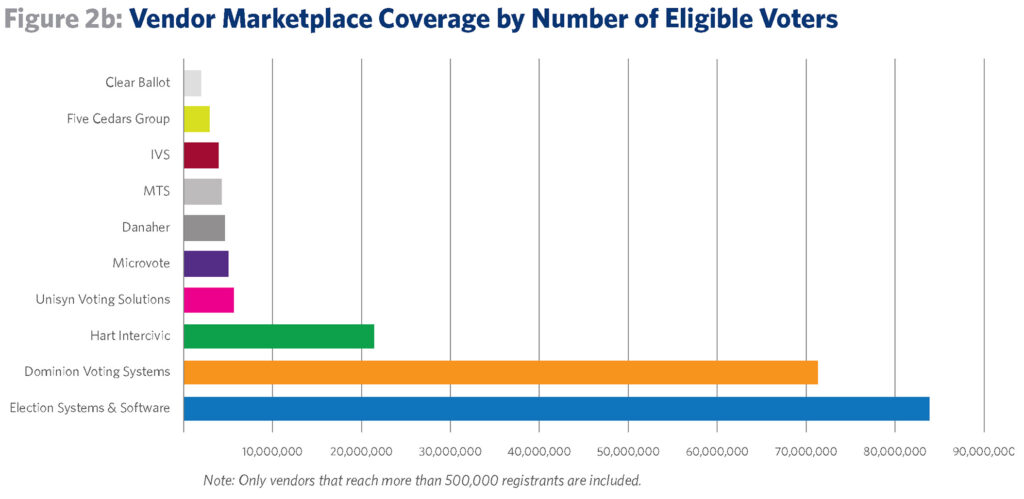
Penn Wharton study chart on election systems companies’ share of U.S. market. By Penn Wharton.

40% of U.S. Market

According to a 2017 Penn Wharton study, three companies reach over 92% of U.S. voters and Dominion serves 40% of them, second only to Omaha, Nebraska-based Election Systems & Software. The third largest provider of election systems technology is Austin, Texas-based Hart InterCivic, which has a regional office in Sacramento.

Concerns of Democrat Senators, 2018 Vote Switching Incidents

The concerns are mainly being expressed, this year by Republican officials and attorneys, But according to an MSN news report just last month, “Massachusetts Senator Elizabeth Warren and Minnesota Senator Amy Klobuchar… co-signed letters sent to investors of the three major voting systems used in the U.S. last December, including a Dominion investor…did raise concerns about how investors might be influencing the funding and security of Dominion.”

“The letter drew attention to a handful of incidents during the 2018 midterm elections in which voters reported that the machines they used switched their votes, raising concerns about the machines’ security and the importance of updating voting machine technology whenever possible.”

Video Shows System Flaws Revealed in Georgia

In a two-part video on YouTube entitled “Dominion Voting Machine Flaws — 2020 Election Coffee County, Georgia” it shows how the same ballots can be run through the system multiple times, and that elections office workers can add or change votes on ballots inside the system. (Video Part 1 and Video Part 2)

Douglas Now, the newspaper and website based in Coffee County, GA, which posted the videos, commented on the test of the system, “The Dominion voting machines that Georgia and several other states use are unsecure and open to manipulation during the counting process. This first of two videos shows the weaknesses of the system and the ways in which an unscrupulous election official may alter ballots with virtually no chance of being caught.”

Asked if that is also possible in our county Konopasek responded,I watched most of the videos.  The characterization of ‘changing’ votes is wrong and misleading.  The adjudication process interprets marks the voter made but the scanners could not decipher.”

Contra Costa Machines Not Connected to Internet, But Flash Drives Used

While the machines used by Contra Costa County are not connected to the internet it was learned by the Herald that flash drives are inserted and removed from the voting tabulation machines. New questions about the use of the flash drives were also asked, including how they are used and where do they and the data on them go before, during and after the ballot/vote count.

Konopasek responded with an explanation of the ballot and vote counting process in Contra Costa County.

“The ICE Scanner uses a Compact Flash Card (“CF card”) that contains the parameters for the election and polling site, it also stores the scanned ballot images from voting. Prior to the election two CF cards are formatted and programmed with the election definition and inserted into an ICE Scanner.  The scanner, and cards, are tested and the test results are reset. The cards are sealed inside the scanner with a serialized tamper evident seal.  Election day poll workers verify this seal is unbroken prior to voting.

After voting is completed the poll workers break the seal on one of the two CF cards, put the primary CF card into a transport container and seal the container.  The container is returned to the Elections Division on election night, the CF card is removed and the results and logs from that CF card are uploaded to the voting system.  The secondary card remains sealed in the scanner in case the primary card is damaged or will not properly upload.

After election night the ballot images from the CF cards are transferred to the voting system and stored along with the results and logs.  The secondary card is retrieved from all scanners.

After all images, logs, and results are in the voting system the CF cards are then reformatted for future use.”

Dominion Denies Allegations

In response to the accusations against their technology in last month’s elections, Dominion issued a lengthy statement on their website, updated December 7, 2020, denying any allegations of fraud. In addition, an opinion piece by the co-founder, president and CEO of Dominion, John Poulos, was published in the Wall Street Journal on Nov. 30, further responding to and denying the various accusations against his company’s technology.

Assistant Registrar of Voters Calls Reporting “Baseless Hoax, to Retire Dec. 31

Konopasek who announced, last week, his retirement at the end of the month, offered a comment in response to the questions from the Herald.

“From my perspective you are investigating and reporting on a baseless hoax intended to undermine confidence in our electoral institutions for the benefit of sore losers,” he said. “Bi-partisan experts, Federal, State and local election officials as well as the US the Attorney General and Department of Homeland Security announced the most secure election in recent history.”

National Lawsuits Continue

Additional lawsuits against the results in other states continue in the courts and as of Friday, Dec. 11 at least three have been filed with the U.S. Supreme Court.