








Five-county coalition launches campaign against $14 billion+ Bay Area transit tax
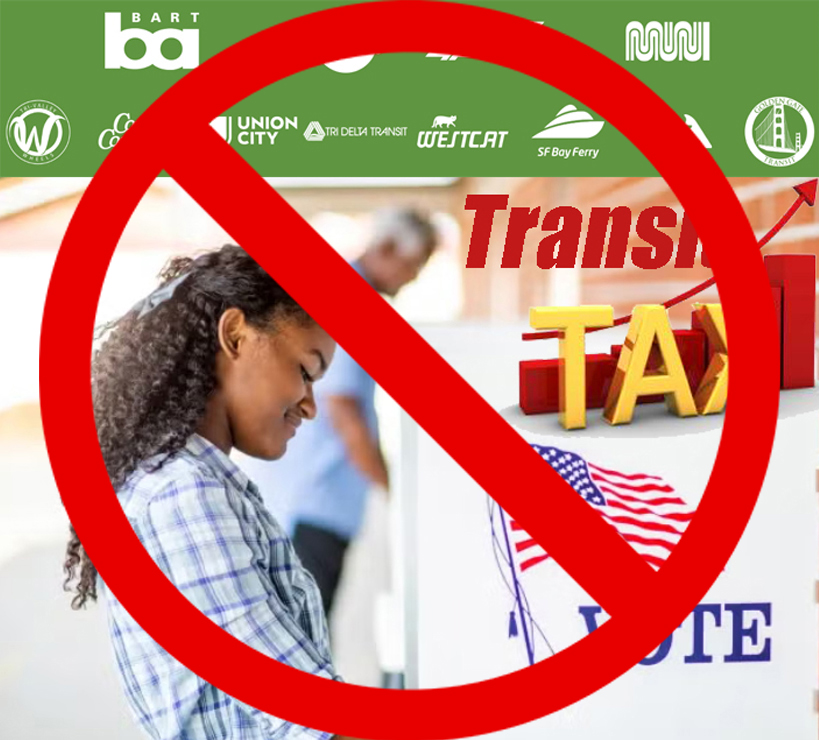
Committee for Affordable Bay Area Transit demands transit agencies address waste, alternative funding sources and non-binding oversight loopholes before locking in a 14-year tax hike.
WALNUT CREEK, CA — A five-county coalition of taxpayer advocates, transit reformers and civic leaders today announced Monday, July 6, 2026, a campaign to defeat the regional transit sales tax slated for the November ballot. The newly formed Committee for Affordable Bay Area Transit warns that the 14-year measure will push total sales tax rates up to or over a crushing 11 percent in nine Bay Area cities across Alameda, Contra Costa, San Francisco, San Mateo, and Santa Clara counties.
Authorized by SB 63 (Wiener, 2025), the measure seeks to raise sales taxes by a half-percent in four counties and a full one percent in San Francisco. The Metropolitan Transportation Commission (MTC) projects the tax, at inception, will extract roughly $1 billion annually from the local economy and rising with inflation to surpass $14 billion over its term. This funding would come on top of the estimated $6 billion in tax and toll subsidies regional transit operators already receive each year.
Campaign organizers highlighted a strategic maneuver by the tax’s proponents, who utilized a citizens’ initiative route rather than having the MTC or transit districts place it on the ballot directly. This path lowers the voter approval threshold from the standard two-thirds supermajority to a simple majority.
“Bay Area voters are being asked to approve more than $14 billion in new taxes at a time when transit agencies are carrying fewer riders and receiving enormous subsidies,” said Marc Joffe, President of the Contra Costa Taxpayers Association and campaign committee member. “Before squeezing working families and seniors with sales tax rates of over 11 percent in some Bay Area cities and over 10 percent in many others, these agencies must explain why administrative overhead surged since 2019.”
“This measure locks taxpayers into an obsolete, pre-pandemic transit cost structure for 14 years, entirely ignoring how remote work and convenient, emerging transportation alternatives are reshaping regional mobility at no taxpayer expense,” said Gregg Dieguez of SHIFT-Bay Area, representing San Mateo County. “Furthermore, the oversight language in SB 63 is completely non-binding. It allows these agencies to continue wasteful business-as-usual operations with a guaranteed, unaccountable blank check.”
The committee emphasizes that defeating the measure will not shut down public transit. Instead, the coalition argues that the state should redirect a portion of the $1 billion annual cap-and-invest funds currently flowing to high-speed rail. They also propose pausing the region’s two largest capital megaprojects—BART’s Silicon Valley Phase II extension and Caltrain’s Portal downtown extension—to free up existing state and local dollars directly for operations while a leaner funding mechanism is designed for 2028. The committee notes that BART could potentially save hundreds of millions annually through targeted management actions alone, adding that the San Jose VTA does not require this funding for operations, labeling the measure a fiscal “hidden ball trick” to cover a bloated BART extension recently criticized by the Santa Clara County Grand Jury.
The Committee for Affordable Bay Area Transit is actively recruiting volunteers, distributing lawn signs beginning in August, and accepting contributions at transitaccountability.com. The campaign website features a localized household tax calculator where residents across all five counties can instantly check the tax’s impact on their family.
About the Committee for Affordable Bay Area Transit
The Committee for Affordable Bay Area Transit (CABAT) is a campaign committee sponsored by the Contra Costa Taxpayers Association, a nonpartisan civic organization founded in 1937 and based in Walnut Creek. The committee has leadership and representation from all five counties affected by the so-called Connect Bay Area Transit sales tax: Alameda, Contra Costa, San Francisco, San Mateo, and Santa Clara counties. Contributions to the committee are not tax-deductible. The committee expects to amend its formal name to incorporate the official alphanumeric ballot designation of the “Connect Bay Area Transit” measure once assigned by election officials.
the attachments to this post:
Transit Tax No